GST Registration in Another State in 2026: New Multistate Facility with One Master TRN, Branches, Warehouses and Amazon FBA
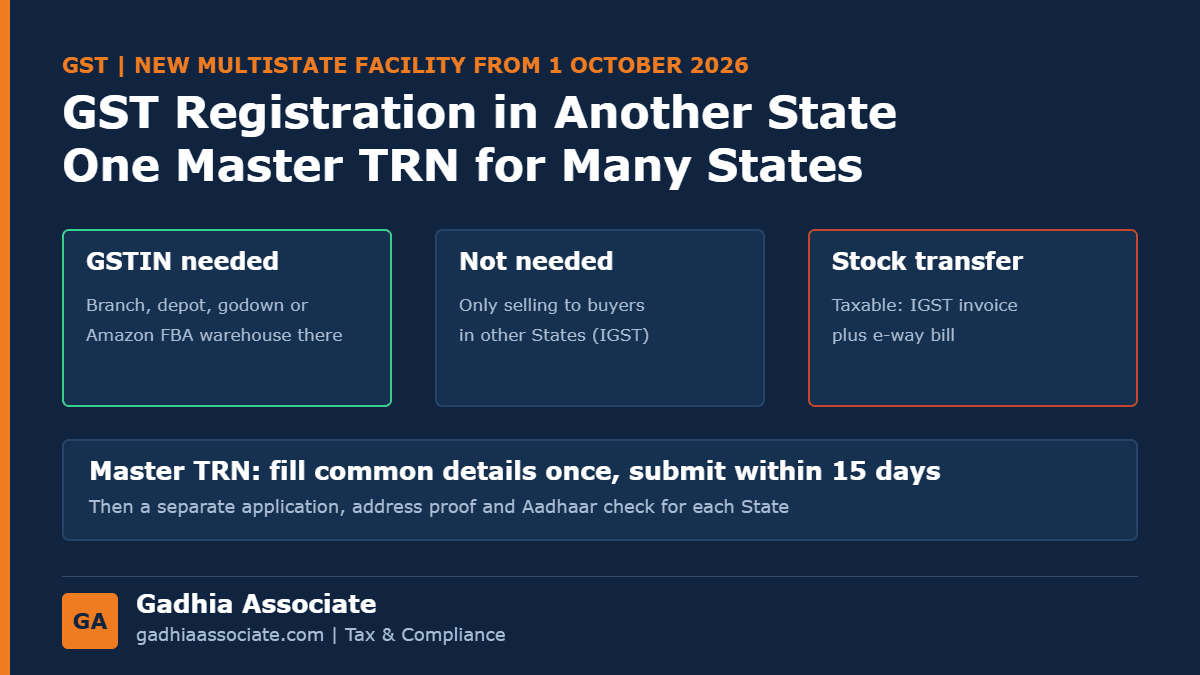
GST registration in another State is needed once you supply from a branch or warehouse there, and from 1 October 2026 one Master TRN starts them all.
Nileshbhai runs a groundnut oil and namkeen business from Junagadh. Orders from Maharashtra and Rajasthan have grown, so he wants a depot in Pune to cut delivery time, and his online store is moving to Amazon's fulfilment programme, which will keep his stock in warehouses in Gujarat, Maharashtra and Karnataka. His Pune distributor has asked for Maharashtra bills, and his accountant has heard of a new portal facility that lets him apply for several States in one go.
A GSTIN works State by State. One PAN can hold a separate registration in every State or Union Territory from which the business supplies, and each of those registrations files its own returns and is treated by law as a separate person. Here is when you need one, how the new Multistate Registration facility works, and what changes once you have more than one GSTIN.
In short: GST registration is State-wise. If you supply goods or services from a place in another State, such as a branch, depot, godown or a marketplace warehouse like an Amazon fulfilment centre, you need a separate GSTIN in that State. An additional place of business can be added to a GSTIN only within the same State. Selling to customers in other States from Gujarat does not need registration there. From 1 October 2026, the GST portal's Multistate Registration facility lets a normal taxpayer select several States, fill the common details once under a Master TRN within 15 days, and then complete a State-wise application with the local address and Aadhaar authentication for each. Each GSTIN is a distinct person: stock sent to your own branch in another State is a taxable supply with IGST and an e-way bill, and each GSTIN files its own returns.
Our GST team handles registration in Gujarat and other States, stock transfer invoicing, ISD and monthly returns for businesses with more than one GSTIN. The details are at the end of this guide.
When do you need GST registration in another State?
- Branch, depot or godown: if you sell or dispatch from a place in another State, you need a GSTIN in that State. The law asks for registration in every State or Union Territory from where you make a taxable supply.
- Marketplace warehouses: if Amazon, Flipkart or another e-commerce operator keeps your stock in its fulfilment centre in another State, your sales are made from that State, so you need a GSTIN there and must show the warehouse as your place of business. See our guide to GST for e-commerce sellers.
- Only selling to buyers in other States: no registration is needed in their State. You charge IGST on your Gujarat GSTIN and send the goods with an e-way bill.
- Services to clients in other States: a consultant, software firm or agency in Junagadh that serves a client in Mumbai charges IGST from its Gujarat GSTIN. Registration in Maharashtra is needed only if it sets up an office or other fixed establishment there.
- Project sites: a contractor that runs a site office, store or staff at a construction or installation project in another State is usually treated as supplying from that State, and most register there. This is a common area of dispute, so take advice before the project starts.
- Exhibitions and trade fairs: selling at a fair in another State needs registration as a casual taxable person. Apply at least five days before the event. The registration is valid for up to 90 days, can be extended by another 90 days, and needs an advance deposit of the estimated tax.
Do the turnover limits help?
- The limit is counted on your PAN: aggregate turnover adds up the supplies of every registration under the same PAN across India. In Gujarat the limit is Rs 40 lakh for businesses supplying only goods and Rs 20 lakh for services, and some north-eastern and hill States have lower limits. See do I need GST registration.
- Once you are over the limit: you need a GSTIN in every State you supply from, however small the branch is.
- Inter-State sales of goods: need registration whatever your turnover, with a few exceptions such as notified handicraft goods.
- Inter-State services: a service provider whose aggregate turnover is within the limit does not have to register only because it serves clients in other States.
How the new Multistate Registration facility works
GSTN added the facility to the GST portal from 1 October 2026. It is available only to normal taxpayers for now. It does not remove any State requirement; it saves you from typing the same details again for every State.
- On the GST portal, open Multistate Registration and select the States or Union Territories you need.
- The portal generates a Master TRN (temporary reference number).
- Fill the common registration information once: business details, promoters or partners, authorised signatory, authorised representative, and the goods and services you deal in. Submit it within 15 days.
- The portal then creates a separate TRN for each selected State, with the common details filled in. You can still edit them.
- For each State, add the principal place of business, any additional places, the State-specific details and Aadhaar authentication, and submit that application.
- Each State's application is checked and approved on its own, and each State gives you its own GSTIN.
Documents for each new State
- Proof of the place: a rent or leave and licence agreement, or ownership proof such as a property tax receipt or electricity bill, with the owner's consent letter where the premises belong to someone else. For a marketplace warehouse, the operator's agreement or letter showing the warehouse address.
- Identity: PAN of the business, and Aadhaar authentication of the promoters and authorised signatory. In Gujarat and many other States, applicants picked by the system must visit a GST Suvidha Kendra for biometric verification and a photograph.
- Bank account: the same business bank account can be used for every GSTIN. Add it within 30 days of registration, or before filing the first GSTR-1, whichever is earlier.
- Timeline: approval normally comes within 7 working days, or up to 30 days if the officer orders physical verification of the premises. Since 1 November 2025, applicants whose output tax on supplies to registered businesses will not exceed Rs 2.5 lakh a month can opt for a simplified route with approval in 3 working days.
Applications most often get stuck on the address proof or the biometric step. Our guides on GST registration documents and registrations stuck or rejected in Gujarat cover the usual fixes.
What changes once you have a GSTIN in another State
- Separate person, separate returns: each GSTIN files its own GSTR-1, GSTR-3B and annual return. Input tax credit stays with the GSTIN that received the bill and cannot be moved to another. A cash ledger balance can be transferred to another GSTIN under the same PAN, in Form PMT-09.
- Stock transfers are supplies: goods sent from Junagadh to your own Pune depot need a tax invoice with IGST and an e-way bill, and the Pune GSTIN takes the credit. The value should be the open market value, but where the receiving branch can take full credit, the invoice value is accepted. Moving stock between two places under the same GSTIN needs only a delivery challan.
- Head office costs: where your head office provides services to branches, such as staff, accounts or management, the cross-charge can be at the invoice value, or nil if no invoice is raised, when the branch is entitled to full credit (CBIC Circular 199/11/2023-GST). Credit on common services billed to the head office, such as audit fees, advertising or software, must be passed to branches through an Input Service Distributor registration since 1 April 2025. See our guide on ISD registration.
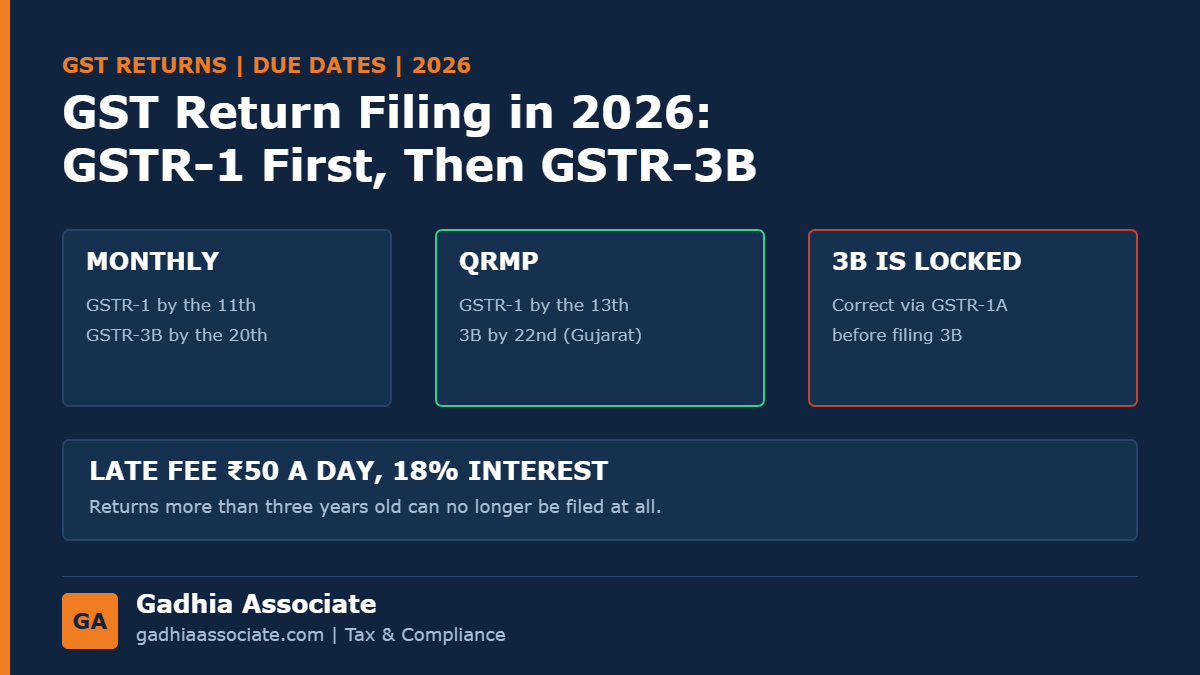
- PAN-level limits: e-invoicing applies to every GSTIN once the PAN's aggregate turnover has crossed Rs 5 crore in any year since 2017-18 (see e-invoicing), and quarterly QRMP returns are allowed only up to Rs 5 crore. See our GST return calendar.
- Composition: all registrations under the same PAN must opt for the composition scheme together, and a composition dealer cannot make inter-State supplies of goods. A business with branches in several States will normally have to pay tax at regular rates.
The cost of not registering where you should
- Penalty: failing to register when you are liable attracts a penalty of Rs 10,000 or the tax evaded, whichever is higher.
- Tax demand from the other State: it can demand tax, interest and penalty on supplies made from your premises there, even if you paid tax on the same bills from your Gujarat GSTIN. Getting the Gujarat tax back is slow and not always possible.
- Goods detained: stock moving to or from an unregistered place often fails e-way bill checks. See our guide on e-way bill detention.
- Lost customers: buyers in that State want bills that let them claim credit, and distributors often insist on a local GSTIN.
What the 57th GST Council proposed on registration
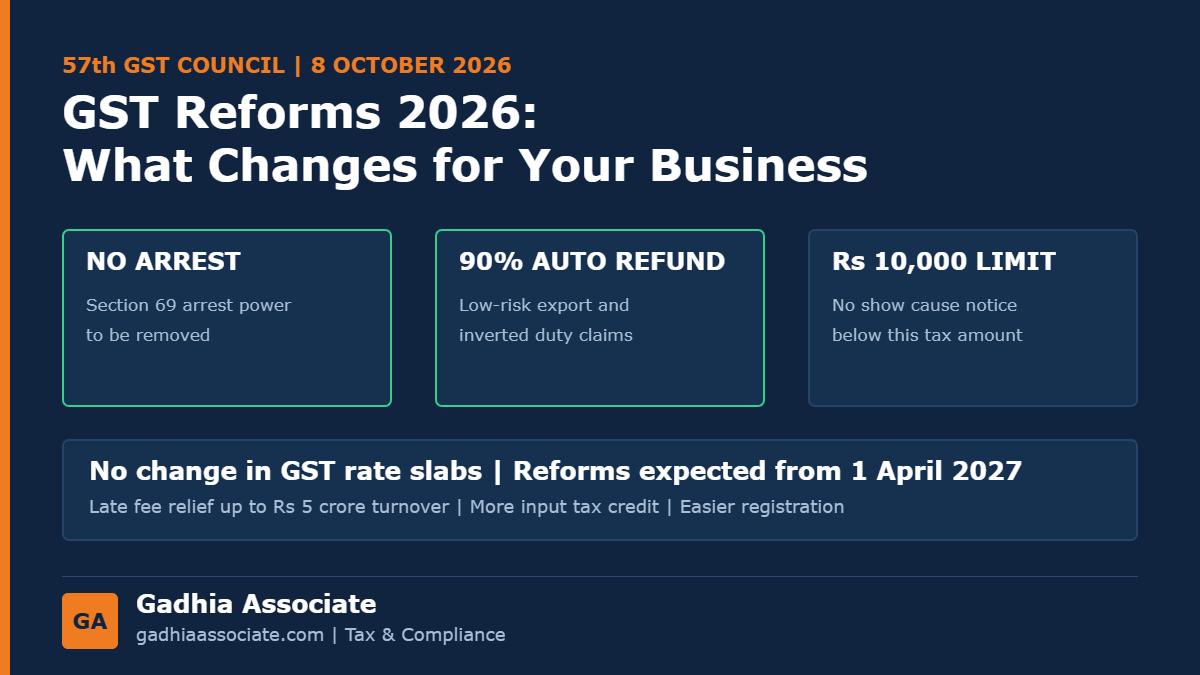
On 8 October 2026, the GST Council recommended easier registration in two phases: a circular listing the documents that officers can ask for, a simpler application form, automatic approval of changes other than the principal place of business, and automatic acceptance of cancellation applications once all returns are filed and dues paid. These apply only once notified. Our summary of the 57th GST Council decisions has the full list.
Back to Nileshbhai. He needs a Maharashtra GSTIN for the Pune depot, which will also cover Amazon's Maharashtra warehouse as an additional place of business, and a Karnataka GSTIN for the Bengaluru warehouse. The Gujarat warehouse is simply added to his existing Gujarat GSTIN. Using the Multistate facility, he can start both new States under one Master TRN. From then on, stock sent from Junagadh to Pune goes on an IGST invoice with an e-way bill, the Pune GSTIN claims that credit and pays tax when it sells, and his distributor gets Maharashtra bills. Each GSTIN files its own returns every month.
How we help
- Tell you in which States you need a GSTIN, and which places can be added to one you already have
- Apply through the Multistate facility, prepare the documents for each State, and handle queries and verification
- Set up stock transfer invoicing, e-way bills and pricing between your GSTINs
- ISD registration and head office cross-charges
- Monthly returns, reconciliation and annual returns for every GSTIN
- Casual registration for exhibitions and trade fairs
- Replies to notices from other States
Gadhia Associate has been in practice since 2007 and has handled work for over 7,000 clients, with a 5.0 Google rating from more than 100 reviews. Manufacturers, traders and online sellers from Junagadh, Rajkot, Jamnagar, Morbi, Jetpur and across Saurashtra come to our Junagadh office, where same-day appointments are available. Registrations in other States are handled online.
Opening a branch, depot or marketplace warehouse in another State? Get the right GSTINs before the first dispatch. Call or WhatsApp +91 82005 28355, or message us on WhatsApp. The first consultation is free.
Frequently asked questions
Do I need GST registration in every State where I sell?
No. You need it only in the States you supply from, where you have a branch, depot, warehouse or other fixed establishment. Sales to customers in other States from Gujarat are made on your Gujarat GSTIN with IGST.
What is a Master TRN in GST?
It is the temporary reference number generated by the Multistate Registration facility, available from 1 October 2026. You submit the common details once under it, within 15 days, and the portal then creates a separate application for each State you selected.
Can I add a warehouse in another State as an additional place of business?
No. An additional place of business can be added only within the State of that registration. A place in another State needs a separate GSTIN.
Do Amazon FBA sellers need GST registration in other States?
Yes. If your goods are stored in a fulfilment centre in another State, you need a GSTIN in that State and must declare the centre as your place of business.
Is stock transfer to my own branch in another State taxable?
Yes. Registrations in different States are distinct persons, so the transfer needs a tax invoice with IGST and an e-way bill. The receiving branch claims the credit.
How long does GST registration in another State take?
Usually 7 working days after Aadhaar authentication, or up to 30 days if the officer orders physical verification. Small applicants who qualify for the simplified route get approval in 3 working days.
Position as of 12 October 2026. The Multistate Registration facility is described as announced by GSTN for 1 October 2026, and the 57th GST Council's registration proposals apply only once notified. Whether you need a GSTIN in a State depends on where and how you supply, so take advice on your own facts.