GST for E-Commerce Sellers in India 2026: Mandatory Registration, TCS by Amazon and Flipkart, GSTR-8 Reconciliation and Claiming Your Credit
GST for E-Commerce Sellers in India 2026: The Short Answer
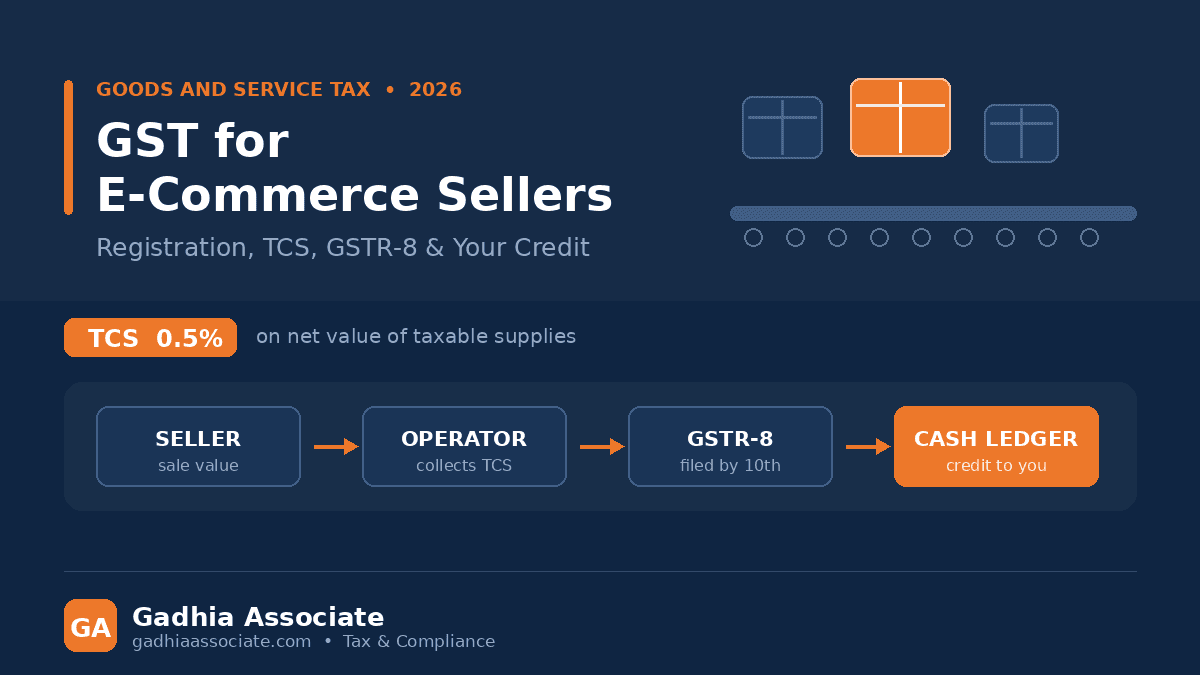
GST for e-commerce sellers works differently from ordinary retail. If you sell goods through Amazon, Flipkart, Meesho or any marketplace, the operator collects TCS under Section 52 of the CGST Act on the net taxable value of your sales, reports it in GSTR-8, and that amount lands as a credit in your electronic cash ledger. You are generally required to be registered under GST to sell goods through a marketplace, subject to a narrow exemption for small intra-state suppliers introduced with effect from 1 October 2023.
The mechanics are not complicated, but the reconciliation is where sellers lose money and attract notices. Below is how the system actually operates, and what a seller in Gujarat shipping across India needs to do every month.
Do I need GST registration to sell on Amazon or Flipkart?
In most cases, yes. A person supplying goods through an e-commerce operator who is required to collect TCS is ordinarily required to register regardless of turnover — the usual Rs 40 lakh / Rs 20 lakh threshold does not protect you. That is why marketplaces ask for a GSTIN at onboarding.
The exemption available from 1 October 2023 relaxes this for genuinely small sellers of goods, but only if every condition is met. Aggregate turnover must stay within the registration threshold applicable in the seller's State or Union Territory, the seller must not make any inter-state supply of goods, the seller must not supply through an operator in more than one State or Union Territory, and the seller must hold a PAN and declare it along with the required details on the common portal to obtain an enrolment number before making supplies.
In practice that last set of conditions rules out most sellers. The moment you accept an order from another State — which is the entire point of selling on a national marketplace — you fall outside the exemption and need full registration. For a Junagadh seller shipping only within Gujarat, the exemption can genuinely work; for anyone shipping pan-India, it will not.
What is TCS under GST and what is the current rate?
Section 52 requires an e-commerce operator that collects the consideration on behalf of suppliers to collect tax at source from the net value of taxable supplies made through its platform. "Net value" means the taxable supplies made through the operator during the month, reduced by supplies returned during that month.
The rate was reduced with effect from 10 July 2024 and now stands at 0.5% overall — 0.25% CGST plus 0.25% SGST or UTGST on intra-state supplies, and 0.5% IGST on inter-state supplies. Before that date it was 1% overall. TCS is not an additional cost to you; it is your own money, parked with the government and returned to you as a ledger credit. It is also not deducted on exempt or nil-rated supplies, and it is not deducted from supplies that fall under Section 9(5).
Goods sellers versus service suppliers under Section 9(5): why the rules differ
If you supply goods through a marketplace, you remain the supplier. You raise the invoice, you charge GST, you pay it in GSTR-3B, and the operator merely collects TCS on top and reports it. Your GSTR-1 carries every one of those sales.
For certain notified services under Section 9(5) — passenger transport, accommodation in unregistered establishments, housekeeping and restaurant service supplied through a platform, within the terms of the notifications — the position reverses. The e-commerce operator itself is liable to pay the GST as though it were the supplier. In those cases the operator does not collect TCS from you, and the underlying service provider does not pay GST on that supply. Small service providers on such platforms can therefore often operate without registration under the separate relaxation for service suppliers below the threshold. This is the single most common point of confusion: a goods seller and a cab driver on a platform are governed by completely different mechanics, and advice written for one does not apply to the other.
How do I claim TCS credit?
The operator files GSTR-8 by the 10th of the following month, declaring the supplies made through the platform for each supplier and the TCS collected. Once that return is filed, the TCS amount is auto-populated for you on the portal, and after you accept it the credit is transferred into your electronic cash ledger. From there you use it to discharge GST liability when you file GSTR-3B, or claim it as a refund if it accumulates and you have no liability to offset.
Note the distinction that trips people up: TCS credit goes to the cash ledger, not the input tax credit ledger. It behaves like tax already paid in cash, not like input credit on purchases.
Illustrative example. Say a Gujarat seller records Rs 10,00,000 of taxable sales through a marketplace in a month and Rs 1,00,000 of returns. Net value is Rs 9,00,000, so TCS at 0.5% is Rs 4,500. The seller declares the full Rs 10,00,000 of outward supplies in GSTR-1, pays the GST on them in GSTR-3B, and offsets Rs 4,500 of the cash liability using the credit that arrived from the operator's GSTR-8. Round numbers, illustrative only, but it shows why the sales figure in your return and the net figure behind TCS will almost never be identical.
Why does my GSTR-1 not match the TCS statement?
Because the two documents are measuring different things, and small operational differences compound. Typical causes:
- Returns and cancellations reduce the operator's net value in one month while your credit note sits in another.
- Timing — an order shipped on the last day of the month may be settled by the operator in the next month.
- Multiple GSTINs or a wrong GSTIN mapped in the marketplace seller panel.
- Sales invoiced by you but reported by the operator under a different place of supply.
- Shipping, gift-wrap and other charges treated differently in your invoice and the operator's report.
- Supplies where TCS does not apply at all being expected to appear in the statement.
- Operator commission, ad spend and fees confused with sales value — they are inward supplies to you, not a reduction of your outward supply.
The GST system compares your declared outward supplies with the operator's GSTR-8 data and generates discrepancy communications where the operator has reported more than you have. Left unanswered, these become demand notices with interest. The fix is boring and effective: reconcile monthly, not annually.
Monthly reconciliation checklist for marketplace sellers
- Download the settlement or TCS report from every marketplace you sell on, for the same period.
- Map operator GSTIN-wise data to your own GSTIN and place-of-supply-wise sales.
- Reconcile gross sales, returns and net value separately — do not compare a net figure to a gross figure.
- Check that credit notes for returns are raised in your GSTR-1 in the correct month.
- Accept the TCS entries on the portal so the credit reaches your electronic cash ledger.
- Confirm the cash ledger balance moved by the expected amount before filing GSTR-3B.
- Claim input tax credit separately on commission, logistics and advertising invoices from the operator.
- Keep a running file of unexplained differences with the reason noted, ready for any notice.
Do small sellers need GST registration now?
Only a limited class escapes it. A seller of goods staying within one State, below the registration threshold, with a PAN and a portal enrolment, and making no inter-state supplies, can sell through a marketplace without registration. Everyone else — and that includes nearly every seller with national ambitions, which describes a large share of Gujarat's trader and MSME seller base — needs registration from day one. If you are unsure whether to register as a proprietor, a partnership or a private limited company before scaling up, our Business Structure Advisor conversation is the right starting point, and our GST Calculator helps you sanity-check rate and value questions on the fly.
How Gadhia Associate Can Help
From Junagadh, Gujarat, we handle end-to-end GST Services for online sellers across India: registration, monthly GSTR-1 and GSTR-3B filing, marketplace TCS reconciliation across Amazon, Flipkart, Meesho and others, refund claims where TCS credit accumulates, and replies to GSTR-1 versus GSTR-8 mismatch notices. Our Income Tax services team handles the direct tax side of the same business so your books tell one story. Book a free consultation and let us take the monthly reconciliation off your desk.
This article reflects the position as of August 2026. GST rates, TCS provisions, thresholds and exemption conditions change through CBIC notifications and circulars, and Council decisions. Please confirm your specific position with a qualified professional before acting.