Death of a Proprietor or Father-to-Son Business Transfer in 2026: New GST Registration, ITC-02 Credit Transfer, Bank Account, Licences and Income Tax
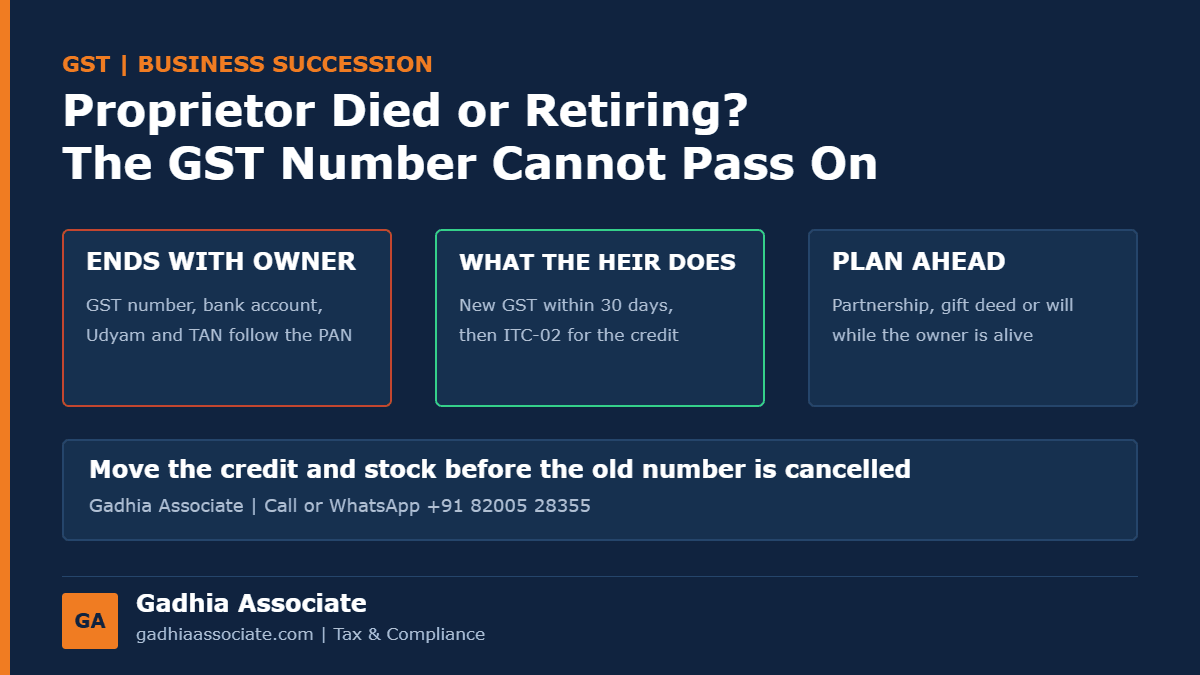
After the death of a proprietor, the GST registration cannot pass to the heir, who needs a new number and must move the credit through Form ITC-02.
Bhaveshbhai ran a hardware and paint shop in Keshod in his own name for 25 years. He died suddenly three weeks ago. His son Jay kept the shop open and went on billing on his father's GST number. Then the bank froze the current account when it learnt of the death, with Rs 4.2 lakh of GST credit and stock worth about Rs 30 lakh still sitting in the old registration.
Thousands of family shops in Saurashtra run in one person's name, and most families find out what that means only after a death, or when the father wants to retire. The business can continue, but almost every registration has to be redone in the successor's name. Here is the order in which to do it.
Short Answer: A proprietorship is tied to its owner's PAN, so its GST registration, bank account, Udyam and TAN end with the owner. A son or other heir who continues the business must take a new GST registration, applying within 30 days so that it takes effect from the date of succession. Unused input tax credit moves to the new number through Form GST ITC-02, filed before the old registration is cancelled, and stock passes without GST as part of a going concern. The heir also files the deceased's last income tax return, opens a new current account and redoes the licences. A living owner can avoid most of this by planning the handover.
Our team handles the GST transfer, the credit in ITC-02, the deceased's tax returns and the new registrations for the successor. Call or WhatsApp +91 82005 28355, or see the details at the end of this guide.
Why the registrations do not pass on
- One PAN: a proprietorship has no identity apart from its owner, so the GST number, Udyam, TAN and bank account are all in the owner's PAN.
- On death: the law treats the business as transferred to the successor, who becomes liable to register from that date.
- On retirement: the same applies when a father hands the running business to a son or daughter.
- Dues follow the business: the person who continues it is liable for the earlier GST dues of the business.
GST: the steps in order
- New registration: the successor applies in his or her own PAN, giving the reason as death of the proprietor or transfer of business. See GST registration documents.
- Thirty days: apply within 30 days, so that the registration is effective from the date of succession and no sale falls in a gap.
- Access to the old number: a legal heir is added as authorised signatory on the deceased's registration through the jurisdictional officer, with the death certificate and proof of heirship.
- Pending returns: file the returns of the old registration up to the date of succession and pay any tax due.
- Credit transfer: file Form GST ITC-02 on the old registration to move the unused credit to the new one, and accept it from the new login. Do this before cancellation.
- CA certificate: ITC-02 needs a certificate that the business has been transferred with its liabilities.
- Cancellation: then apply to cancel the old registration, naming the successor's new GST number, and file the final return. See GST registration cancellation.
Stock, assets and bills
- No GST on stock: when the whole business passes as a going concern, the stock and assets move to the successor without GST.
- If the business closes instead: GST credit on the stock and capital goods held has to be paid back before cancellation.
- Supplier bills: ask suppliers to bill the new GST number from the date of succession, or the credit will sit in a number that is being cancelled.
- Sales bills: bills made on the old number after the succession date are replaced with revised invoices once the new number is granted.
- E-way bills and e-invoices: set them up afresh on the new registration.
Income tax
- Two returns: income up to the date of death is taxed in the deceased's PAN, through a return filed by the legal heir, and income after that belongs to the successor. See filing the return of a person who has died.
- No capital gains: inheritance or a gift of the business is not a sale, so there is no capital gains tax on the transfer, and the old cost carries over.
- No gift tax: what comes by inheritance, a will or a gift from a parent is not taxed as income.
- Depreciation: machinery and vehicles continue at their written-down value, with no fresh start.
- Losses: business losses of the deceased can be carried forward by the heir who inherits the business, but not after a transfer during the owner's lifetime.
- TDS: the successor takes a new TAN, and the old TAN's returns are filed up to the date of succession.
Bank, loans and other registrations
- Current account: the bank stops operations once it learns of the death, and releases the balance to the nominee or legal heirs. The successor opens a new account. See proprietorship registration.
- Loans and cash credit: the limit does not pass automatically. The bank has to sanction it afresh in the successor's name.
- Udyam, shop intimation, professional tax: taken or changed in the successor's name. See shop and establishment registration.
- Licences: FSSAI allows a licence to pass to the legal heir on application, while an import-export code is taken afresh. Check each trade licence.
- Staff: report the change of ownership for PF and ESIC, so that employees' service continues.
- Payment tools: QR codes, card machines and online listings linked to the old account need to be re-issued.
Planning while the owner is alive
- Partnership: bring family members in as partners now. With three or more partners and the right clause, the firm continues when one of them dies. A two-partner firm does not. See partnership firm registration.
- Company or LLP: a separate legal entity is not affected by a death. See converting a proprietorship into a company.
- Gift of the running business: a father can hand over the business by a deed and follow the same GST steps in his lifetime.
- Will and nominees: a will naming who gets the business, and nominees on every bank account, save months. See gift deed or will.
- Shared access: keep a family member as authorised signatory on the GST registration, aware of the logins and filings.
Back to Jay. He applies for GST registration in his own PAN within 30 days, giving the reason as death of the proprietor, so the new number takes effect from the date his father died. He is added as authorised signatory on his father's registration, files the pending returns, moves the Rs 4.2 lakh credit through ITC-02 with a CA certificate, and only then applies for cancellation. The stock of about Rs 30 lakh passes without GST as part of a going concern, and the bills he made on the old number are replaced with revised invoices. He opens a new current account, asks suppliers to bill the new number, takes Udyam and the shop intimation in his name, and files his father's last income tax return as legal heir.
How we help
- New GST registration for the successor and cancellation of the old number
- ITC-02 credit transfer with the CA certificate
- Pending returns and dues of the old registration
- Income tax return of the deceased and legal heir registration
- New Udyam, shop intimation, TAN and bank documentation
- Partnership, LLP or company conversion to protect the business in future
Gadhia Associate has been in practice since 2007 and has handled work for over 7,000 clients, with a 5.0 Google rating from more than 100 reviews. Business families from Junagadh, Keshod, Mangrol, Veraval and Rajkot come to our Junagadh office, where same-day appointments are available. Families elsewhere in Gujarat are handled online.
Lost the owner of a family business, or planning to hand it over? Get the GST, bank and tax steps done in the right order. Call or WhatsApp +91 82005 28355, or message us on WhatsApp. The first consultation is free.
Frequently asked questions
Can GST registration be transferred after the death of a proprietor?
No. The registration is tied to the deceased's PAN. The successor takes a new registration and the old one is cancelled.
How is input tax credit transferred after the proprietor's death?
Through Form GST ITC-02, filed on the old registration before it is cancelled and accepted by the successor.
Is GST payable on stock transferred to the legal heir?
No, where the business passes to the heir as a going concern.
Within how many days must the heir apply for GST registration?
Within 30 days, so that the registration is effective from the date of succession.
Can a father transfer his proprietorship business to his son?
Yes, by a deed, with a new GST registration for the son and transfer of credit through ITC-02. A gift to a son is not taxed.
Who files the income tax return of a deceased proprietor?
The legal heir, for income up to the date of death, in the deceased's PAN.
Position as of 15 November 2026, under the CGST Act and Rules, CBIC Circular 96/15/2019-GST and the Income-tax Act, 2025. Banks and licensing authorities have their own procedures, so check each one for your case.