GST Registration Cancellation and Revocation in 2026: REG-16, REG-21, Suo Motu Cancellation and How to Get Your GSTIN Back
GST Registration Cancellation and Revocation: The Short Answer
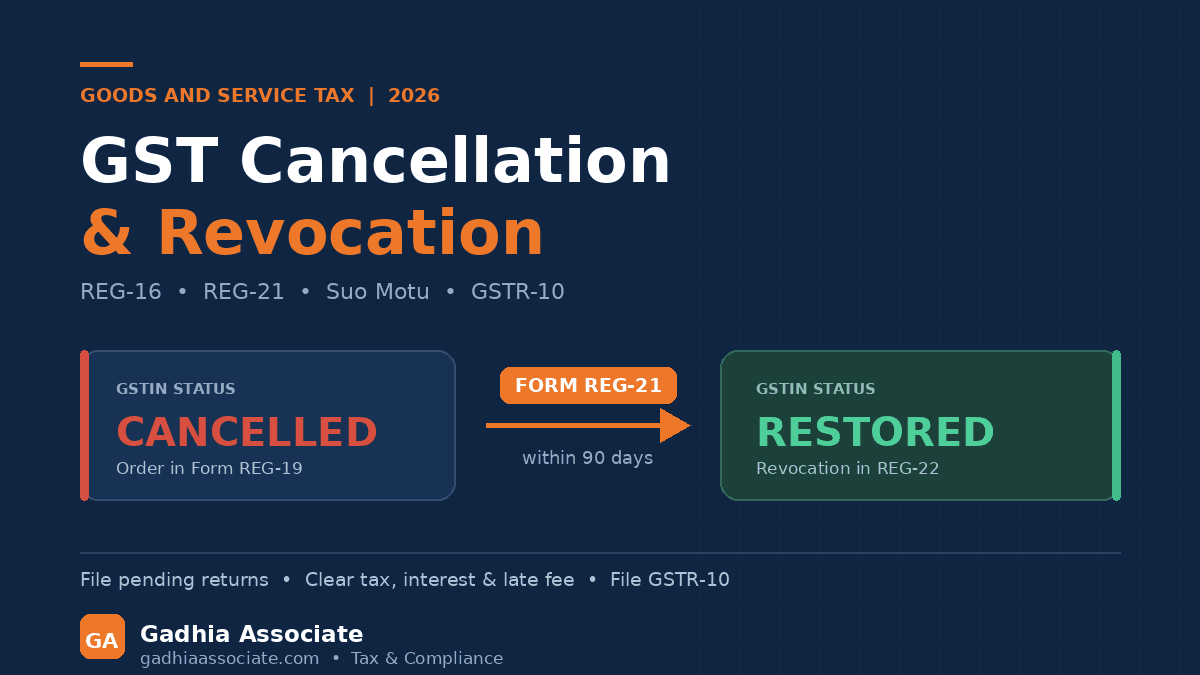
GST registration cancellation happens in two ways: you apply voluntarily in Form GST REG-16 when you close or restructure the business, or a proper officer cancels your GSTIN on his own motion — suo motu — usually after a long run of unfiled returns. If an officer has cancelled your registration, you can apply to get it back by filing Form GST REG-21, normally within 90 days of the cancellation order, after filing every pending return and clearing the dues.
Losing a GSTIN is a trading problem, not a paperwork problem. You cannot raise a tax invoice, buyers cannot claim input tax credit on you, e-way bills stop, and banks and tender committees start asking questions. Here is both routes — and how to get your GSTIN back.
How Do I Cancel My GST Registration?
Voluntary cancellation is done online through the GST portal using Form GST REG-16. It is the right route when the business has genuinely stopped, changed hands or fallen outside the registration requirement.
Valid grounds include closure or discontinuance of the business, transfer on sale, merger, amalgamation or death of the proprietor, a change in constitution requiring a fresh PAN, and turnover falling below the threshold for someone who registered voluntarily.
The application asks for the reason, the date from which cancellation is sought, details of stock of inputs, semi-finished and finished goods and capital goods held on that date, and the tax payable on that stock. That last item catches people out: credit on closing stock must be reversed, and the liability is the higher of the input tax credit involved or the output tax on the market value of those goods.
Once submitted, the officer reviews the application and, if satisfied, issues a cancellation order in Form GST REG-19. Note carefully: where you applied for cancellation voluntarily, revocation in REG-21 is not the remedy — if you want to trade again you apply for a fresh registration.
What Is Suo Motu Cancellation?
Suo motu cancellation is cancellation initiated by the GST department itself, without any application from you. In practice this is what happens to most cancelled taxpayers, and the usual trigger is prolonged non-filing of returns — typically a continuous stretch of unfiled GSTR-3B, with a shorter run for taxpayers under the QRMP scheme.
Other grounds an officer may invoke include registration obtained by fraud or suppression of facts, issuing invoices without any actual supply, the business not being conducted from the declared place of business, failure to commence business within the prescribed period after voluntary registration, and breaches of the invoicing and input tax credit rules.
The process is not silent. Before cancelling, the officer must issue a show cause notice in Form GST REG-17, giving you an opportunity to reply — the reply is filed in Form GST REG-18. If the explanation is accepted, the proceedings are dropped in Form GST REG-20. If it is not, or if you never reply, a cancellation order follows in Form GST REG-19.
The single most important habit is checking the notices and orders tab on the GST portal regularly, since notices are served electronically. Business owners in Junagadh and across Gujarat routinely discover a cancellation months later, when a customer refuses a bill — by which time the easy remedies have expired.
Voluntary Cancellation vs Suo Motu Cancellation
The two look similar on the portal but behave very differently, and the difference decides whether REG-21 is available to you at all.
Who starts it: voluntary cancellation is initiated by the taxpayer in REG-16; suo motu cancellation is initiated by the proper officer, on his own motion.
What precedes it: voluntary cancellation is preceded by your own application and stock declaration; suo motu cancellation is preceded by a REG-17 show cause notice and your chance to reply in REG-18.
Can it be reversed: a suo motu cancellation can be reversed by applying for revocation in REG-21; a cancellation you applied for yourself cannot be revoked that way — you take fresh registration instead.
What is common to both: in either case the order is issued in REG-19, all liabilities up to the date of cancellation survive, and the final return in GSTR-10 must still be filed.
How Many Days Do I Have to Apply for Revocation?
The core rule is 90 days from the date of service of the cancellation order to file Form GST REG-21 on the portal. That window was expanded from the earlier 30-day limit, which gives genuinely stuck taxpayers real breathing room.
Missing 90 days is not automatically fatal. The law allows the period to be extended on sufficient cause being shown, by an officer of the rank of Additional or Joint Commissioner and thereafter by the Commissioner. Extensions are discretionary — you must explain the delay convincingly and show the pending compliance is complete. The exact mechanics have been amended more than once, so confirm the position for your specific order date rather than assuming a number.
Separately, amnesty-type windows have been notified from time to time allowing older cancellations to be revoked on conditions. If your cancellation is old, it is worth checking whether any such scheme is currently open before concluding that only fresh registration remains.
Can I Revoke a GST Registration Cancelled for Non-Filing?
Yes — and this is exactly the situation REG-21 was designed for. But revocation is conditional, not automatic. Before your application can be accepted, you must clean up the entire backlog.
- File every pending return for the period up to the date of the cancellation order — GSTR-1 and GSTR-3B for all missed tax periods
- Pay the tax due, together with interest, penalty and late fee on those returns; the portal will not let the revocation application through with dues outstanding
- File the returns for the period between the cancellation date and the revocation order as well, where the rules require it, within the prescribed time after revocation
- Log in and file Form GST REG-21 stating clear reasons for revocation, attaching supporting documents
- Respond promptly to any notice in Form GST REG-23 seeking clarification — your reply goes in Form GST REG-24
- Watch for the officer's order: revocation is allowed in Form GST REG-22, or rejected in Form GST REG-05
The officer has a limited window to decide once your application or clarification is complete. If revocation is granted the GSTIN is restored with effect from the cancellation date, and input tax credit and e-way bill access come back with it.
Do I Have to File GSTR-10?
Yes. GSTR-10 is the final return, and it is required from every registered person whose registration has been cancelled or surrendered — other than input service distributors, composition taxpayers, non-resident taxpayers and persons deducting or collecting tax at source. It must be filed within three months of the date of cancellation or the date of the cancellation order, whichever is later.
GSTR-10 reports stock held and tax payable on closing inputs and capital goods as on the cancellation date. Late filing attracts a daily late fee subject to a cap, and persistent failure invites a notice in Form GSTR-3A followed by best-judgment assessment. If revocation succeeds, GSTR-10 is not required for that period, since the registration is treated as continuing.
How Gadhia Associate Can Help
Reconcile your books before filing anything — compute closing stock honestly and total the late fees so you know the real cost of restoration up front. Our GST Calculator is a fast way to check tax-inclusive and tax-exclusive values, and if the business is being wound up or sold, our Capital Gain Tax Calculator helps on the direct tax side.
Gadhia Associate handles GST cancellation and revocation end to end from Junagadh, Gujarat, for clients across India. We reply to REG-17 notices before cancellation happens, clear return backlogs, compute stock reversals, file REG-16, REG-21 and GSTR-10, and follow up with the department until the order is issued. See our GST Services and Income Tax Services pages for the full scope. Book a free consultation — if you have a cancellation order in hand, the clock is already running, so speak to us this week.
This article reflects the position as of August 2026. GST provisions, time limits and forms change through CBIC notifications, circulars and amendments. Please confirm the current position with a qualified professional before acting on anything stated here.