Rooftop Solar Business in Gujarat 2026: GST at 5% and the 70:30 Rule, PM Surya Ghar Subsidy, Vendor Registration and Income Tax for Installers
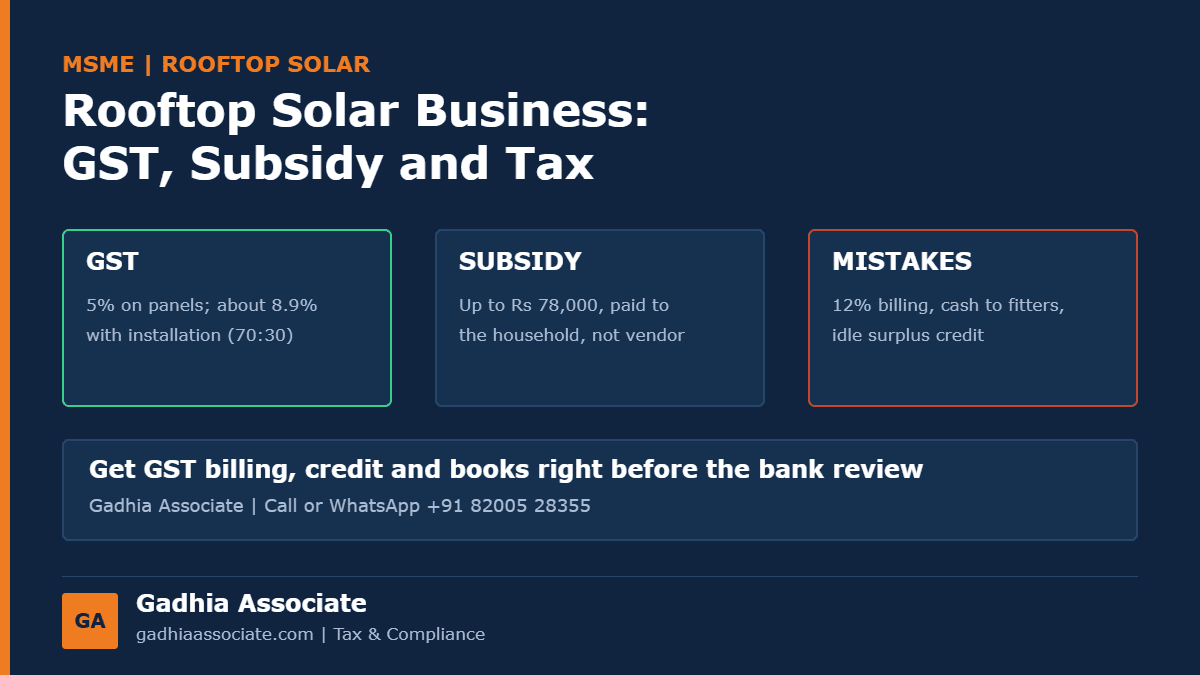
A rooftop solar installer in Gujarat bills about 8.9% GST on a system with installation, and the PM Surya Ghar subsidy goes to the customer.
Harshil, 31, was an electrical contractor in Jetpur before he moved into rooftop solar in 2025. Last year he installed about 140 home systems under PM Surya Ghar, with turnover of around Rs 2.6 crore. He quotes a flat package price including GST, buys panels from a distributor in Ahmedabad and structures from local fabricators, and pays his fitters in cash. His GST credit ledger has built up Rs 9 lakh, he has never worked out the split between goods and services, and his bank wants clean returns and accounts before it sanctions a working capital limit.
Gujarat is among the leading states for rooftop solar under PM Surya Ghar, and many small installers have started up across Saurashtra. The tax side changed too, with the GST cut of September 2025. Here is what an installer needs to get right in 2026.
Short Answer: Solar modules and other renewable energy devices carry 5% GST from 22 September 2025, down from 12%. When a vendor supplies a rooftop system with installation for one price, 70% of the value is treated as goods at 5% and 30% as services at 18%, about 8.9% in all. Under PM Surya Ghar, the central subsidy of up to Rs 78,000 is paid into the household's bank account after the system is commissioned, so the vendor bills and taxes the full price. Installers need GST registration once turnover crosses the limit, Udyam, registration as a vendor on the scheme portal, proper invoices and books, and must pay income tax on business profit.
Our team handles GST registration, billing, returns, credit and accounts for solar installers. Call or WhatsApp +91 82005 28355, or see the details at the end of this guide.
GST rates for solar after September 2025
- Panels and devices: solar modules and other renewable energy devices carry 5% GST from 22 September 2025, down from 12%.
- System with installation: where a rooftop system is supplied with installation for one price, 70% of the value is treated as goods at 5% and 30% as services at 18%, about 8.9% overall.
- Installation alone: installation or maintenance billed on its own carries 18%.
- Items sold separately: structures, cables and some electrical items have their own rates when sold on their own.
- Price effect: the cut made a 3 kW home system about Rs 9,000 to Rs 10,500 cheaper.
PM Surya Ghar: who gets the subsidy
- Amount: Rs 30,000 per kW for the first 2 kW and Rs 18,000 for the third kW, up to Rs 78,000 for systems of 3 kW and above.
- Who receives it: the household, in its own bank account, after the system is installed, the net meter is fitted and the DISCOM inspects it.
- Your invoice: bill the full price with GST. The subsidy is not your income and is not a discount on your bill.
- Balance after subsidy: if a customer pays part of the price after the subsidy arrives, that is simply money the customer owes you.
- Made in India: the subsidy needs modules that meet the scheme's domestic content rules.
- DISCOM role: the local DISCOM, such as PGVCL in Saurashtra, handles the net meter and the inspection.
Registrations for a solar business
- GST: registration is due once turnover crosses Rs 20 lakh, the limit that applies when you supply services, and most installers register from the start. See do I need GST registration.
- Udyam: free MSME registration, useful for loans and payment protection. See Udyam registration.
- Scheme registration: vendors work through the PM Surya Ghar national portal as registered vendors.
- Electrical licence: wiring and grid connection generally need a licensed electrical contractor, so keep the licence on file.
- Shop and professional tax: the usual registrations for an office or godown. See proprietorship registration.
Credit, invoices and returns
- Invoices: show the system, its capacity, the HSN or SAC, and the goods and services values at their rates, as per the contract.
- Input credit: claim GST on panels, inverters, structures, cables, transport and sub-contracted work, with proper invoices from registered suppliers.
- Surplus credit: many inputs carry 18% while the output averages about 8.9%, so credit can pile up. Check whether an inverted duty refund is available, and plan purchases.
- E-way bills: needed for moving panels and equipment worth more than Rs 50,000.
- Returns: file on time, monthly or quarterly. See our GST return calendar.
- Business customers: factories and offices can claim your GST as credit, and may deduct TDS on your bills. See GST and income tax for contractors.
Income tax for installers
- Presumptive tax: profit can be declared at 8% of turnover, or 6% of digital receipts, up to Rs 2 crore, or Rs 3 crore where cash receipts are within 5%. See presumptive taxation.
- Books and audit: above those limits, keep full books and get a tax audit. See tax audit.
- Cash payments: paying any one person more than Rs 10,000 in cash in a day is disallowed, so pay fitters through the bank or UPI. See cash transaction limits.
- TDS on sub-contractors: once turnover crosses Rs 1 crore, deduct TDS on contract payments from the next year.
- For your business customers: solar power systems used in a business get depreciation at 40%. See machinery depreciation.
Common mistakes
- Still billing 12%, or one flat rate with no split between goods and services.
- Showing the subsidy as a discount on the invoice, or as your own income.
- Taking large cash payments from customers, or paying fitters in cash.
- Moving panels without e-way bills.
- Letting surplus credit pile up without checking for a refund.
- Mixing personal and business money in one account.
Back to Harshil. His invoices are reworked so that each home system shows the 70% goods and 30% services values, about 8.9% in all, with the full price billed and the subsidy left out of the bill. The Rs 9 lakh of surplus credit is checked for an inverted duty refund, and his purchases are planned so that it stops building up. His fitters are now paid through the bank, he takes Udyam and keeps proper books, and with almost all receipts digital, he stays within the Rs 3 crore presumptive limit. With clean returns and accounts, the bank takes up his working capital proposal.
How we help
- GST registration, invoicing and the goods and services split
- Monthly returns, e-way bills and credit tracking
- Inverted duty refund claims
- Udyam, bank and working capital papers
- Books, presumptive tax, tax audit and advance tax
- TDS on sub-contractors and staff payments
Gadhia Associate has been in practice since 2007 and has handled work for over 7,000 clients, with a 5.0 Google rating from more than 100 reviews. Solar installers and electrical contractors from Junagadh, Jetpur, Rajkot, Keshod and Porbandar come to our Junagadh office, where same-day appointments are available. Installers elsewhere in Gujarat are handled online.
Running a rooftop solar business? Get your GST billing, credit and books right before the next bank or tax review. Call or WhatsApp +91 82005 28355, or message us on WhatsApp. The first consultation is free.
Frequently asked questions
What is the GST rate on solar panels in 2026?
5% since 22 September 2025, down from 12%.
What is the GST on rooftop solar with installation?
70% of the value at 5% and 30% at 18%, about 8.9% overall.
Who gets the PM Surya Ghar subsidy?
The household, in its own bank account, after installation, net metering and the DISCOM's inspection.
Should the vendor show the subsidy on the invoice?
No. The vendor bills the full price with GST.
Do solar installers need GST registration?
Yes, once turnover crosses Rs 20 lakh, and most register from the start.
Can a solar installer use presumptive tax?
Yes, at 8% of turnover or 6% of digital receipts, up to Rs 2 crore, or Rs 3 crore if cash receipts are within 5%.
Position as of 17 November 2026, under the GST rates in force from 22 September 2025, the PM Surya Ghar Muft Bijli Yojana guidelines and the Income-tax Act, 2025. Scheme terms and DISCOM procedures change, so check the national portal for the current position.