Is Audit Compulsory for a Private Limited Company in 2026? Statutory Audit With No Turnover, Auditor Appointment, ADT-1, Deadlines and Penalties
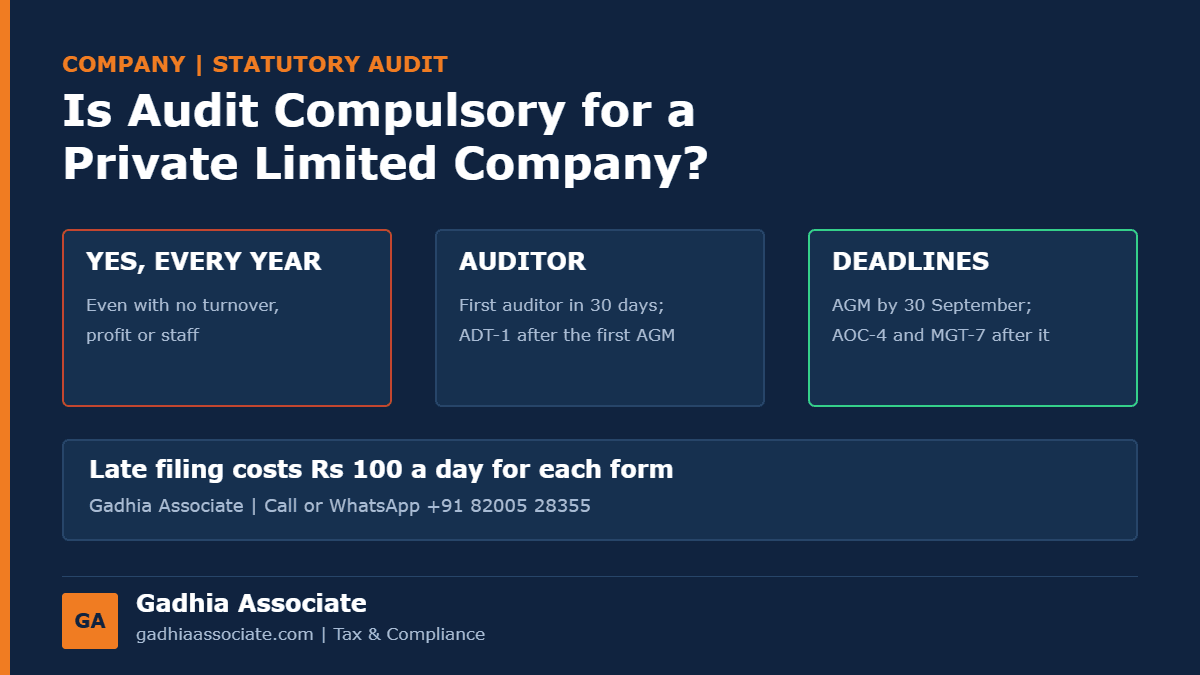
Statutory audit of a private limited company is compulsory every year, even if the company has no turnover, no profit and no staff.
Two friends from Rajkot registered a private limited company in June 2025 for a packaging business that never started. The company has Rs 1 lakh in its bank account, no sales and no employees, so they assumed there was nothing to file. In November 2026 a bank asked for audited accounts before looking at a loan for their new plan. They then learnt that no auditor was ever appointed, and that nothing has been filed with the ROC since incorporation.
This is the most common surprise for first-time company owners in Saurashtra. A company is a separate legal person, and the law wants an independent check on its accounts every year, however small it is. Here is what the audit involves in 2026.
Short Answer: Yes. Every private limited company must have its accounts audited by a practising chartered accountant every financial year, whatever its turnover, profit or activity. The board appoints the first auditor within 30 days of incorporation, and at the first annual general meeting the auditor is appointed for five years, with Form ADT-1 filed within 15 days. The audited accounts go before the AGM, due by 30 September, and are filed with the ROC in AOC-4 within 30 days and in MGT-7 or MGT-7A within 60 days. Late filing costs Rs 100 a day for each form, and continued default brings penalties, director disqualification and strike-off. This audit is separate from the income tax audit.
Our team handles auditor appointment, statutory audit and ROC filings for private limited companies. Call or WhatsApp +91 82005 28355, or see the details at the end of this guide.
Who must be audited
- Every company: private limited, one person, small, Section 8 and even dormant companies. There is no turnover limit.
- From the first year: the first financial year is audited even if the company only opened a bank account.
- LLPs are different: an LLP needs an audit only above Rs 40 lakh turnover or Rs 25 lakh contribution. See private limited vs LLP vs proprietorship.
- Not the tax audit: the income tax audit depends on turnover and is a separate report. See tax audit.
Appointing the auditor
- First auditor: appointed by the board within 30 days of incorporation. If the board does not, the members appoint one within 90 days.
- At the first AGM: the auditor is appointed for five years, and Form ADT-1 is filed with the ROC within 15 days.
- Consent: the CA gives written consent and a certificate of eligibility before appointment.
- Who cannot be auditor: a director's relative, a shareholder, an employee, or anyone with a business relationship with the company.
- Rotation: small private companies need not change auditors every five years. Rotation applies only from Rs 50 crore of paid-up capital or borrowings.
- Changing the auditor: a resignation is reported in Form ADT-3, and removal before the term ends needs government approval.
What the audit covers
- True and fair view: whether the balance sheet and profit and loss account show the real position.
- Books and records: whether proper books are kept, including an edit log in the accounting software, required since April 2023.
- Sensitive items: loans to directors, related party dealings, deposits and unpaid statutory dues.
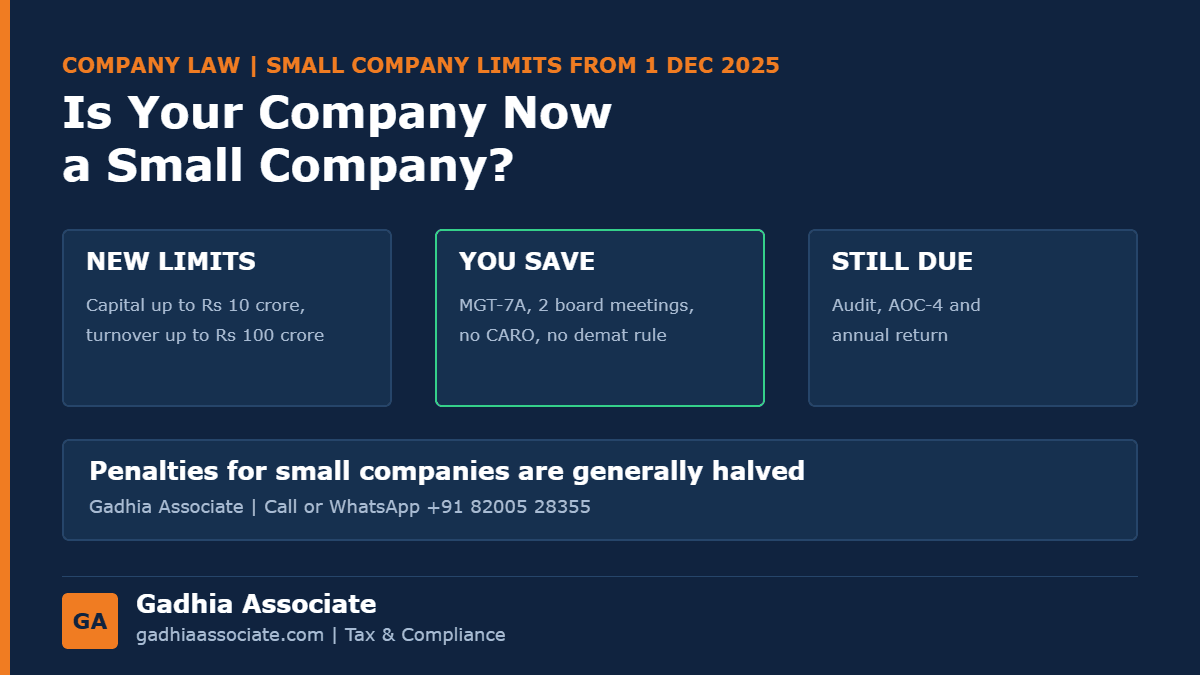
- Lighter for small companies: the detailed order known as CARO and the report on internal controls do not apply to small companies. See small company limits.
- UDIN: the audit report carries a UDIN that banks and departments can verify.
Deadlines
- AGM: by 30 September each year. The first AGM can be held within nine months of the end of the first financial year.
- AOC-4: audited accounts are filed within 30 days of the AGM.
- MGT-7 or MGT-7A: the annual return is filed within 60 days of the AGM. See private limited company annual compliance.
- Income tax return: normally by 31 October, extended this year to 21 November. See the extended due dates.
- Directors: DIR-3 KYC continues separately. See DIR-3 KYC.
If you skip it
- Late fee: Rs 100 a day for each form, with no upper limit.
- Penalty for not filing accounts: Rs 10,000 plus Rs 100 a day, up to Rs 2 lakh for the company and Rs 50,000 for each director in default.
- No auditor appointed: a fine of Rs 25,000 to Rs 5 lakh on the company.
- Three years of default: directors are disqualified and the company can be struck off. See struck-off companies and disqualified directors.
- In practice: banks, investors, tenders and buyers ask for audited accounts before anything else.
A company with no business
- Still audited: a company with no transactions files audited accounts showing nil activity.
- Dormant status: an inactive company can apply to be marked dormant, which lightens the filings, though its accounts are still audited.
- Close it: if the plan is dead, strike the company off instead of paying for compliance every year. See closing a private limited company.
- Commencement: a new company must also file its commencement declaration within 180 days of incorporation.
What to give your auditor
- Books of account, bank statements and vouchers for the year
- Loan statements, and confirmations from major parties
- Details of directors, shareholders and related party dealings
- GST, TDS, PF and other returns filed
- Minutes of board and general meetings, and the statutory registers
Back to the two friends. Because the board never appointed an auditor, the members appoint one now, and the first year's accounts to 31 March 2026 are audited even though they show only share capital and bank charges. The first AGM is held before 31 December 2026, within nine months of the year end, so AOC-4 and MGT-7A can still be filed on time. The income tax return is filed before the extended date, the missed commencement declaration is filed with its late fee, and the bank gets its audited accounts. They also decide whether to keep the company for the new plan or close it.
How we help
- Auditor appointment paperwork and ADT-1 filing
- Statutory audit and audited financial statements
- AGM papers, AOC-4 and MGT-7 or MGT-7A
- Catching up on missed years and late filings
- Tax audit and income tax return of the company
- Dormant status or strike-off for inactive companies
Gadhia Associate has been in practice since 2007 and has handled work for over 7,000 clients, with a 5.0 Google rating from more than 100 reviews. Companies from Junagadh, Rajkot, Jamnagar, Morbi and Porbandar come to our Junagadh office, where same-day appointments are available. Companies elsewhere in India are handled online.
Company registered but never audited, or filings pending? Get it regular before the late fees grow. Call or WhatsApp +91 82005 28355, or message us on WhatsApp. The first consultation is free.
Frequently asked questions
Is audit compulsory for a private limited company with no turnover?
Yes. Every company is audited every year, whatever its turnover or activity.
Who appoints the first auditor of a company?
The board, within 30 days of incorporation. If it does not, the members appoint one within 90 days.
What is Form ADT-1?
The form that tells the ROC about the auditor's appointment, filed within 15 days of the AGM.
What is the due date for the audit of a private limited company?
The audited accounts must be ready for the AGM, due by 30 September, and are filed in AOC-4 within 30 days after it.
What is the penalty for not getting a company audited?
Late fees of Rs 100 a day for each form, penalties on the company and its directors, and in the end disqualification and strike-off.
Is statutory audit different from tax audit?
Yes. Statutory audit applies to every company under the Companies Act, while tax audit applies only above the income tax turnover limits.
Position as of 16 November 2026, under the Companies Act, 2013 and its rules. Due dates are sometimes extended by the Ministry of Corporate Affairs, so check the current position for your year.