How to Close a Private Limited Company in India 2026: Form STK-2 Strike Off, C-PACE Processing, Documents, Cost and the Dormant Company Alternative
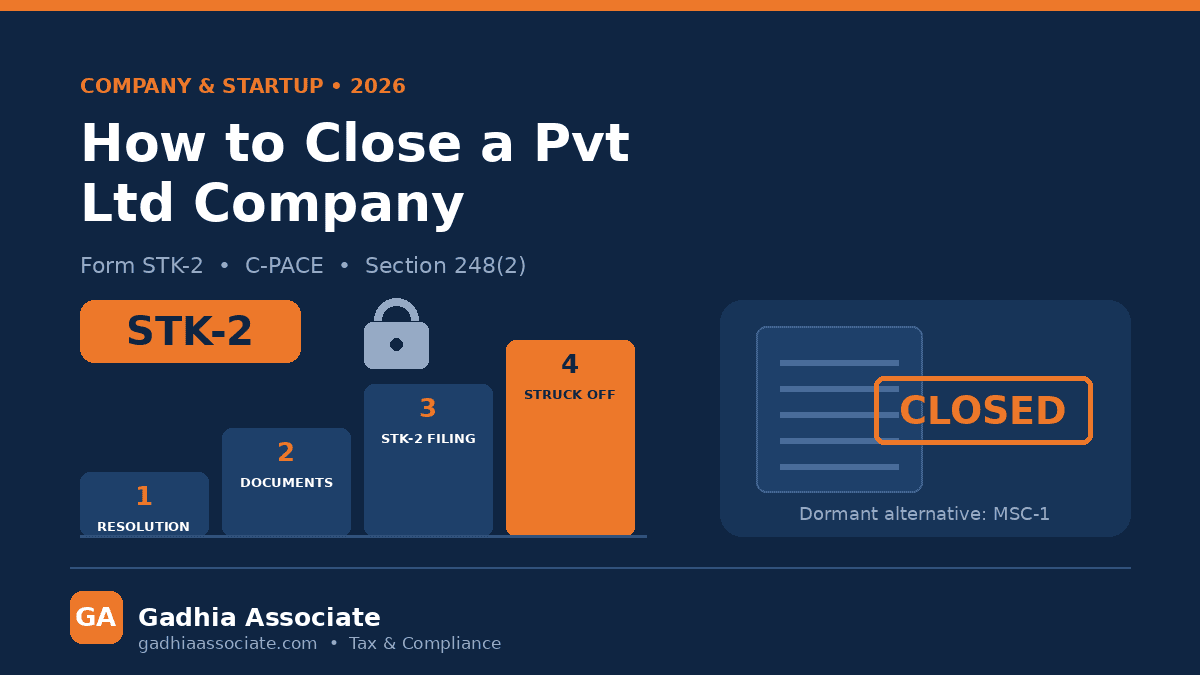
To close a private limited company in India, the normal route is voluntary strike off under Section 248(2) of the Companies Act, 2013 by filing Form STK-2 with the Registrar, which is now processed centrally by C-PACE. You will need a board resolution, consent of members holding at least 75% of paid-up capital, an indemnity bond, affidavits from the directors, a CA-certified statement of accounts, closed bank accounts and all overdue annual filings brought up to date. The government fee for STK-2 is commonly stated as Rs 10,000, and a clean application is typically disposed of in a few months.
A dormant private limited company is not free. It keeps generating annual filing obligations, late fees that accrue daily, and eventually director disqualification. Many promoters in Junagadh and across Gujarat come to us with a company that stopped trading four years ago and has quietly built up a liability larger than the cost of closing it properly. This guide sets out exactly how to close a private limited company, what it costs, how long it takes, and when dormant status is the smarter choice.
How do I close a private limited company?
Voluntary strike off follows a fairly fixed sequence:
- Settle and extinguish all liabilities — creditors, loans, statutory dues, employee dues
- Close every company bank account and obtain a closure certificate from the bank
- Complete all overdue annual filings, including AOC-4 and MGT-7, up to the relevant date
- Hold a board meeting and pass a board resolution approving the closure and authorising a director
- Pass a special resolution in a general meeting, or obtain written consent of members holding at least 75% of paid-up share capital
- File MGT-14 where a special resolution route is used
- Prepare the indemnity bond in Form STK-3, signed by every director
- Prepare the affidavit in Form STK-4 from every director
- Get the statement of accounts in Form STK-8 certified by a Chartered Accountant, dated not earlier than 30 days before the application
- File Form STK-2 online on the MCA portal with the prescribed fee and attachments
The Registrar then publishes a public notice in Form STK-5/STK-6 inviting objections. If none arise, the name is struck off and the dissolution is notified in the Official Gazette.
What is Form STK-2?
Form STK-2 is the application by a company to the Registrar for removing its name from the register of companies. It is the operative filing in the whole exercise — everything else is an attachment to it. It must be digitally signed by a director and certified by a practising Chartered Accountant, Company Secretary or Cost Accountant. Since the introduction of C-PACE, STK-2 filings are routed to a single central authority rather than to the individual state ROC.
What is C-PACE and why does it matter?
The Centre for Processing Accelerated Corporate Exit (C-PACE) was set up by the MCA in 2023 to centralise and speed up strike-off processing. Before C-PACE, applications sat with regional Registrars and timelines varied wildly from state to state — some applicants waited well over a year. C-PACE gave the process a single queue, uniform scrutiny standards and a much shorter turnaround. In practice a well-prepared application today is generally processed in a matter of months rather than years, though incomplete filings still get resubmission notices that reset the clock.
How much does it cost to close a private limited company?
There are two components: the government fee and the professional cost. The statutory fee for Form STK-2 is commonly stated as Rs 10,000. On top of that you have notarisation and stamp paper for the indemnity bond and affidavits, the CA certification of Form STK-8, and professional fees for preparing the resolutions and the filing itself. The real variable is arrears — if AOC-4 and MGT-7 have not been filed for several years, the additional fee on those overdue forms can dwarf the closure cost itself.
Indicative cost and timeline for a small company (illustrative only)
Take a small Gujarat-based private limited company with two directors, Rs 1 lakh paid-up capital, no assets, no litigation, and two years of pending annual filings. Indicatively: clearing the two years of AOC-4 and MGT-7 arrears including additional fee might run to roughly Rs 25,000 to Rs 40,000; the STK-2 government fee Rs 10,000; notarisation and documentation around Rs 3,000; professional and certification fees on top. On timing, allow about two to three weeks to close bank accounts, gather signatures and get the CA-certified STK-8 dated within the 30-day window, then filing, then the public notice and objection period, with dissolution typically following a few months after filing. These are round, illustrative figures for planning only — your actual arrears and fees will differ.
Which companies cannot use strike off?
Strike off is not available to every company. Broadly excluded are listed companies, companies delisted for non-compliance, vanishing companies, companies under inspection or investigation or where prosecution is pending, companies with pending litigation before any court or tribunal, companies with outstanding public deposits or unpaid charges on their assets, and Section 8 (not-for-profit) companies. Companies that have changed name or shifted registered office, disposed of property for value, or otherwise carried on business in the immediately preceding period also face restrictions on applying. If any of these apply, the exit route is liquidation or winding up, not STK-2.
What happens if I just stop filing?
This is the most expensive option, and it is the one most people default into. The company remains on the register, so AOC-4 and MGT-7 obligations continue and additional fees accrue on a per-day basis for every year missed. Once annual returns or financial statements have not been filed for a continuous period of three financial years, every director attracts disqualification under Section 164(2) of the Companies Act, 2013. That disqualification is personal and portable — it follows the individual into every other company they direct, and the DIN becomes unusable, which can freeze filings for a completely unrelated and perfectly healthy business. The Registrar may also strike the company off on its own motion, which removes the company but leaves the directors carrying the disqualification and any residual liability. Silence is not an exit strategy.
Strike off vs dormant status vs doing nothing
Compare the three honestly. Strike off is final: the company ceases to exist, all compliance stops, and the cost is a one-time spend. Choose it when the business is genuinely finished and you have no intention of reviving the name or the entity. Dormant status under Section 455, applied for in Form MSC-1, is the middle path: the company is formally recognised as inactive or as holding an asset for a future project, the name and the incorporation date are preserved, and the compliance burden shrinks to a light annual return in Form MSC-3. It suits a promoter who has paused a venture, is holding intellectual property or a brand name, or expects to restart within a few years. Doing nothing looks free and is the most costly of the three — accumulating late fees, director disqualification under Section 164(2), and eventual involuntary strike off on terms you did not choose. Between a definite ending and a genuine pause, both legal routes are cheaper than drift.
What about tax and PAN after closure?
File the final income tax return before dissolution and settle any outstanding demand — the ROC will not treat a company as free of liabilities if there is a live tax demand. Surrender GST registration through cancellation, close any professional tax and TDS registrations, and keep the PAN and books safely; PAN surrender is usually taken up only after dissolution is notified. Our Income Tax services team handles the final return and demand clearance alongside the ROC filing so nothing is left dangling.
Thinking of restructuring instead of closing?
Sometimes the answer is not closure at all. If the company failed because the structure was wrong — too much compliance for a one-person operation, or the wrong entity for the funding plan — an LLP or proprietorship may serve better, and our Business Structure Advisor is a good starting point. If you are winding up one venture and starting another, our Company Registration team can time the new incorporation so that the outgoing directors are clear of any Section 164(2) exposure first. NRI directors closing an Indian entity should also loop in our NRI Desk for the FEMA and repatriation side.
How Gadhia Associate Can Help
We handle end-to-end company closure from Junagadh for clients across Gujarat and India: arrears cleanup, resolutions, STK-3, STK-4 and STK-8 preparation, STK-2 filing with C-PACE, dormant applications under Form MSC-1, and the tax and GST closure alongside. If you have a company sitting idle, the cost of acting now is always lower than the cost of waiting another year. Book a free consultation with Gadhia Associate today.
Disclaimer: This article reflects the position as of August 2026. Fees, forms, eligibility conditions and processing timelines change through MCA notifications, amendment rules and periodic settlement schemes. Please confirm the current position with a qualified professional before acting on this information.