NRI Inherited Property in India 2026: Tax on Inheritance, Selling Inherited Property, Capital Gains, TDS and Taking the Money Abroad
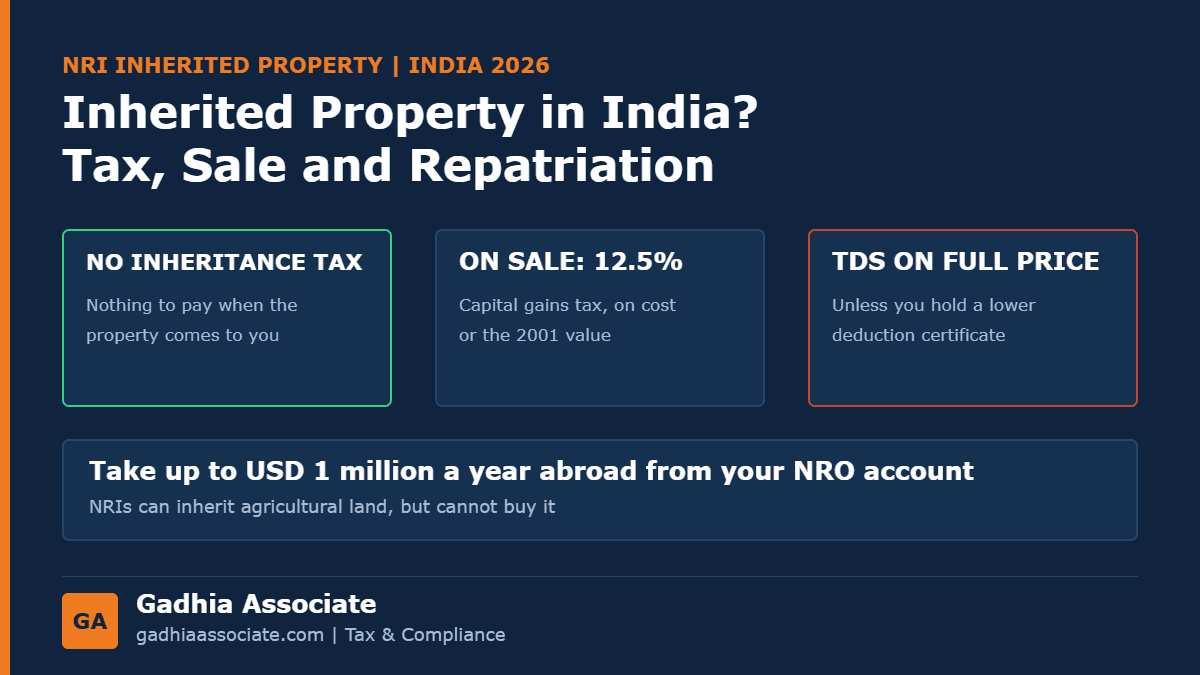
An NRI who inherits property in India pays no tax on the inheritance, but pays capital gains tax and faces TDS when the property is sold.
Nisha has lived in New Jersey for twenty years. When her father died in Junagadh in 2024, she and her brother inherited the family house, a shop and some agricultural land in a village near Keshod. Two years on, the house is still in her father's name, a buyer is waiting, and she has three questions. Is there tax on what she inherited? How much will the sale cost her? Can she take her share to the United States?
The answers are better than most NRIs expect, provided the steps are taken in the right order. Here is how inheritance works for an NRI in India, from the paperwork to the tax to the bank transfer.
In short: India has no inheritance tax, and an NRI or OCI can inherit any property in India, including agricultural land. Tax arises only on income from the property after you inherit it, and on capital gains when you sell. Your cost is what the earlier owner paid, or the property's value on 1 April 2001 if it was bought before that, and the earlier owner's years of holding count as yours. The gain is taxed at 12.5%, without indexation for NRIs. The buyer must deduct TDS on the full sale price unless you hold a lower deduction certificate. After tax, up to USD 1 million a year can be sent abroad from your NRO account, with Form 145 and Form 146.
Our NRI Desk handles the capital gains working, the certificate, the return and the remittance for NRI heirs in any country. The details are at the end of this guide.
Is there tax when an NRI inherits property in India?
- No inheritance tax: India does not tax an inheritance, and what you receive under a will or as a legal heir is not your income.
- FEMA allows it: an NRI or OCI can inherit a house, flat, shop, plot or agricultural land, from a resident or from another NRI, without RBI permission. The same goes for deposits, shares and gold.
- Income after you inherit is yours: rent, interest and dividends are taxed in your hands from the date of death. See NRI rental income.
- The last return of the person who died: the heir files it. See filing the return of a person who has died.
- Your country of residence: it may ask you to report the inheritance even if it does not tax it. Check that side too.
What papers put the property in your name?
- Death certificate.
- The will, if there is one. In Gujarat a will generally does not need probate.
- If there is no will: a family tree, called a pedhinamu, and legal heir papers. For deposits and shares, the bank may ask for a succession certificate from the court.
- Land: an inheritance entry, called a varsai entry, in the revenue records. It can be applied for online on the iORA portal.
- A house or flat in a city: the city survey property card, the municipal tax record and the housing society's records.
- Bank accounts, demat and mutual funds: claim forms with the nominee's or heirs' papers. An NRI heir receives the money in an NRO account.
- Acting from abroad: a power of attorney in favour of a family member, signed at the Indian consulate or apostilled, then stamped in India within three months and registered where the law requires it.
Do this early. A sale, a loan or even a tax refund gets stuck when the records still show a person who has died.
How is capital gains tax worked out when you sell?
- Cost: the price paid by the person who originally bought the property. If that was before 1 April 2001, you can take the fair market value on 1 April 2001 instead, but not more than the stamp duty (jantri) value on that date.
- Holding period: counted from the original purchase. So inherited property is almost always long-term, which needs more than 24 months.
- Rate: 12.5%, plus 4% cess, and a surcharge where the income is above Rs 50 lakh. The option of 20% with indexation is only for residents.
An example: Nisha's share of the sale price is Rs 90 lakh. Her share of the value on 1 April 2001 was Rs 10 lakh. Her gain is Rs 80 lakh. Tax at 12.5%, with 10% surcharge and 4% cess, comes to Rs 11.44 lakh.
- Saving the tax with bonds: invest the gain, up to Rs 50 lakh, in capital gains bonds within six months of the sale. If Nisha does this, her taxable gain falls to Rs 30 lakh and her tax to Rs 3.9 lakh.
- Saving the tax with a house: buy or build a house in India within the time allowed. Our guide on saving capital gains tax on a property sale has the conditions.
- Agricultural land: agricultural land in a village, away from a town, is "rural" and is not a capital asset, so its sale is not taxed. Land close to a town is taxed like any other land. Our guide on selling agricultural land in Gujarat has the distance test. Under FEMA, an NRI cannot buy agricultural land but can inherit it, and can sell it only to a person resident in India, who in Gujarat must generally be an agriculturist.
How much TDS will the buyer deduct?
- No minimum price: a buyer must deduct TDS on a taxable sale by an NRI, whatever the price. The Rs 50 lakh limit is for resident sellers only.
- Without a certificate: it is deducted on the full sale price. In the example, 14.3% of Rs 90 lakh is Rs 12.87 lakh.
- With a lower deduction certificate: the TDS is worked out on your actual gain, not on the whole price. Apply in Form 128 as soon as the sale is agreed, and before any advance is paid, because TDS applies to every payment. It takes about a month.
- Several heirs: each heir's share is taxed separately, and resident and non-resident heirs have different TDS rules.
Our guide for an NRI selling property in India covers the buyer's side, including the PAN-based TDS route from 1 October 2026.
Can you take the money abroad?
- Where it goes first: sale proceeds and inherited money are credited to your NRO account. See NRE, NRO and FCNR accounts.
- The limit: up to USD 1 million in a financial year, for each person, after tax.
- What the bank asks for: proof of the inheritance, the sale deed, and Form 145 with a chartered accountant's certificate in Form 146. See Form 15CA and 15CB, now Form 145 and 146.
- Larger amounts: spread the transfer over more than one financial year.
How our NRI Desk helps
- Work out the capital gain for each heir, including the 2001 valuation
- Apply for the lower deduction certificate before the sale
- Plan the exemption, through bonds or a new house, before you commit
- Guide the buyer on TDS, and file your return to claim any refund
- File the last return of the person who has died
- Issue Form 146 and file Form 145 to send your share abroad
The will, heirship papers and land records are legal steps. We handle the tax and banking side, and coordinate with your family's advocate on the rest.
How it works from abroad: a first call at a time that suits your time zone, a clear fixed fee before we start, documents shared on WhatsApp or email, and one person who handles your file from start to finish. No visit to India is needed for the tax work. See everything our NRI Desk does.
Gadhia Associate has been in practice since 2007 and has handled work for over 7,000 clients, with a 5.0 Google rating from more than 100 reviews. From our office in Junagadh, Gujarat, the NRI Desk works with NRIs in the UK, the USA, Canada, the UAE and the Gulf, Australia, Singapore and Africa.
Inherited property in India and planning to sell? Talk to us before you sign. Call or WhatsApp +91 82005 28355, or message us on WhatsApp. The first consultation is free.
Frequently asked questions
Is inherited property taxable for an NRI in India?
No tax is payable on inheriting it. Tax applies to income from the property afterwards, and to capital gains when it is sold.
Can an NRI inherit agricultural land in India?
Yes. An NRI cannot buy agricultural land but can inherit it, and can sell it only to a person resident in India.
How is capital gains tax calculated on inherited property?
Sale price less the original owner's cost, or the value on 1 April 2001 for older property. For an NRI the gain is taxed at 12.5%, plus surcharge and cess.
How much TDS is deducted when an NRI sells inherited property?
12.5% plus surcharge and cess on the full sale price, unless a lower deduction certificate limits it to the tax on the actual gain.
Can an NRI send the sale proceeds of inherited property abroad?
Yes, up to USD 1 million in a financial year from the NRO account, with Form 145, Form 146 and proof of the inheritance.
Does an NRI have to come to India to sell inherited property?
Not necessarily. A power of attorney signed abroad, then stamped and registered in India, can authorise a relative to complete the sale, and the tax work is done online.
Position as of 6 October 2026. Succession law, land records and stamp duty differ by state and by family, and the tax depends on each heir's share and status. Take advice on your own facts before you sell.