How to Save Capital Gains Tax on Property Sale in 2026: Section 54, 54F and 54EC Exemptions, the Rs 10 Crore Cap and Capital Gains Account Scheme
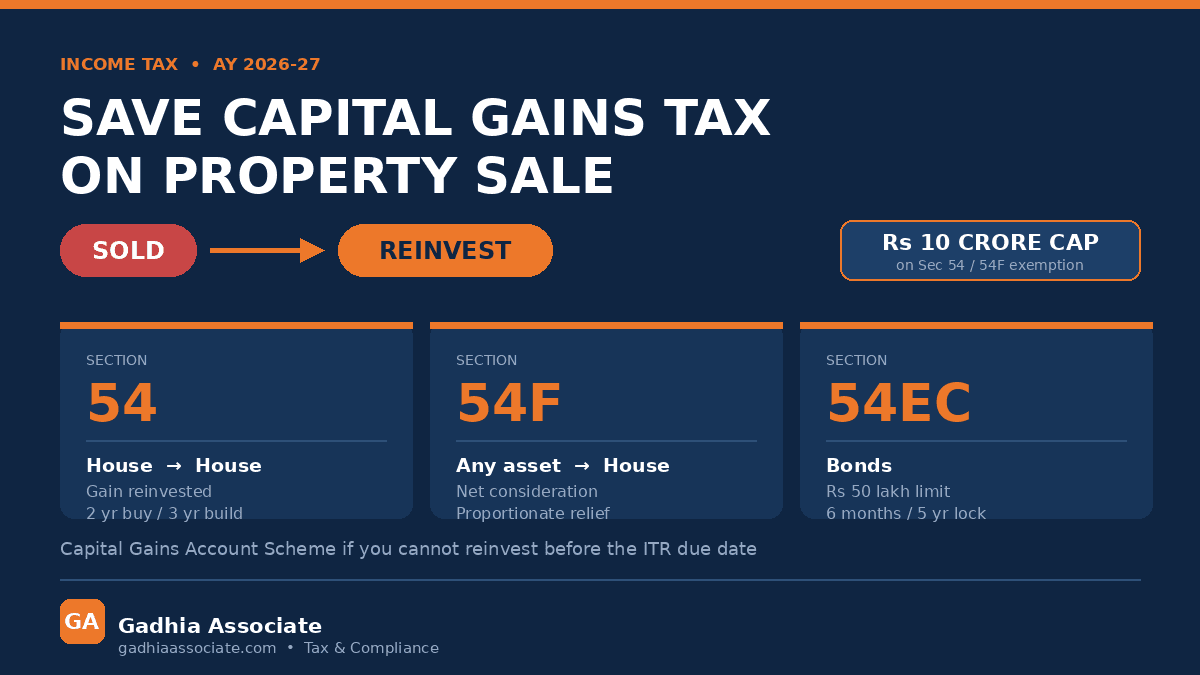
If you are selling a flat, a plot or an ancestral house this year, the good news is that capital gains tax on property sale can often be reduced to zero with correct planning. The three main routes are Section 54 (sell a house, buy a house), Section 54F (sell any other asset, buy a house) and Section 54EC (park the gain in specified bonds within six months). Each has its own conditions, its own deadline and, in the case of Sections 54 and 54F, a Rs 10 crore ceiling on the exemption.
How can I avoid capital gains tax on property sale in 2026?
You avoid it by converting the gain into an approved reinvestment before the statutory deadline, and by parking any unspent amount in a Capital Gains Account Scheme (CGAS) account before your income tax return due date. There is no other legal shortcut — the sale is already reported to the department through the SFT and TDS trail. So the planning question is not whether to pay, but which exemption fits your facts and whether you can meet the timeline.
When does property become long term?
Immovable property — land, buildings, flats — is treated as a long-term capital asset when it is held for more than 24 months. Sell before that and the gain is short term, taxed at your slab rate with no Section 54, 54F or 54EC relief available. This single fact decides more tax outcomes than anything else, so check your date of acquisition (allotment or registration, as applicable) before you sign an agreement to sell.
Is indexation still available in 2026?
The Finance Act 2024 changed the long-term regime for immovable property with effect from 23 July 2024. The standard position now is a flat 12.5% rate without indexation. However, a grandfathering option was retained: a resident individual or HUF who acquired the property before 23 July 2024 may compute the tax both ways — 20% with indexation and 12.5% without indexation — and pay the lower of the two. Non-residents, firms and companies do not get this comparative choice on land and buildings.
In practice, ancestral property held for decades in Junagadh and elsewhere in Gujarat often comes out better under the indexed 20% route, while recently acquired property usually favours 12.5%. Run both numbers. Our Capital Gain Tax Calculator lets you test both in a minute.
Section 54: selling one house and buying another
Section 54 applies when the asset sold is a residential house and the long-term capital gain is reinvested in another residential house in India. The timelines are:
- Purchase within 1 year before the date of transfer, or
- Purchase within 2 years after the date of transfer, or
- Construction completed within 3 years after the date of transfer.
Only the amount of the gain needs to be reinvested, not the whole sale value. The exemption is restricted to Rs 10 crore, a cap that applies from AY 2024-25 onwards.
Can I buy two houses to save tax?
Yes, but only once in a lifetime and only if the long-term capital gain does not exceed Rs 2 crore. Where those conditions are met, the exemption can be claimed against two residential houses instead of one. Exercise it in the return for that year; once used, the option is gone permanently.
Section 54F: when you sell land, shares or a shop
Section 54F covers long-term gains from any capital asset other than a residential house — agricultural-turned-NA land, a plot, a commercial unit, listed or unlisted shares, gold. The critical difference is that you must reinvest the entire net sale consideration, not merely the gain. If only part is reinvested, the exemption is allowed proportionately, in the ratio the amount invested bears to net consideration.
There is also an ownership test: on the date of transfer you must not own more than one residential house other than the new one, and you should not buy or construct another house within the prescribed period. The same Rs 10 crore ceiling applies.
What is the difference between Section 54 and 54F?
Put them side by side. Section 54 requires the asset sold to be a residential house, needs only the capital gain to be reinvested, has no restriction on how many other houses you already own, and is capped at Rs 10 crore. Section 54F applies to every other long-term asset, demands reinvestment of the full net consideration for a full exemption, imposes the "not more than one other house" condition, and carries the same Rs 10 crore cap. Section 54EC stands apart: it needs no house at all — you invest the capital gain from land or building in specified bonds within 6 months, subject to a Rs 50 lakh limit and a 5-year lock-in. Sections 54 or 54F can be combined with 54EC in the same year, which is how larger transactions are usually structured.
Section 54EC bonds: the simple option
If you do not want another property, invest the gain in bonds of NHAI, REC, PFC or IRFC within six months of transfer. The ceiling is Rs 50 lakh for the same transfer and the bonds carry a five-year lock-in. Redeem or borrow against them early and the exemption is withdrawn.
What if I cannot reinvest before filing my ITR?
This is the most common failure point. If the new house has not been bought or the construction is incomplete by the due date for filing your income tax return, the unutilised amount must be deposited in a Capital Gains Account Scheme account with a scheduled bank before that date, and the deposit proof filed with the return. Money simply lying in your savings account does not qualify, however genuine your intention. If the CGAS balance is not used within the permitted period, it becomes taxable in the year the period expires.
An illustrative worked example
Illustrative only. Assume a residential house in Gujarat sold in May 2026 for Rs 1.60 crore, with an indexed cost of acquisition of Rs 60 lakh, giving a long-term capital gain of Rs 1 crore. The seller buys a new flat for Rs 70 lakh and invests Rs 30 lakh in 54EC bonds within six months. Section 54 covers Rs 70 lakh, Section 54EC covers Rs 30 lakh, and the taxable long-term gain becomes nil. Had the seller reinvested only Rs 70 lakh, the balance Rs 30 lakh would have been taxed at the applicable long-term rate.
Checklist before you sign the sale deed
- Confirm the holding period crosses 24 months.
- Compute the gain under both 20% with indexation and 12.5% without, if eligible.
- Fix the exemption route — 54, 54F, 54EC or a combination — before receiving the money.
- Diarise the 6-month bond deadline and the 2-year / 3-year reinvestment windows.
- Open a CGAS account before the ITR due date if reinvestment is incomplete.
- Preserve the sale deed, purchase deed, bank trail, stamp duty receipts and improvement bills.
- If the buyer or seller is a non-resident, check TDS separately — see our article on NRI property sale TDS, where the rate and Form 13 lower-deduction route work very differently from resident 1% TDS.
What happens if I sell the new house within 3 years?
The exemption is clawed back. Under Section 54 the exemption earlier allowed is reduced from the cost of the new house, bringing the old gain back to tax. Under Section 54F the amount exempted is taxed as long-term capital gain in the year of the new transfer. The practical rule: hold the new house at least three years.
Have the section numbers changed under the new law?
Yes. The Income-tax Act, 2025, effective 1 April 2026, has re-enacted and renumbered the capital gains provisions. The substance of the relief for house reinvestment, other-asset reinvestment and specified bonds is carried forward, but the familiar labels "54", "54F" and "54EC" now sit under new clause numbers. Confirm the exact numbering for your assessment year before filing or replying to a notice.
How Gadhia Associate can help
From Junagadh, Gujarat, we handle property capital gains end to end for families, NRIs and investors across India — computing the gain both ways, choosing the exemption route, opening the CGAS account, timing the 54EC investment and filing a return that survives scrutiny. Try our Capital Gain Tax Calculator, explore our Income Tax services, and book a free consultation before you sign anything. Our GST Services and GST Calculator are on the same site.
Disclaimer: This article reflects the position as of August 2026. Tax rates, limits and procedures change through Finance Acts, CBDT notifications and circulars. Please confirm the current position with a qualified professional before acting.