GST for Transporters and GTA in 2026: 5% RCM or 18% Forward Charge, Annexure V Deadline, Registration and Exempt Freight
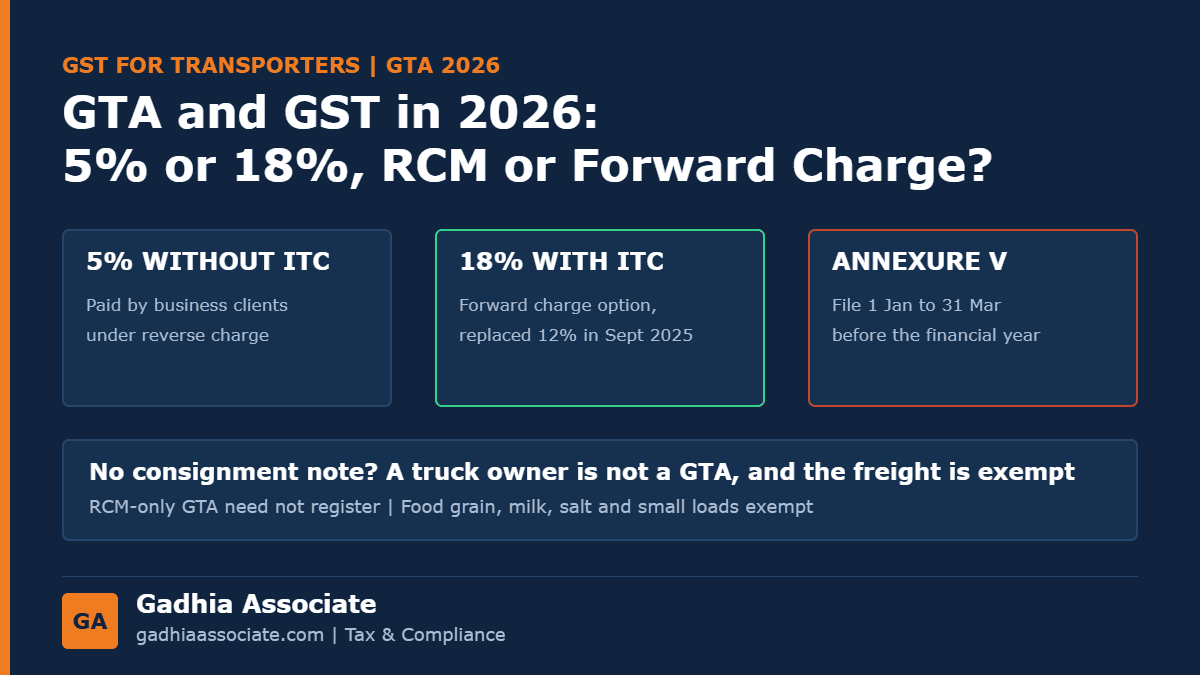
GST for transporters in 2026: a GTA charges 5% without credit or 18% with credit, and a truck owner who issues no consignment note is exempt.
Bharatbhai runs eight trucks out of Jetpur, carrying cotton bales, ceramic tiles and kirana goods across Saurashtra. His bigger clients pay GST on his freight themselves, under reverse charge, and a few small shops pay nothing. Now a Morbi tile manufacturer wants him to charge 18% on his bills, so that it no longer has to pay reverse charge in cash and report it itself, and his accountant is not sure whether he can, from when, or what it means for the clients who pay 5% under reverse charge today.
Transport is one of the most confusing corners of GST, because the answer depends on who issues the consignment note, who the customer is, and a declaration that an existing GTA can file only in a three-month window each year. Here is how it works in 2026.
In short: A goods transport agency (GTA) is anyone who transports goods by road and issues a consignment note. A truck owner who does not issue one is not a GTA, and that freight is exempt. A GTA's services are taxed at 5% without input tax credit, usually paid by business customers under reverse charge. A GTA that files Annexure V between 1 January and 31 March just before the financial year pays GST itself under forward charge, at 5% without credit or 18% with full credit. The 18% option replaced 12% from 22 September 2025. A GTA that supplies only under reverse charge does not need GST registration. Freight for agricultural produce, food grains, milk and salt is exempt, as are small consignments and transport for unregistered customers other than factories, companies, firms, societies and similar bodies.
Our GST team handles registration, the Annexure V decision, monthly returns and reverse charge reconciliation for transporters and for the businesses that hire them. The details are at the end of this guide.
Are you a GTA?
- The test: you provide a service in relation to transport of goods by road and issue a consignment note, whatever it is called: bilty, LR or GR.
- No consignment note: an individual truck or tempo owner who just carries goods and issues no consignment note is not a GTA, and the service is exempt.
- Hiring out a truck to a GTA: exempt. Hiring it out with a driver to any other business is renting of a goods carriage, which is taxed (see below).
- Local delivery through e-commerce apps: since 22 September 2025, local delivery services provided by or through an e-commerce operator are taxed separately at 18%, and the road transport exemption does not apply to them.
GST rates for a GTA in 2026
- 5% without input tax credit: the standard rate, paid under reverse charge by business customers, or by the GTA itself under forward charge. At this rate the GTA cannot take credit of GST on trucks, tyres, spare parts, repairs or other costs used for the service.
- 18% with full credit: available only to a GTA that has opted for forward charge. It replaced the 12% option from 22 September 2025 (Notification 15/2025-Central Tax (Rate)). A 2025 Gujarat advance ruling confirmed that a GTA paying the higher rate can take full credit.
Which suits you? 18% suits a GTA whose customers are mostly GST-registered businesses that can claim the credit, and which buys new trucks, tyres and spares that carry GST. 5% suits a GTA whose costs are mostly diesel and drivers' wages, which carry no GST credit anyway.
Reverse charge: who pays the 5%?
If the GTA has not opted for forward charge, these customers pay the GST themselves:
- a factory registered under the Factories Act
- a society or a co-operative society
- any person registered under GST, except a government department, local authority or government agency registered only to deduct TDS
- a company or other body corporate, including an LLP
- a partnership firm or association of persons
- a casual taxable person
- Paid in cash: reverse charge tax cannot be paid from the credit ledger.
- Credit for the customer: the customer can take credit of the GST it paid under reverse charge if the freight is for its business.
- Unregistered GTA: the customer issues a self-invoice within 30 days of receiving the service.
Which freight is exempt?
- Transport of agricultural produce
- Milk, salt and food grain, including flour, pulses and rice
- Organic manure
- Registered newspapers and magazines
- Relief materials meant for victims of natural or man-made disasters
- Defence or military equipment
- Freight up to Rs 1,500 for a consignment carried in a single vehicle, or up to Rs 750 for all goods carried for a single consignee
- Services to unregistered persons, other than the factories, societies, companies, firms and casual taxable persons listed above
- Services to government departments, local authorities and government agencies registered only to deduct TDS
Switching to forward charge: Annexure V
- When: file Annexure V on the GST portal between 1 January and 31 March just before the financial year in which you want to pay GST yourself. For 2027-28, the window is 1 January to 31 March 2027.
- How long: the choice continues for later years until you file Annexure VI to go back to reverse charge, in the same January to March window.
- New GTAs: a GTA that starts business or crosses the registration limit can opt within 45 days from applying for registration, or one month from getting it, whichever is later.
- Your invoices: once you opt in, every tax invoice must carry the declaration that you are paying GST under forward charge, so that customers do not pay it again under reverse charge.
- Where: on the GST portal, under Services, User Services, Opting Forward Charge Payment by GTA (Annexure V).
Back to Bharatbhai. The window for 2026-27 closed on 31 March 2026, so for the rest of this year his business customers keep paying 5% under reverse charge. If he is registered, or registers first, and files Annexure V between 1 January and 31 March 2027, he can charge 18% with full credit from 1 April 2027. Before he does, he should check which customers can use the credit, because those that cannot, such as businesses on the composition scheme, will carry the 18% as a cost.
Do you need GST registration?
- Reverse charge only: a GTA whose services are all taxed under reverse charge, or exempt, need not register, whatever its turnover.
- Forward charge: a GTA that opts for forward charge must be registered.
- Other transport services: for services such as renting trucks with drivers, registration is needed once turnover crosses Rs 20 lakh a year in Gujarat. See do I need GST registration.
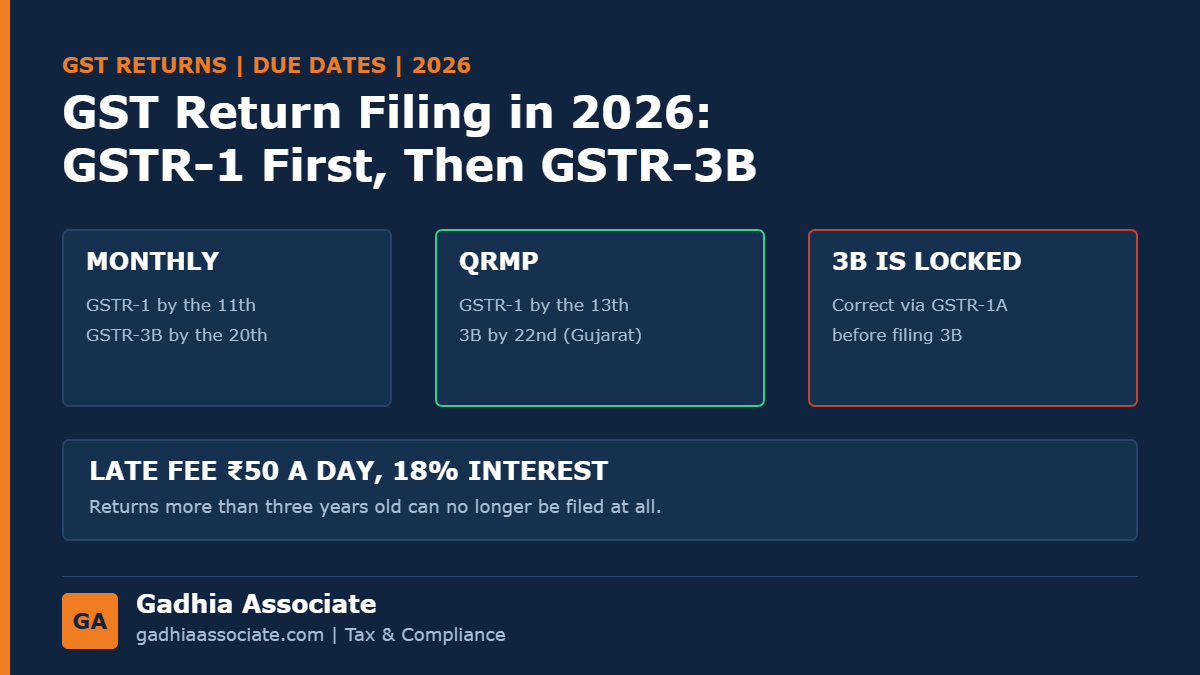
A registered transporter then files monthly or quarterly returns; our guide to GST return due dates has the calendar.
Renting trucks and buses
- Truck with driver, fuel included in the price: 5% with credit only of input services in the same line of business, or 18% with full credit. It was 12% before 22 September 2025.
- Truck rented to a GTA: exempt.
- Passenger transport by road: 5% without credit, other than credit of input services in the same line of business, or 18% with full credit if the operator opts for it.
E-way bills and detention
- Part B: the transporter fills in the vehicle details in Part B of the e-way bill. It is not needed when goods move up to 50 km within the state from the consignor's place of business to the transporter's place of business for onward transport.
- Old documents: since 1 January 2025, an e-way bill can be generated only for documents dated within the last 180 days.
- Detention: goods moving without a valid e-way bill can be detained under section 129. When the owner comes forward, release is on payment of 200% of the tax, or for exempt goods 2% of the value or Rs 25,000, whichever is less. Our guide on e-way bill detention explains the release process.
What the 57th GST Council proposed
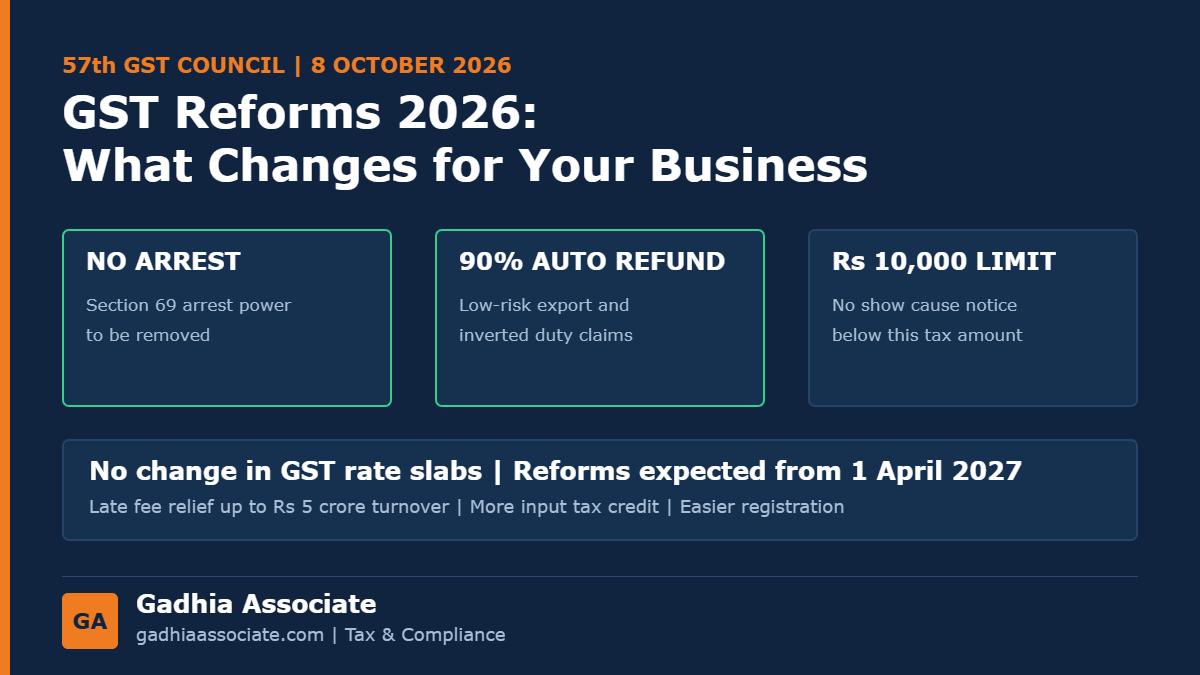
On 8 October 2026, the GST Council recommended changes that matter for transport and delivery. They are recommendations and apply only once notified, or once the GST law is amended where that is needed:
- Delivery services through e-commerce apps, other than courier and postal, at 5% without credit, with the e-commerce operator paying where the delivery provider is not liable to register.
- The exemption for GTA services to unregistered persons to be withdrawn where the goods are ordered or supplied through an e-commerce operator.
- Vehicles to be stopped only on specific intelligence approved by an officer of at least Joint Commissioner rank and not in transit states, though goods with no e-way bill or no document showing origin or destination can be detained in any state, and goods in transit would not be confiscated.
- A new statement matching reverse charge tax paid with the credit claimed, proposed from the return for April 2027.
Our summary of the 57th GST Council decisions has the full list.
The notices transporters and their customers are getting
- Reverse charge not paid on freight: officers compare expense ledgers with returns, and ask businesses that booked freight without paying reverse charge for the tax, interest and penalty.
- Credit taken at 5%: a GTA paying 5% cannot take input tax credit, so credit taken by mistake has to be reversed, with interest if it has been used.
- Mismatches: differences between GSTR-1, GSTR-3B and e-way bill data. See our guide to ITC mismatch notices.
How we help
- Tell you whether you are a GTA, and which of your freight is exempt
- Work out whether 5% or 18% saves more for your business, and file Annexure V or VI in the January to March window
- Handle GST registration where it is needed, and your monthly returns
- For businesses that hire transport, reconcile freight and pay reverse charge correctly
- Reply to notices on reverse charge, credit and e-way bills
- Get detained vehicles and goods released
Gadhia Associate has been in practice since 2007 and has handled work for over 7,000 clients, with a 5.0 Google rating from more than 100 reviews. Transporters, traders and manufacturers from Junagadh, Jetpur, Rajkot, Gondal, Morbi and Jamnagar come to our Junagadh office, where same-day appointments are available. GST work can equally be handled online for businesses anywhere in India.
Running trucks, or paying freight every month? Get your GST position checked before the next notice. Call or WhatsApp +91 82005 28355, or message us on WhatsApp. The first consultation is free.
Frequently asked questions
What is the GST rate for GTA in 2026?
5% without input tax credit, under reverse charge or forward charge, or 18% with full credit under forward charge. The 18% option replaced 12% from 22 September 2025.
Is GST payable on transport by a truck owner who issues no consignment note?
No. A transporter who issues no consignment note is not a GTA, and transport of goods by road by such a person is exempt.
Who pays GST under reverse charge on GTA services?
Factories, societies, co-operative societies, GST-registered persons other than government bodies registered only for TDS, companies, LLPs and other bodies corporate, partnership firms and casual taxable persons pay 5% under reverse charge, unless the GTA has opted for forward charge.
What is the last date to file Annexure V?
31 March, just before the financial year starts. The window opens on 1 January, so for 2027-28 it runs from 1 January to 31 March 2027. A new GTA has 45 days from applying for registration, or one month from getting it, whichever is later.
Does a GTA need GST registration?
Not if all its services are under reverse charge or exempt. A GTA that opts for forward charge must be registered.
Can a GTA paying 5% claim input tax credit?
No. The 5% rate is available only if no credit is taken on goods and services used for the service. Full credit is available only at 18%.
Position as of 10 October 2026. Rates are as notified from 22 September 2025, and the 57th GST Council's recommendations apply only once notified or written into the law. Exemptions depend on the goods, the customer and the documents, so take advice on your own facts.