GST for Doctors, Clinics and Hospitals in 2026: What Is Exempt, When You Must Register, and the Cosmetic and Room Rent Traps
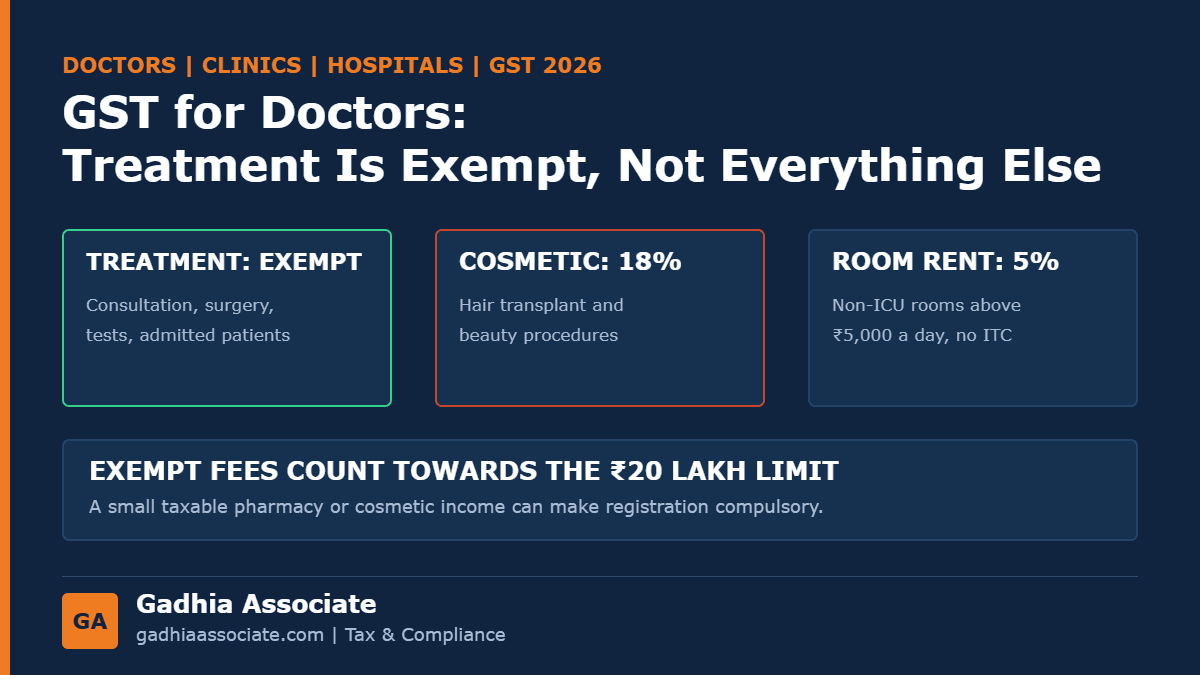
Doctors' treatment fees are exempt from GST, but a clinic pharmacy or cosmetic work can make GST registration compulsory.
A dermatologist in Rajkot earns about Rs 70 lakh a year from consultations and treatment. Over the last few years she added laser hair removal, chemical peels and anti-ageing injections, which now bring in about Rs 15 lakh, and a small counter selling sunscreens and creams. She never registered for GST, because everyone knows doctors are exempt. Then a notice arrived, built from her income tax return and bank credits, asking for 18% GST on the cosmetic work for three years, with interest and penalty.
The exemption for doctors is real, but it is narrower than most people think. This article explains what is exempt, what is taxable, when a doctor, clinic or hospital must register, why input tax credit is limited, and the income tax points every doctor should know.
Short answer: Health care services by a doctor, clinic, hospital, diagnostic lab or para-medic are exempt from GST. The exemption does not cover cosmetic or aesthetic procedures, hair transplants, non-ICU hospital rooms charged above Rs 5,000 a day, medicines sold over the counter, or side income such as a visitors' canteen or rented space. A doctor or hospital making only exempt supplies need not register, however large the receipts. But once there is any taxable supply, the exempt fees also count towards the Rs 20 lakh registration limit, so even a small taxable income can make registration compulsory. Input tax credit on costs used for exempt treatment is not available.
What is exempt from GST?
The exemption covers health care services by a clinical establishment, an authorised medical practitioner or para-medics. Health care means diagnosis, treatment or care for illness, injury, deformity, abnormality or pregnancy in any recognised system of medicine in India. In practice, this includes:
- Consultation, surgery, procedures and treatment by doctors, including consultants visiting a hospital
- Services of hospitals, nursing homes, clinics, and diagnostic and pathology labs
- Ayurveda, homeopathy, unani, siddha and the other recognised systems
- Physiotherapy and other services by qualified para-medics
- Transport of patients to and from a hospital by ambulance
- Medicines, implants, consumables and food given to admitted patients as part of their treatment
What is taxable?
- Cosmetic and aesthetic work: hair transplant and cosmetic or plastic surgery are taxable at 18%, unless the procedure restores or reconstructs a body part or function affected by a birth defect, developmental abnormality, injury or trauma. Treatments done only to improve appearance, such as most laser, peel and anti-ageing work, do not treat an illness, so they are taxable too.
- Hospital rooms: non-ICU rooms charged above Rs 5,000 a day attract 5% GST, without input tax credit. ICU, CCU, ICCU and NICU rooms are exempt at any rate.
- Medicines sold over the counter: pharmacy sales to out-patients and walk-in customers are taxable sales of goods. Since 22 September 2025, most medicines are taxed at 5%, and a list of life-saving drugs at nil.
- Other income: the visitors' canteen, parking, space rented to a pharmacy, lab or ATM, training courses, and sales of cosmetics and supplements.
When must a doctor or hospital register for GST?
This is where most doctors get caught.
- Only exempt services: no registration is needed, whatever the receipts.
- Any taxable supply: registration becomes compulsory once aggregate turnover crosses Rs 20 lakh in a year. Aggregate turnover includes exempt receipts, so the treatment fees count towards the limit.
- The goods limit does not help: the higher Rs 40 lakh limit is only for businesses that supply goods alone. A doctor who sells medicines and also provides services is tested at Rs 20 lakh.
An example: Rs 70 lakh of consultation and treatment fees and Rs 3 lakh from cosmetic procedures give an aggregate turnover of Rs 73 lakh. Registration is compulsory, but GST is payable only on the Rs 3 lakh.
If a pharmacy is run by a separate person, such as a family member's own proprietorship, it is registered and tested on its own turnover. Our guide on whether you need GST registration covers the other cases where registration is compulsory.
Why is input tax credit limited?
Credit is not available on goods and services used for exempt treatment. A hospital that buys equipment, builds wards or pays for maintenance cannot claim the GST on those costs to the extent they relate to exempt services, and common credit must be split between exempt and taxable supplies. For room rent above Rs 5,000 a day, the 5% rate comes with no credit at all. For most doctors and hospitals, GST is therefore a cost built into their prices, which is why the taxable parts should be identified and billed correctly.
Income tax points every doctor should know
- Presumptive tax: a doctor can declare 50% of gross receipts as income without detailed accounts, where receipts are up to Rs 50 lakh, or Rs 75 lakh if cash receipts are within 5% (old Section 44ADA, now Section 58 of the Income-tax Act, 2025). See our note on presumptive taxation.
- Books and audit: above these limits, or when declaring less than 50%, full books and a tax audit are usually needed.
- TDS on your fees: hospitals deduct 10% TDS on fees paid to visiting consultants above Rs 50,000 a year. Match it with your Form 26AS and AIS before filing.
- TDS you must deduct: once your receipts crossed Rs 50 lakh in the previous year, you must deduct TDS on rent, professional fees and contract payments you make.
- Benefits from pharma companies: foreign trips, gifts and other benefits are taxable, and the company deducts TDS on them. See TDS on gifts and incentives.
- Cash: a hospital or clinic cannot accept Rs 2 lakh or more in cash from one person for one bill or in one day, or a penalty equal to the amount follows. See cash transaction limits.
A checklist for doctors and hospitals
- List every source of receipts and mark it exempt or taxable.
- Bill cosmetic procedures, over-the-counter medicines and room rent above Rs 5,000 separately from treatment.
- Add exempt fees and taxable income to check the Rs 20 lakh limit, and register if needed.
- For past years with unregistered taxable income, work out the exposure before a notice arrives.
- Track TDS deducted by hospitals and companies against your Form 26AS and AIS.
- Choose presumptive tax or regular books each year, with the audit limit in mind.
What we do for you
- Review your receipts and tell you what is exempt and what is taxable
- Register you for GST where needed and set up correct billing
- File GST returns and handle notices about cosmetic procedures or room rent
- Keep accounts for clinics and hospitals and handle the tax audit
- File income tax returns under presumptive tax or regular books
- Handle TDS on your payments and reconcile TDS deducted on your fees
Gadhia Associate has been in practice since 2007 and has handled work for over 7,000 clients across Saurashtra and Gujarat, with a 5.0 Google rating from more than 100 reviews. Doctors, clinics, nursing homes and diagnostic labs from Junagadh, Rajkot, Keshod, Veraval, Porbandar and Amreli come to our Junagadh office, where same-day appointments are available. GST and income tax work is handled online, so we also work with medical professionals anywhere in India. Fixed-fee and monthly plans are available.
Running a clinic or hospital and not sure what is taxable? Call or WhatsApp +91 82005 28355. The first consultation is free.
Frequently asked questions
Is GST applicable on a doctor's consultation fees?
No. Consultation and treatment by a doctor, clinic or hospital are exempt health care services.
Do doctors need GST registration?
Only if they make some taxable supply, such as cosmetic procedures or pharmacy sales, and their aggregate turnover, including exempt fees, crosses Rs 20 lakh in a year.
Is GST charged on hospital room rent?
Yes, 5% without input tax credit on non-ICU rooms charged above Rs 5,000 a day. ICU rooms are exempt.
Is GST applicable on hair transplant and cosmetic surgery?
Yes, 18%, unless the procedure reconstructs a body part or function affected by a birth defect, developmental abnormality, injury or trauma.
What is the GST rate on medicines in 2026?
Most medicines are taxed at 5% since 22 September 2025, and specified life-saving drugs at nil. Medicines given to admitted patients as part of treatment are covered by the exemption.
Can a doctor use presumptive taxation?
Yes. A doctor can declare 50% of receipts as income where receipts are up to Rs 50 lakh, or Rs 75 lakh if cash receipts are within 5%.
Position as of 28 September 2026. GST exemptions and rates are set by notifications that change from time to time, and income tax provisions are shown with their old section numbers where people still search for them. Take advice on your own clinic's receipts before you decide.