GST Appeal Against a Demand Order in 2026: APL-01 Deadline, 10% Pre-Deposit, Stay on Recovery and When to Go to GSTAT
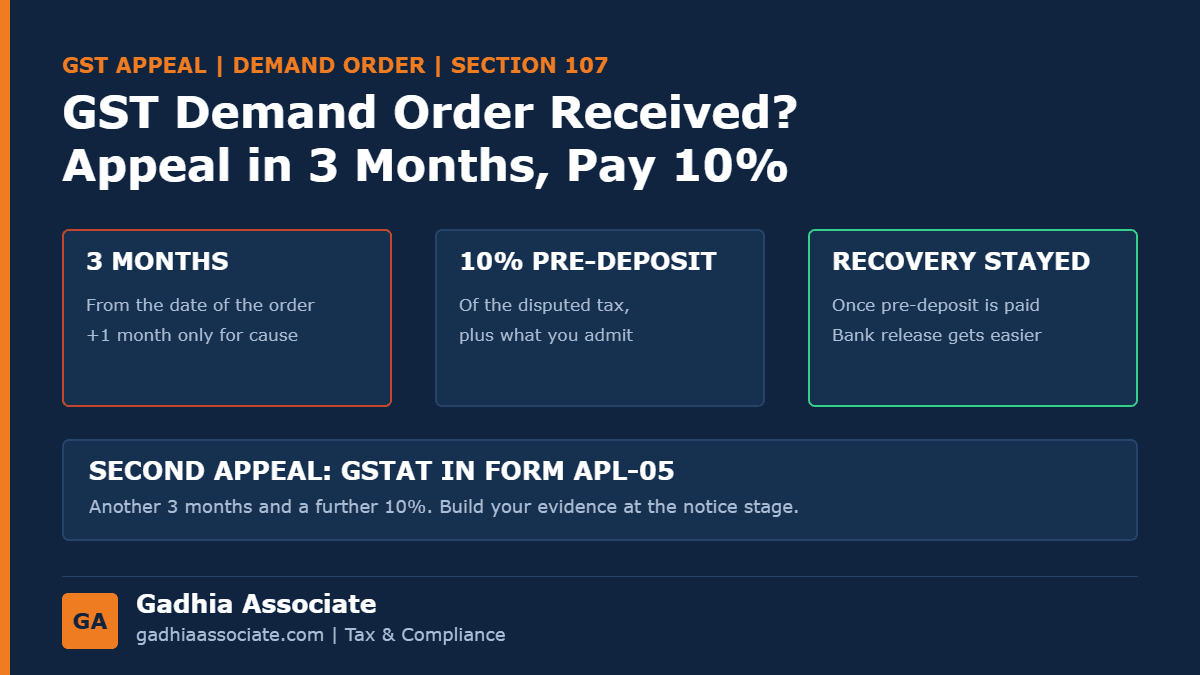
A GST demand order starts a three-month clock: appeal in APL-01, pay a 10% pre-deposit, and recovery of the balance is stayed while the appeal runs.
Most businesses discover this the hard way. The order arrives by email, the accountant files it away because "we already replied to the notice", and ten weeks later the bank calls to say the current account has been attached. By then, the choice is no longer about winning the argument. It is about getting the account released before salaries are due.
A demand order is not the end of the matter. It can be challenged, and in many cases it should be. But the appeal has a strict deadline, a cost to file, and rules about what evidence you can still produce. This article explains all three.
Short answer: Against a GST demand order (the summary comes in Form DRC-07), you can file a first appeal in Form GST APL-01 before the Appellate Authority under Section 107 of the CGST Act, within three months of the date the order was communicated. The Appellate Authority can allow one more month for a genuine reason, and nothing beyond that. To file, you pay any amount you accept in full, plus 10% of the tax you dispute. Once that pre-deposit is paid, recovery of the rest is treated as stayed until the appeal is decided. If the first appeal fails, a second appeal lies with the GST Appellate Tribunal (GSTAT) in Form APL-05 within three months, with a further 10% pre-deposit.
What exactly are you appealing against?
The show cause notice (DRC-01) proposes a demand. The order that follows decides it. The order is uploaded on the GST portal, with a summary in Form DRC-07, and it is the date of communication of this order that starts the appeal clock, not the date you happened to open it.
Demands for periods up to FY 2023-24 are raised under Section 73 (no fraud alleged) or Section 74 (fraud or suppression alleged). From FY 2024-25 onwards, both are covered by a single provision, Section 74A. The appeal route is the same for all of them.
If the order has an obvious mistake, such as a calculation error or a payment already made that was ignored, you can also ask for rectification under Section 161. But rectification does not stop the appeal clock. File the appeal in time even while rectification is pending.
How much time do you have to file a GST appeal?
- Normal time limit: three months from the date the order is communicated to you. An order communicated on 10 July must normally be appealed by 10 October.
- Extension: the Appellate Authority can condone a further one month if you show sufficient cause, such as illness or the order not reaching the right person.
- After four months: the Appellate Authority has no power to accept the appeal. Your remaining option is a writ petition before the High Court, which is slower, costlier and discretionary.
Missed deadlines are rarely a decision to give up. Usually the order went to an old email address, or to an accountant who had left, or the business assumed that replying to the notice was enough. Check the "Orders" section of your GST portal once a month, even if you think nothing is pending.
How much pre-deposit do you have to pay?
The appeal is admitted only after you pay:
- The full amount you admit: tax, interest, fee and penalty that you accept is correct.
- 10% of the disputed tax: calculated on the tax portion only. Interest and penalty are not included in this 10%.
Two special cases:
- Penalty-only orders: from 1 October 2025, an appeal against an order that demands only a penalty also needs a pre-deposit of 10% of that penalty.
- Detention of goods: an appeal against a penalty for goods detained in transit under Section 129 needs 25% of the penalty.
The pre-deposit can be paid from your electronic cash ledger, and CBIC has clarified that it can also be paid from your electronic credit ledger. When you file APL-01 on the portal, you select the ledger and the amount is debited as part of the filing.
An example: a Rajkot manufacturer receives an order for tax of Rs 18 lakh, interest of Rs 6 lakh and penalty of Rs 1.8 lakh. It accepts Rs 3 lakh of the tax as a genuine mistake and disputes the remaining Rs 15 lakh. To appeal, it pays the admitted Rs 3 lakh with interest on it, plus 10% of Rs 15 lakh, which is Rs 1.5 lakh. It does not pay 10% of the interest or penalty. The remaining demand is then stayed while the appeal is heard.
Does filing an appeal stop recovery?
Yes, once the pre-deposit is paid. Under Section 107(7), recovery of the balance is treated as stayed until the appeal is disposed of. On the portal, the demand in your electronic liability register is marked accordingly once the appeal is filed.
This is the practical reason to file quickly. If the department has already attached your bank account or started recovery, a properly filed appeal with the pre-deposit paid is the strongest ground for asking the officer to release it. Our article on a bank account frozen by the GST or income tax department explains that process.
How do you file APL-01 on the GST portal?
- Log in and go to Services, then User Services, then My Applications, and choose Appeal to Appellate Authority.
- Select the order you are appealing against. The order details and demand are picked up from the portal.
- Enter the admitted and disputed amounts for each head. The portal calculates the pre-deposit.
- Upload the statement of facts, the grounds of appeal and your supporting documents.
- Pay the pre-deposit from the cash or credit ledger, and sign with DSC or EVC.
- Download the acknowledgement in APL-02. This is your proof of filing.
Where the order is available on the portal, you no longer need to submit a separate certified copy. Keep the acknowledgement safe. Officers and banks will ask for it.
What makes an appeal succeed or fail?
Most appeals are decided on the record. What matters:
- Clear grounds. A specific ground such as "the credit was denied only because the supplier filed GSTR-1 late, though the invoice appears in the next month's GSTR-2B" beats ten generic lines about natural justice.
- Evidence that was already on record. Evidence that was not produced before the officer who passed the order is admitted in appeal only in limited situations. This is why the reply to the show cause notice matters so much.
- Hearing and natural justice. An order passed without giving you a personal hearing, when you asked for one or when an adverse decision was proposed, has a serious defect. Say so, with dates.
- Correct amounts. Check the tax, interest and penalty head by head. Many orders contain arithmetic errors or double-count the same invoice.
The Appellate Authority can confirm, modify or cancel the order. It cannot send the matter back to the officer for a fresh decision, so it has to decide it. The law asks for appeals to be decided within one year where possible.
What if the first appeal fails? The GSTAT route
The GST Appellate Tribunal is now functioning, and appeals are filed online in Form GST APL-05.
- Time limit: three months from the date the Appellate Authority's order is communicated. The Tribunal can condone a further delay of up to three months for sufficient cause.
- Pre-deposit: a further 10% of the tax still in dispute, in addition to what you paid at the first stage. This was reduced from 20% in November 2024.
- Fee: Rs 1,000 for every Rs 1 lakh of the amount in dispute, with a minimum of Rs 5,000 and a maximum of Rs 25,000.
After the Tribunal, appeals on questions of law go to the High Court. Very few cases need to go that far if the first two stages are handled properly.
A quick checklist when a demand order arrives
- Note the date of communication and mark the three-month deadline in your calendar the same day.
- Download the order, the notice, your reply and the hearing record from the portal.
- Separate what you genuinely owe from what you dispute. Paying the admitted part reduces interest.
- Check for errors that rectification can fix quickly, but file the appeal anyway.
- Arrange the pre-deposit, from the cash or credit ledger.
- Draft specific grounds, supported by documents that were before the officer.
- File APL-01, keep the APL-02 acknowledgement, and send it to the officer if recovery has started.
What we do for you
- Read the order with you and tell you honestly whether an appeal is worth filing
- Compute the admitted amount and the correct pre-deposit, head by head
- Draft the statement of facts and grounds of appeal, and file APL-01 within time
- Seek condonation where the order was communicated late or reached the wrong person
- Get attached bank accounts released once the appeal is filed
- Represent you at the personal hearing before the Appellate Authority
- Take the matter to the GST Appellate Tribunal where the first appeal fails
- Draft strong replies at the show cause notice stage, so the record is right before any order is passed
Gadhia Associate has been in practice since 2007 and has handled work for over 7,000 clients across Saurashtra and Gujarat, with a 5.0 Google rating from more than 100 reviews. Traders, manufacturers and exporters from Junagadh, Rajkot, Jetpur, Veraval, Porbandar and Amreli come to our Junagadh office, where same-day appointments are available. Appeals and hearings can equally be handled online for businesses anywhere in India. Fixed-fee and monthly plans are available.
Received a GST demand order? The three-month clock is already running. Call or WhatsApp +91 82005 28355, or bring the order to our Junagadh office. The first consultation is free.
Frequently asked questions
What is the time limit to file a GST appeal against a demand order?
Three months from the date the order is communicated, with a further one month allowed by the Appellate Authority for sufficient cause. Beyond four months, the appeal cannot be admitted.
How much pre-deposit is required for a GST appeal?
The full amount you admit, plus 10% of the disputed tax. For penalty-only orders, 10% of the penalty. At the GSTAT stage, a further 10% of the disputed tax.
Can I pay the GST pre-deposit from input tax credit?
Yes. CBIC has clarified that the pre-deposit can be paid from the electronic credit ledger as well as the cash ledger.
Does filing APL-01 stop recovery of the demand?
Yes. Once the pre-deposit is paid, recovery of the balance is treated as stayed until the appeal is decided.
Can I submit new documents in the appeal?
Only in limited situations, such as where the officer refused to accept them or you were prevented from producing them for a sufficient reason. Put your evidence on record at the notice stage.
Is a rectification application enough instead of an appeal?
No. Rectification fixes apparent errors only, and it does not extend the appeal deadline. File the appeal in time.
Position as of 25 September 2026. Time limits, pre-deposit rules, portal procedures and GSTAT practice change through amendments and notifications, and every case turns on its own facts and the period involved. Take advice on your order before you decide.