Employee or Consultant? TDS Under Section 192 vs 194J, the PF and Gratuity Risk, GST, and How to Get the Paperwork Right
A Rajkot engineering unit had fourteen people on the payroll and nine "consultants." The consultants came at 9 in the morning, left at 7, took Sunday off, used company laptops, and had been raising the same monthly invoice for four years. The owner had done this on a friend's advice, to keep PF and ESIC out of the picture. Then an EPFO inspection came. The nine were held to be employees, and the unit paid provident fund dues for four years, plus interest and damages. The saving of four years was gone in one order.
Calling someone a consultant does not make them one. The label on the paper matters far less than how the person actually works.
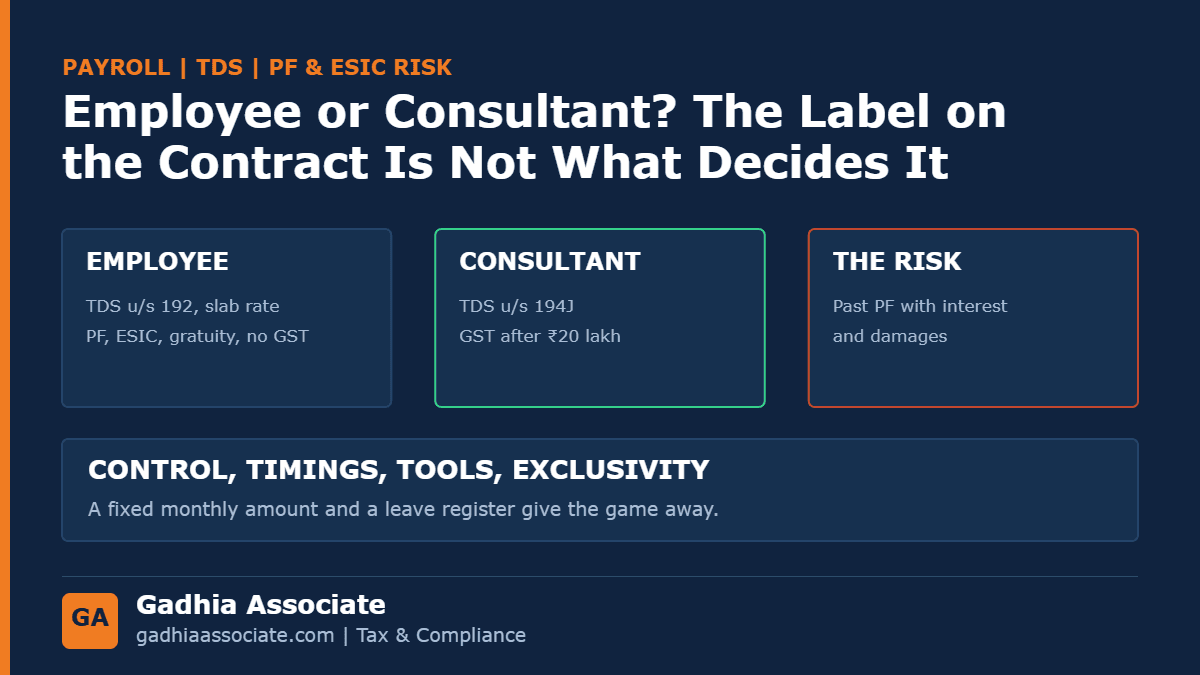
Short answer: If a person works under your control, at your premises, on your timings, with your tools, and only for you, the law treats them as an employee whatever the contract says. Then TDS is under Section 192 at slab rates, PF, ESIC and gratuity apply, and there is no GST. A genuine consultant works independently, may serve other clients, invoices for output rather than attendance, attracts TDS under Section 194J, and charges GST once turnover crosses Rs 20 lakh. Choose one and make the paperwork match it. The half-and-half arrangement is what gets caught.
What actually decides the answer?
No single factor settles it. Inspectors and courts look at the substance of the relationship:
- Control: do you direct how the work is done, not just what result you want?
- Timings and attendance: fixed hours, biometric punching, leave applications
- Tools and place: your laptop, your desk, your email ID, your uniform
- Exclusivity: can the person work for others, or is their whole income from you?
- Integration: is the person part of the team, in the organisation chart, attending staff meetings?
- Payment pattern: a fixed monthly amount that never varies looks like salary, whatever the invoice says
- Right to substitute: a true contractor can send someone else to do the work
If most answers point one way, that is your answer.
The tax difference, side by side
If the person is an employee
- TDS: Section 192, at slab rates on estimated annual salary, deducted every month
- Deductions available to them: standard deduction of Rs 75,000 under the new regime, and employer contribution to provident fund within limits
- GST: none. Services by an employee to the employer in the course of employment are outside GST
- Other laws: provident fund, ESIC, gratuity, bonus, leave, and the new labour codes apply
If the person is a consultant
- TDS: Section 194J, generally 10% on professional fees, with a lower rate for certain technical services. The threshold is Rs 50,000 a year. Where the work is contractual rather than professional, Section 194C applies at 1% or 2%
- Their taxation: business or professional income, with genuine expenses deductible, or the presumptive scheme where eligible. No standard deduction
- GST: registration once turnover crosses Rs 20 lakh in a year, and 18% GST on the invoice. Your company can usually claim that as input tax credit
- Other laws: no PF, no ESIC, no gratuity, if the relationship is genuinely independent
What it costs when the classification is wrong
This is the part owners underestimate. If consultants are later held to be employees:
- Provident fund for past years, both the employee and employer share, because the employer cannot recover the employee share afterwards
- Interest and damages on the delayed PF, which together can approach the amount of the dues themselves
- ESIC contributions for anyone within the wage limit, with interest
- Gratuity for anyone who completed five years
- TDS short deduction under Section 192, with interest, and the payments can be treated as short-deducted for disallowance in your income tax assessment
- Labour law exposure, including notice pay and termination claims from a person you thought was a vendor
The reverse mistake also costs money. Treating a genuine consultant as an employee means deducting PF on someone who did not want it, and losing the input tax credit you would have got on their GST invoice.
The middle ground that is safest
Many small businesses have both, and there is nothing wrong with that. What matters is keeping the two clearly separate:
- Employees: appointment letter, salary structure, attendance, leave record, PF and ESIC from day one, Form 16 at year end.
- Consultants: a written agreement describing deliverables, not duties. Invoices with GST where applicable, raised by them, varying with work done. No attendance record, no leave approval, no company email ID where avoidable, no performance appraisal. Payment against invoice, not on the salary day.
Two habits give the game away more than anything else: paying consultants on the same day as salaries, and asking them to apply for leave. Fix those two first.
What about part-time and retainer staff?
A part-time accountant who comes twice a week, works for four other businesses, uses their own laptop and invoices monthly is a consultant. A part-time person who reports only to you, on fixed days, doing whatever you assign, is an employee working part time. Part-time employees are covered by PF and ESIC in the same way as full-time ones.
Does it change under the new labour codes?
The labour codes bring a common definition of wages, where basic pay and dearness allowance must generally be at least half of total remuneration. For employees, this raises the base on which provident fund and gratuity are worked out, which raises cost. That makes classification an even more important decision than before, and also makes it more tempting to misclassify. Fixed-term employment is the legitimate route for short projects, with the same benefits but a defined end date.
What the person themselves should consider
If someone is choosing between a salary of Rs 12 lakh and a consultancy of Rs 12 lakh, the consultancy is not automatically better:
- No standard deduction, no PF, no gratuity, no employer health insurance
- GST registration, monthly filings and 18% on invoices once past Rs 20 lakh
- Advance tax to pay in four instalments, instead of TDS handled by the employer
- Against that: genuine expenses can be claimed, and the presumptive scheme can make the effective tax lower where it applies
For most people, the right answer depends on their expenses and whether they have other clients. Work it out on numbers, not on a feeling that consultancy sounds better.
A quick self-check for employers
- Does any consultant's payment stay exactly the same every month?
- Does any consultant record attendance or apply for leave?
- Has any consultant worked only for you for more than two years?
- Do you have a written agreement for each one, signed and current?
- Are their invoices raised by them, with GST where turnover requires it?
- Would you feel comfortable if the EPFO inspector read the contract and then interviewed the person?
More than two uncomfortable answers means the arrangement needs fixing, preferably before an inspection, when it is still your choice.
What we do for you
- Review your current staff and consultant list and flag the ones at risk
- Draft proper consultancy agreements and employment appointment letters
- Design a salary structure that works under the new wage definition
- Set up PF and ESIC registration and monthly filing, or correct past defaults
- Fix TDS deductions between Sections 192, 194J and 194C, and file corrections
- Advise consultants on GST registration, invoicing and presumptive taxation
- Handle EPFO and ESIC inspections, notices and assessments
- Run your monthly payroll, TDS returns and Form 16 issuance
Gadhia Associate has been in practice since 2007 and has handled work for over 7,000 clients across Saurashtra and Gujarat, with a 5.0 Google rating from more than 100 reviews. Manufacturers, traders and professional firms from Junagadh, Rajkot, Veraval, Gir Somnath, Amreli and Porbandar come to our Junagadh office, where same-day appointments are available. Payroll and TDS work can equally be handled digitally for businesses anywhere in India. Fixed-fee and monthly plans are available.
Not sure whether your team is correctly classified? Send us your list and we will tell you where the risk is. Call or WhatsApp +91 82005 28355. The first consultation is free.
Frequently asked questions
Can I hire someone as a consultant to avoid PF?
Only if the relationship is genuinely independent. If the person works under your control on fixed timings, the EPFO can treat them as an employee and recover past dues with interest and damages, whatever the contract says.
What is the TDS rate for a consultant?
Professional fees generally attract 10% under Section 194J, with a lower rate for certain technical services, once payments cross Rs 50,000 in a year. Contractual work falls under Section 194C at 1% or 2%.
Does a consultant have to charge GST?
Only after crossing Rs 20 lakh of turnover in a financial year for services. Below that, no GST registration is needed, though some choose to register to work with larger clients.
Is there GST on salary?
No. Services by an employee to the employer in the course of employment are outside the scope of GST.
Can the same person be an employee and a consultant in the same company?
It is possible for clearly separate work, but it invites questions and is usually more trouble than it is worth. Pick one relationship and document it.
Does a consultant get gratuity?
No, if the relationship is genuinely independent. If the person is later held to be an employee and has completed five years, gratuity becomes payable.
Position as of 23 September 2026. TDS rates, thresholds and labour law positions change through amendments and notifications, and the Income-tax Act, 2025 has renumbered the income tax provisions from 1 April 2026; the older section numbers are used here because that is how people still search for them. Classification depends on the facts of each arrangement. Take advice on your own case before restructuring.