Private Family Trust Taxation in India: Specific vs Discretionary Trust, When the Maximum Marginal Rate Applies, and How One Clause in the Deed Decides Your Tax
Two brothers from Junagadh sat across from us a few months ago with a trust deed their earlier advisor had drafted. The trust held two shops and some shares of the family company, and the rent and dividends were meant to support their mother and their children. It all looked sensible. Then we read clause 7: "The trustees may distribute the income among the beneficiaries in such proportion as they deem fit." That one line had turned the trust into a discretionary trust, and the family had been paying tax at the maximum marginal rate on every rupee of rent for three years.
The family was not doing anything wrong. They simply did not know that how a trust deed is worded decides how the trust is taxed. This article explains that, in plain language.
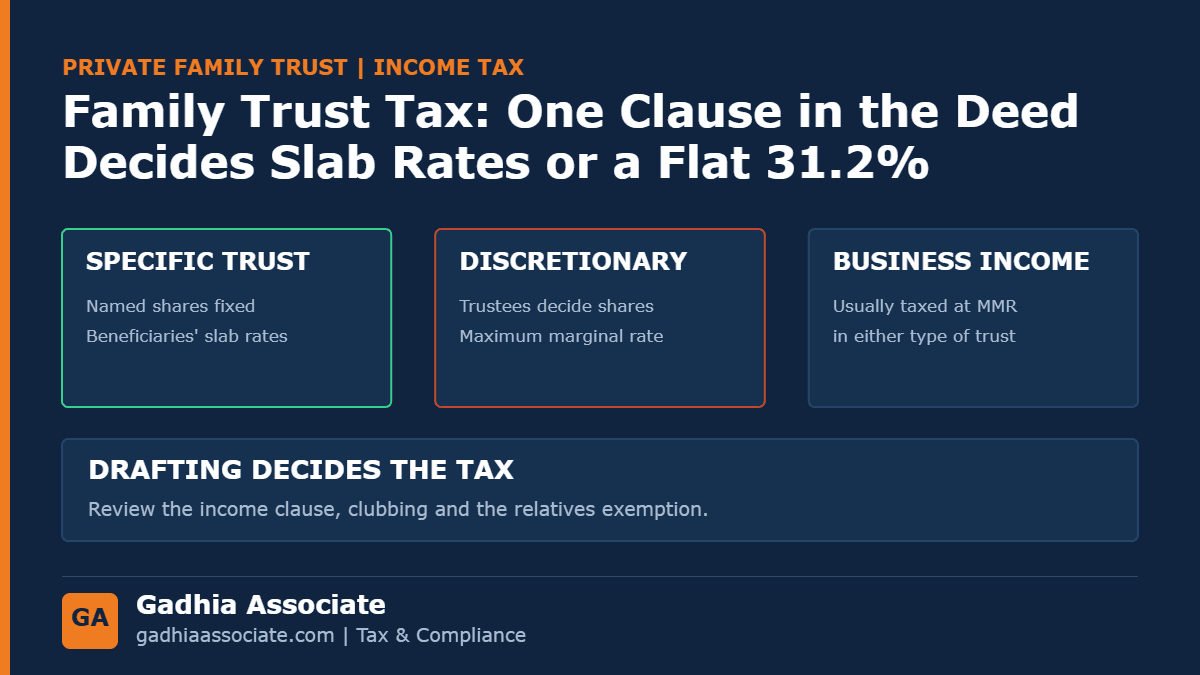
Short answer: A private family trust in India is taxed through its trustees. If the deed names the beneficiaries and fixes each person's share, it is a specific trust, and income is taxed at the beneficiaries' own slab rates. If the trustees have discretion over who gets how much, it is a discretionary trust, and income is usually taxed at the maximum marginal rate, which means 30% plus cess (and surcharge where income is high). Business income in a trust is taxed at the maximum marginal rate in most cases, whatever the wording. A few exceptions exist, and clubbing rules can pull income back to the settlor. The drafting has to be right from day one.
How is a private trust taxed at all?
A trust is not a separate taxpayer the way a company is. Under the Income-tax Act the trustee is treated as a representative assessee of the beneficiaries (earlier Sections 160 to 164). The trustee takes a PAN in the trust's name, files the return (usually ITR-5), and pays tax on the trust's income. What changes is the rate, and that depends on the type of trust.
What is a specific trust?
A trust is specific (also called determinate) when the deed clearly names who the beneficiaries are and what share of income each one gets. For example: "Income to be paid in equal shares to my wife Meena, my son Raj and my daughter Riya."
For a specific trust, tax is charged in the trustee's hands "in the like manner and to the same extent" as it would be charged on each beneficiary. In practice, each beneficiary's share is taxed at that beneficiary's slab rates. A homemaker mother, a student grandchild or a retired parent with little other income can receive their share with little or no tax. The department can also assess the beneficiaries directly instead of the trustee.
What is a discretionary trust, and why does it cost more?
A trust is discretionary when the beneficiaries' shares are not fixed. Common wording that makes a trust discretionary:
- "In such proportion as the trustees may decide"
- "To any one or more of the beneficiaries, at the trustees' discretion"
- "The beneficiaries shall include such other persons as the trustees may add"
- A class of beneficiaries described loosely, such as "my descendants," without clear shares
Discretion is useful. It lets trustees respond to a child's illness, a wedding or a business loss. But the tax law charges the income of a discretionary trust at the maximum marginal rate (earlier Section 164). The maximum marginal rate is the highest slab rate, 30%, plus 4% cess. In April 2025 a Special Bench of the Mumbai Tribunal held in the Araadhya Jain Trust case that surcharge should follow the income slabs in the Finance Act rather than automatically applying the highest surcharge rate. So a trust with modest income pays 31.2%, and surcharge comes in only as income crosses the usual thresholds.
A simple example
Say a trust earns Rs 12 lakh a year in rent and dividends. The beneficiaries are a mother with no income, a son who is salaried and pays tax at 30%, and a daughter in college.
- As a discretionary trust: tax at 30% plus cess on Rs 12 lakh, about Rs 3.74 lakh a year.
- As a specific trust with fixed shares: each share is taxed at that beneficiary's rates. The mother's and daughter's shares may attract little or no tax. Only the son's share bears tax at his high rate.
Over ten years, that difference easily runs into several lakh rupees. It comes entirely from a few sentences in the deed.
Are there exceptions where a discretionary trust is taxed at normal rates?
Yes. The law gives relief in a few situations. The two that matter most for families are:
- None of the beneficiaries has taxable income. If no beneficiary has income above the basic exemption limit and none is a beneficiary of any other trust, the trust is taxed at normal slab rates instead of the maximum marginal rate. This rarely lasts long, because children grow up and start earning.
- The trust is created by a will. A trust declared by a will, where it is the only trust so declared by that person, is taxed at normal rates. This is why many families use a testamentary trust in the will, alongside or instead of a trust created during their lifetime.
There is also an older exception for trusts created before 1 March 1970 for dependent relatives, which rarely applies to new planning.
What happens if the trust runs a business?
This is where many family trusts get surprised. If a trust has business income, the tax law generally charges it at the maximum marginal rate even if it is a specific trust (earlier Section 161(1A)). The main exception is a trust declared by will exclusively for relatives who were dependent on the testator. So a trust that becomes a partner in the family firm, or runs a shop directly, can end up paying more than the family would have paid holding the business themselves. Holding property, shares and investments in a trust is usually more tax-efficient than running a business through one.
Is transferring property into the trust taxable?
Usually not, if it is done correctly:
- Capital gains: transferring an asset by way of gift to an irrevocable trust is not treated as a transfer for capital gains purposes. The trust takes over the settlor's cost and holding period, so nothing is lost when the trust eventually sells.
- Gift tax in the trust's hands: property received by a trust created solely for the benefit of the settlor's relatives is exempt from tax as a gift (under the gift provisions, earlier Section 56(2)(x)). Relatives include spouse, children, parents, siblings and their spouses, and lineal ascendants and descendants. If even one beneficiary is not a "relative," this exemption can be lost.
- Stamp duty: a trust of immovable property must be created by a registered deed, and stamp duty applies to the settlement. In Gujarat this can be significant, so the order and method of settlement need planning. Many families settle a small sum first and transfer property later in the most efficient way available.
The clubbing trap most people miss
If you settle your own property in a trust for your wife, the income is not taxed in the trust or in her hands. It comes back to you. The clubbing provisions (earlier Section 64) tax the settlor on income from assets transferred, directly or through a trust, for the benefit of a spouse or a daughter-in-law, and income arising to a minor child is also clubbed with the parent. So a trust with a spouse or a minor child as beneficiary, funded by the other spouse or parent, may not save any tax on that part of the income. It can still be the right structure for succession and protection, but the tax figures must be worked out honestly before you sign.
Revocable or irrevocable?
If the settlor keeps the power to take the property back, the trust is revocable, and all its income is taxed in the settlor's hands. Most families who want control choose an irrevocable trust with themselves as a trustee. You keep control through trusteeship, not through ownership, and the tax and succession benefits stay intact.
What does a well-drafted family trust deed include?
- Names of the settlor, trustees and each beneficiary, with relationships stated
- Fixed shares of income for each beneficiary if you want specific-trust treatment
- Clear treatment of corpus: who gets the capital, and when
- A mechanism for future beneficiaries such as grandchildren that does not accidentally make the trust discretionary
- Succession of trustees when a trustee dies or resigns
- Powers of trustees to invest, lease, borrow and vote shares
- An irrevocability clause, where that is the intention
- Restrictions that keep all beneficiaries within the definition of "relative," so the gift exemption applies
We already have a trust. Can it be fixed?
Often, yes. Depending on the deed, trustees may have power to vary it, or beneficiaries can agree to a deed of rectification or a fresh arrangement. Past years cannot be changed, but the next year can. If your trust has been paying 31.2% on rent, the first step is to have the deed reviewed and the last three returns checked.
What we do for you
- Review your existing trust deed and tell you whether it is specific or discretionary in the eyes of the tax law
- Calculate the tax under each option on your family's actual income and beneficiaries
- Draft or restructure a private family trust deed with a clear tax outcome
- Plan the transfer of property and shares into the trust, including stamp duty and capital gains
- Advise on holding family company shares through a trust for smooth succession
- Obtain PAN for the trust, open its bank account and set up its books
- File the trust's income tax return every year and handle any notices
- Coordinate the trust with your will so both work together
Gadhia Associate has been in practice since 2007 and has handled work for over 7,000 clients across Saurashtra and Gujarat, with a 5.0 Google rating from more than 100 reviews. Business families from Junagadh, Rajkot, Veraval, Gir Somnath, Amreli and Porbandar come to our Junagadh office, where same-day appointments are available. Deed reviews can equally be done digitally for families anywhere in India. Fixed-fee and monthly plans are available.
Send us your trust deed, or tell us what you want to protect, and we will explain the tax position in one meeting. Call or WhatsApp +91 82005 28355. The first consultation is free.
Frequently asked questions
What is the tax rate for a private family trust in India?
A specific trust is taxed at the beneficiaries' own slab rates. A discretionary trust is generally taxed at the maximum marginal rate of 30% plus cess, with surcharge following the income slabs. Business income is usually taxed at the maximum marginal rate in either case.
How do I know if my trust is specific or discretionary?
Read the income clause. If each beneficiary is named and their share is fixed, it is specific. If the trustees decide who gets how much, or can add beneficiaries, it is discretionary.
Is a family trust required to file an income tax return?
Yes. The trust needs its own PAN and files a return, usually in ITR-5, through its trustees.
Is putting my house into a family trust taxable?
Transferring an asset by gift to an irrevocable trust is not a transfer for capital gains, and the trust is exempt from gift tax if it exists solely for your relatives. Stamp duty on the registered deed still applies.
Can I be a trustee and a beneficiary of my own trust?
You can be a trustee. Being both the settlor and a beneficiary needs care, because the clubbing and revocability rules can bring the income back to you.
Does a trust avoid probate?
Yes. Property held in a trust passes according to the trust deed, not through your will, so probate or succession certificates are not needed for those assets.
Position as of 22 September 2026. Rates, exemptions and tribunal positions can change, and the Income-tax Act, 2025 has renumbered the income tax provisions from 1 April 2026; the section numbers quoted follow the 1961 Act because that is how people still search for them. Trust taxation depends heavily on the exact wording of the deed. Confirm the current position for your trust before acting.