Missed the ITR Deadline? Belated Return, Late Fee Under Section 234F, and When ITR-U Is Your Only Option Left
The 31st of July came and went. You meant to file. The Form 16 was lying in your drawer, or the accounts were not ready, or you simply forgot. Now it is September, a friend has told you there is a penalty, and you are not sure if the portal will even let you file. Maybe you are also wondering if the department will send you something. That worry is normal, and the position is usually far less frightening than people imagine.
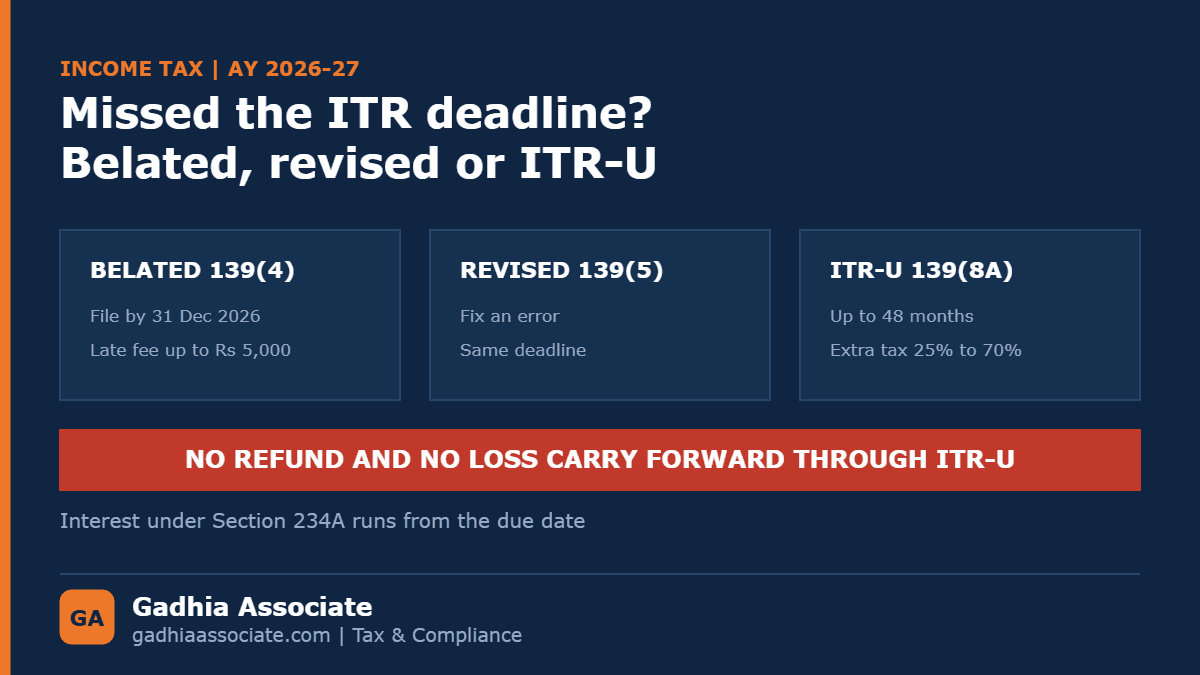
Short answer: You can still file. For AY 2026-27 a belated return under Section 139(4) can be filed up to 31 December 2026. It costs a late fee under Section 234F of up to Rs 5,000, plus 1% a month interest under Section 234A on unpaid tax. Miss 31 December too, and ITR-U is what is left.
What exactly is a belated return, and is it different from a revised return?
Yes, they are different things, and mixing them up costs people money. There are four kinds of returns you could be filing right now. Find yours.
- Belated return, Section 139(4). You never filed at all. You file now, late. Last date for AY 2026-27 is 31 December 2026.
- Revised return, Section 139(5). You did file, but something in it is wrong. You file a corrected version. We have written separately about mistakes in a filed ITR, and that piece covers the revised return mechanics step by step, so we will not repeat it here.
- Updated return, Section 139(8A), in Form ITR-U. The normal windows have closed. This is the late door, open for 48 months, and it costs extra tax.
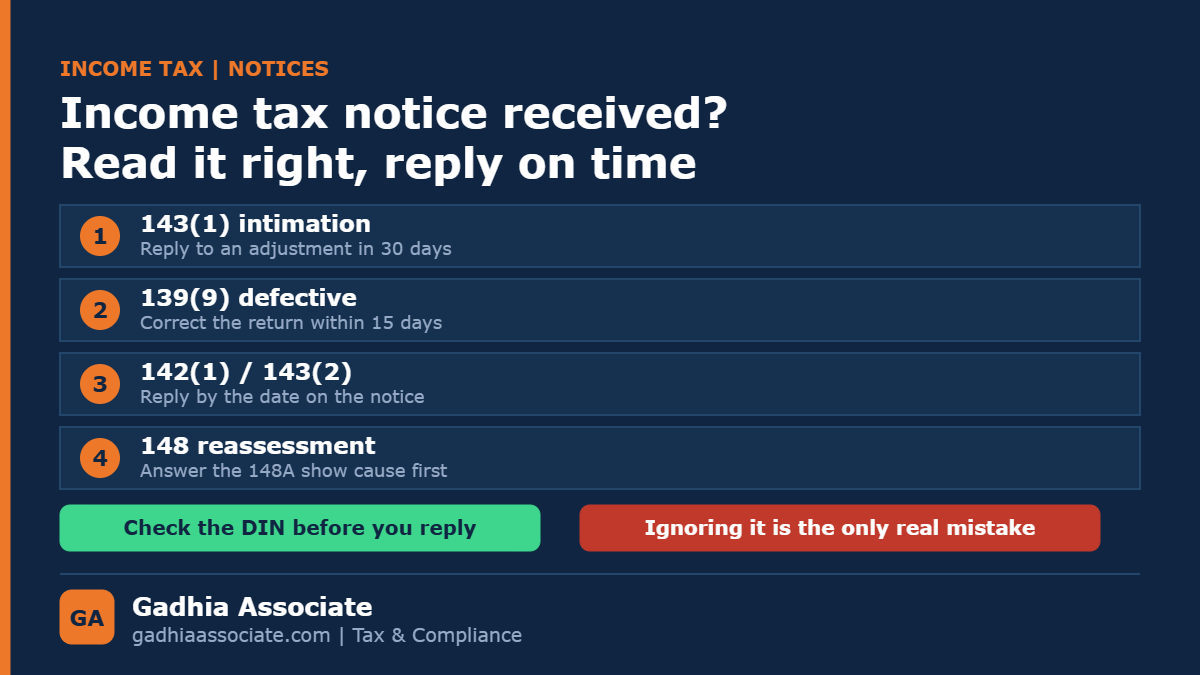
- Return filed against a notice. The department has asked you to file, usually under Section 142(1) or 148. This is not voluntary. Different rules, different pressure.
Most people reading this are in the first box. If it is still 2026 and you have not filed, a belated return is your route.
Were the AY 2026-27 due dates extended by CBDT?
As far as we can see, no. For AY 2026-27 the due date for a salaried person or anyone else not under audit was 31 July 2026. For an audit case it is 31 October 2026. Last year the department pushed the date to mid-September because the utilities came out late. This year they came out on time and no similar extension has been announced. A few sources also mention 31 August 2026 for business income without audit. That is not the common reading, so check your own due date on the portal before you assume anything.
What is the late fee 234F on a missed ITR deadline?
It is a flat fee, not a percentage. Rs 5,000 if your total income is above Rs 5,00,000. Rs 1,000 if your total income is Rs 5,00,000 or less. If your income is below the basic exemption limit, there is no fee at all, unless you fall into one of the categories that must file a return anyway.
Then there is interest under Section 234A. That is 1% for every month or part of a month on the tax still unpaid, counted from the due date until you file. If your TDS already covered everything and nothing is payable, 234A does not bite. Advance tax shortfalls attract separate interest under Sections 234B and 234C.
Illustrative example (round numbers, for understanding only). Mr Patel, a salaried man in Junagadh. Total income Rs 7,20,000. After TDS, Rs 18,000 of tax is still payable. He files on 10 November 2026. Late fee under Section 234F: Rs 5,000. Interest under Section 234A for August, September, October and November, being four part months at 1%: about Rs 720. He pays roughly Rs 5,720 more than he would have on 31 July. Your figures will differ.
The fee does not grow the longer you wait. The interest does.
Not sure what your late filing will cost? Call or WhatsApp +91 82005 28355 for a free first consultation. We will work out your exact fee and interest before you pay anything.
What do I lose by filing a belated return?
Three things, and the first one hurts businesses most.
Losses stop travelling forward. File after the due date and you cannot carry forward business losses or capital losses to set off against future profits. Speculative and specified business losses go the same way. Two survive: loss under the head house property, and unabsorbed depreciation. So a trader in Rajkot who lost Rs 4,00,000 in the year and files in November has, in practice, thrown that set-off away.
The regime choice. The option to be taxed under the old regime under Section 115BAC has to be exercised in a return filed by the due date. File belated and you are generally stuck with the new regime for that year. For a business or professional, the option runs through Form 10-IEA, which itself has to be filed by the 139(1) date. Sources differ on how strictly this plays out for a salaried person versus a business, and a few appellate decisions have taken a softer view. Get your own case checked rather than assuming the deductions will hold.
Timing. A belated return is processed later. Refunds land later. That is the quiet cost nobody mentions.
Will I still get my income tax refund if I file late?
Yes. A refund is not forfeited because the return is belated. Pre-validate your bank account on the portal and e-verify the return, otherwise nothing moves.
The catch is interest. Under Section 244A, when the return goes in after the due date, interest on the refund is normally reckoned from the date you actually filed, not from 1 April. Delay eight months and you have handed the government eight months of free money. On a Rs 60,000 refund that is real.
One thing we see repeatedly: people with a refund due assume there is no hurry because they are owed money. The late fee under 234F still applies if your income crosses the threshold, refund or no refund.
Refund stuck, or not sure if you are even due one? Send your Form 16 and PAN on WhatsApp to +91 82005 28355. We will tell you where it stands, free of charge.
What is an ITR-U updated return and when is it my only option left?
Once 31 December 2026 passes, the belated door shuts for AY 2026-27. After that the updated return under Section 139(8A), filed in Form ITR-U, is what remains.
The Finance Act 2025 widened this window from 24 months to 48 months from the end of the relevant assessment year. So for AY 2026-27 you have until roughly 31 March 2030. The price rises the longer you sit on it. Additional tax, on top of the tax and interest due, runs at:
- 25% if filed within 12 months from the end of the assessment year
- 50% within 24 months
- 60% within 36 months
- 70% within 48 months
Now the hard limits, and this is where people get a shock. ITR-U cannot be used to claim a refund or increase one. It cannot be used to reduce your tax liability. It has to result in more tax going to the government, not less. It also cannot be filed where a search under Section 132 or a survey under Section 133A has taken place, and in some other restricted situations. On whether an updated return can now report a loss, the position after the 2025 amendment is read differently by different commentators. Do not plan around it without confirming.
Put plainly: if you are owed a refund and you miss 31 December 2026, that refund is very likely gone. That single sentence is the reason to file before December rather than in January.
What happens if I simply never file?
The department does not forget. It has your TDS, your bank interest, your property registrations and your share sales sitting in the AIS.
First comes a nudge, often an SMS or an e-campaign email. Then a notice under Section 142(1) asking you to file. Ignore that and the Assessing Officer can complete a best judgment assessment under Section 144, where he estimates your income himself. That estimate is rarely generous.
Above that, Section 276CC allows prosecution for wilfully failing to file. There is a protection: no prosecution where the tax payable after TDS and advance tax does not exceed Rs 10,000. For a shop owner in Veraval or Porbandar with real turnover, that protection runs out quickly. Prosecution is uncommon, but it is not theoretical, and the Supreme Court has held that filing after the due date does not by itself wipe out the offence.
Which one applies to me?
- Never filed for AY 2026-27, and today is before 31 December 2026: belated return, Section 139(4).
- Filed, but got a figure wrong, and today is before the revised return deadline: revised return, Section 139(5).
- Never filed, and 31 December 2026 has gone: ITR-U under Section 139(8A), and no refund through it.
- Have a notice in hand: reply to the notice first. Do not file a stray return and hope it covers you.
- Running a business and also behind on GST registration or returns: sort both together. Our piece on GST registration documents and biometric Aadhaar verification covers that side.
What we do for you
- Check your AIS, Form 26AS and TIS line by line and match them against your bank and broker statements
- Work out the exact late fee under Section 234F and interest under Sections 234A, 234B and 234C before you pay
- Tell you honestly whether a belated return or ITR-U is your route, and what each will cost
- Prepare and file the return, including capital gains, house property and business income
- Pay the self-assessment tax through the correct challan and attach it properly
- E-verify and confirm the acknowledgement in writing to you
- Track processing and chase the refund until it reaches your bank
- Reply to any 143(1)(a) adjustment or defective return notice that follows
Gadhia Associate has been in practice since 2007 and has served over 7,000 clients across Saurashtra and Gujarat, with a 5.0 Google rating from more than 100 reviews. Clients come from Junagadh, Gir Somnath, Amreli and Porbandar, and our Junagadh office gives same-day appointments. Everything can also be done digitally for clients anywhere in India. We work on fixed-fee and monthly plans, so you know the cost upfront.
31 December 2026 is the last date for a belated return. Call or WhatsApp +91 82005 28355 today and book your free first consultation, or walk into our Junagadh office the same day.
Frequently asked questions
Can I still file my ITR for AY 2026-27 in September 2026?
Yes. A belated return under Section 139(4) can be filed until 31 December 2026 for AY 2026-27. You will pay a late fee under Section 234F of Rs 5,000, or Rs 1,000 where total income is Rs 5,00,000 or less, plus 1% a month interest under Section 234A on any unpaid tax. The portal accepts belated returns normally.
How much is the late fee under Section 234F?
Rs 5,000 where total income exceeds Rs 5,00,000, and Rs 1,000 where it does not. Where total income is below the basic exemption limit, no fee applies, unless you fall within one of the categories required to file a return regardless of income. The fee is flat and does not increase with further delay, but Section 234A interest keeps accruing every month.
Can I claim an income tax refund in a belated return?
Yes, a refund can still be claimed and paid on a belated return. E-verify the return and pre-validate your bank account, or it will not be released. Interest under Section 244A is usually calculated from the date of filing instead of from the start of the assessment year, so a long delay reduces the interest you receive on your own money.
What is the difference between a belated return and an ITR-U updated return?
A belated return under Section 139(4) is a normal return filed after the due date, up to 31 December of the assessment year, and a refund can be claimed. ITR-U under Section 139(8A) is filed after that window, within 48 months, with additional tax of 25% to 70%. ITR-U cannot claim a refund or reduce tax.
Do I lose my business loss if I file after 31 July 2026?
Yes, in most cases. Business losses, capital losses, speculative losses and specified business losses cannot be carried forward unless the return is filed by the Section 139(1) due date. Loss under the head house property and unabsorbed depreciation are the two exceptions and can still be carried forward in a belated return. Have your set-off position reviewed before filing.
Position as of September 2026. Dates, fees and time limits change through CBDT notifications, and the Income-tax Act, 2025 has renumbered the income tax provisions with effect from 1 April 2026, so the section numbers quoted here follow the 1961 Act because that is how people still search for them. Confirm the current position before acting.