Income Tax Notice Received? How to Read Section 143(1), 139(9), 142(1) and 148 Notices and Reply Correctly
An email lands from the Income Tax Department. Or an SMS. There is a section number in it, a date, and a lot of words you do not use in daily life. Your stomach drops. Is this serious? Is somebody coming to your shop? Is it even real, or one of those fake messages? You show it to a friend and he says something that worries you more. Before you do anything, read the next paragraph.
Short answer: Most income tax notices are automatic, computer generated, and answerable in a few days with the right papers. A notice under Section 143(1) is usually just a processing summary. Ignoring it is the only real mistake. Check the Document Identification Number first, read the section number, note the reply date, and respond on the portal.
Is this income tax notice genuine or a fake?
Check this before anything else. Every notice, order, letter or summons issued by the department on or after 1 October 2019 must carry a Document Identification Number, a DIN. A communication without a valid DIN is treated as never having been issued at all. It is not a valid notice.
Go to the income tax e-filing portal and use the Authenticate notice or order issued by ITD service. It is available before you even log in. Enter the DIN and the date, or your PAN and the details asked. If the portal says the document exists, it is real. If it does not, you are looking at a fake, and you should not click any link in it or send anybody money.
Real notices also appear inside your own portal account under Pending Actions, e-Proceedings. A notice that only exists in your email and nowhere on the portal deserves suspicion.
What does a notice under section 143(1) mean?
It means your return has been processed. Nothing more dramatic. It is called an intimation, not a notice, and most people get one every year.
It shows two columns side by side: what you declared, and what the system computed. If both match, you can file it away. If there is a refund, it says so. If there is a demand, it says that too.
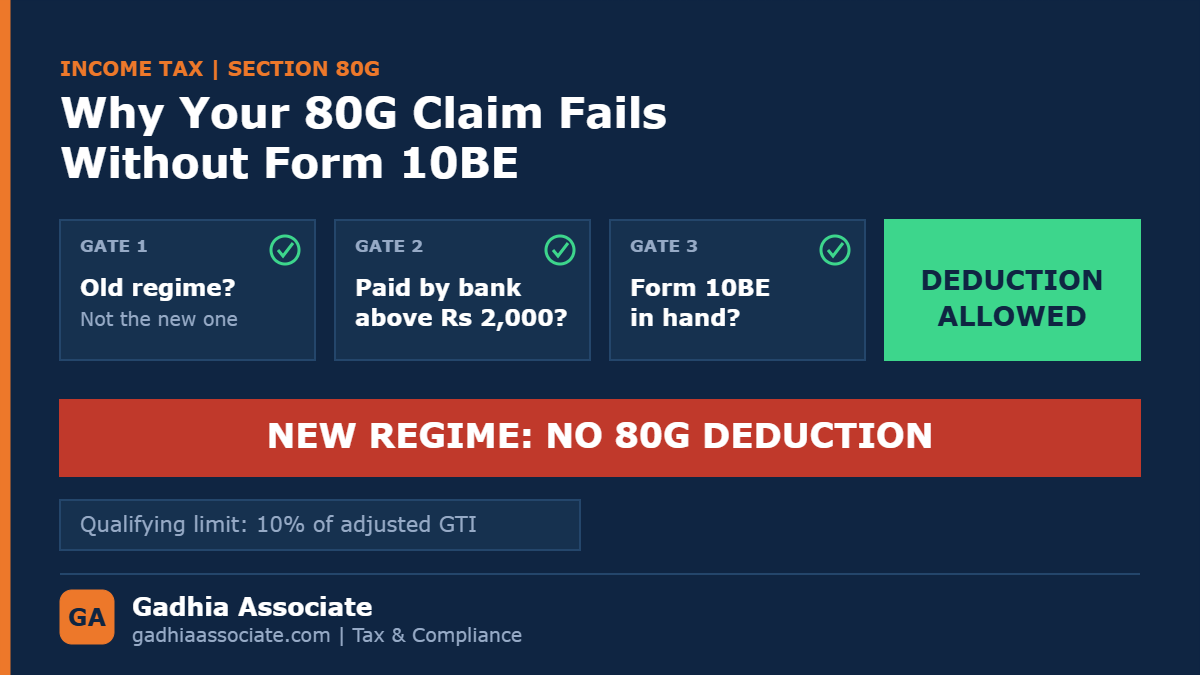
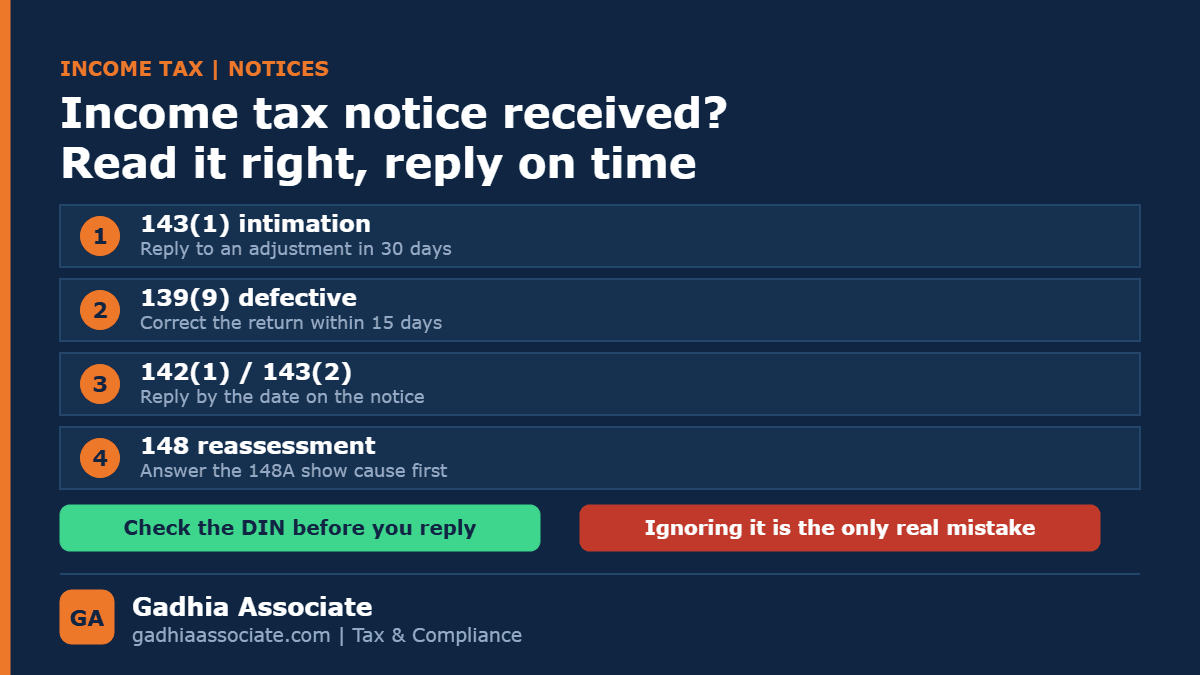
Before making an adjustment under Section 143(1)(a), the department has to tell you and give you 30 days to respond. The adjustments allowed are limited: an arithmetical error, an incorrect claim apparent from the return itself, a loss or deduction that is disallowed, and income showing in Form 26AS or the AIS that is missing from your return. Wrongly claimed deductions are a frequent trigger here, and donation claims are a classic example. Our article on claiming 80G deduction on donations explains what proof you need to hold.
The intimation has to be issued within nine months from the end of the financial year in which the return was furnished. If you do not reply to a 143(1)(a) proposal within 30 days, the adjustment is made anyway and you get a demand.
What is a defective return 139(9) notice?
It means the return you filed is incomplete, so the department will not treat it as a proper return until you fix it. Common causes are a missing balance sheet or profit and loss account where one was required, income shown without the corresponding tax paid, a wrong ITR form, or an audit report that was not filed.
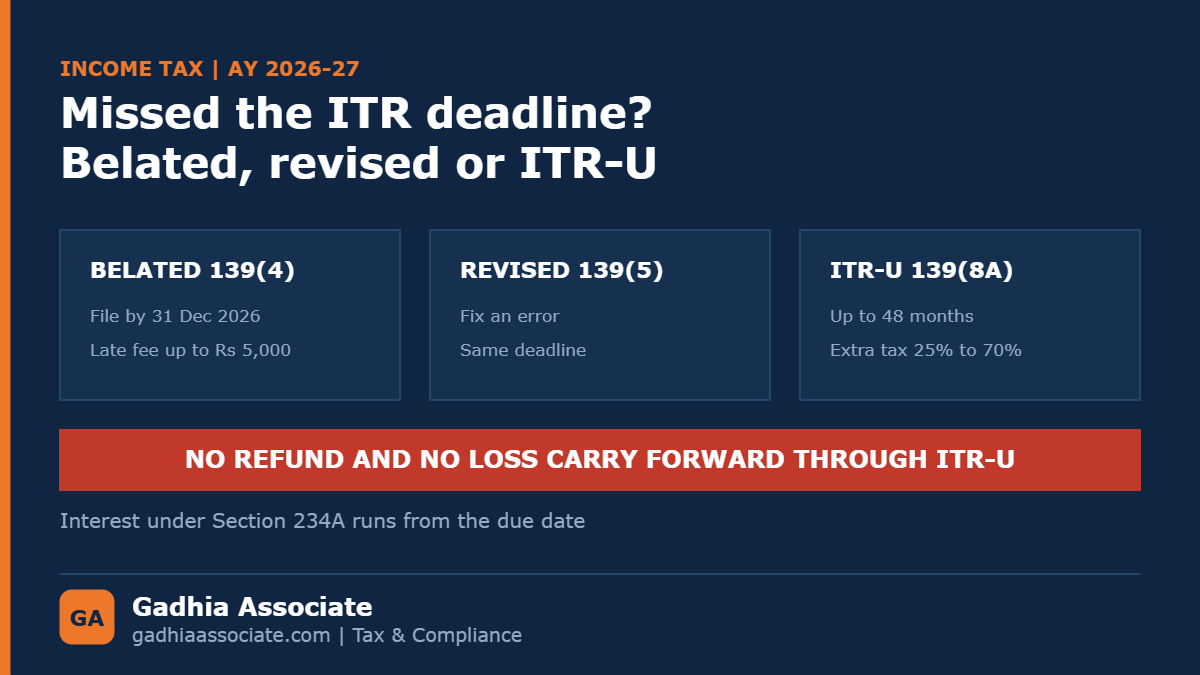
You get 15 days to correct it, and that period can be extended if you apply. If you do not correct it, the return is treated as invalid. Invalid means it is as though you never filed. Every consequence of not filing then follows, including the late fee and the loss of carry forward.
This is the notice people most often ignore, because the word defective sounds minor. It is not minor.
What are notices under section 142(1) and 143(2)?
Section 142(1) is the Assessing Officer asking. He can ask you to file a return you have not filed, or to produce accounts, bank statements or details he wants. There is no fixed reply period in the section itself; the notice states the date. Not complying can attract a penalty, generally Rs 10,000 per default, and it can push the case towards a best judgment assessment under Section 144.
Section 143(2) is the scrutiny notice. Your return has been picked for detailed examination. The time limit for issuing it is three months from the end of the financial year in which the return was filed, so it comes reasonably quickly or not at all. Scrutiny today is faceless under Section 144B. There is no officer to meet, no office to visit. Everything happens through the portal, and the file may be handled anywhere in the country.
What is a notice under section 148?
This is the serious one. Section 148 means the department believes income has escaped assessment and wants to reassess an earlier year. The reassessment order then comes under Section 147.
Before issuing it, the officer must go through Section 148A. You get a show cause notice, you get the information he is relying on, and you get a chance to explain. That reply matters enormously. A good reply at the 148A stage can stop the reassessment before it starts.
On time limits: three years from the end of the relevant assessment year in normal cases, extended where the escaped income is Rs 50 lakh or more. The Finance (No. 2) Act 2024 cut the old ten year outer limit to five years from the end of the assessment year for those larger cases, with effect from 1 September 2024. Commentary on how the transition applies to older years is not consistent, so if your notice relates to an old year, have the limitation point checked properly. It is often the strongest defence available.
Notice in hand and a date running? Call or WhatsApp +91 82005 28355 for a free first consultation. Send us a photo of the notice and we will tell you what it is and how many days you have.
How to reply to an income tax notice on the portal?
Log in at the e-filing portal with your PAN. Open Pending Actions, then e-Proceedings. Your notice sits there with the section, the assessment year and the response due date. Click Submit Response, type your reply, attach your documents as PDFs, and submit before the date.
A reply that works has four parts:
- A plain statement of what the department has said
- Your answer to it, in numbers, not adjectives
- Documents that prove those numbers: bank statements, contract notes, sale deed, Form 16, 26AS extract, the donation receipt
- A short closing line saying what you want, whether that is dropping the adjustment or accepting part of it
Keep the acknowledgement number. Download the submitted response. If a document is too large, split it rather than skipping it.
If the notice is a GST one instead, the track is completely separate, with its own forms and time limits. Our article on ASMT-10, DRC-01A and DRC-01 covers that side.
Why does an AIS mismatch cause a notice?
Because the department now receives your financial life from third parties before it ever sees your return. Banks, registrars, mutual funds, brokers and card companies report under the SFT rules. All of it collects in your Annual Information Statement and the shorter Taxpayer Information Summary.
The usual culprits behind a mismatch:
- Cash deposits above the reporting threshold in a savings or current account
- Property purchase or sale reported by the sub registrar
- Mutual fund redemptions and share sales
- Bank and post office interest left out because the bank deducted TDS anyway
- Dividend income
- Foreign remittances under LRS
- Large credit card spending
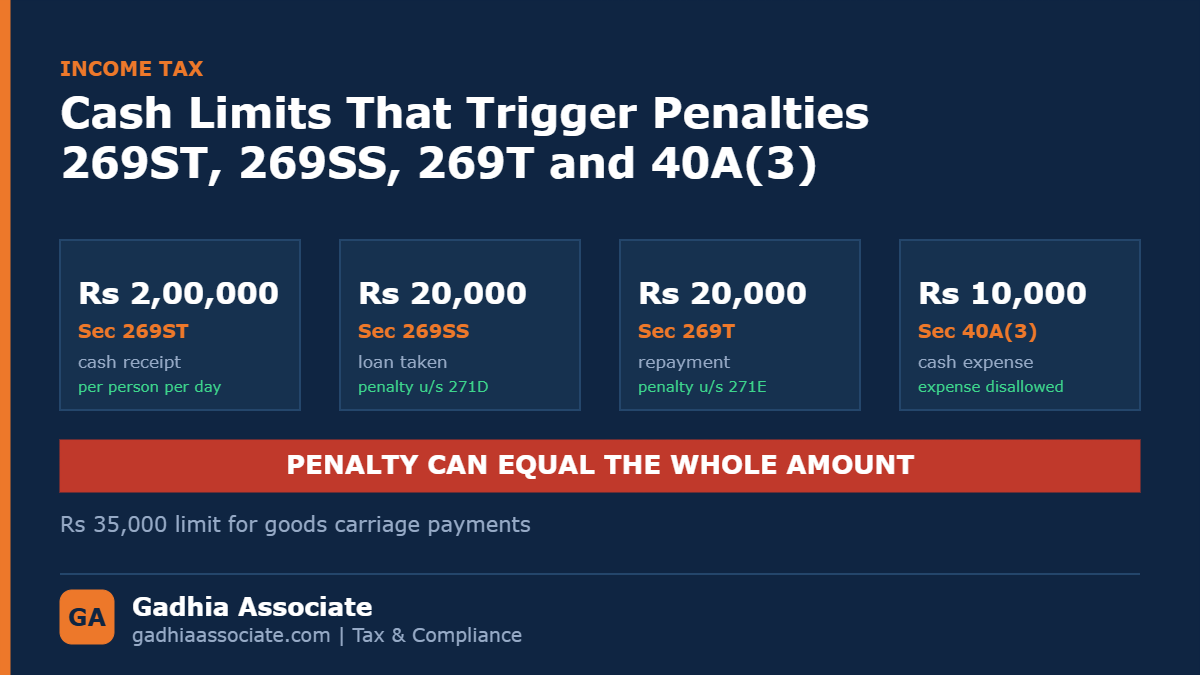
Two points from practice. First, savings bank interest is the mismatch the department catches most often, because people think small amounts do not matter. They are all reported. Second, cash entries pull attention fast, and the limits under Sections 269ST, 269SS, 269T and 40A(3) are where a routine query turns into a penalty. Our separate article on cash transaction limits sets those out.
The AIS has a feedback facility. If an entry is wrong, mark it in the AIS with the right option. Do that before you argue in a reply, not after.
Illustrative example (round numbers, for understanding only). A salaried reader in Rajkot declared Rs 12,000 of bank interest. His AIS showed Rs 48,000 across three banks. A 143(1)(a) proposal came for the Rs 36,000 difference. At a 20% slab, the extra tax was about Rs 7,200 plus interest. He had 30 days. Because the AIS figures were correct, the sensible reply was to accept and pay, not to fight. Fighting would have cost more.
Not sure whether to accept or contest? Call or WhatsApp +91 82005 28355. A free first consultation usually settles that question in ten minutes.
What if the notice ends in a demand under section 156?
A notice of demand under Section 156 follows an assessment or an adjustment. It tells you the amount and gives you 30 days from service of the notice to pay. Miss that and interest under Section 220(2) starts, and recovery steps can follow.
You have three routes, and picking the right one matters.
- Rectification under Section 154, where the demand comes from an obvious mistake, such as TDS credit not given or a challan not matched. It is an online request and the time limit is four years from the end of the financial year in which the order was passed.
- Appeal in Form 35 to the Commissioner (Appeals) under Section 246A, where you dispute the officer view. The limit is 30 days from service of the order. This is a date people miss constantly.
- Dispute Resolution Committee under Section 245MA, for small cases. The commonly stated conditions are that the total variation proposed does not exceed Rs 10 lakh and returned income for that year does not exceed Rs 50 lakh, with search based cases excluded. Confirm the current limits before relying on this route.
Which replies make things worse?
Two, and we see both every season.
The bare denial. A reply that says the income is not mine, or the claim is correct, with nothing attached. The officer has a third party report in front of him. A sentence does not beat a bank record. Attach the statement, the contract note, the deed. If you cannot attach it, say why and say when you can.
Agreeing to something you have not checked. The portal makes it easy to click agree on a proposed adjustment. Many people do it to make the notice go away. We have seen readers accept additions that were simply double counting, where the same interest appeared twice in the AIS, or where a joint account was reported fully in one holder name. Once you agree, the demand is yours. Check the underlying figure first, every time.
What we do for you
- Authenticate the DIN and confirm the notice is genuine before anything else
- Identify the section, the exact reply date and what is actually at stake
- Pull your AIS, TIS and Form 26AS and reconcile them against your own records
- File AIS feedback where an entry is wrong or duplicated
- Draft the reply and assemble the supporting documents
- Submit through e-Proceedings and keep the acknowledgement
- File rectification under Section 154 where the demand is a clear mistake
- Prepare and file Form 35 appeals and represent you through the faceless proceedings
- Handle 148A replies and limitation arguments where an old year is reopened
Gadhia Associate has been in practice since 2007 and has handled work for over 7,000 clients across Saurashtra and Gujarat, with a 5.0 Google rating from more than 100 reviews. Clients from Junagadh, Veraval, Gir Somnath, Amreli and Porbandar come to our Junagadh office, where same-day appointments are available. Notices can equally be handled digitally for clients anywhere in India. Fixed-fee and monthly plans are available.
Do not let the reply date pass. Call or WhatsApp +91 82005 28355 now, or come to our Junagadh office today. The first consultation is free.
Frequently asked questions
Is a notice under section 143(1) something to worry about?
Usually not. An intimation under Section 143(1) simply reports how your return was processed and compares your figures with the department computation. If both agree, no action is needed. If it proposes an adjustment under Section 143(1)(a), you have 30 days to respond on the portal. If you do not respond, the adjustment is made and a demand follows.
How many days do I get to reply to a defective return 139(9) notice?
Fifteen days from the date of the notice, and the period can be extended if you apply to the Assessing Officer. If the defect is not corrected within the allowed time, the return is treated as invalid, which means it is as though you never filed. The late fee, interest and loss of carry forward then apply just as they would for non-filing.
How do I check if an income tax notice is fake?
Use the Authenticate notice or order issued by ITD service on the income tax e-filing portal. It works without logging in. Enter the Document Identification Number and date, or your PAN with the notice details. Every genuine communication issued since 1 October 2019 carries a DIN, and a notice without a valid DIN is treated as never having been issued.
What is a notice under section 148 and how far back can the department go?
A Section 148 notice reopens an earlier year because income is believed to have escaped assessment. It must be preceded by the Section 148A procedure, which gives you a show cause opportunity. The normal limit is three years from the end of the assessment year, extended where escaped income is Rs 50 lakh or more, with the outer limit reduced to five years by the Finance (No. 2) Act 2024.
What happens if I ignore an income tax notice?
Nothing good. Proposed adjustments become final demands. A defective return becomes invalid. Non-compliance with a Section 142(1) notice can attract a penalty and can lead to a best judgment assessment under Section 144, where the officer estimates your income himself. Demands then move to recovery, and appeal deadlines of 30 days pass while you wait.
Position as of September 2026. Dates, fees and time limits change through CBDT notifications, and the Income-tax Act, 2025 has renumbered the income tax provisions with effect from 1 April 2026, so the section numbers quoted here follow the 1961 Act because that is how people still search for them. Confirm the current position before acting.