Claiming 80G Deduction on Donations: Why Your Claim Fails Without Form 10BE, and Why the New Regime Gives You Nothing
You gave Rs 50,000 to a children's trust in Junagadh last November. You have the receipt, stamped and signed, with an 80G registration number printed along the bottom. Filing season comes, the return is prepared, and the deduction is simply not there. Tax payable hasn't moved a rupee. If that is you, a salaried person or a doctor or a trader who donates every year and assumes the benefit follows automatically, the reason is almost always one of three things. Only one of them can still be fixed after the year has closed.
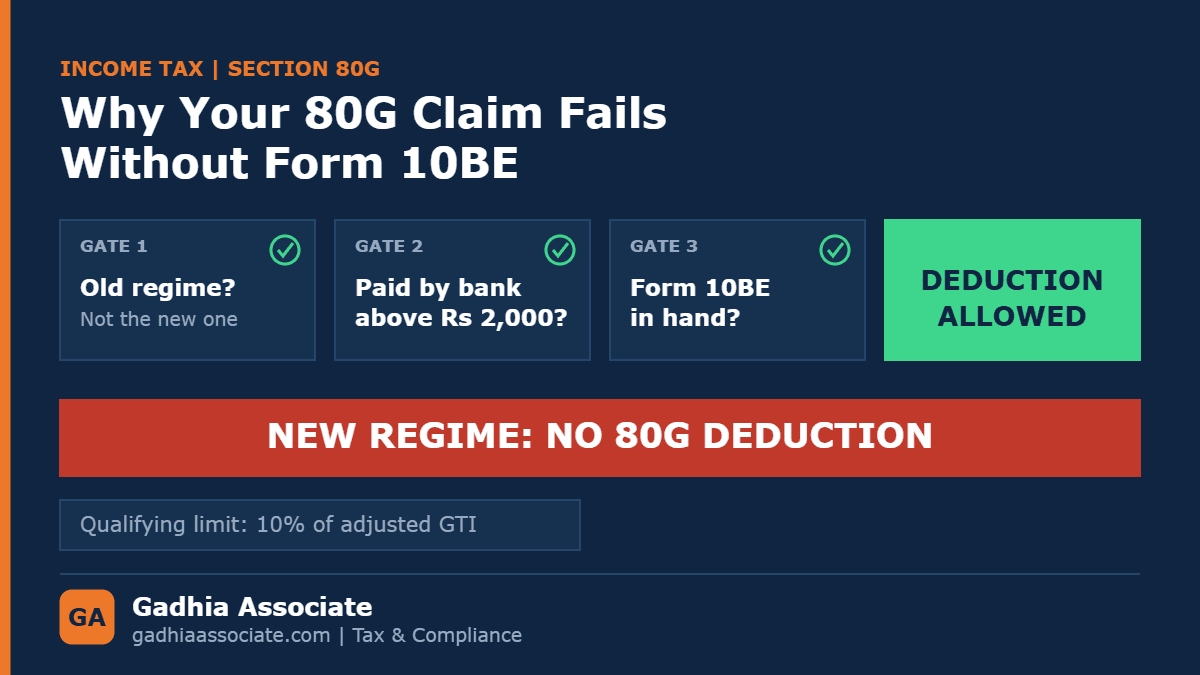
Short answer: Section 80G is a Chapter VI-A deduction, so it is available only if you file under the old tax regime. Under the default new regime of Section 115BAC you get nothing at all for the donation. You also need Form 10BE from the institution, and any cash donation above Rs 2,000 is disallowed in full.
The money at stake is not small. On a Rs 50,000 donation that falls in the 50 per cent bucket, the deduction is Rs 25,000, which at the 30 per cent slab plus cess is roughly Rs 7,800 of tax. Pick the wrong regime and that becomes zero. Donate Rs 2,01,000 in cash and the whole Rs 2,01,000 becomes zero. These are not marginal losses.
Why is my 80G deduction missing even though I have a valid receipt?
Because you are most likely filing under the new regime, where Section 80G does not exist for you. Since the new regime under Section 115BAC became the default, almost every Chapter VI-A deduction has been switched off inside it. The narrow survivors are Section 80CCD(2) for the employer's NPS contribution, Section 80CCH, and Section 80JJAA. Section 80G is not on that list.
This is now the single biggest reason donors get nothing. The receipt is genuine, the trust is properly registered, the donation went by cheque, and none of it matters, because the regime you ticked decides the answer before any of the other rules are reached.
To claim it you have to opt out of the new regime. In ITR-1 and ITR-2 that is the "opting out" field in the Personal Information schedule. In ITR-3, ITR-4 and ITR-5 the option has to be exercised within the due date, and for business and professional income there is Form 10-IEA to contend with. Miss the due date with business income and you are stuck in the new regime for that year, donation or no donation.
So the arithmetic has to be done before you file, not after. Add up the whole old-regime basket: 80C, 80D, home loan interest, HRA, the standard deduction, and the donation. If the old regime total beats the new regime's wider slabs and higher rebate, opt out. If it doesn't, accept that the donation was charity and not tax planning. Both are respectable. Pretending the deduction exists when it doesn't is what creates the notice.
How much of my donation can I actually claim under Section 80G?
Between nothing and the full amount, depending on which of four buckets the donee falls into. Section 80G does not give a flat benefit, and this is where most people overestimate.
- 100 per cent, no qualifying limit: the Prime Minister's National Relief Fund, the National Defence Fund, the National Foundation for Communal Harmony, the National or State Blood Transfusion Council, the PM CARES Fund.
- 50 per cent, no qualifying limit: the Prime Minister's Drought Relief Fund, the Jawaharlal Nehru Memorial Fund, the Indira Gandhi Memorial Trust.
- 100 per cent, subject to the qualifying limit: donations to government or a local authority for promoting family planning, and to the Indian Olympic Association.
- 50 per cent, subject to the qualifying limit: the large residual category, and this is where nearly every local charitable trust, school society, hospital trust and temple trust sits. Also donations to government or a local authority for any charitable purpose, and sums paid for repair of a notified place of worship.
Read that last line again. The trust down the road in Junagadh that does genuinely good work is, in the overwhelming majority of cases, a 50 per cent donee with a limit on top. Half of what you gave, capped.
What is the 10 per cent qualifying limit and how is adjusted gross total income worked out?
The qualifying limit is 10 per cent of your adjusted gross total income, and it caps the donations in the two limited categories before the 100 or 50 per cent is applied. Adjusted gross total income means gross total income reduced by all Chapter VI-A deductions other than 80G itself, and by long-term capital gains, short-term capital gains chargeable at the special rate, and income taxable under the special provisions such as Sections 115A, 115AB, 115AC and 115AD.
That capital gains exclusion catches people out. A retired client sells a plot near Junagadh, makes a large long-term gain, donates a chunk of it, and finds the gain does not count towards the base at all. Their salary or interest income is all that is left, so the 10 per cent cap is tiny.
Illustrative example (round numbers, not a computation for any real person):
- Gross total income: Rs 12,00,000, all salary and interest, no capital gains.
- Other Chapter VI-A deductions claimed: Rs 1,50,000 under 80C and Rs 25,000 under 80D, so Rs 1,75,000.
- Adjusted gross total income: Rs 12,00,000 minus Rs 1,75,000, which is Rs 10,25,000.
- Qualifying limit: 10 per cent of that, which is Rs 1,02,500.
- Donation of Rs 50,000 to a local trust in the 50 per cent limited bucket. Rs 50,000 is below Rs 1,02,500, so the whole donation qualifies. Deduction is 50 per cent, which is Rs 25,000.
- Now change one number. Donate Rs 2,00,000 instead. Only Rs 1,02,500 clears the cap, and the deduction is 50 per cent of that, which is Rs 51,250. The remaining Rs 97,500 of your generosity earns nothing.
Illustrative only. Your figures, your slab, your regime choice.
Does a cash donation qualify, and what about clothes, food or equipment?
Cash above Rs 2,000 gets you nothing, and donations in kind get you nothing regardless of value. The Rs 2,000 cash ceiling came in with the Finance Act, 2017, and it is not a partial disallowance. Hand over Rs 25,000 in notes and the entire Rs 25,000 is out, not just the excess over Rs 2,000. Anything above Rs 2,000 has to move through a banking channel: cheque, demand draft, NEFT, UPI, card, net banking.
Donations in kind are the harder conversation. Two hundred blankets to a shelter, a dialysis machine to a hospital trust, a truckload of grain after a flood, all admirable and all outside Section 80G, which speaks of donations of any sum of money. No valuation certificate rescues it. If the tax benefit matters to you, transfer the money and let the trust buy the goods.
One more trap worth naming. A fair number of donations reach a trustee's personal account by UPI because that is the number on the WhatsApp appeal. That is not a donation to the institution. There is no way to get a 10BE for it, and no way to claim it.
Want the regime choice and the donation checked before you file?
Send us the receipt and last year's return and we will tell you in one sitting whether the old regime is worth choosing for you this year and whether the donation will actually survive. First consultation is free. Call or WhatsApp +91 82005 28355.
Gadhia Associate has been practising since 2007 and works with more than 7,000 clients across Saurashtra and Gujarat, with a 5.0 Google rating from over 100 reviews. We are based in Junagadh, Gujarat and work with clients across India, with same-day appointments at the Junagadh office, digital service anywhere in the country, and fixed-fee or monthly plans so you know the cost in advance.
What is Form 10BE and what should I ask the trust for, and by when?
Form 10BE is the donation certificate the institution generates on the e-filing portal after it files Form 10BD, the statement of donations. It is the document your claim actually rests on. A receipt on the trust's letterhead, however official it looks, is not a substitute.
The mechanics matter for you as the donor. The trust files Form 10BD by 31 May following the financial year of receipt, listing every donor with name, address, PAN and amount. Roughly a day later the portal produces a Form 10BE for each donor, which the trust downloads and hands over. Your deduction is matched against what the trust reported. If the trust never filed, there is no 10BE and no trail, and your claim is sitting on its own.
The certificate people never have is exactly this one. Donors arrive with a stamped receipt and a photograph of a cheque and are genuinely surprised that the certificate exists. Two practical habits fix it: ask for the 10BE in early June, and ask for the trust's current 80G registration number rather than trusting the number printed on old stationery. A striking number of small trusts are still issuing receipts with a pre-re-registration number that no longer matches the portal.
If the trust is dragging its feet, tell them plainly what their own exposure is. Late or non-filing of Form 10BD carries a fee under Section 234G and penalty under Section 271K, and continued default can put their 80G approval at risk. Our article on trust and NGO annual compliance, covering Form 10B or 10BB along with Form 10BD and 10BE, is written from the trust's side, and it is a useful thing to forward to a treasurer who has never heard of 10BD. We have also written on 12A and 80G registration and renewal, and on CSR-1 registration for NGOs seeking corporate funding.
What exactly do I enter in the 80G schedule of my ITR?
Four pieces of donee information per donation, plus the amount split by mode. Schedule 80G in the return asks for the name of the donee, the complete address, the PAN of the donee, and the donation amount broken into cash and other-than-cash. You then place the entry in the correct table depending on which of the four categories the donee falls into, and the utility computes the eligible deduction and applies the qualifying limit.
Keep the ARN, meaning the acknowledgement or reference number from the trust's Form 10BD filing, and the 80G registration number with your papers even where the field is not mandatory in a given year's utility. When a query comes, that is the number that closes it fastest.
The donee's PAN is where returns go wrong. Type the trustee's PAN, or an old PAN from a merged entity, and the deduction is liable to be adjusted at processing. If you have already filed with the wrong details, a revised return is usually the clean answer; our piece on mistakes in a filed ITR sets out the options and the time limits.
Is Section 80GGA the same as 80G? And what about donations to a political party?
No, they are separate provisions with separate conditions, and all of them are unavailable under the new regime. People mix these up constantly.
Section 80GGA covers donations for scientific research or rural development to approved research associations, universities, colleges and notified rural development funds. The deduction is 100 per cent of the amount donated, with no qualifying limit, and it is meant for taxpayers without business or professional income. Cash above Rs 2,000 is disallowed here too.
Section 80GGB allows an Indian company to claim contributions to a political party or an electoral trust. Section 80GGC does the same for individuals, HUFs, AOPs and BOIs. Both give 100 per cent with no cap tied to a percentage of income, and both bar cash absolutely, with no Rs 2,000 tolerance. Recently these claims have drawn heavy scrutiny, with large numbers of notices where the recipient party turned out to be unregistered or non-existent. Do not treat 80GGC as a routine deduction.
Can a company claim 80G on a CSR donation?
Generally not straightforward, and it depends on the recipient. CSR spending is mandated by Section 135 of the Companies Act, 2013, and is not business expenditure under Section 37(1). For Section 80G, the statute expressly denies the deduction for CSR contributions to the Swachh Bharat Kosh and the Clean Ganga Fund. Tribunals have read that express exclusion to mean other CSR donations to approved 80G institutions are not automatically barred, and several orders have allowed them. Departmental practice still resists such claims, so a company should expect a contest and document the donation and approval properly before relying on it.
One drafting point: the Income-tax Act, 2025, in force from 1 April 2026, has renumbered and rearranged the whole of the old Chapter VI-A. The substance of the donation deduction and the Form 10BD and 10BE machinery carries forward, but the section numbers you quote on forms and in correspondence change. Check the current numbering against the mapping tables before citing a section in any filing.
Have a donation that needs to be salvaged?
If the 10BE never came, or the regime was chosen wrongly, or the trust's details went in incorrectly, there is often still a route, and the sooner it is looked at the more room there is. Free first consultation. Call or WhatsApp +91 82005 28355, or walk into the Junagadh office.
FAQ
Can I claim 80G if I have already filed under the new regime?
Only by moving to the old regime, and whether you can depends on your income type. A salaried taxpayer without business income can generally switch regimes in a revised or belated return within the time allowed. With business or professional income the opt-out through Form 10-IEA has to be exercised by the original due date, and missing it usually locks you into the new regime for that year.
The trust gave me a receipt but no Form 10BE. Can I still claim?
You can enter the claim, but it is exposed. Your deduction is matched against the trust's Form 10BD filing, so if the trust did not file, there is nothing to match. Chase the trust for the 10BE, which they should generate after filing by 31 May following the year of donation. A letterhead receipt alone rarely survives a query.
I donated Rs 5,000 in cash to a temple trust. Is that allowed?
No. Any single cash donation above Rs 2,000 is disallowed in full under Section 80G, not merely the portion over Rs 2,000. The whole Rs 5,000 is out. Had you paid the same amount by cheque, UPI or net banking to the trust's own bank account, it would have qualified subject to the trust's category and the 10 per cent limit.
Is every 80G donation deductible at 50 per cent?
No. There are four categories: 100 per cent without a qualifying limit, 50 per cent without a limit, 100 per cent subject to the qualifying limit, and 50 per cent subject to it. Most ordinary charitable trusts fall in the last category, so half the donation, capped at 10 per cent of adjusted gross total income. Certain national funds get 100 per cent uncapped.
Does the deduction apply against my capital gains?
The deduction reduces total income, so it can reduce tax on gains taxed at slab rates. But long-term capital gains and special-rate short-term gains are excluded when computing adjusted gross total income, which shrinks your 10 per cent qualifying limit. Selling an asset and donating from the proceeds therefore gives far less relief than most people expect.
This article reflects the position as of September 2026. Rates, limits, forms and the regime rules change through CBDT notifications and circulars, and the Income-tax Act, 2025 has renumbered the relevant provisions with effect from 1 April 2026. Please confirm the current position, or speak to us, before acting on anything here.