Tax Rules for Senior Citizens in India: Higher Exemption, Section 80TTB, Form 15H and the Advance Tax Relief Most People Miss
The deposit matured in April, the interest was credited, and about eight thousand rupees simply was not there. TDS. Nobody at the branch mentioned it was coming. Or it runs the other way: your father is 74, draws a pension and interest from three banks, and the family cannot agree on whether he needs to file at all, so nobody does. Both cost money. A retired person who never files can leave twenty or thirty thousand rupees of refund with the department every year, and that window does not stay open forever.
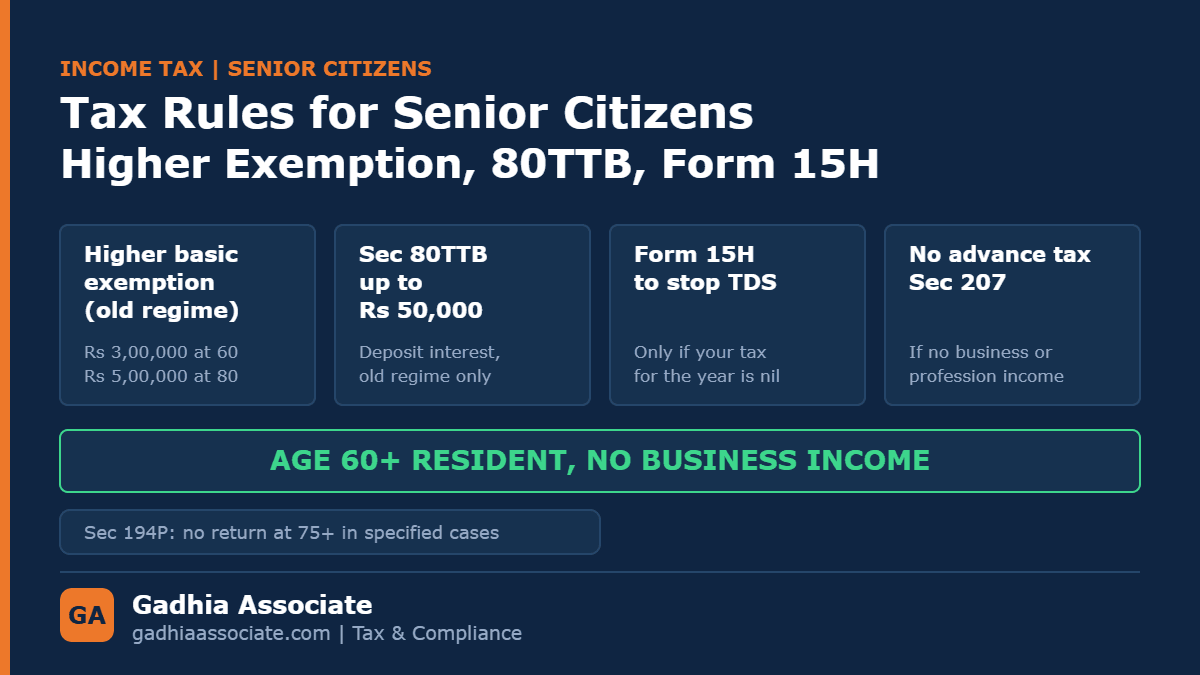
Short answer: If you are a resident aged 60 or more, the old regime gives you a Rs 3,00,000 basic exemption (Rs 5,00,000 once you are 80), Section 80TTB allows up to Rs 50,000 against deposit interest, and Section 207 means you owe no advance tax at all provided you have no business or professional income.
Who counts as a senior citizen for income tax, and does turning 80 change anything?
A senior citizen is a resident individual who is 60 years or more at any time during the previous year; a very senior citizen is 80 or more. Those two words, "any time", do more work than people expect. Someone turning 60 on 20 March 2027 is a senior citizen for the whole of FY 2026-27, right back to April. Banks get this wrong constantly, because their systems key off the date the deposit was opened rather than the birthday falling inside the year.
Residence matters too. A parent who has moved to the Gulf and is non-resident for the year gets none of this, whatever their age.
Old regime or new regime: which one actually suits a pensioner?
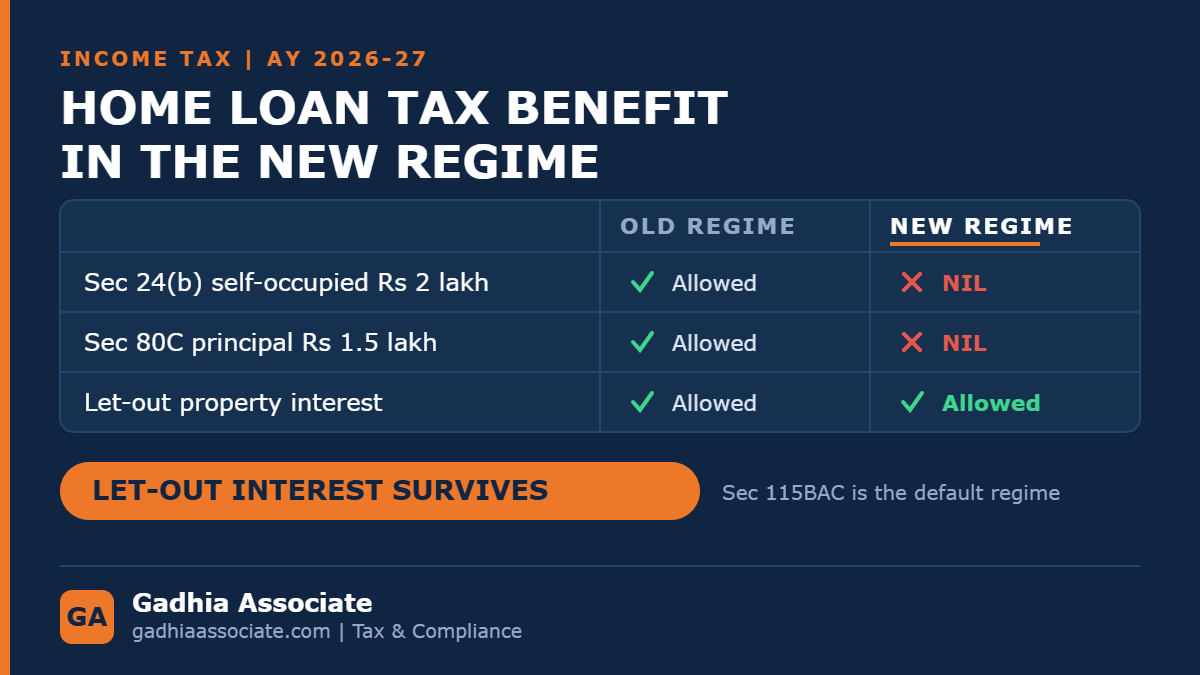
The higher age-based exemption exists only in the old regime, and yet for a great many pensioners the new regime still wins. That sounds contradictory, so here is the arithmetic. Under the default new regime in Section 115BAC the basic exemption is identical for everyone regardless of age, standing at Rs 4,00,000 from FY 2025-26, with a Section 87A rebate of up to Rs 60,000 that takes a resident's total income up to Rs 12,00,000 to nil tax. Standard deduction against pension taxed as salary is Rs 75,000 new regime, Rs 50,000 old.
The old regime offers Rs 3,00,000 at 60, Rs 5,00,000 at 80, an 87A rebate capped at Rs 12,500, and access to 80C, 80D, 80TTB and 80DDB. A pensioner on Rs 9,00,000 with no large deductions is usually better off in the new regime even after giving up 80TTB, because the rebate is worth more than the deductions are. The old regime earns its place where there is heavy medical expenditure, a housing loan, or income well above the rebate ceiling. Run both. Do not assume.
How much is the Section 80TTB deduction, and what interest does it cover?
Section 80TTB allows a resident senior citizen up to Rs 50,000 against interest on deposits with a bank, a co-operative bank or the post office, and only in the old regime. Savings, fixed and recurring deposit interest all count together. Claim 80TTB and Section 80TTA is not available, so there is no stacking.
Illustrative example. Deposits of Rs 9,00,000 at 7.5 per cent throw off Rs 67,500 of interest. Under 80TTB, Rs 50,000 comes off and Rs 17,500 stays taxable. In the new regime the whole Rs 67,500 remains in the computation. Round numbers, used only to show the mechanism.
Where claims fall apart is what the section leaves out. Interest on bonds, debentures, company deposits and NCDs sits outside it, as does interest on a partner's capital account.
One point to flag honestly. Reports have circulated that the ceiling rose to Rs 1,00,000 from FY 2026-27. We have not confirmed that against the enacted Finance Act text, so treat Rs 50,000 as the working figure and check before finalising anything. The Income-tax Act, 2025, in force from 1 April 2026, has also renumbered these provisions; the substance carries over, but we are not going to guess at the new numbers.
Can Gadhia Associate check last year's return before the refund window closes?
Yes, and the first consultation is free. Gadhia Associate is a tax and compliance practice based in Junagadh, Gujarat, working across Saurashtra and all over India. Bring the interest certificates, the pension statement and Form 26AS, and we will tell you in one sitting whether a refund is sitting there.
Call or WhatsApp +91 82005 28355. Same-day appointments in Junagadh, or handled digitally if your parents are elsewhere.
Who can give Form 15H, and when does giving it become a mistake?
Form 15H can be given by a resident individual aged 60 or above with a valid PAN whose estimated total tax liability for the year is nil. That is the whole test. Unlike Form 15G, the interest may exceed the basic exemption limit, so long as the final tax after deductions and the 87A rebate comes to nothing.
Here is the part the bank never mentions. Form 15H goes branch by branch, not bank by bank. Three branches, three forms. It lapses on 31 March and must be given again, and April is the month to do it, not July, because once TDS has gone in the first quarter the only way back is a return and a wait.
The mistake we see most is giving 15H when tax is genuinely payable, usually because only one bank's interest got added up. It is a declaration, not a request, and a false one carries consequences under Section 277.
Check first whether TDS would even arise. For senior citizens the Section 194A threshold on interest from banks, co-operative banks and post offices rose from Rs 50,000 to Rs 1,00,000 with effect from 1 April 2025. Below that, nothing should be deducted. If the bank deducted anyway and the credit is not showing, our articles on AIS versus Form 26AS and on employer TDS missing from Form 26AS set out the correction route, and the piece on ITR refunds getting stuck explains why a genuine refund sits unprocessed.
Do senior citizens have to pay advance tax?
No, and this is the relief most people miss. Section 207 provides that a resident individual who is 60 or more during the previous year and has no income chargeable under "Profits and gains of business or profession" is not liable to pay advance tax at all. Pension, interest, rent, capital gains, dividends: all of it can be there and the relief still holds.
So no interest under Sections 234B and 234C, and the tax can simply be paid as self-assessment tax before filing. Every year we meet pensioners who have paid quarterly instalments for a decade because a bank official told them to. The condition is strict, though. Any business or professional income at all, even a small commission, and the relief goes entirely.
My father is 78. Can he stop filing a return altogether?
Only from 75, and only on narrow facts, under Section 194P. He must be resident and 75 or more during the year; his pension must be credited to an account with a specified bank notified by the Central Government; his only other income must be interest from that same bank; and he must file a declaration in Form 12BBA with that bank. The bank then computes tax after Chapter VI-A and the 87A rebate, deducts it, and no return is required under Section 139.
Most people fall at the "no other income" hurdle. One rent receipt, one dividend, one small FD elsewhere, and the relief is gone for the year. Bank staff also vary enormously in how confidently they handle Form 12BBA, so budget a couple of visits.
A reverse mortgage, separately, does not create taxable income. Instalments under a notified scheme are not a transfer for capital gains and are not income in the borrower's hands; tax arises later, when the lender sells. Read that alongside our articles on making a gift deed or a will, and on filing the return of a deceased person.
What can be claimed for medical costs under 80D and 80DDB?
A senior citizen gets Rs 50,000 under Section 80D and up to Rs 1,00,000 under Section 80DDB, both old regime only. The 80D limit covers health insurance premium, and where no policy is held, actual medical expenditure; the preventive check-up sits inside that limit. Premium paid in cash is not allowed, though cash for a check-up is. A son or daughter paying premium for senior citizen parents claims a separate Rs 50,000 in their own return.
Section 80DDB covers actual expenditure on specified diseases, reduced by insurance or employer reimbursement. The claim that fails is almost always documented wrongly: hospital bills, and no prescription from the required specialist. The prescription is the evidence, not the bill.
Not sure which regime your parents should be in this year?
That takes about twenty minutes to answer properly, and it is worth asking before the year ends rather than after. We have been in practice since 2007 and look after more than 7,000 clients across Saurashtra and Gujarat, with a 5.0 Google rating from over 100 reviews, fixed-fee and monthly plans, and full digital service for families whose children live in other cities or abroad.
Free first consultation. Call or WhatsApp +91 82005 28355.
Frequently asked questions
Is Section 80TTB available in the new tax regime?
No. Section 80TTB is a Chapter VI-A deduction and it does not apply where income is computed under the default new regime in Section 115BAC. A senior citizen who wants the Rs 50,000 against deposit interest must choose the old regime at the time of filing. Compare both computations first, because the larger 87A rebate often outweighs the deduction.
The bank deducted TDS even though I gave Form 15H. What now?
Check whether the form reached the correct branch, and whether it was given before the interest was credited. TDS already deducted cannot be reversed by the bank once the quarterly statement is filed; you recover it by filing a return and claiming a refund. Confirm the deduction appears in Form 26AS and the AIS, since a missing credit is the usual reason a refund stalls.
If Section 207 means no advance tax, when is the tax paid?
As self-assessment tax under Section 140A, before the return for the year is filed. No quarterly instalments, and no interest under Sections 234B or 234C. Interest under Section 234A can still apply where the return itself is late, so the filing deadline continues to matter even though the advance tax dates do not.
My mother is 82. Her only income is pension and bank interest. Must she file?
Usually yes, unless the Section 194P conditions are met exactly, which needs the pension and the interest to come from the same specified bank plus a Form 12BBA declaration. Filing voluntarily is worth it wherever TDS has been deducted, because a return is the only route to the refund. At 82 the old regime gives her Rs 5,00,000 of basic exemption.
Do these rules change under the Income-tax Act, 2025?
The Act came into force on 1 April 2026 and renumbered the provisions. The reliefs described here carry over in substance: the higher exemption, the deposit interest deduction, the advance tax relief, the return-filing relief at 75. Most section numbers quoted online still refer to the 1961 Act, so check which statute a source is using before relying on it.
Position as of September 2026. Limits, thresholds and rates change through CBDT notifications and each year's Finance Act, and outcomes depend on individual facts. Please confirm the current position with us before acting on anything here.