Home Loan Tax Benefit in the New Regime: What You Still Get, What You Lost, and Which Regime Actually Suits a Borrower
You signed the loan papers partly because someone told you the tax would come back. Then you sat down to file, ticked the default regime, and the deduction rows weren't there. If you're paying an EMI on the house you live in, and your employer put you in the new regime because that's now the default, the housing side of your tax plan has quietly stopped working. What that usually costs is Rs 30,000 to Rs 60,000 a year, either tax you overpaid or a deduction you claimed wrongly and will repay with interest.
What home loan tax benefits do I still get under the new tax regime?
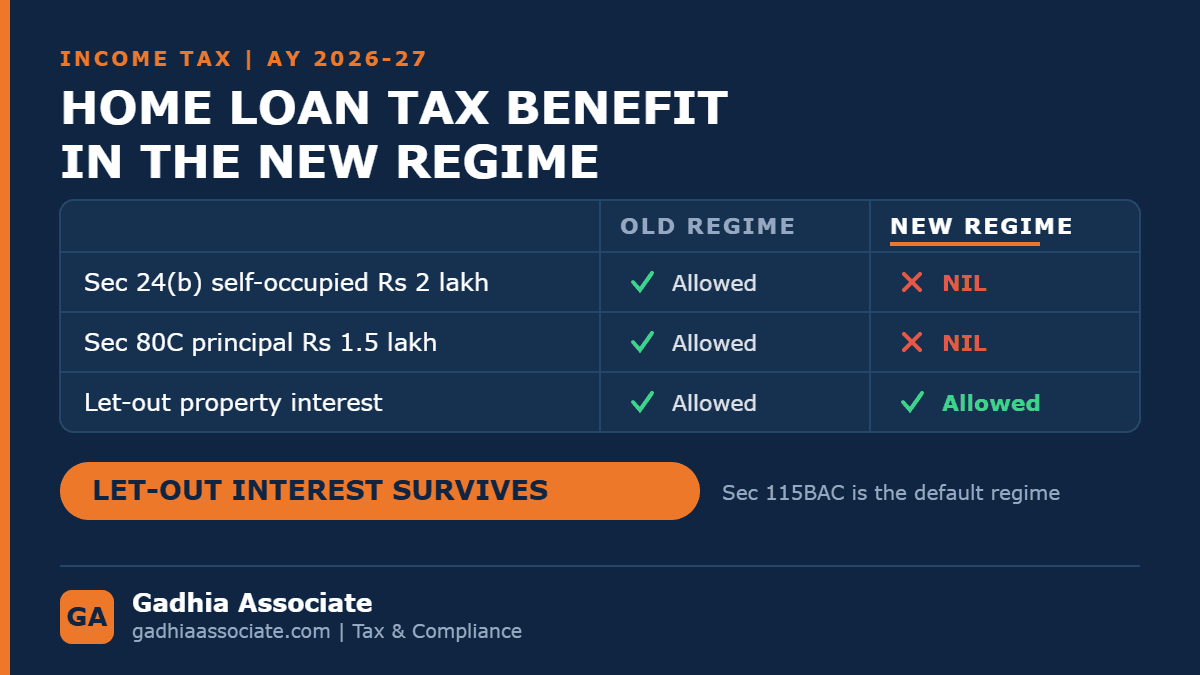
Only let-out property interest survives. Anything tied to a house you occupy yourself is gone. The position for AY 2026-27:
- Self-occupied interest, Section 24(b): up to Rs 2 lakh in the old regime, nil in the new.
- Principal repayment, Section 80C: old regime only, inside the shared Rs 1.5 lakh limit along with EPF, PPF, LIC premium and school fees. Stamp duty and registration charges sit in the same bucket in the year you pay them.
- Let-out interest, Section 24(b): allowed in both regimes, with no cap on the interest itself.
- 30% standard deduction on let-out rent: both regimes. Flat 30% of net annual value, whether or not you spent anything on repairs.
- Sections 80EE and 80EEA: closed to new loans. 80EEA needed a sanction between 1 April 2019 and 31 March 2022. If your sanction letter falls inside that window you can keep claiming in the old regime until the loan ends.
- Salary standard deduction: Rs 75,000 new against Rs 50,000 old.
This trips up almost every borrower: the deduction was never on the EMI, only on the interest inside it. In year two of a twenty-year loan roughly 90 paise of each EMI rupee is interest. By year fifteen it may be 35 paise. Same EMI, very different deduction, which is why the right regime for you changes as the loan ages.
Is home loan interest on a let-out property still allowed in the new regime?
Yes, and this is the most misunderstood point in the subject. Interest under Section 24(b) on a let-out or deemed let-out property stays deductible in the new regime. Take the rent, knock off the 30% standard deduction and municipal taxes actually paid, then subtract the full year's interest.
The catch is what happens when interest exceeds rent, which it usually does early in a loan. That creates a loss under the head "income from house property", and the regimes part company there.
Old regime: Section 71(3A) allows up to Rs 2 lakh of that loss to be set off against salary or other income in a year. The excess carries forward for eight assessment years, but only against house property income after that.
New regime: on the reported position, house property loss cannot be set off against any other head and cannot be carried forward. So the interest shelters the rent from that property and nothing more. The drafting here isn't as clear as it should be and commentators read the carry-forward point differently, so if you have a big let-out loss, get it computed both ways before locking a regime.
Not sure which regime your own numbers point to?
Send us your lender's interest certificate and a recent salary slip. We run both computations side by side, tell you in writing which is cheaper this year, and draft what you hand your employer so the TDS stops being wrong.
First consultation is free. Call or WhatsApp +91 82005 28355.
Which tax regime is better if I have a home loan?
For most single-home borrowers the new regime now wins, even after losing the housing deductions. Slabs under Section 115BAC for AY 2026-27 run nil up to Rs 4 lakh, then 5%, 10%, 15%, 20%, 25%, and only touch 30% above Rs 24 lakh. The old regime reaches 30% at Rs 10 lakh. That gap swallows a Rs 3.5 lakh housing deduction fairly easily.
A rough rule we use as a starting point, not an answer: at higher salaries the old regime only overtakes the new once total old-regime deductions cross around Rs 8 lakh, standard deduction included. Housing alone rarely gets anyone there. Housing plus HRA sometimes does.
Illustrative, new regime wins. Salary Rs 16,00,000. Self-occupied flat in Junagadh, interest Rs 3,00,000 but capped at Rs 2,00,000, 80C full at Rs 1,50,000, 80D Rs 25,000.
- Old regime: taxable Rs 11,75,000, tax with cess about Rs 1,71,600.
- New regime: taxable Rs 15,25,000, tax with cess about Rs 1,13,100.
- New regime cheaper by roughly Rs 58,500, having given nothing for the loan.
Illustrative, old regime wins. Salary Rs 18,00,000. He owns a flat in Junagadh that is let out and pays rent in Ahmedabad for work, so he has an HRA exemption of about Rs 3,60,000 as well. Rent received Rs 2,40,000, interest Rs 5,00,000, giving a house property loss of Rs 3,32,000 after the 30% deduction. 80C Rs 1,50,000, 80D Rs 25,000.
- Old regime: Rs 2,00,000 of loss set off under Section 71(3A), Rs 1,32,000 carried forward. Taxable Rs 10,15,000, tax with cess about Rs 1,21,680.
- New regime: no HRA, no set-off. Taxable Rs 17,25,000, tax with cess about Rs 1,50,800.
- Old regime cheaper by about Rs 29,000, plus the carried-forward loss.
Both are illustrative, at AY 2026-27 rates with 4% cess. Your answer shifts with rent, interest and whether you pay rent elsewhere.
Can my wife and I both claim home loan deduction on a joint loan?
Yes, if you are both co-owners and both co-borrowers and both actually pay. Each claims within their own limits, so a couple in the old regime can claim up to Rs 4 lakh of self-occupied interest between them, and principal inside two separate 80C limits. Ownership share drives the split. Being a co-borrower without being a co-owner gets you nothing, and that gets discovered late, usually when a notice lands. Since the deduction follows the person who paid, a joint account for the EMI settles most of these arguments before they start.
Can I treat two houses as self-occupied?
Yes. The Finance Act 2025 amended Section 23 so the annual value of up to two houses can be taken as nil where the owner occupies them or cannot occupy them for any reason, and the old conditions about explaining why you weren't living there are gone. It applies from AY 2025-26 onwards. Handy if you have a flat in Rajkot and the family house in Junagadh sitting empty. Note what it doesn't do: it stops notional rent on the second house, it does not revive any interest deduction in the new regime, and in the old regime the Rs 2 lakh cap covers both houses together.
How do I claim the interest I paid before the house was completed?
In five equal instalments, starting with the year construction is completed. Aggregate the interest from the date of borrowing up to the 31 March before the completion year, divide by five, and claim one-fifth a year alongside your regular interest. For a self-occupied house the old regime's Rs 2 lakh cap applies to the current year's interest and the pre-construction instalment together, so a large under-construction interest bill often yields less than people expect. Buyers who took possession three or four years ago and never started the five-year run are the ones we fix most often. Our article on mistakes people find in a filed ITR covers the revised and updated return routes if you've already filed.
What do I give my employer, and when, so my TDS is right?
Declare your regime in April and submit proof by December or January, whichever payroll asks for. Say nothing in April and you'll be taxed under the new regime by default, and proof handed in February won't undo a year of over-deducted TDS. The certificate must show the split: principal repaid, interest paid, property address. Ask for the provisional certificate in April and the final one after year-end. Most banks and housing finance companies issue it from net banking in a minute, though a few cooperative banks in Saurashtra still want you at the counter. On joint property, ask for both names on it. Before filing, cross-check what's already reported against you; our piece on AIS versus Form 26AS explains which to trust when they disagree.
Get the regime decision right before the next TDS cycle
Gadhia Associate is a tax and compliance firm based in Junagadh, Gujarat, working with clients across India and with NRIs. In practice since 2007, over 7,000 clients across Saurashtra and Gujarat, and a 5.0 Google rating from more than 100 reviews. Same-day appointments at the Junagadh office, fully digital service if you're not in town, fixed-fee filings and monthly plans so the cost is known before we start.
Free first consultation. Call or WhatsApp +91 82005 28355 and bring your interest certificate.
Frequently asked questions
Can I switch from the new regime to the old regime just to claim home loan interest?
A salaried person with no business income can choose either regime each year, provided the return is filed by the Section 139(1) due date. File late and you are locked into the new regime for that year, losing the Rs 2 lakh Section 24(b) deduction outright. Taxpayers with business or professional income face a far stricter one-time exit.
Is Section 80C principal repayment available in the new regime?
No. Section 80C doesn't apply under Section 115BAC, so principal repayment, stamp duty and registration charges give you nothing there. Only the old regime allows them, inside the Rs 1.5 lakh ceiling shared with EPF, PPF, ELSS, insurance premium and tuition fees. Employer NPS contribution under Section 80CCD(2) is the main deduction that survives in both.
My flat is let out to a relative at low rent. Does the interest still qualify?
The interest is deductible, but rent well below market invites scrutiny of the annual value, and the officer can substitute a reasonable expected rent. Related-party tenancies at token rents are a known trigger. Keep a rent agreement, take rent by bank transfer, and be ready to show comparable rents for that locality.
What happens to a house property loss I can't set off in the new regime?
On the reported position it simply lapses, with no set-off against salary that year and no carry-forward. Contrast the old regime, where the excess above the Rs 2 lakh limit in Section 71(3A) carries forward eight assessment years against house property income. The position isn't fully settled, so anyone with a large let-out loss should get it confirmed on their facts.
If I sell the house later, do the deductions come back to bite me?
Interest deductions aren't reversed. Section 80C principal is clawed back if you sell within five years from the end of the year of possession, and the earlier deduction is added to income in the year of sale. The capital gain is separate; see our articles on Sections 54, 54F and 54EC, and the Capital Gain Tax Calculator for a quick estimate.
Position as of September 2026. Limits, slab rates and thresholds change through CBDT notifications and each year's Finance Act, and the Income-tax Act, 2025, in force from 1 April 2026, has renumbered these provisions, so section references in older material may not match the new numbering even where the substance is unchanged. Outcomes depend on individual facts. Please confirm your position before acting.