Partnership Firm in 2026: What the Deed Must Say, Partner Remuneration Limits Under Section 40(b), and When to Convert to an LLP

Two brothers started a trading firm in Junagadh in 1996. The deed was typed on a stamp paper, signed, put in a steel cupboard, and never opened again. The firm now turns over several crores, pays both of them a monthly salary, and the deed still says remuneration will be "as mutually agreed". That single phrase is enough for an assessing officer to disallow the entire salary claim and add it straight back to the firm's income. At a 30 per cent rate plus cess, a Rs 12,00,000 salary claim disallowed costs roughly Rs 3,74,000 in one year. Then interest on top.
Short answer: A firm can deduct partner remuneration only if the partnership deed authorises it, quantifies the amount or states the manner of working it out, and the partner is a working partner. The deduction is then capped by Section 40(b), and nothing can be claimed for any period before the deed's date.
What must a partnership deed say for a remuneration claim to survive an assessment?
The deed has to do two jobs at once: govern the relationship between the partners under the Indian Partnership Act, 1932, and satisfy the income tax conditions in Section 40(b). Most old deeds do the first and fail the second. A workable deed sets out:
- Names, addresses and capacity of every partner, and who is a working partner
- Capital contributed by each partner
- The profit-sharing ratio, and how losses are borne
- Remuneration to working partners, with either the actual amount or a stated manner of quantification
- The rate of interest on partners' capital
- Duties, banking and signing authority
- Admission, retirement, death and what happens to the outgoing partner's capital
- Dissolution, and the effective date of the deed
Two clauses cause almost all the disallowances we see. The first is the remuneration clause that says "as may be mutually agreed" or simply "within the limits of Section 40(b)". Neither quantifies anything. The long-standing departmental position, and the view taken by the courts, is that the deed must either specify the amount or lay down a formula the amount can be worked out from without any further agreement between the partners.
The second is the effective date. Section 40(b) does not allow remuneration for any period falling before the date of the deed that authorises it. A supplementary deed signed in November cannot support salary for April to October. This is where old deeds fail, and it is why we push clients to sign the supplementary deed in March, before the year they want it to cover.
How much partner remuneration is allowed under Section 40(b)?
For AY 2025-26 onwards the limit is the higher of Rs 3,00,000 or 90 per cent of book profit on the first Rs 6,00,000 of book profit (and Rs 3,00,000 where the firm has a loss), plus 60 per cent of the balance of book profit. These figures were revised upwards by the Finance Act, 2024 and are widely reported; confirm the current position before you compute, because the older slab of Rs 1,50,000 or 90 per cent on the first Rs 3,00,000 is still floating around in software and templates.
Illustrative example. Book profit of Rs 20,00,000, computed before partner remuneration. On the first Rs 6,00,000, 90 per cent gives Rs 5,40,000, which beats Rs 3,00,000. On the balance of Rs 14,00,000, 60 per cent gives Rs 8,40,000. Maximum allowable remuneration is Rs 13,80,000. Pay more and the excess is disallowed and taxed in the firm's hands, while remaining taxable in the partner's hands as business income under Section 28(v). Round numbers, to show the mechanism.
Two further limits. Remuneration is allowed only to working partners, so a sleeping partner or a partner in a representative capacity cannot be paid a salary that the firm deducts. And where the firm declares income under the presumptive scheme in Section 44AD, remuneration and interest to partners are not separately deductible at all. That surprises people every year.
Can Gadhia Associate review our deed before the year ends?
Yes, and the first consultation is free. Gadhia Associate is a tax and compliance practice based in Junagadh, Gujarat, working with firms across Saurashtra and all over India. Send us the existing deed and last year's computation and we will tell you what needs a supplementary deed and by when.
Call or WhatsApp +91 82005 28355. Same-day appointments at the Junagadh office; digital service if you are elsewhere.
How much interest can a firm pay on partners' capital?
Twelve per cent simple interest per annum is the ceiling for deduction under Section 40(b). Anything above that is disallowed to the extent of the excess. The same two conditions apply as for salary: the deed must authorise it, and nothing is deductible for a period before the deed's date.
A detail worth catching. Interest is computed on the running capital balance, so drawings during the year reduce it. Firms that compute interest on the opening balance and never adjust for withdrawals build up a small annual disallowance that nobody notices until a scrutiny.
Does the firm have to deduct TDS on what it pays its partners?
Yes, since 1 April 2025. Section 194T requires a firm or LLP to deduct tax at 10 per cent on salary, remuneration, commission, bonus or interest paid or credited to a partner, once the aggregate for the financial year crosses Rs 20,000. Share of profit is outside it.
The trap is the word "credited". Deduction is triggered at credit or payment, whichever is earlier, and credit to the partner's capital account counts. A firm that books the whole year's remuneration on 31 March has a TDS liability on 31 March, not whenever the money moves. Firms that never needed a TAN now need one, plus quarterly returns in Form 26Q. Our separate article on TDS on partner payments under Section 194T works through the mechanics.
Does registering the firm matter if a customer stops paying?
It matters enormously, and this is the moment people discover it. Registration with the Registrar of Firms is optional under the Indian Partnership Act, 1932, but Section 69 attaches real disabilities to an unregistered firm. An unregistered firm cannot file a suit to enforce a right arising from a contract against a third party. A partner of an unregistered firm cannot sue the firm or the other partners to enforce a contractual right either.
So the firm that has been happily unregistered for fifteen years discovers, on the day a customer refuses to pay a Rs 40,00,000 bill, that it cannot sue. Registration afterwards does not revive a suit already barred, and by the time the paperwork is done the debt may be close to time-barred. Limited exceptions exist for a suit for dissolution, for accounts of a dissolved firm, and to realise the property of a dissolved firm. None of them help you collect a trade receivable.
When does converting to an LLP make sense, and is the conversion tax neutral?
Convert when limited liability starts to matter more than simplicity, which is usually when the firm takes on borrowing, employs people in numbers, or wants a partner who will not accept unlimited personal exposure. An LLP is a body corporate with perpetual succession, files with the MCA, and cannot use the presumptive scheme in Section 44AD, which a partnership firm can. That last point is often the reason a small firm stays a firm.
On tax neutrality, be careful with what you read. Section 47(xiiib) deals with the conversion of a private or unlisted public company into an LLP, and it is frequently but wrongly cited for firm-to-LLP conversions. A firm converting under the Second Schedule to the LLP Act, 2008 has assets vesting in the LLP by operation of law rather than by transfer, and the general view is that no capital gains arise. The position is not entirely settled, so the practical safeguards are: every partner of the firm becomes a partner of the LLP and nobody else joins at conversion, capital contribution and profit-sharing ratios stay as they were, and no partner receives anything other than their interest in the LLP. Change the partners in the same breath as converting and you invite an argument.
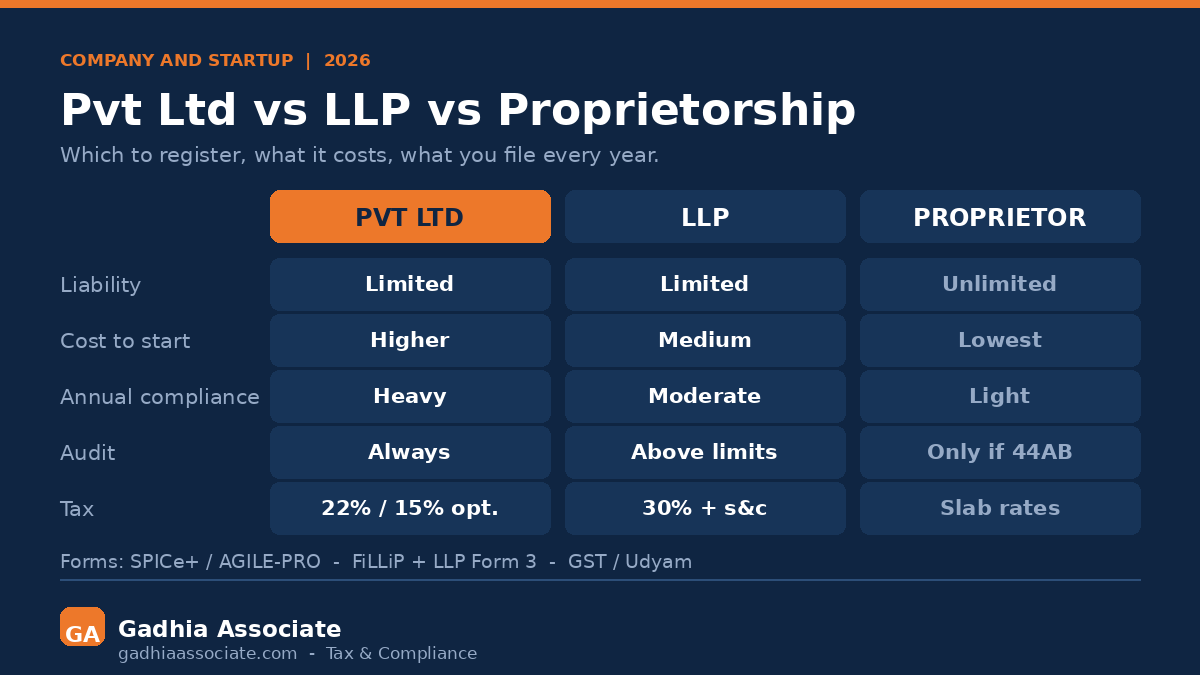
If you are still deciding between structures, our comparison of private limited versus LLP versus proprietorship, and the Business Structure Advisor tool on this site, will narrow it down faster than a conversation will. Our articles on presumptive taxation under Sections 44AD and 44ADA and on tax audit under Section 44AB cover the compliance load each structure carries.
Deed from the nineties, or a firm being set up this month?
Either way, an hour now is cheaper than an addition later. We have been in practice since 2007 with more than 7,000 clients across Saurashtra and Gujarat, a 5.0 Google rating from over 100 reviews, and fixed-fee and monthly plans covering the deed, registration, TDS and the annual return.
Free first consultation. Call or WhatsApp +91 82005 28355.
Frequently asked questions
At what rate is a partnership firm taxed?
A firm is taxed at a flat 30 per cent, with a 12 per cent surcharge where total income exceeds Rs 1 crore, plus health and education cess at 4 per cent. There are no slabs. The partner's share of profit is exempt in the partner's hands under Section 10(2A), because the firm has already paid tax on it.
Is a partner's salary taxable in the partner's own return?
Yes. Remuneration and interest on capital allowed to the firm as a deduction are taxable in the partner's hands as business income under Section 28(v), not as salary, so no standard deduction applies. Any part disallowed to the firm under Section 40(b) is correspondingly not taxed again in the partner's hands.
Can a deed be backdated to cover the whole year?
No. Section 40(b) blocks remuneration for any period before the date of the deed authorising it, and a backdated document creates stamp duty and evidentiary problems on top of the tax one. Sign the supplementary deed before the financial year it is meant to cover begins. March is the month to deal with it.
Does Section 194T apply to an LLP as well?
Yes. Section 194T applies to firms and LLPs alike from 1 April 2025, at 10 per cent on salary, remuneration, commission, bonus or interest to a partner once the annual aggregate crosses Rs 20,000. It does not apply to the partner's share of profit. Deduction bites on credit, including credit to a capital account.
Do the section numbers change under the Income-tax Act, 2025?
The Act came into force on 1 April 2026 and renumbered the provisions. The substance described here carries over: the remuneration ceiling, the 12 per cent interest limit, the working partner condition and the deduction at source on partner payments. Most numbers quoted online still refer to the 1961 Act, so check which statute a source is citing.
Position as of September 2026. Limits, thresholds and rates change through CBDT notifications and each year's Finance Act, and outcomes depend on individual facts. Please confirm the current position with us before acting on anything here.