Company Struck Off or Director Disqualified? How to Restore Your Company and Reactivate Your DIN
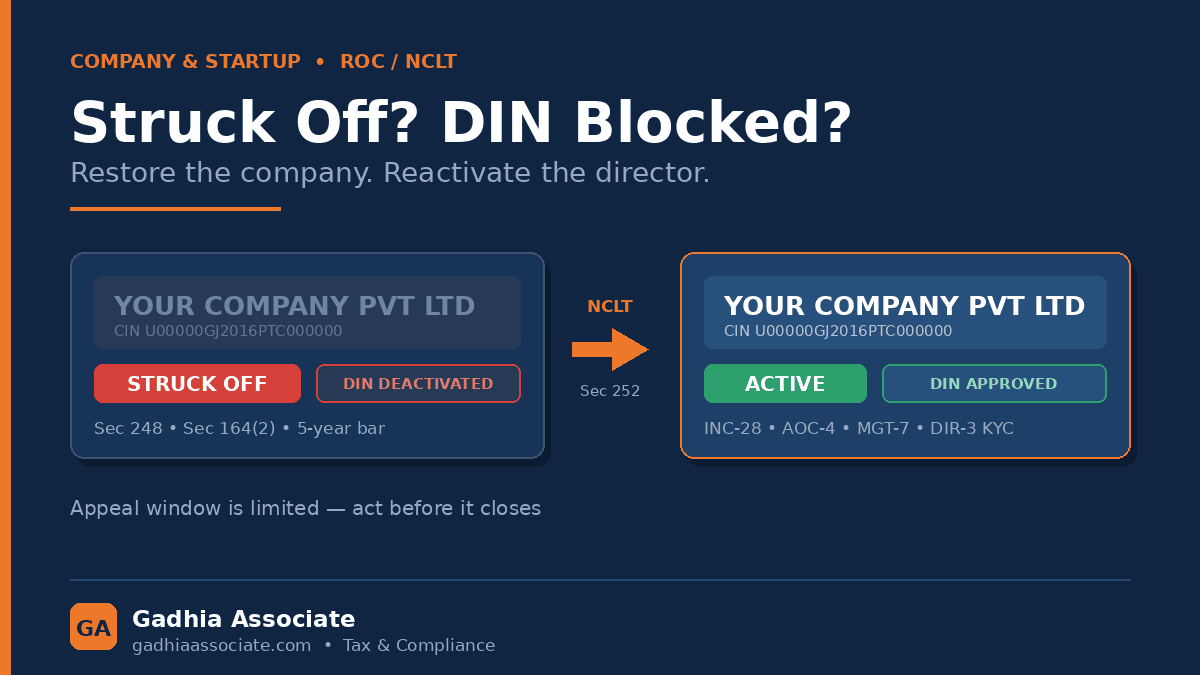
You tried to file a routine form and the MCA portal refused your DIN. Or you searched your own company and the master data reads Struck Off. Or the bank has frozen the current account and asked for a fresh CIN check. Perhaps you only found out because a new company you were joining as a director could not file DIR-12 with your name on it.
If any of that sounds familiar, you are dealing with one or both of two connected problems: a company struck off from the register by the Registrar of Companies, and a director disqualified under Section 164(2) with a deactivated DIN. They usually arrive together, they are both fixable, and the fix is procedural rather than mysterious. What it is not is instant, so the sooner you start, the better.
Check this in two minutes
Before assuming the worst, confirm which of the two problems you actually have. Both checks are free and public on the MCA portal.
- Company status: On the MCA site, use MCA Services then View Company/LLP Master Data. Enter your CIN or search by name. The field to read is Company Status. "Active" means you are fine. "Strike Off" or "Struck Off" means the ROC has removed the company under Section 248. Also note the date of strike off, because your appeal clock runs from there.
- Director status: Use Enquire DIN Status and enter your DIN. It will show Approved, Deactivated due to non-filing of DIR-3 KYC, or Disqualified.
- Disqualification lists: ROCs publish lists of disqualified directors under Section 164(2). Check whether your DIN appears against any company, not just the one you were thinking of.
That one screen tells you which of the sections below applies to you. Read only that one.
Situation 1: Your DIN is deactivated for DIR-3 KYC (the good news case)
If Enquire DIN Status says "Deactivated due to non-filing of DIR-3 KYC", stop worrying. This is not disqualification. It is an annual KYC formality that you simply missed, and it is unrelated to your company's filing record.
The fix: file DIR-3 KYC (or DIR-3 KYC-WEB if none of your details have changed) on the MCA portal with a late filing fee of Rs 5,000. Your DIN reactivates once the form is processed, usually within a few working days.
How to tell the two apart: a KYC deactivation says so in plain words in the DIN status and affects only you. A Section 164(2) disqualification shows as "Disqualified", carries a five-year period, and is tied to a company that failed to file. If you are unsure which you have, our earlier article on DIR-3 KYC covers the KYC route in detail.
How do I restore a struck off company?
Only one authority can put your company back on the register: the National Company Law Tribunal, under Section 252 of the Companies Act, 2013. The ROC cannot restore it, and no form filed on the MCA portal can undo a strike off on its own.
Do you still have time to appeal?
Yes, if you are within the limitation period. Broadly, an appeal against the strike off order can be filed within three years from the date of the ROC's order, by the company, a member, a creditor or a workman. Separately, where a person feels aggrieved by the company's name having been struck off, an application can be made up to twenty years from the publication of the notice in the Official Gazette. Confirm your exact date and route before you draft anything, because filing under the wrong limb wastes months.
What the petition involves
- A petition to the NCLT bench having jurisdiction over your registered office. For a Gujarat company that is the NCLT Ahmedabad bench. The petition is filed in the prescribed NCLT form (commonly Form NCLT-9 for applications of this kind), with the prescribed affidavit and Vakalatnama.
- Evidence that the company was carrying on business or in operation at the time of strike off, or that restoration is otherwise just. This is the heart of the case: bank statements, GST returns, invoices, contracts, employee records, property or lease documents, income tax returns.
- Board resolution and authorisation, latest available financial statements, and the ROC's strike off order and gazette notice.
- Service of the petition on the ROC and any other required parties, followed by hearings.
How long does NCLT restoration take?
Plan for six months to a year in practice, driven mostly by hearing dates. Some benches move faster. Filing to order in three to six months is a good outcome and does happen, but do not promise a bank or a buyer a date.
Cost range: the NCLT filing fee is modest, typically in the range of a few thousand rupees depending on the application. The real cost is professional and legal fees for drafting and appearance, plus the ROC filing fees and additional fees for the entire backlog of returns you must file after restoration. That backlog is frequently the larger number, because additional fees accrue per day per form.
After the order is passed, the work is not over
The NCLT order almost always comes with conditions. You must:
- File the certified copy of the order with the ROC in Form INC-28, within the time stated in the order (commonly 30 days).
- File the complete backlog of AOC-4 (financial statements) and MGT-7 / MGT-7A (annual returns) for every defaulting financial year, with additional fees.
- Pay any cost the Tribunal imposes, which is often directed to the ROC or a specified account.
Only when INC-28 is filed and processed does the master data flip back to Active. Until then, the company is still struck off for every practical purpose.
What being struck off actually costs you while it lasts
This is why it is not something to sit on. A struck off company cannot legally carry on business. Bank accounts are typically frozen, so receivables cannot be collected and salaries cannot be paid. Contracts become difficult or impossible to enforce or renew. Assets, including property and vehicles held in the company name, sit in limbo and cannot be cleanly transferred. Tenders, licences and GST registration come under threat. And every month, the annual filing backlog grows with additional fees.
How do I reactivate my DIN after disqualification?
Under Section 164(2), a director of a company that has failed to file its financial statements or annual returns for a continuous period of three financial years becomes disqualified, and is ineligible for re-appointment or appointment in any company for five years. In practice the MCA deactivates the DIN and the associated DSC becomes unusable for filings, so you cannot file even the forms that would cure the default. That circularity is exactly what makes people feel stuck.
Route 1: Restore the company through the NCLT
This is the cleanest route where the default relates to a struck off company. When the NCLT restores the company and INC-28 is filed, the MCA system generally removes the disqualification flag against the directors, and the company can then file its pending returns. Once the DIN is no longer flagged, you complete DIR-3 KYC to bring it back to Approved status. Restoration and DIN relief are therefore usually one project, not two.
Route 2: Writ petition before the High Court
Where the company is not struck off but the disqualification has still been imposed, or where the facts are disputed, directors have approached the High Court by writ petition. Courts have, in appropriate cases, granted relief allowing the DIN and DSC to be reactivated so that the pending filings can be completed. Outcomes here depend heavily on facts, on the bench, and on whether you can show bona fides. For a Gujarat company that means the Gujarat High Court, and it needs legal representation.
Route 3: A condonation or amnesty scheme, if one is open
The MCA has in the past opened schemes such as the Company Law Settlement Scheme and the Condonation of Delay Scheme (CODS), which allowed defaulting companies to file overdue returns and directors to have DINs restored on payment of a fee, without litigation. These schemes are notified from time to time and are not permanently available. Before you commit to an NCLT or writ route, it is always worth checking whether any such scheme is currently open, because it is by far the cheapest and fastest path when it exists.
Can a disqualified director be appointed in another company?
No. This is the point most people get wrong. The disqualification is attached to you, not to the defaulting company. For the five-year period you cannot be appointed or re-appointed as a director in any company, including a brand new one and including companies that are fully compliant. That is why DIR-12 filings naming you get rejected and why a co-founder's clean startup suddenly cannot add you to the board.
Illustrative scenario. A Junagadh trading private limited company stopped filing after FY 2019-20. The ROC struck it off in 2023. Its two directors discovered the problem in 2026 only when one of them tried to join a new company. The bank account holding roughly Rs 6,00,000 of receivables was frozen. They filed a Section 252 petition, obtained a restoration order after about seven months, filed INC-28, then cleared four years of AOC-4 and MGT-7 with additional fees. Total outlay across NCLT costs, professional fees and ROC additional fees ran into a few lakh rupees, and both DINs came back. Had they acted in 2023, the backlog and the additional fees would have been a fraction of that. Figures are illustrative only.
What makes it worse, and what not to do
- Incorporating a new company to escape the problem. You cannot. Your DIN is flagged, so you cannot be a director in the new entity either. You will have spent money on an incorporation you cannot use.
- Continuing to sign documents, contracts or cheques as a director. Acting as a director while disqualified carries its own consequences, and it undermines your case when you eventually go to the Tribunal or the Court.
- Ignoring it because the company was dormant anyway. Dormancy is not a defence to the annual filing obligation, and the disqualification runs regardless.
- Trying to voluntarily strike off your way out. If you wanted a clean closure, STK-2 was the route before the default; our article on company strike off and STK-2 covers when that is the right choice. Once the ROC has struck the company off and disqualification has attached, STK-2 is irrelevant.
- Waiting for the five years to pass quietly. Where the company was struck off, DINs are not simply restored at the end of the period. The company still has to be restored and the filings still have to be made.
- Letting the three-year appeal window lapse. This is the one genuinely irreversible mistake in this whole article.
When to stop DIY and get help
- Your company shows Struck Off and you need it back. NCLT proceedings are adversarial filings with the ROC as respondent, not portal forms.
- Your disqualification spans more than one company, or your DIN is flagged against a company you had already resigned from.
- The strike off happened close to three years ago and limitation is a live question.
- Bank accounts are frozen or assets need to be dealt with urgently.
- You are being asked for a solvency or compliance confirmation by a buyer, lender or tender authority.
- Several years of AOC-4 and MGT-7 must be reconstructed from incomplete books.
How Gadhia Associate Can Help
We deal with struck off companies and disqualified directors regularly, from our office in Junagadh, for clients across Gujarat and, digitally, across India.
We start with a status audit: company master data, DIN status, the disqualification lists, the exact strike off date and your remaining limitation. Then we tell you plainly which route fits, including whether any condonation scheme is currently open. We prepare and file the Section 252 restoration petition before the NCLT with the evidence of operations that actually persuades a bench, coordinate legal representation for hearings, file INC-28 once the order is passed, and then clear the entire backlog of AOC-4 and MGT-7 filings so the company returns to Active status. On the director side, we get DINs reactivated, complete DIR-3 KYC, sort out DSC issues, and where a writ petition to the High Court is the right route, we prepare the documentation and work with counsel.
The first consultation is free. Call or WhatsApp +91 82005 28355 with your CIN or DIN and we will tell you within one call what you are actually facing and what it will realistically take.
Position as of August 2026. Provisions on strike off, restoration, director disqualification and DIN reactivation are amended from time to time through MCA notifications, rules and schemes, and fees and timelines vary by bench, capital and case. Outcomes depend entirely on individual facts, and NCLT and High Court matters may require legal representation. This article is general information and not a substitute for advice on your specific case.