MSME Payment Not Received in 45 Days? Recover It with 3x Interest Through MSME Samadhaan, and File MSME-1 by 31 October 2026
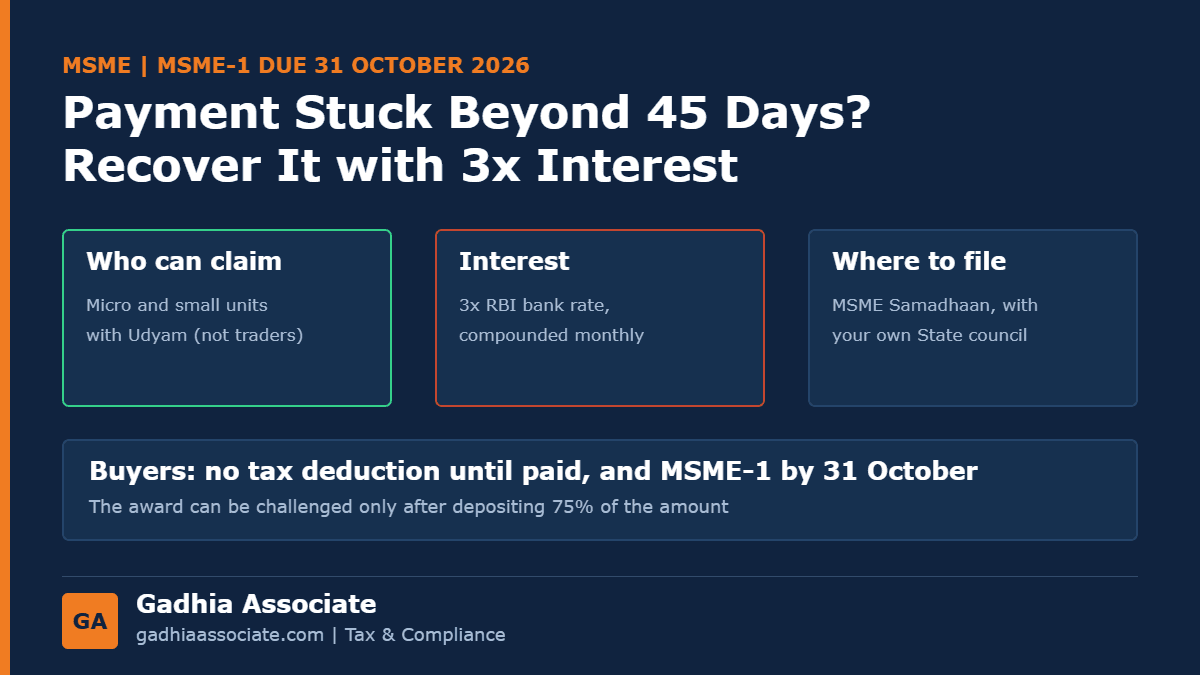
MSME payment not received in 45 days? A micro or small supplier can claim interest at three times the RBI bank rate through MSME Samadhaan.
Ketanbhai runs a micro unit in Rajkot that machines pump parts for a manufacturer in Ahmedabad. His bills of Rs 18 lakh are now five months old, the buyer keeps saying it pays "as per our cycle", and Diwali wages and raw material bills are due. He has had Udyam registration since 2021, but he did not know that the law fixes the credit period, adds steep interest after it, and gives him a forum in his own State to recover the money.
Delayed payment is the biggest cash-flow problem for small manufacturers and service firms in Saurashtra. The MSMED Act gives micro and small suppliers real teeth, and on the other side, buyers who pay late lose a tax deduction and, if they are companies, must report the dues to the MCA. Here is how both sides work in 2026.
In short: A buyer must pay a micro or small supplier within the agreed credit period, which can never be more than 45 days from acceptance of the goods or services, or within 15 days if nothing was agreed. After that, the buyer owes compound interest with monthly rests at three times the bank rate notified by the RBI. The supplier can file a case online on the MSME Samadhaan portal with the Micro and Small Enterprises Facilitation Council (MSEFC) of its own State, whatever State the buyer is in. The Council first tries conciliation and then decides the case as an arbitrator. A buyer that wants to challenge the award in court must first deposit 75% of it. Traders and medium enterprises cannot use this route. On the buyer side, late payments are allowed as a tax deduction only in the year they are actually paid, and companies must file Form MSME-1 for dues pending beyond 45 days; the return for April to September 2026 is due by 31 October 2026.
Our team handles Udyam registration, interest working, demand notices and MSME Samadhaan cases for suppliers, and MSME-1 and tax audit reporting for buyers. The details are at the end of this guide.
Who can claim under the MSME delayed payment law?
- Micro and small enterprises only: since 1 April 2025, a micro enterprise has investment up to Rs 2.5 crore and turnover up to Rs 10 crore, and a small enterprise up to Rs 25 crore and Rs 100 crore. Medium enterprises are not covered. See our guide to Udyam registration and the new limits.
- Manufacturers and service providers: retail and wholesale traders can get Udyam registration, but only for priority sector lending, so they cannot use the delayed payment protection.
- Registration date matters: the Supreme Court has held that the supplier should be registered when it enters into the contract. Bills for supplies made before your Udyam registration may not qualify, so register early.
- Any buyer: the buyer can be a company, firm, proprietor or government body anywhere in India.
How much interest can you claim?
- Due date: the agreed credit period, capped at 45 days from the day the buyer accepts the goods or services, or is deemed to accept them. If no period was agreed, 15 days.
- Rate: compound interest with monthly rests at three times the RBI bank rate, from the due date until payment. At recent bank rates, that is well over 15% a year.
- Agreement cannot reduce it: a clause offering 90 or 120 days of credit does not override the 45-day limit.
- Not deductible for the buyer: interest paid under this law is not allowed as a deduction in the buyer's income tax.
How to recover your dues through MSME Samadhaan
- Check your Udyam certificate: it must show micro or small, in manufacturing or services.
- Collect the papers: purchase orders or agreement, invoices, delivery challans or LRs, proof of acceptance such as GRNs or emails, the buyer's ledger statement and any written promises to pay.
- Send a demand notice: a notice with the interest worked out often brings payment without a case, and it records the default.
- File online: apply on the MSME Samadhaan portal with your Udyam number. The case goes to the MSEFC of your State, which has jurisdiction even if the buyer is in Maharashtra or Delhi.
- Conciliation: the Council calls both sides and tries to settle the dues.
- Arbitration: if conciliation fails, the Council decides the case as an arbitrator. The law asks for a decision within 90 days of the reference, though it often takes longer in practice.
- The award: it can be enforced like a court decree. To challenge it, the buyer must first deposit 75% of the amount in court.
Act quickly: very old dues can face limitation objections, and a case is stronger when the acceptance and the demands are on record.
Simple steps that protect your payments
- Print your Udyam number and the 45-day term on quotations, purchase orders and invoices
- Get written acceptance of deliveries, even by email or WhatsApp
- Keep a ledger confirmation from big buyers every quarter
- Follow up in writing after 45 days, so the delay is recorded
What it costs a buyer who pays late
- Income tax: a payment to a micro or small supplier made after the 45-day limit, or after the agreed period if shorter, is allowed as a deduction only in the year it is actually paid. This was section 43B(h) of the old Act and continues under the Income-tax Act, 2025. See our guide to the 45-day payment rule.
- Interest: three times the bank rate, compounded monthly, and not deductible.
- Disclosure: the buyer's annual accounts must show the principal and interest unpaid to micro and small suppliers, and auditors check it.
- Form MSME-1: a company that owes a micro or small supplier for more than 45 days from acceptance must file a half-yearly return with the MCA, giving the amount due and the reason for the delay. The return for April to September is due by 31 October, and for October to March by 30 April.
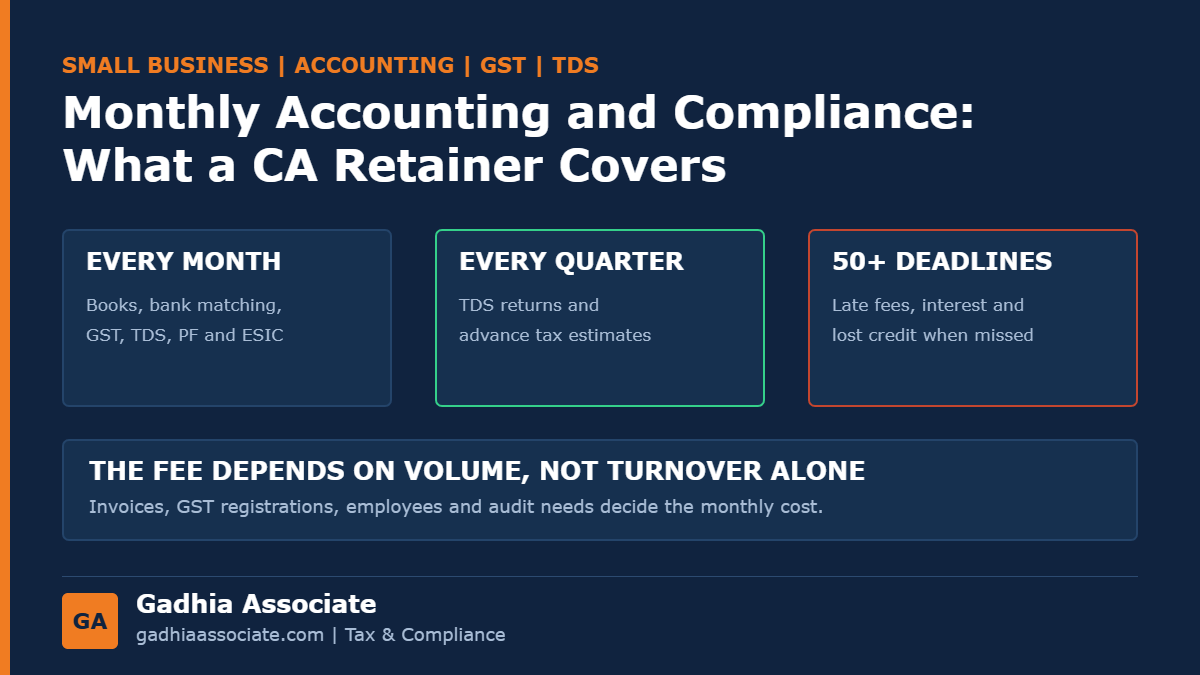
For companies, MSME-1 sits alongside the yearly ROC filings covered in our guide to private limited company annual compliance. Vendor classification is easier when the books are kept up every month, which is what a monthly accounting retainer covers.
Back to Ketanbhai. His purchase orders say 60 days, but the law caps the credit at 45 days, so interest runs from the 46th day after each delivery was accepted. A demand notice with the interest worked out goes to the buyer first. If it does not pay, he files on MSME Samadhaan with the Gujarat Council, using his Udyam number, invoices, LRs and the buyer's emails accepting the goods. The buyer, meanwhile, cannot claim these purchases as a tax deduction until it pays, and as a company it must show the dues in its MSME-1 return by 31 October.
How we help
- Udyam registration, update and classification checks
- Interest working and demand notices for overdue bills
- Filing on MSME Samadhaan and support through conciliation and arbitration
- Form MSME-1 filing and vendor classification for buyer companies
- Review of section 43B(h) disallowances in the tax audit
- Monthly accounts that track receivables and payables against the 45-day limit
Gadhia Associate has been in practice since 2007 and has handled work for over 7,000 clients, with a 5.0 Google rating from more than 100 reviews. Manufacturers and service businesses from Junagadh, Rajkot, Jamnagar, Morbi and Gondal come to our Junagadh office, where same-day appointments are available. Work for businesses elsewhere in India is handled online.
Buyer holding your payment beyond 45 days? Let us work out the interest and send the notice this week. Call or WhatsApp +91 82005 28355, or message us on WhatsApp. The first consultation is free.
Frequently asked questions
What is the MSME 45-day payment rule?
A buyer must pay a micro or small supplier within the agreed period, which cannot exceed 45 days from acceptance of the goods or services, or within 15 days if no period was agreed. Delay brings interest at three times the RBI bank rate.
How do I file a complaint on MSME Samadhaan?
Apply online on the MSME Samadhaan portal with your Udyam number, invoices and proof of delivery and acceptance. The case goes to the Facilitation Council of your State.
Can a trader file a case for delayed payment?
No. Retail and wholesale traders with Udyam registration get priority sector lending benefits only, not the delayed payment protection.
Can I file against a buyer in another State?
Yes. The Council of the State where the supplier is located can hear the case, wherever the buyer is.
What is the due date of MSME-1 for April to September 2026?
31 October 2026. The return for October 2026 to March 2027 is due by 30 April 2027.
Can the buyer appeal against the Council's award?
Yes, but it must first deposit 75% of the award amount in court.
Position as of 13 October 2026. Classification limits are those in force from 1 April 2025, and the tax rule continues under the Income-tax Act, 2025. Whether a claim succeeds depends on your registration, documents and dates, so take advice on your own facts.