PF and ESIC Registration in 2026: When It Becomes Compulsory, the New Rs 25,000 PF Wage Ceiling, Monthly Cost and How to Register in Gujarat
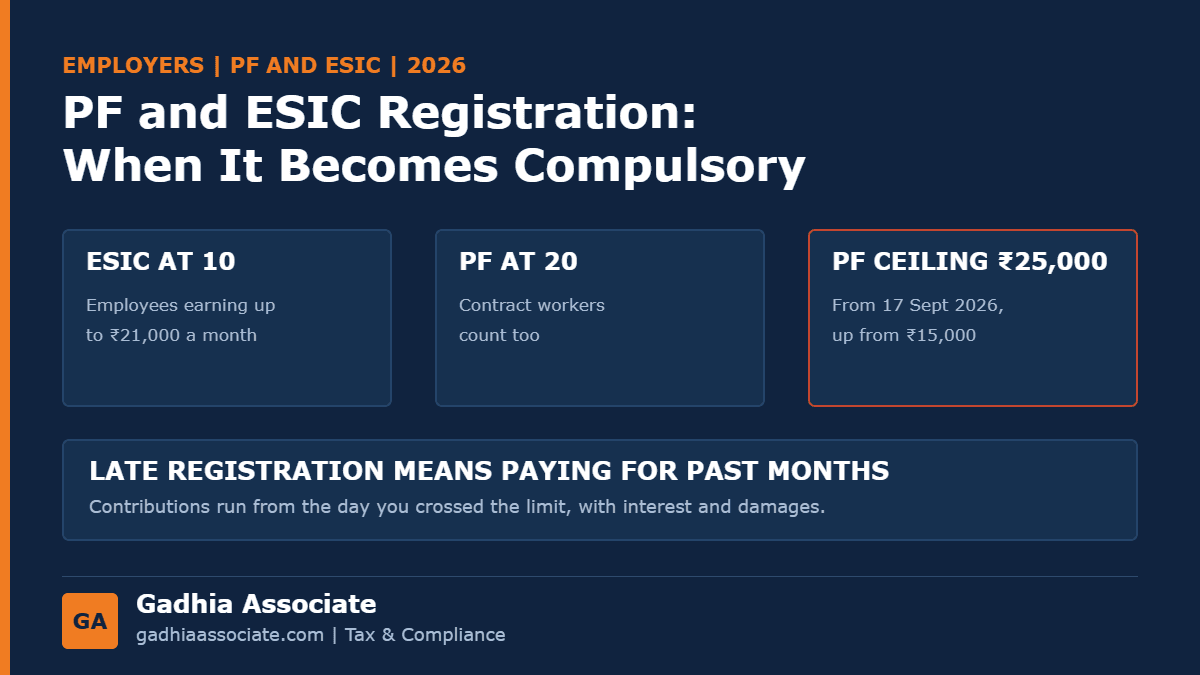
PF registration is compulsory at 20 employees and ESIC at 10, and from 17 September 2026 the PF wage ceiling is Rs 25,000, not Rs 15,000.
A Rajkot engineering unit had 17 workers in April. By Diwali, after two new orders, it has 23, plus a contractor's team on the shop floor. The owner never thought about PF, because "we are a small unit". But PF became compulsory the day the 20th worker joined, and ESIC had applied long before, at 10. Now his biggest buyer wants PF and ESIC challans before it releases the next order.
This happens to growing businesses all the time. Here is when PF and ESIC registration becomes compulsory, what changed in September 2026, what it costs each month, and how to register and stay compliant.
In short: Under the Code on Social Security, 2020, PF applies to an establishment once it has 20 or more employees, and ESIC once it has 10 or more, counting workers engaged through contractors. From 17 September 2026, the PF wage ceiling is Rs 25,000 a month, so employees earning up to that amount must be covered, and the maximum contribution on each side rises from Rs 1,800 to Rs 3,000. ESIC covers employees earning up to Rs 21,000 a month, at 3.25% from the employer and 0.75% from the employee. Registration is online, contributions are due by the 15th of the next month, and once covered, an establishment stays covered even if its headcount falls.
When do PF and ESIC become compulsory?
- PF: once you have 20 or more employees.
- ESIC: once you have 10 or more employees. Employees earning up to Rs 21,000 a month are covered.
- Who counts: all employees, including workers supplied by a contractor, apprentices aside.
- No going back: once covered, you stay covered, even if the number of employees later drops.
- Smaller businesses: can register voluntarily, which many do because larger buyers and tenders ask for it.
New companies get PF and ESIC registration along with incorporation, as part of the SPICe+ filing explained in our guide to private limited company registration in Gujarat.
What changed in September 2026?
By Notification S.O. 5109(E) dated 17 September 2026, the wage ceiling for PF, pension and deposit-linked insurance went up from Rs 15,000 to Rs 25,000 a month. That has two effects:
- Employees whose wages are between Rs 15,000 and Rs 25,000 now fall under compulsory PF coverage.
- The maximum contribution rises from Rs 1,800 to Rs 3,000 a month on each side, and the employer's pension share is worked out on wages up to Rs 25,000.
Two more things matter for payroll. "Wages" under the Code now include allowances above 50% of total pay, which raises PF for many salary structures, as explained in our note on the new labour codes. And under the Social Security (Central) Rules, 2026, new employees have to be registered on the ESIC portal from their first day of work.
What does it cost each month?
Take a worker whose wages are Rs 18,000 a month for both PF and ESIC:
- PF, employer: 12%, that is Rs 2,160, of which Rs 1,499 goes to the pension fund and Rs 661 to PF, plus about 1% more for insurance and administration charges.
- PF, employee: 12%, Rs 2,160, deducted from salary.
- ESIC, employer: 3.25%, Rs 585.
- ESIC, employee: 0.75%, Rs 135, deducted from salary.
So the employer's cost on this worker is about Rs 2,925 a month over the salary, and the worker gets PF savings, a pension, insurance cover and ESIC medical care for the family.
How do you register?
- Keep ready: PAN and address proof of the business, GST registration if any, a cancelled cheque, details of the owner or directors, a digital signature, and a list of employees with Aadhaar, bank details and dates of joining.
- Apply online on the government's Shram Suvidha portal for PF and ESIC, mentioning the date from which coverage applies.
- Get the codes: a PF establishment code and an ESIC code are allotted, usually within a few days if the documents are in order.
- Register employees: generate a UAN for each employee for PF, and an insurance number for each employee for ESIC.
- Pay and file every month: the PF return and payment, and the ESIC contribution, are due by the 15th of the following month.
What if you register late?
Coverage starts from the date you crossed the limit, not the date you register. So a late registration means paying contributions for all the past months, with interest at 12% a year and damages. In practice, the employer usually ends up paying the workers' share for those months too, because it cannot be recovered from old salaries. If a worker is injured or falls ill before ESIC registration, the employer can be asked to bear the cost of the benefits ESIC would have paid.
Inspections also follow complaints and data matches, and large buyers now check PF and ESIC challans as part of vendor audits.
Using contract labour?
If a contractor does not pay PF or ESIC for the workers he supplies, the principal employer can be made to pay and recover it from him. So factories ask contractors for their registration numbers and monthly challans, and contractors without them lose work. If you supply labour, registration is the first thing your client will ask for. If you hire through contractors, check their challans every month. And if you engage people as "consultants" to avoid PF, read our note on employee or consultant first.
A quick checklist
- Count all employees, including contract workers, every month.
- Register for ESIC by the time you reach 10 employees, and for PF by the time you reach 20.
- Recheck the PF coverage of employees earning between Rs 15,000 and Rs 25,000 from September 2026 salaries.
- Review the salary structure under the 50% wages rule.
- Register new joiners on the ESIC portal from day one.
- Pay PF and ESIC by the 15th, every month.
- Collect PF and ESIC challans from every contractor.
What we do for you
- Register your business for PF and ESIC, including voluntary registration
- Generate UANs and ESIC numbers and complete employee KYC
- File monthly PF and ESIC returns and payments on time
- Restructure salaries under the new wage definition and the Rs 25,000 ceiling
- Handle PF and ESIC inspections, notices and past-period regularisation
- Check contractors' compliance for principal employers
Gadhia Associate has been in practice since 2007 and has handled work for over 7,000 clients across Saurashtra and Gujarat, with a 5.0 Google rating from more than 100 reviews. Factories, contractors, hospitals, schools, shops and service businesses from Junagadh, Rajkot, Jamnagar, Jetpur, Veraval, Porbandar and Amreli come to our Junagadh office, where same-day appointments are available. Registration and monthly filings are online, so we also work with employers across Gujarat. Fixed-fee and monthly plans are available.
Crossed 10 or 20 employees, or not sure where you stand after the new ceiling? Call +91 82005 28355 or message us on WhatsApp. The first consultation is free.
Frequently asked questions
When is PF registration mandatory?
When an establishment has 20 or more employees, including workers supplied by contractors. Smaller businesses can register voluntarily.
When is ESIC registration mandatory?
When an establishment has 10 or more employees. It covers employees earning up to Rs 21,000 a month.
What is the new PF wage ceiling?
Rs 25,000 a month from 17 September 2026, up from Rs 15,000, under Notification S.O. 5109(E).
What is the ESIC contribution rate in 2026?
3.25% of wages from the employer and 0.75% from the employee.
What is the due date for PF and ESIC payment?
The 15th of the following month, for both PF and ESIC.
What happens if PF registration is done late?
Contributions are payable from the date coverage began, with interest and damages, and the employer usually bears the workers' share for the past months as well.
Position as of 1 October 2026. Thresholds, rates and procedures are under the Code on Social Security, 2020 and its rules, and can change through notifications. Take advice on your own establishment before you register.