Gold and Income Tax in 2026: How Much Gold You Can Keep at Home, Tax on Selling Old Jewellery, and the New Rules for Gold Bonds
There is no legal limit on how much gold you can keep at home, but you should be able to show where it came from, especially when you sell.
Every Dhanteras, a Junagadh family adds a coin or two to the jewellery the grandmother brought at her wedding in 1978. Now the granddaughter's wedding is close, gold prices are at a record, and the family wants to exchange some old pieces for new designs and sell a few others. Two questions come up at the dinner table. Can the tax department ask how much gold we have? And do we pay tax when we sell or exchange it?
Both have clear answers. Here they are, along with the new rules for gold bonds from April 2026 and what to keep in mind while buying this Diwali.
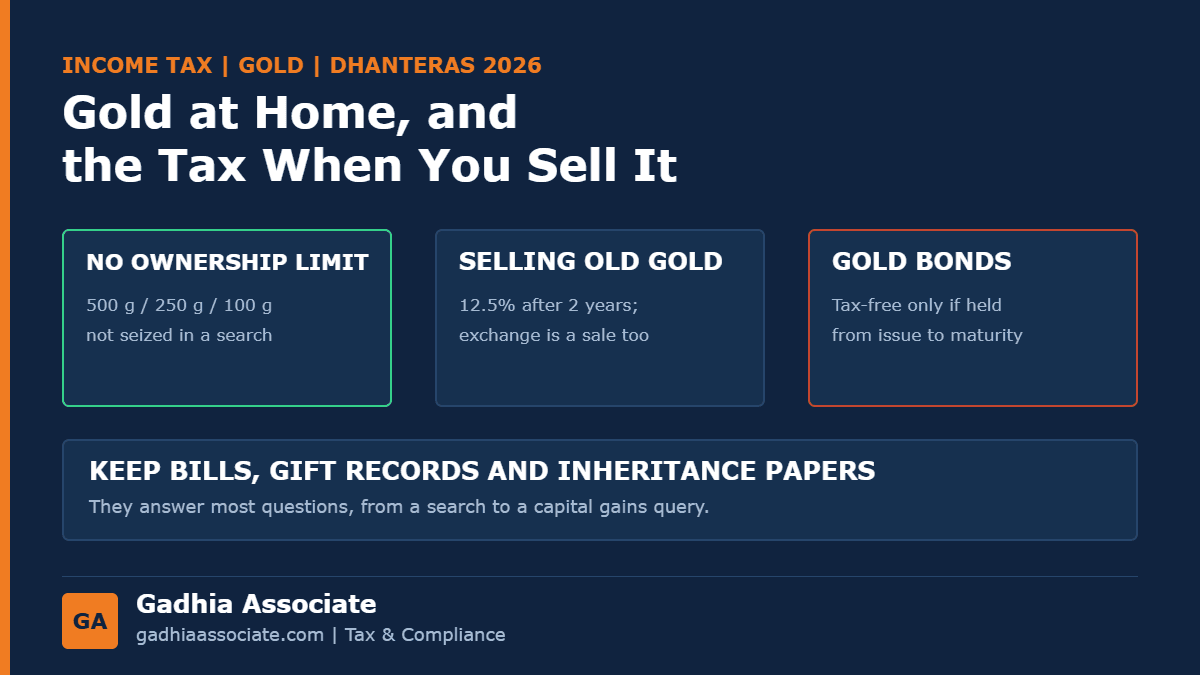
In short: Indian law does not cap how much gold a family can own. Under a CBDT instruction of 1994, reaffirmed in 2016, officers do not seize up to 500 grams of jewellery per married woman, 250 grams per unmarried woman and 100 grams per man during a search, even without proof. Gold bought from explained income, received as a gift or inherited is not taxed. When you sell or exchange old gold held for more than 24 months, the gain is taxed at 12.5% without indexation. From 1 April 2026, Sovereign Gold Bonds are tax-free on redemption only for investors who subscribed at issue and held them until maturity.
How much gold can you keep at home?
As much as you can explain. The limits people quote come from CBDT Instruction No. 1916 dated 11 May 1994, which tells officers what not to seize during a search, and the government repeated them in a press release on 1 December 2016:
- 500 grams for each married woman
- 250 grams for each unmarried woman
- 100 grams for each male member of the family
For a family with a husband, wife, an unmarried daughter and a son, that is 950 grams that will not be seized even if no bills are shown. These are not ownership limits. Gold above them is perfectly legal if it was bought from declared income, inherited, received as wedding or family gifts, or built up from household savings. You only need to be able to show it.
What helps: purchase bills, wedding photographs and lists of gifts, a will, family settlement or partition papers, and your income tax returns. For old family jewellery with no bills, a valuation report today and a written family history go a long way.
Do you pay tax when you sell old gold?
Yes, on the gain. Gold jewellery, coins and bars are capital assets.
- Held for more than 24 months: long-term capital gain, taxed at 12.5% without indexation, plus cess.
- Held for 24 months or less: short-term gain, added to your income and taxed at slab rates.
- Exchange for new jewellery: handing over old gold in exchange is also a sale of the old gold, even if no cash changes hands.
- Inherited or gifted gold: the cost and holding period of the previous owner are taken. For gold acquired before 1 April 2001, you can take its value on that date, as certified by a registered valuer, as the cost.
An example: the grandmother's jewellery is sold for Rs 10 lakh. A registered valuer certifies that it was worth Rs 40,000 on 1 April 2001. The long-term gain is Rs 9.6 lakh, and the tax at 12.5% is Rs 1.2 lakh, plus cess.
That tax can be saved by putting the sale proceeds into a residential house within the time allowed, under the old Section 54F, subject to its conditions. Our guide to capital gains exemptions explains how it works.
Gold bonds, ETFs and digital gold
- Sovereign Gold Bonds: the 2.5% yearly interest is taxable. From 1 April 2026, the gain on redemption is tax-free only if you subscribed at the time of issue and held the bond until maturity. Bonds bought on the stock exchange, or redeemed early, are taxed like other capital gains.
- Gold ETFs: long-term after 12 months, taxed at 12.5%. Short-term gains are taxed at slab rates.
- Gold mutual funds: long-term after 24 months, taxed at 12.5%.
- Digital gold: taxed like physical gold, long-term after 24 months.
Buying gold this Diwali
- GST: 3% on gold and jewellery, shown on the bill. Keep every bill.
- Cash: a jeweller cannot accept Rs 2 lakh or more in cash from one person for one bill or in one day, and the penalty equals the amount. Pay larger bills from your bank account. See our guide to cash transaction limits.
- Gifts: gold gifted by relatives, or received at your wedding, is not taxed. Gifts from others are taxable if they add up to more than Rs 50,000 in a year. Our note on gift taxation lists the relatives.
- Your return: if your income is above Rs 1 crore, jewellery and bullion must be shown in the assets schedule of your income tax return.
What if gold cannot be explained?
Gold found in a search, or bought with money that cannot be explained, is taxed as unexplained investment at a special flat rate, without any deduction. For income of tax year 2026-27 onwards, the rate under the new Act is 30%, about 39% with surcharge and cess, after the Finance Act, 2026 cut it from 60%. Penalties for misreporting can be heavy on top. The cheaper course is always to keep the paper trail ready.
A simple checklist for families
- Keep bills for every purchase, and file them with the year's papers.
- Write down jewellery received at weddings, with who gave it.
- For old family gold, get a valuation report and note how it came to you.
- Before selling or exchanging, work out the gain and whether a house purchase can save the tax.
- Pay jewellers by bank for larger bills.
- If you hold gold bonds, check whether you are an original subscriber before planning an early exit.
What we do for you
- Work out the capital gains tax before you sell or exchange gold
- Arrange valuation reports for inherited and pre-2001 jewellery
- Plan the sale proceeds to save tax under the house exemption
- File returns with capital gains and the assets schedule correctly
- Advise on gifts, wills and family settlements involving jewellery
- Reply to notices and questions about gold and high-value purchases
Gadhia Associate has been in practice since 2007 and has handled work for over 7,000 clients across Saurashtra and Gujarat, with a 5.0 Google rating from more than 100 reviews. Families, jewellers and business owners from Junagadh, Rajkot, Jamnagar, Veraval, Porbandar and Amreli come to our Junagadh office, where same-day appointments are available. We also advise online for families anywhere in India. Fixed-fee and monthly plans are available.
Planning to sell or exchange old gold this Diwali? Check the tax first. Call or WhatsApp +91 82005 28355. The first consultation is free.
Frequently asked questions
How much gold can I keep at home in India?
There is no legal limit. During a search, officers do not seize up to 500 grams per married woman, 250 grams per unmarried woman and 100 grams per man. Gold above that is fine if you can explain its source.
Is tax payable on inherited gold?
Not when you inherit it. When you sell it, capital gains tax applies, using the original owner's cost and holding period, or the value on 1 April 2001 if it was acquired before that date.
What is the tax on selling gold jewellery in 2026?
12.5% without indexation, plus cess, if held for more than 24 months. If held for 24 months or less, the gain is taxed at your slab rate.
Is exchanging old gold for new jewellery taxable?
Yes. Handing over old gold is treated as a sale, and the gain on it is taxable.
Are Sovereign Gold Bonds still tax-free?
Only for investors who subscribed at the time of issue and hold them until maturity. From 1 April 2026, bonds bought on the exchange or redeemed early are taxable.
Do I have to show my gold in my income tax return?
Only if your income is above Rs 1 crore, in the assets and liabilities schedule. Sales of gold are always reported as capital gains.
Position as of 1 October 2026. Holding periods and rates are under the Income-tax Act, with the new Act applying from tax year 2026-27, and CBDT's search instructions are administrative. Take advice on your own jewellery before you sell or exchange it.