Agricultural Income Tax in 2026: When Farm Income Is Tax-Free, How It Still Raises Tax on Your Other Income, and Which ITR Farmers Should File
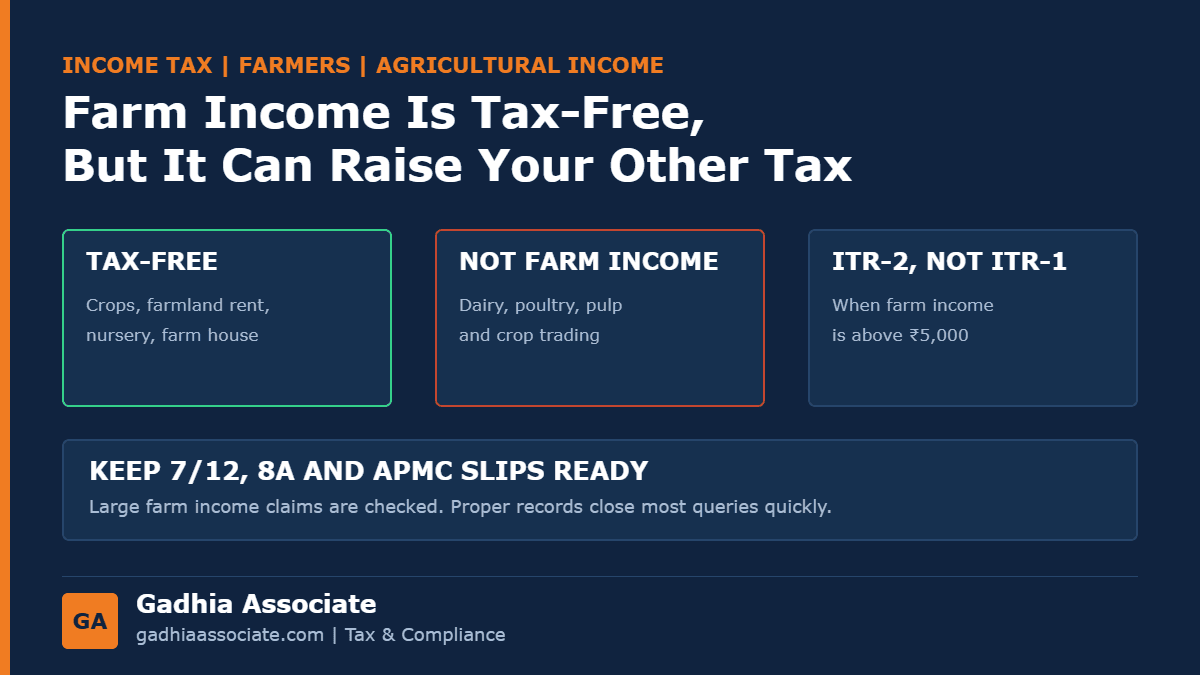
Agricultural income is exempt from income tax, but it can still increase the tax on your other income and must be shown in your return.
A Talala family grows Kesar mangoes on its orchard, keeps a dozen buffaloes, and the son works for a company in Rajkot. At tax time, the son files ITR-1 with his salary and leaves out the farm, because farm income is tax-free. Three things are wrong with that. The mango income is indeed exempt, but the milk income is not. The farm income pushes up the tax on his salary. And ITR-1 cannot be used at all once farm income crosses Rs 5,000.
Saurashtra runs on agriculture, and most farming families have some other income too. Here is what counts as agricultural income, how it affects your tax, which return to file, and what to keep ready if the department asks.
In short: Income from land in India used for agriculture, such as the sale of crops you grow, rent from farmland and income from a nursery, is exempt from income tax. Dairy, poultry, fisheries and processed products are not agricultural income and are taxed as business income. If your net agricultural income is more than Rs 5,000 and your other income is above the basic exemption limit, the farm income is added only to work out your tax rate, which raises the tax on your other income. Anyone with agricultural income above Rs 5,000 must use ITR-2 or ITR-3, not ITR-1.
What counts as agricultural income?
- Sale of crops grown by you on land in India: groundnut, cotton, wheat, cumin, mangoes, coconuts and so on
- Rent or lease income from land given to someone else for farming
- Income from saplings and seedlings grown in a nursery
- Processing done only to make the produce fit for the market, such as cleaning, drying and grading
- Income from a farm house on or next to the land, used by the farmer as a home or store, subject to conditions
What is not agricultural income?
- Dairy, poultry and fisheries: milk, eggs and fish are business income, even if the animals graze on your own land.
- Processed products: mango pulp, pickles, juice or oil made from your crop are business income beyond the stage of the raw produce.
- Trading: buying crops from other farmers and selling them is business, not farming.
- Non-farm use of land: rent from a mobile tower, a wedding plot or a godown on farmland is taxable.
- Interest: interest on delayed payment for produce, or on compensation for land acquired, is taxable.
- Selling the land: this is a capital gains question, which our guide to selling agricultural land in Gujarat covers.
How can tax-free farm income raise your tax?
Through a rule called partial integration. It applies to individuals and HUFs when net agricultural income is more than Rs 5,000 and other income is more than the basic exemption limit. The farm income is not taxed itself, but it is used to push your other income into a higher slab:
- Work out tax on your other income plus the agricultural income.
- Work out tax on the agricultural income plus the basic exemption limit.
- The difference is the tax you pay.
An example under the new regime for 2025-26: taxable income from salary and interest is Rs 14 lakh, and net agricultural income is Rs 6 lakh. Tax on Rs 20 lakh is Rs 2,00,000. Tax on Rs 10 lakh, which is the farm income plus the Rs 4 lakh exemption limit, is Rs 40,000. The tax payable is Rs 1,60,000, plus cess. Without the farm income, the tax on Rs 14 lakh would have been Rs 90,000. The exempt farm income has added Rs 70,000 to the bill.
This is not a penalty for farming. It is how the law keeps the slab system fair. But it does mean the farm income must be reported honestly, and planned for.
Which ITR should a farmer file?
- ITR-1: only if agricultural income is Rs 5,000 or less.
- ITR-2: salary, pension, interest, house rent or capital gains along with agricultural income above Rs 5,000.
- ITR-3: where there is also business income, such as a dairy, a shop or a trading business.
- Land details: where agricultural income is more than Rs 5 lakh, the return asks for each piece of land: district and PIN code, area, whether owned or leased, and whether irrigated or rain-fed.
A farmer with only agricultural income does not have to file a return. But it becomes compulsory in some cases, for example when deposits in savings accounts reach Rs 50 lakh in a year, and a return is useful proof of income for loans, visas and any question about cash.
Why large farm income claims are checked
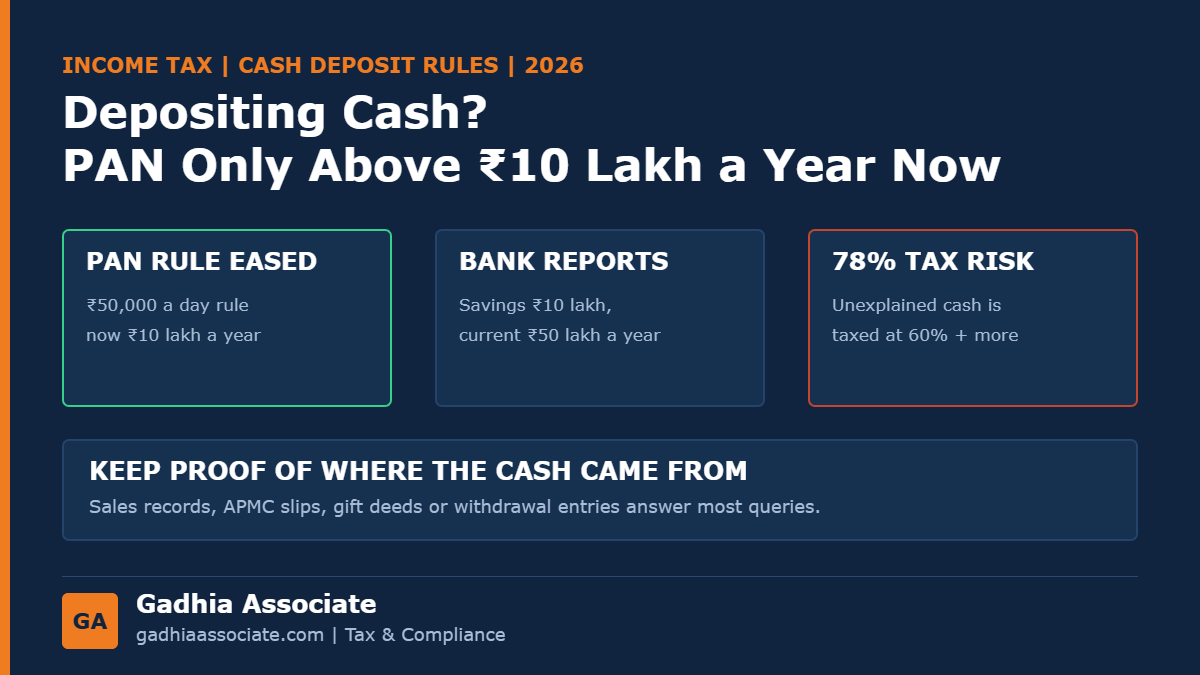
The department knows that agricultural income is sometimes used to cover money from elsewhere, so large claims are examined, especially when they come with big cash deposits. Our guide to cash deposit rules explains when banks report deposits. A genuine farmer can answer any such question with the right papers:
- 7/12 and 8A extracts for every piece of land, in your name or the family's
- APMC sale slips, or bills from the traders who bought the crop
- Bills for seeds, fertiliser, pesticide and diesel, and records of labour paid
- Lease agreements, if you farm leased land or lease yours out
- Bank statements showing where the sale money went
A claim of Rs 15 lakh from 3 acres of rain-fed land will raise questions. The same claim from 30 irrigated acres with sale slips will not.
Do farmers need GST registration?
No, not for selling produce they grow themselves. Registration can be needed for other activities, such as trading or processing, once the limits are crossed. Our guide on whether you need GST registration explains the limits.
What we do for you
- Separate agricultural income from dairy, processing and other business income
- Compute tax with partial integration under the old or the new regime
- File the right ITR with land details and agricultural income correctly reported
- Prepare records and replies when farm income or cash deposits are questioned
- Advise on the sale of agricultural land and the capital gains exemptions
- Keep accounts for dairies, orchards with processing units and agri-trading businesses
Gadhia Associate has been in practice since 2007 and has handled work for over 7,000 clients across Saurashtra and Gujarat, with a 5.0 Google rating from more than 100 reviews. Farmers and farming families from Junagadh, Talala, Keshod, Mangrol, Una, Veraval, Rajkot and Amreli come to our Junagadh office, where same-day appointments are available. Returns and notice replies are filed online, so we also help farming families living elsewhere. Fixed-fee and monthly plans are available.
Have farm income along with salary, a dairy or a business? Get the return right. Call or WhatsApp +91 82005 28355. The first consultation is free.
Frequently asked questions
Is agricultural income taxable in India?
No. Income from land in India used for agriculture is exempt. But it is added to your other income to work out the tax rate when it is more than Rs 5,000 and your other income is above the basic exemption limit.
Is dairy income agricultural income?
No. Income from selling milk, eggs or fish is business income and is taxable.
Which ITR should I file if I have agricultural income and salary?
ITR-2, if agricultural income is more than Rs 5,000. ITR-1 can be used only when it is Rs 5,000 or less.
Is rent from agricultural land taxable?
Rent from land given for farming is agricultural income and exempt. Rent from non-farm use, such as a tower or a wedding plot, is taxable.
Do farmers have to file an income tax return?
Not if they have only agricultural income, unless a condition such as large bank deposits makes it compulsory. Filing is still useful as proof of income.
What documents prove agricultural income?
7/12 and 8A extracts, APMC sale slips or trader bills, bills for farm inputs, lease agreements and bank statements.
Position as of 1 October 2026. Agricultural income remains exempt under the Income-tax Act, 2025, which applies from tax year 2026-27, and the example uses the new regime slabs for 2025-26. Take advice on your own family's income before you file.