Income Tax on F&O Trading in 2026: Business Income, Turnover Calculation, Tax Audit, ITR-3, Loss Carry Forward and the New STT Rates
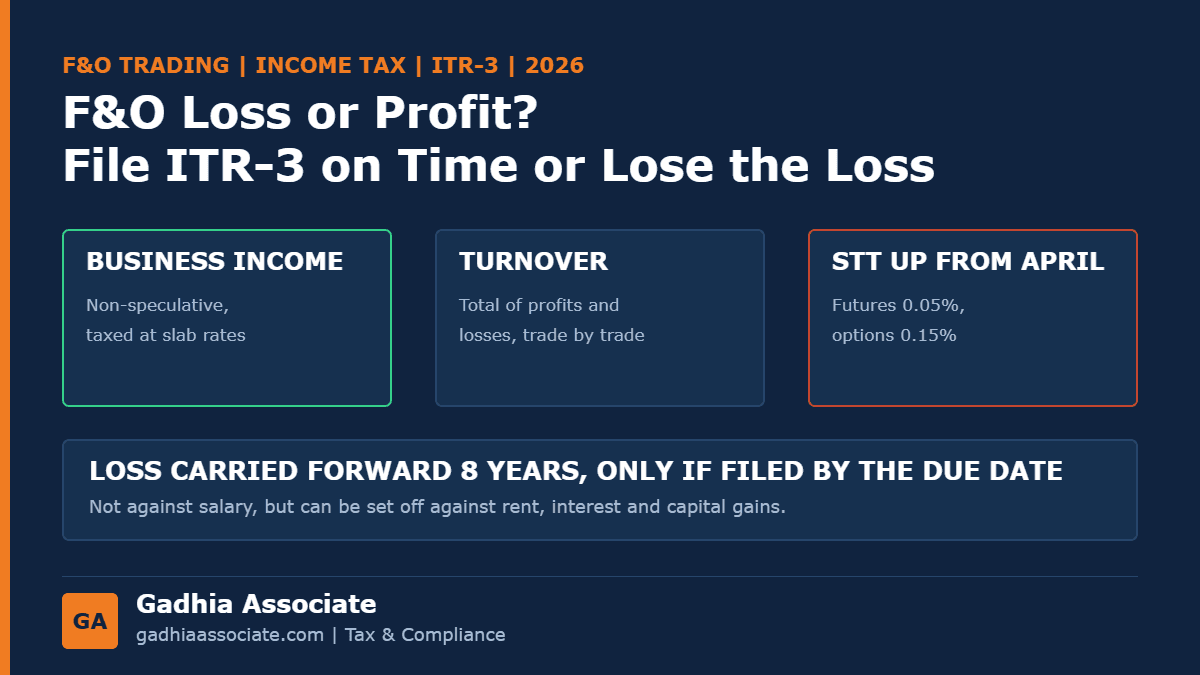
F&O trading is taxed as business income in ITR-3, and a loss can be carried forward for eight years, but only if you file on time.
A Jamnagar engineer with a salary of Rs 9 lakh trades Nifty options on his phone in the evenings. In 2025-26 he lost Rs 3.4 lakh. He filed ITR-1 as usual, showing only his salary, because a loss surely means no tax. In 2026-27 his trading turned around and he made Rs 5 lakh. That is when he learnt that last year's loss, which could have been set off against this profit, was gone, because it was never reported in ITR-3 by the due date.
F&O taxation is not complicated once you know how it is classified. This article explains how F&O income is taxed, how turnover is calculated, when a tax audit is needed, how losses are set off and carried forward, which expenses you can claim, and what the higher STT from April 2026 means.
Short answer: Profit or loss from futures and options on a recognised exchange is non-speculative business income, taxed at your slab rate and reported in ITR-3. Intraday equity trading is different: it is speculative business income. F&O turnover for tax purposes is the total of the profits and losses on each trade, not the contract value. A tax audit is needed if that turnover crosses Rs 10 crore, or if you left presumptive tax within the last five years and your income is above the basic exemption limit. An F&O loss can be set off against any income except salary in the same year and carried forward for eight years, but only if the return is filed by the due date. From 1 April 2026, STT on futures rose to 0.05% and on options to 0.15%.
How is F&O income taxed?
- F&O on a recognised exchange: non-speculative business income.
- Intraday equity: buying and selling shares on the same day without delivery is speculative business income, kept separate.
- Delivery-based shares and mutual funds: capital gains, taxed at special rates, as explained in our guide to tax on shares and mutual funds.
- Tax rate: F&O profit is added to your other income and taxed at slab rates, under the old or the new regime.
How is F&O turnover calculated?
Turnover here is not the value of the contracts you trade. Under the ICAI Guidance Note on Tax Audit, turnover is the total of the favourable and unfavourable differences, that is, the profit or loss on every closed trade added together, ignoring the minus sign. The same method applies to futures and options, and the premium on options sold is not added again where it is already part of the profit or loss on the trade.
An example: three trades end in a profit of Rs 40,000, a loss of Rs 65,000 and a profit of Rs 10,000. The net result is a loss of Rs 15,000, but the turnover is Rs 1,15,000.
When is a tax audit needed?
- Turnover above Rs 10 crore: an audit is required where cash receipts and cash payments are each within 5% of the total, as they are for most traders. Otherwise, the limit is Rs 1 crore.
- Presumptive tax history: if you declared income under presumptive tax (old Section 44AD) for any year and then moved out of it, an audit is needed in each of the next five years in which your income exceeds the basic exemption limit.
- Otherwise: a trader below these limits who declares the actual profit or loss is not required to get an audit, even with a loss.
Presumptive tax is available to traders in principle, but it locks you in for five years and does not suit a loss year. Read our note on presumptive taxation before choosing it.
How are F&O losses set off and carried forward?
- Same year: an F&O loss can be set off against any other income except salary, such as rent, interest, capital gains or other business income.
- Carry forward: the balance can be carried forward for eight years and set off against business income, including future F&O profits.
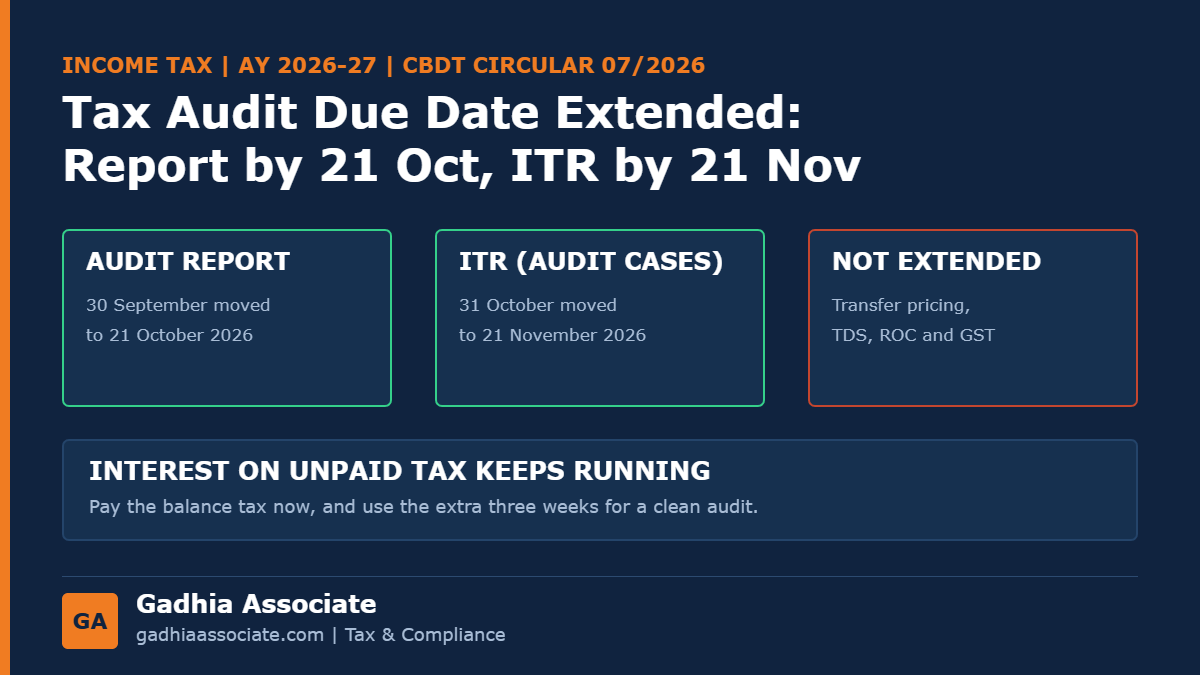
- The condition: the return must be filed in ITR-3 by the due date, which is 31 August if no audit is needed, or 31 October where an audit applies (21 November for AY 2026-27, after the CBDT extension). A loss in a belated return cannot be carried forward.
- Intraday loss: a speculative loss can be set off only against speculative income, and carried forward for four years.
Which expenses can you claim?
- Brokerage, exchange and SEBI charges, stamp duty, and GST on these charges
- STT paid on your trades
- Internet and phone costs, to the extent used for trading
- Subscriptions to trading software, data and advisory services
- Depreciation on your laptop and other equipment
- Interest on money borrowed for trading
Keep the contract notes and your broker's annual profit and loss statement and ledger. They are the base for turnover, profit and expenses.
What does the higher STT from April 2026 mean?
- Futures: 0.05% of the sale value, up from 0.02%.
- Options sold: 0.15% of the premium, up from 0.1%.
- Options exercised: 0.15% of the settlement value, up from 0.125%.
Selling Nifty futures worth Rs 12 lakh now costs Rs 600 in STT, against Rs 240 earlier. For an active trader, STT alone can run into lakhs a year. It is still allowed as a business expense, so record it properly. Rates on delivery and intraday equity trades are unchanged.
Do you need to pay advance tax?
No TDS is deducted on trading profits, so a profitable trader must pay advance tax in instalments by 15 June, 15 September, 15 December and 15 March, or pay interest. Our guide to advance tax explains the instalments and the interest.
A checklist before you file
- Download the broker's tax profit and loss statement and contract notes for the full year.
- Separate F&O, intraday and delivery trades.
- Work out F&O turnover by the ICAI method.
- Check whether an audit applies, including your presumptive tax history.
- List trading expenses, with proof.
- File ITR-3 by the due date, even in a loss year, to protect the carry forward.
- Pay advance tax during the year if you are in profit.
What we do for you
- Compute F&O turnover, profit and loss correctly from broker statements
- Tell you whether a tax audit applies, and carry it out where needed
- File ITR-3 with losses set off and carried forward correctly
- Plan advance tax during the year for profitable traders
- Reply to notices about trading income or mismatches in the AIS
- Revise or update past returns where F&O income was missed
Gadhia Associate has been in practice since 2007 and has handled work for over 7,000 clients across Saurashtra and Gujarat, with a 5.0 Google rating from more than 100 reviews. Traders, salaried investors and business owners from Junagadh, Rajkot, Jamnagar, Veraval, Porbandar and Amreli come to our Junagadh office, where same-day appointments are available. Returns and tax audits are handled online, so we also work with traders anywhere in India. Fixed-fee and monthly plans are available.
Made a profit or a loss in F&O this year? Talk to us before you file. Call or WhatsApp +91 82005 28355. The first consultation is free.
Frequently asked questions
Is F&O income business income or capital gains?
It is non-speculative business income, taxed at slab rates and reported in ITR-3.
Which ITR form is used for F&O trading?
ITR-3, even if you also have salary and the F&O result is a loss.
How is F&O turnover calculated for tax audit?
As the total of the profits and losses on each closed trade, ignoring the minus sign, under the ICAI Guidance Note. It is not the contract value.
Is a tax audit required for an F&O loss?
Not if turnover is within Rs 10 crore and you have not moved out of presumptive tax in the last five years. Otherwise, it may be.
Can an F&O loss be set off against salary?
No. It can be set off against other income such as rent, interest or capital gains, and the rest carried forward for eight years.
What is the STT on F&O from April 2026?
0.05% on the sale of futures, 0.15% on the premium of options sold, and 0.15% on options exercised.
Position as of 29 September 2026. From tax year 2026-27, these rules continue under the Income-tax Act, 2025 with new section numbers, such as Section 63 for tax audit and Section 58 for presumptive tax. ICAI guidance and STT rates can change. Take advice on your own trading statements before you file.