Presumptive Taxation in 2026: Section 44AD and 44ADA Explained, Turnover Limits, the 6% vs 8% Rule and the Five-Year Lock-In
Presumptive taxation in 2026: the short answer
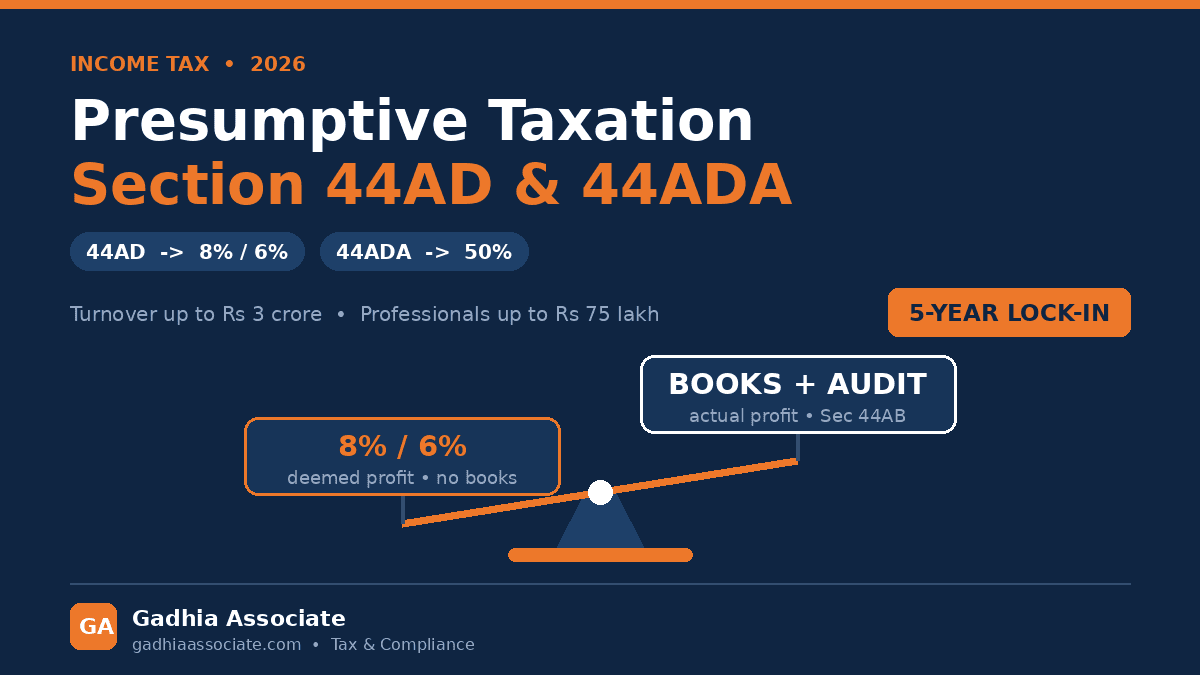
Presumptive taxation lets small businesses and professionals declare a fixed percentage of turnover or gross receipts as profit, pay tax on that, and skip detailed books and audit. Under Section 44AD a small business declares 8% of turnover as income, reduced to 6% for receipts through banking or digital modes. Under Section 44ADA a specified professional declares 50% of gross receipts. Choose it and your compliance shrinks to a single simple return.
The scheme exists because Parliament accepted a practical truth: a kirana shop in Junagadh, a contractor in Rajkot or a freelance designer working from home should not need the same accounting machinery as a listed company. What follows is the full working position as we advise clients in Gujarat today.
What is presumptive taxation and why does it exist?
Ordinarily, a business computes taxable profit as income minus every allowable expense, supported by books of account maintained under Section 44AA. Presumptive taxation replaces that computation with a statutory percentage. You declare the deemed profit, pay tax at your slab rate, and the law does not ask you to prove each expense. The trade-off is simple and absolute: once you declare the deemed percentage, no further deduction for business expenses or depreciation is allowed. Rent, salaries, electricity, interest on business loans, depreciation on your vehicle or machinery are all treated as already absorbed inside the presumed margin.
Depreciation is notionally deemed to have been allowed, so the written down value of your assets keeps reducing year after year even though you never claimed it. That matters the day you sell the asset or exit the scheme.
Who can opt for Section 44AD?
Section 44AD is available to a resident individual, a resident Hindu Undivided Family, and a resident partnership firm other than a Limited Liability Partnership. Companies and LLPs cannot use it at all. Nor can a non-resident, however small the turnover.
Certain activities are carved out even for eligible persons. You cannot use 44AD if you are in the business of plying, hiring or leasing goods carriages covered by Section 44AE, if you earn income in the nature of commission or brokerage, or if you carry on an agency business. Insurance agents, mutual fund distributors, commission agents in the APMC trade and similar intermediaries are therefore outside the scheme, a point many taxpayers in Gujarat's trading belt discover only when a notice arrives.
A person carrying on a profession covered by Section 44ADA also cannot use 44AD for that professional income.
What are the turnover limits and the 6% versus 8% rule?
The basic turnover limit for Section 44AD is Rs 2 crore. The limit is enhanced to Rs 3 crore where cash receipts during the year do not exceed 5% of total turnover. For this test, a cheque or bank draft that is not account payee is treated as cash. The message is deliberate: go digital and you get a larger presumptive window.
On the rate, the deemed profit is 8% of turnover, reduced to 6% to the extent of turnover received through account payee cheque, account payee bank draft, electronic clearing system or other prescribed electronic modes, provided the amount is received during the year or by the due date for filing the return. In practice a fully digital business declares 6% across the board; a mixed business splits its turnover and applies each rate to the relevant slice.
You are always free to declare a higher profit than the deemed percentage. You are not free to declare less while staying inside the scheme.
What is Section 44ADA and can a freelancer use it?
Yes, in most cases. Section 44ADA covers resident professionals carrying on a profession specified under Section 44AA(1): legal, medical, engineering, architectural, accountancy, technical consultancy, interior decoration, and other notified professions such as authorised representatives, film artists and company secretaries. Independent software and IT consultants are commonly covered under technical consultancy, though the classification should be checked against the actual nature of the work.
The gross receipts limit is Rs 50 lakh, raised to Rs 75 lakh where cash receipts do not exceed 5% of gross receipts. The deemed profit is 50% of gross receipts. Again, no further deduction for expenses or depreciation is available, though deductions under Chapter VI-A such as 80C or 80D remain available if you are in the old regime.
Goods transport operators have their own scheme in Section 44AE, where income is computed per goods carriage per month based on gross vehicle weight, available to those owning not more than ten goods carriages at any time during the year.
What is the difference between 44AD, 44ADA and normal books and audit?
Think of three routes. Under 44AD, a business with Rs 80 lakh digital turnover declares Rs 4.8 lakh as income, keeps no formal books, and files a short return. Under 44ADA, a professional with Rs 40 lakh receipts declares Rs 20 lakh, a far higher proportion, because professional practices genuinely carry higher margins and lower input costs. Under the normal route, either of them computes actual profit after every real expense, maintains books under Section 44AA, and gets a tax audit under Section 44AB where turnover crosses the audit threshold.
The normal route wins when your real margin is genuinely below the presumptive percentage, for instance a thin-margin trading business or a professional who has taken an office on rent and employs staff. The presumptive route wins on cost, speed and certainty. There is no universally right answer, only an arithmetic one for your numbers.
What happens if I opt out of Section 44AD?
This is the trap that catches the most people. Section 44AD carries a five-year continuity rule. If you declare presumptive income in one year and then, in any of the next five assessment years, declare profit lower than the deemed percentage, you are barred from Section 44AD for the five assessment years following the year of default. During that period you must maintain books of account and, if your total income exceeds the basic exemption limit, get them audited under Section 44AB.
So opting out is not a neutral one-year decision. It closes the door for half a decade and imports an audit obligation at turnover levels that would otherwise never require one. Section 44ADA does not carry an equivalent five-year lock-in, but the audit consequence of declaring lower profit while claiming to be covered still applies.
Do I need to maintain books under presumptive taxation?
No formal books of account are required under Section 44AA while you remain in the scheme, and no tax audit is triggered merely by turnover within the limits. That said, keep the basics:
- Bank statements for all business accounts, clearly separated from personal accounts
- A record of turnover split between digital and cash receipts, to defend the 6% rate and the 5% cash test
- Sales invoices and GST returns, which must reconcile with declared turnover
- Fixed asset details, since depreciation is deemed allowed and the written down value keeps reducing
- Proof of advance tax payment and the challan
- Chapter VI-A deduction proofs if you are claiming them
Which ITR form and what about advance tax?
Presumptive taxpayers generally file ITR-4 Sugam. It cannot be used if total income exceeds Rs 50 lakh, if you are a director in a company, hold unlisted equity shares, own more than one house property, have capital gains, agricultural income above Rs 5,000, foreign assets or foreign income, or brought forward losses. In those cases you move to ITR-3 while still computing income presumptively.
On advance tax, presumptive taxpayers get a genuine relaxation: the entire advance tax liability can be paid in a single instalment by 15 March of the financial year, instead of the four-instalment calendar. Miss that date and interest under Section 234C applies. Our earlier article on advance tax explains the instalment mechanics and interest calculation in detail, and if a mismatch between your declared turnover and your GST or AIS data brings a query, our article on handling income tax notices sets out the response process.
An illustrative example
Illustrative only. Priya is a freelance architect in Junagadh with gross receipts of Rs 30,00,000, all received by bank transfer. Under Section 44ADA she declares 50%, that is Rs 15,00,000, as professional income. No books, no audit, one simple return. Suppose her actual expenses, including an assistant's salary, office rent and software, come to Rs 18,00,000, leaving a real profit of Rs 12,00,000. Maintaining books would let her declare Rs 12,00,000 instead of Rs 15,00,000 and save tax on Rs 3,00,000, but she would take on bookkeeping cost and, because her declared profit is below 50%, a tax audit obligation. If her expenses were only Rs 8,00,000, the presumptive route would be clearly better. Run the arithmetic before you choose.
A note on the Income-tax Act, 2025
The Income-tax Act, 2025 came into force on 1 April 2026 and renumbered the sections of the old 1961 Act, consolidating the presumptive provisions for business, professions and goods carriages into a restructured set of clauses. The substance described above, the eligibility, the limits, the 6% and 8% rates, the 50% rate for professionals and the five-year rule, has been carried forward. Because references in older documents, contracts and software still use the familiar 44AD, 44ADA, 44AE and 44AB numbering, we have used those numbers here; confirm the corresponding new section reference before quoting it in any filing or legal document.
How Gadhia Associate can help
We advise businesses and professionals across Junagadh and Gujarat on whether presumptive taxation actually saves them money, and on the structural questions that sit behind it. Try our Business Structure Advisor to see whether a proprietorship, partnership or company suits you, since the choice decides whether 44AD is even available. Our GST Calculator helps you reconcile turnover before you declare it. For return filing, notice handling and planning, see our Income Tax services, and for incorporation or conversion, our Company Registration support. Book a free consultation and we will run both routes on your numbers before you commit to a five-year decision.
Position as of August 2026. Tax law changes through CBDT notifications, circulars and Finance Act amendments, and section numbering has been restructured by the Income-tax Act, 2025. Please confirm the current position with a qualified professional before acting on this article.