NRI Rental Income from Property in India 2026: 30% TDS by the Tenant, How to Reduce It, Tax Calculation and Sending Rent Abroad
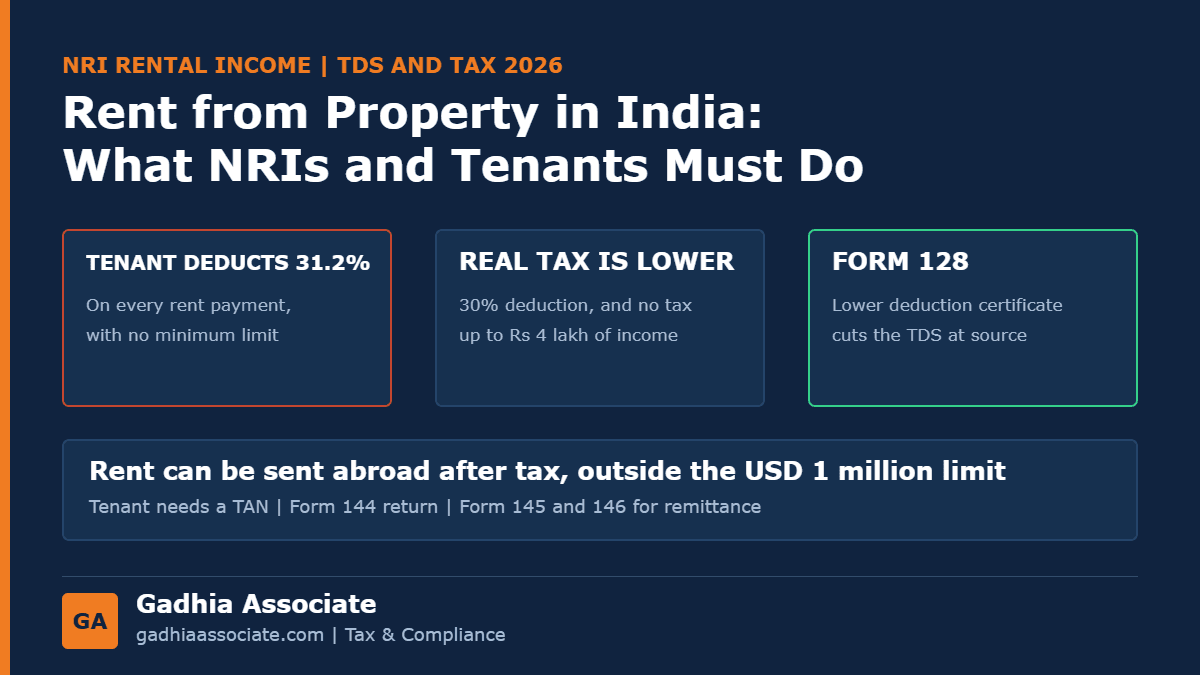
NRI rental income from property in India is taxed here, and the tenant must deduct 30% TDS plus cess from every rent payment.
Bhavesh lives in Leicester and lets out his flat in Rajkot for Rs 40,000 a month. His tenant, a bank officer, has paid the full rent into his account for three years. Neither of them knew that a tenant paying rent to an NRI must deduct tax at 31.2% from every payment, whatever the rent. When the tenant's accountant finally spots it, both have a problem: the tenant for not deducting, and Bhavesh for returns he never filed.
The rule is harsh on paper and easy to manage in practice. Here is how rent is taxed for an NRI, what the tenant has to do, how to bring the TDS down to what you really owe, and how to take the rent abroad.
In short: Rent from a property in India is taxable in India even if you live abroad. The tenant must deduct TDS at 30% plus cess, which is 31.2%, on the full rent, with no minimum limit, and needs a TAN to do it. Your real tax is much lower, because 30% of the rent is allowed as a flat deduction and the first Rs 4 lakh of income is not taxed under the new regime. You can get the excess back by filing a return, or avoid it from the start with a lower deduction certificate applied for in Form 128. Rent is normally received in your NRO account and can be sent abroad after tax, with Form 145 and, above Rs 5 lakh a year, Form 146.
Our NRI Desk handles the certificate, the tenant's paperwork, the return and the remittance for NRI landlords in any country. The details are at the end of this guide.
How is rental income taxed for an NRI?
- Start with the rent for the year.
- Deduct the municipal tax you paid.
- Deduct a flat 30% of the balance for repairs and upkeep, whether you spent it or not.
- Deduct interest on a home loan taken for that property.
- The balance is added to your other Indian income and taxed at the slab rates.
An example: Bhavesh's rent is Rs 40,000 a month, or Rs 4,80,000 a year. Less 30%, the taxable amount is Rs 3,36,000. He has no other income in India, so for 2025-26 he is below Rs 4 lakh and his tax is nil. In the earlier years the limit was Rs 3 lakh, so a return and a small tax, under Rs 2,000 a year, were due.
- More than one house: up to two houses that you keep for your own use are not taxed, even if they stay locked. A third house is taxed on a notional rent, even if it is vacant.
- Joint owners: each owner is taxed on his or her own share of the rent.
- No rebate for NRIs: the rule that residents pay no tax up to Rs 12 lakh does not apply to non-residents. Our guide to NRI income tax in India explains the slabs.
What must the tenant do?
- Get a TAN. The PAN-based route that began on 1 October 2026 is only for buying property from an NRI, not for rent.
- Deduct TDS at 31.2% from every rent payment. The rule that no TDS applies up to Rs 50,000 a month is for resident landlords only, as our guide to TDS on rent explains.
- Deposit it by the 7th of the next month, or by 30 April for tax deducted in March.
- File the quarterly TDS return in Form 144, and give the landlord a TDS certificate in Form 131.
- File Form 145 for the payments. Once rent to that landlord crosses Rs 5 lakh in the year, a chartered accountant's certificate in Form 146 is also needed, unless the landlord holds a lower deduction certificate. See Form 15CA and 15CB, now Form 145 and 146.
On Rs 40,000 a month, the TDS is Rs 12,480 a month, or Rs 1,49,760 a year, against a real tax of nil in Bhavesh's case.
A tenant who does not deduct is treated as a defaulter. He can be asked for the tax, interest of 1% to 1.5% a month, and a penalty equal to the tax. A business tenant also loses the deduction for the rent.
How do you reduce the TDS?
- Lower deduction certificate: apply online to the tax department in Form 128, with your expected income for the year. If the officer agrees that your tax is lower, a certificate is issued under Section 395 telling the tenant to deduct at a lower rate, or nothing at all. It usually takes about a month and has to be taken again each year.
- Refund: if TDS has already been deducted, file your return and claim it back.
- What does not work: Form 15G and 15H, now Form 121, cannot be used by NRIs.
Where does the rent go, and can you take it abroad?
- The account: rent is normally received in your NRO account. The RBI also allows it in an NRE account after tax, if your bank agrees. Our guide to NRE, NRO and FCNR accounts explains the difference.
- Sending it abroad: rent is current income, so it can be remitted after tax and does not count towards the USD 1 million a year limit on NRO balances.
- The forms: Form 145 for each remittance, and Form 146 from a chartered accountant once taxable remittances cross Rs 5 lakh in the year.
- Tax in your country: most countries tax the rent again and give credit for the Indian tax. Keep Form 131 and your Indian return as proof.
What else do NRI landlords miss?
- The rent agreement: state that the landlord is a non-resident, give the PAN, and say that TDS will be deducted.
- Security deposit: a refundable deposit is not income.
- Shops and offices: GST can apply to commercial rent. See GST on rent.
- An inherited house on rent: the rent is taxed in your hands from the date you inherit. See NRI inherited property.
- Selling later: the TDS rules are different again. See NRI selling property in India.
How our NRI Desk helps
- Work out your real tax on the rent and apply for the lower deduction certificate each year
- Guide your tenant on the TAN, the monthly deposit, Form 144, Form 131 and Form 145
- Issue Form 146 for sending rent abroad
- File your Indian return and get past TDS refunded
- Set right past years where no TDS was deducted or no return was filed
- Review the rent agreement for the tax clauses
How it works from abroad: a first call at a time that suits your time zone, a clear fixed fee before we start, documents shared on WhatsApp or email, and one person who handles your file from start to finish. No visit to India is needed. See everything our NRI Desk does.
Gadhia Associate has been in practice since 2007 and has handled work for over 7,000 clients, with a 5.0 Google rating from more than 100 reviews. From our office in Junagadh, Gujarat, the NRI Desk works with NRIs in the UK, the USA, Canada, the UAE and the Gulf, Australia, Singapore and Africa.
Earning rent in India while living abroad? Call or WhatsApp +91 82005 28355, or message us on WhatsApp. The first consultation is free.
Frequently asked questions
What is the TDS on rent paid to an NRI landlord?
30% plus 4% cess, which is 31.2%, on the whole rent, with no minimum limit.
Does a tenant need a TAN to pay rent to an NRI?
Yes. The tenant must get a TAN, deposit the TDS every month and file a quarterly return in Form 144.
How can an NRI avoid 30% TDS on rent?
By getting a lower deduction certificate, applied for in Form 128, before the rent is paid. Otherwise the excess is refunded after filing a return.
Is rental income below Rs 4 lakh taxable for an NRI?
If your total Indian income is within Rs 4 lakh under the new regime, no tax is payable. TDS is still deducted unless you hold a certificate, so file a return to get it back.
Can rent from India be credited to an NRE account?
The RBI allows it after tax, because rent is current income, but most banks ask for rent to come into the NRO account first. From there it can be moved to an NRE account or abroad, with Form 145 and, above Rs 5 lakh a year, Form 146.
Can an NRI send rental income abroad?
Yes. Rent is current income and can be remitted after tax, outside the USD 1 million a year limit.
Position as of 6 October 2026. Tax on rent depends on your total Indian income, the loan on the property and the tax treaty with your country. Take advice on your own facts before you act.