NRI Income Tax in India 2026: Residential Status, the 182-Day and 120-Day Rules, What Is Taxable, TDS Rates and When to File a Return
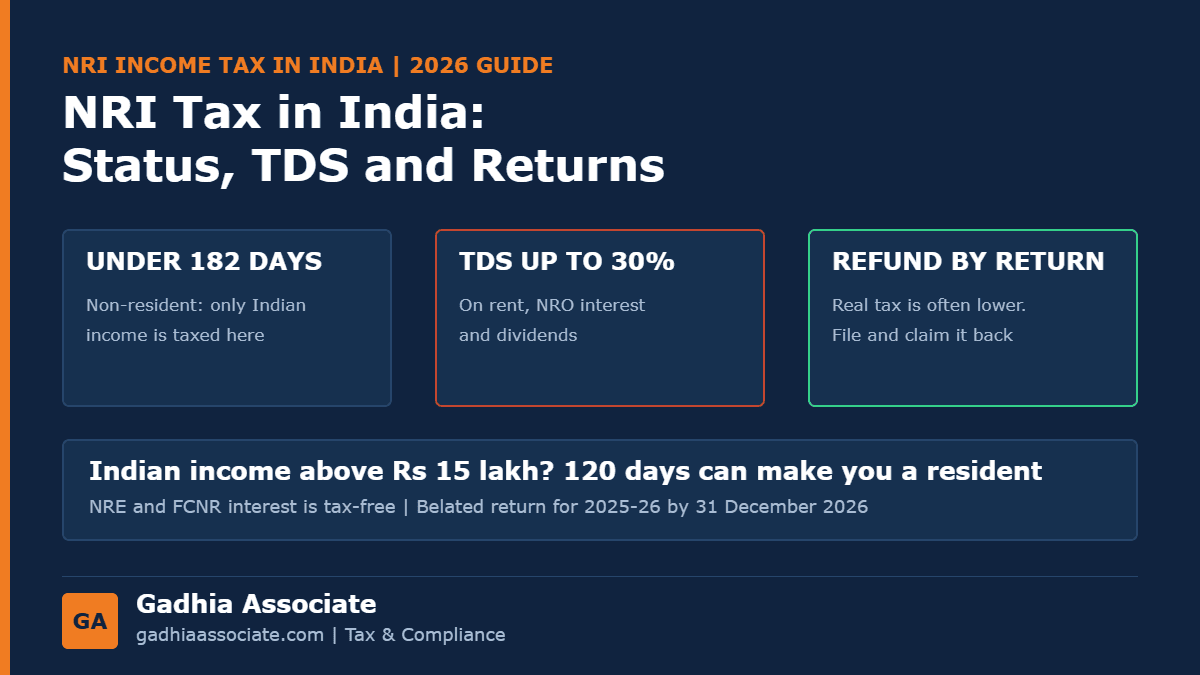
NRI income tax in India depends first on residential status: visit for under 182 days a year and only your Indian income is taxed here.
Hiren has lived in Dubai since 2019. He has an NRO fixed deposit in Rajkot that earns Rs 3 lakh a year, and a flat in Junagadh let out at Rs 30,000 a month. Between them, the bank and the tenant deduct about Rs 2.06 lakh as TDS every year. His actual tax in India is under Rs 8,000. He has never filed a return, so he has never got the difference back.
Most NRIs are in one of two positions: paying more tax in India than they owe, or not sure whether they owe any. Both come down to three questions. Are you a non-resident for tax? Which income does India tax? Do you need to file a return? This guide answers them in plain language.
In short: If you live abroad and only visit India, you are a non-resident for Indian tax as long as you spend fewer than 182 days here in the year, counted from 1 April to 31 March. If your Indian income is above Rs 15 lakh, a stay of 120 days can be enough to make you a resident. A non-resident pays Indian tax only on income earned or received in India, such as rent, NRO interest, dividends and capital gains. Salary earned abroad and interest on NRE and FCNR deposits are not taxed. Tax is deducted at source at flat rates, 30% on rent and NRO interest and 20% on dividends, so the return is where most NRIs get money back. For April 2025 to March 2026, the due date was 31 July 2026, or 31 August for those with business income, and a belated return can still be filed until 31 December 2026.
Our NRI Desk handles all of this for NRIs in the UK, the USA, Canada, the Gulf and elsewhere, without a visit to India. The details are at the end of this guide.
Am I an NRI for income tax?
Tax residence is decided afresh every year by counting your days in India. The day you arrive and the day you leave both count.
- The basic rule: you are a resident if you are in India for 182 days or more in the year.
- The second rule: you are also a resident if you are in India for 60 days or more in the year, and 365 days or more in the four years before it.
- If you left India for a job abroad during the year: the 60 days become 182 for an Indian citizen.
- If you live abroad and come on visits: the 60 days also become 182 for an Indian citizen or a person of Indian origin. But if your Indian income is more than Rs 15 lakh, they become 120.
- Deemed resident: an Indian citizen with Indian income above Rs 15 lakh, who is not liable to tax in any other country, is treated as a resident of India even with no days here.
People caught by the 120-day rule or the deemed resident rule are treated as "not ordinarily resident". India still does not tax their income earned abroad, unless it comes from a business controlled from India, but the status has to be reported correctly.
An example: Hiren visits India for 95 days in the year. His Indian income is Rs 6.6 lakh, well below Rs 15 lakh, so his limit is 182 days and he is a non-resident. If his Indian income were Rs 18 lakh and he stayed 130 days, having spent 365 days or more here in the previous four years, he would become a resident, though "not ordinarily resident", so his income outside India would still not be taxed here.
This is the income tax test. Your bank accounts follow a different law, FEMA, which looks mainly at why you went abroad, not only at a count of days. Our guide to NRE, NRO and FCNR accounts explains that side.
Which income does India tax for an NRI?
Taxed in India:
- Rent from property in India. See our guide to NRI rental income.
- Interest on NRO accounts and deposits.
- Dividends from Indian companies and income from mutual funds.
- Capital gains on property, shares and mutual funds in India. See NRI selling property in India.
- Salary for work done in India, and income from a business in India.
Not taxed in India:
- Salary and business income earned and received abroad.
- Interest on NRE accounts and FCNR deposits.
- Gifts from relatives and inheritances. See NRI gift tax and NRI inherited property.
How much tax is deducted, and how much do you really owe?
For a non-resident, tax is deducted at source at flat rates on the gross amount, with a 4% cess on top and a surcharge on large incomes:
- NRO interest: 30%, which is 31.2% with cess, from the first rupee.
- Rent: 30%, which is 31.2% with cess, whatever the rent.
- Dividends: 20%.
- Long-term gain on property: 12.5%.
Your actual tax is worked out differently. Under the new tax regime, which applies unless you choose the old one, the first Rs 4 lakh of income is not taxed, the next Rs 4 lakh is taxed at 5%, and the rate rises in steps to 30% above Rs 24 lakh. Rent gets a flat 30% deduction before tax.
Three things are different for NRIs:
- No rebate: residents pay no tax on income up to Rs 12 lakh because of a rebate. NRIs do not get it.
- No slab benefit on long-term capital gains: an NRI cannot set the Rs 4 lakh exemption against them.
- No self-declaration to stop TDS: Form 15G and 15H, now Form 121, are for residents only. An NRI needs a lower deduction certificate from the tax officer.
Hiren's sums: interest Rs 3,00,000, plus rent of Rs 3,60,000 less 30%, which is Rs 2,52,000, makes a taxable income of Rs 5,52,000. Tax is nil on the first Rs 4 lakh and 5% on the remaining Rs 1,52,000, which is Rs 7,600, or Rs 7,904 with cess. TDS deducted was Rs 2,05,920. His refund for 2025-26 is about Rs 1.98 lakh, and a similar amount builds up every year.
Tax treaties: if you live in a country that has a tax treaty with India, the treaty can lower the Indian TDS on interest and dividends, and your country gives credit for the tax paid in India. You need a tax residency certificate from your country and Form 41, the old Form 10F, filed in India.
Do I have to file a return in India?
You must file when your Indian income for the year is above the exemption limit: Rs 4 lakh under the new regime or Rs 2.5 lakh under the old one. You must also file, whatever your income, if TDS of Rs 25,000 or more was deducted during the year, which covers most NRIs with rent or NRO interest. You should also file when:
- Any TDS deducted is more than your tax. A return is the only way to get the refund.
- You sold property, shares or mutual funds in India.
- You have a capital loss to carry forward. This works only if the return is filed on time.
- You want a clean record for a future loan, a notice or sending money abroad.
- Which form: ITR-2 if you have no business income, ITR-3 if you do. ITR-1 and ITR-4 are not for NRIs.
- Due date for April 2025 to March 2026: it was 31 July 2026, or 31 August 2026 for those with business income and no tax audit. A belated return can be filed until 31 December 2026, with a late fee of up to Rs 5,000, or Rs 1,000 where income is up to Rs 5 lakh. The refund can still be claimed, but losses cannot be carried forward.
- From 1 April 2026: the new Income-tax Act, 2025 applies. It calls the year "tax year 2026-27", and for most NRIs that return will be due by 31 July 2027.
- Older years: see our guide for an NRI who has not filed returns in India.
- PAN: NRIs do not have to link Aadhaar, but the department must know you are a non-resident, or the PAN can be marked inoperative. See PAN inoperative.
- Refund: it is paid into an Indian bank account validated on the portal, usually the NRO account.
Six mistakes NRIs make
- Assuming that living abroad means no return is needed, and leaving refunds unclaimed year after year.
- Staying in India a few days too long in a year when Indian income is high.
- Leaving bank, PAN and investment records showing a resident status.
- Treating NRO interest as tax-free, or showing NRE interest as taxable.
- Not asking for the treaty rate or a lower deduction certificate before a large payment.
- Filing ITR-1 because it looks simpler. It is not valid for an NRI.
How our NRI Desk helps
- Work out your residential status, year by year, from your passport and travel dates
- File your Indian return and follow the refund until it reaches your account
- Apply the tax treaty with your country, with Form 41 and your residency certificate
- Apply for a lower deduction certificate, so that less tax is cut on rent, interest or a property sale
- Fix past years with belated and updated returns, and reply to notices
- Correct PAN and portal records that still show you as a resident
How it works from abroad: a first call at a time that suits your time zone, a clear fixed fee before we start, documents shared on WhatsApp or email, and one person who handles your file from start to finish. No visit to India is needed. See everything our NRI Desk does.
Gadhia Associate has been in practice since 2007 and has handled work for over 7,000 clients, with a 5.0 Google rating from more than 100 reviews. From our office in Junagadh, Gujarat, the NRI Desk works with NRIs in the UK, the USA, Canada, the UAE and the Gulf, Australia, Singapore and Africa.
Living abroad with income or property in India? Call or WhatsApp +91 82005 28355, or message us on WhatsApp. The first consultation is free.
Frequently asked questions
How many days can an NRI stay in India without becoming a resident?
Up to 181 days in a tax year, if you live abroad and are only visiting. If your Indian income is above Rs 15 lakh, a stay of 120 days or more can make you a resident, if you were also in India for 365 days or more in the previous four years. In the year you move back for good, 60 days can be enough.
Is the foreign salary of an NRI taxable in India?
No. A non-resident is taxed in India only on income earned or received in India.
Is interest on an NRE account taxable?
No. Interest on NRE accounts and FCNR deposits is exempt while you are a non-resident. Interest on an NRO account is taxable, with TDS at 30% plus cess.
Which ITR form should an NRI file?
ITR-2 if there is no business income, and ITR-3 if there is. ITR-1 and ITR-4 are not available to NRIs.
Can an NRI get a refund of TDS?
Yes, by filing a return. TDS is deducted at flat rates of up to 30% on the gross amount, which is usually more than the actual tax.
What is the last date for an NRI to file the return for 2025-26?
The due date was 31 July 2026, or 31 August 2026 for those with business income. A belated return can be filed up to 31 December 2026, with a late fee.
Position as of 6 October 2026. Residential status and tax depend on your own dates, income and the tax treaty with your country. Take advice on your own facts before you act.