PAN Inoperative? Why 20% TDS Is Being Deducted, Your Refund Is Blocked, and How to Fix It Fast
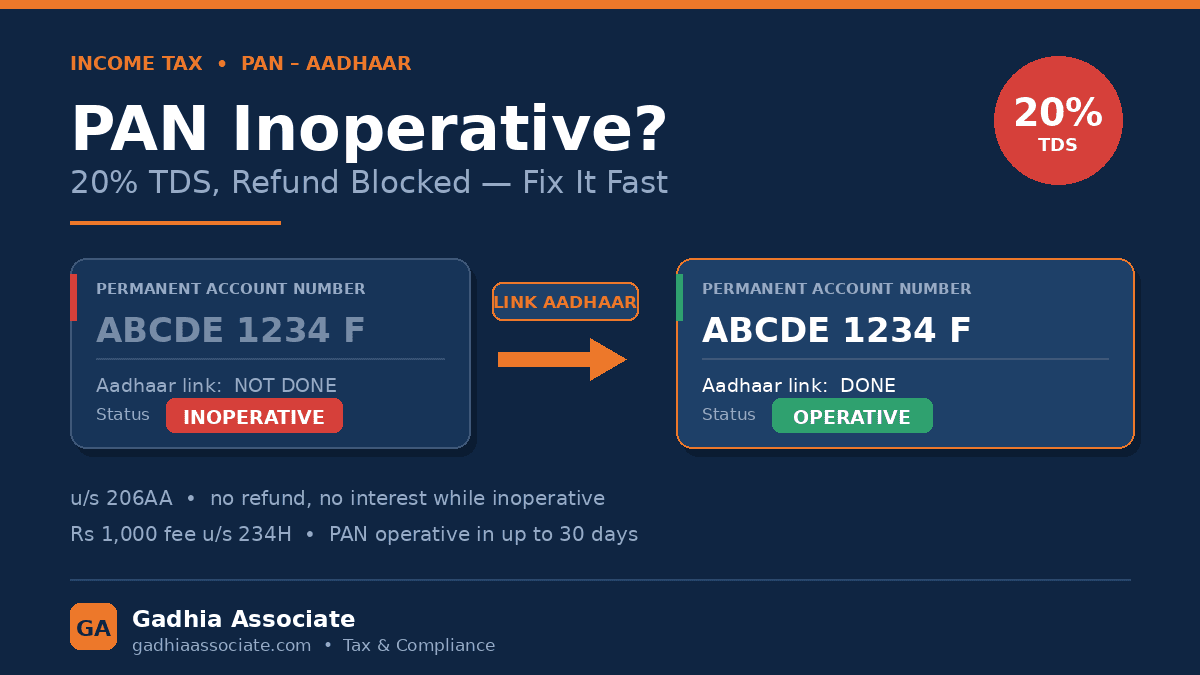
Your salary slip shows TDS deducted at 20% instead of 10%. The refund you were counting on has simply not arrived, and the portal says nothing useful. Your bank has deducted 20% on an FD that should have attracted 10%. Or you are an employer and TRACES has thrown a short-deduction demand at your TAN for a vendor you paid correctly. In almost every one of these cases the answer is the same three words: your PAN is inoperative, because it has not been linked with Aadhaar under Section 139AA.
An inoperative PAN is not a cancelled PAN. It still exists, you can still quote it, but the Income Tax Department treats it as if you had not furnished a PAN at all. That single fact triggers everything you are currently frustrated about. Here is how to confirm it, fix it, and claw back the money.
Why is my PAN inoperative?
Because Aadhaar was never linked, or was linked and rejected because the details did not match. There is no notice, no email, no warning. Your PAN simply flips status on the department's database and the consequences start on their own:
- Higher TDS and TCS. Under Section 206AA, when a valid PAN is not furnished, tax is deducted at the higher of the specified rate, the rate in force, or 20%. In practice that means 20% on most payments. On the TCS side, Section 206CC pushes the rate up too, commonly to 5% where the normal rate is 1%.
- No refund. No refund of any tax due to you is issued while the PAN remains inoperative.
- No interest on that refund. For the period the PAN stays inoperative, no interest is payable on the refund you were owed.
- Pending proceedings stall. Assessments, rectifications and other pending proceedings are not completed.
- KYC friction. Banks, demat and mutual fund platforms treat an inoperative PAN as invalid KYC, and high-value transactions get flagged or blocked.
If your ITR has been filed and processed but the money never landed, read our article on ITR refunds being stuck alongside this one, because an inoperative PAN is one of the most common hidden reasons behind it.
Check this in two minutes
Before you do anything else, confirm the diagnosis. It takes less time than reading this paragraph.
- Go to the Income Tax e-filing portal and open the Link Aadhaar Status service on the home page. You do not need to log in.
- Enter your PAN and Aadhaar number and submit.
- The screen tells you one of three things: Aadhaar is already linked (you are fine, look elsewhere for your problem), Aadhaar is not linked (this article is for you), or the linking request is under process.
- Also log in and check Profile, where PAN status is displayed. If it reads inoperative, that is your answer.
- Employers and businesses: check the PAN status of your deductees in bulk before you file each TDS return. TRACES flags inoperative PANs, and the compliance check facility lets you verify a batch at once.
How do I make my PAN operative again?
The route is the same for almost everyone, and it is entirely online. Work through it in this order.
Situation 1: PAN and Aadhaar details match, you simply never linked
This is the easy case and the most common one. You pay the fee under Section 234H, then submit the linking request.
- On the e-filing portal, go to e-Pay Tax. Select Income Tax as the major head and Other Receipts (500) as the minor head. Pay the fee of Rs 1,000 under Section 234H.
- Wait for the challan to be reflected. This is usually quick but can take a few working days.
- Return to Link Aadhaar on the portal, enter PAN and Aadhaar, validate, and submit.
- Once submitted, the PAN becomes operative after processing. The CBDT has indicated a window of up to 30 days from the date of intimation, so plan on up to a month rather than the same evening.
Cost: Rs 1,000 government fee. Time: a few minutes of work, up to 30 days for the status to flip.
Situation 2: Your name, date of birth or gender do not match between PAN and Aadhaar
This is where most people get stuck. The portal rejects the link, or accepts it and then fails silently. A middle name present on one document and absent on the other, a spelling variation, "Bhai" or "Kumar" on one side only, a date of birth captured as 01-01-YYYY on Aadhaar because the original record was incomplete: any of these will break the match.
You have to correct one side so the two agree. Do not guess which one. Choose the document that is wrong compared to your other records.
- To correct PAN: file a PAN correction application through Protean (NSDL) or UTIITSL, with supporting proof. Turnaround is typically two to three weeks, and the fee is a few hundred rupees.
- To correct Aadhaar: update the record on the UIDAI self-service portal or at an Aadhaar Seva Kendra, again with proof. Demographic updates carry a small UIDAI fee.
- Once the two match, go back and submit the linking request.
Realistic timeline: three to six weeks end to end. Start this today if a refund is riding on it.
Situation 3: You are exempt and should not be in this position at all
The linking requirement does not apply to everyone. You are outside it if you are a non-resident as per the Act, an individual aged 80 years or above at any time during the previous year, a resident of the specified states notified for this purpose (Assam, Jammu and Kashmir and Meghalaya), or not a citizen of India.
The problem is that the department's system does not always know your residential status. NRIs in particular find their PAN marked inoperative because their status was never updated. The fix is to get your residential status corrected in the department's records through the jurisdictional Assessing Officer, supported by proof of non-residence and your ITR history. Once the status is updated, the PAN is restored without any Aadhaar link.
Situation 4: You are the deductor and TRACES has raised a short-deduction demand
This is the expensive version of the problem, because it is not your mistake and yet it is your TAN. You deducted at 10% on a professional fee, the vendor's PAN was inoperative on the date of payment, and TRACES computes 20%, raises a short-deduction demand for the difference, and adds interest.
The CBDT has recognised this and issued relief. Circular No. 6/2024 gave deductors relief for earlier transactions where the deductee's PAN was made operative by the stated date. Circular No. 9/2025 extended the approach: broadly, where the PAN becomes operative within the window specified in the circular, the higher-rate liability does not arise and the demand is dropped in the TRACES system.
What you actually do:
- Pull the justification report from TRACES and identify exactly which deductee PANs triggered the demand.
- Contact those vendors or employees and get them to link Aadhaar and make the PAN operative, quickly.
- Once the PAN turns operative, the demand relating to it is expected to be withdrawn or reprocessed in TRACES. Track it rather than assuming.
- Where required, file a correction statement for the relevant quarter so the deductee record and the demand line up.
- Do not casually pay the short deduction before checking whether the circular relief covers your period. Once paid, recovering it is far harder.
Can I claim back the extra 20% TDS?
Yes, if you are the deductee. The excess deducted is not lost. It is your tax credit. Once the PAN is operative and the deductor has reported the deduction correctly in the TDS return, it appears in your Form 26AS and AIS, and you claim it in your ITR for that year. The excess over your actual liability comes back as a refund.
Two conditions must hold. First, the PAN must be operative before the refund can be released. Second, the deductor must have quoted your PAN correctly in the TDS return. If the credit is not visible in 26AS, chase the deductor for a correction statement, because the department will only give credit for what is reported.
Illustrative scenario. A consultant in Junagadh bills Rs 10,00,000 in a year. TDS should have been Rs 1,00,000 at 10%. Because her PAN was inoperative, deductors withheld Rs 2,00,000 at 20%. Her actual tax liability works out to Rs 90,000. She pays the Rs 1,000 fee, links Aadhaar, and once the PAN turns operative and the credits reflect, she claims Rs 2,00,000 and receives roughly Rs 1,10,000 back as refund. The cost of not fixing it earlier was not the tax, it was a year of blocked cash flow and no interest for that period. Figures are illustrative only.
What makes it worse, and what not to do
- Waiting for the refund to arrive on its own. It will not. The block is systemic, not a queue. Every month you wait is another month of 20% deductions on top.
- Submitting a linking request with mismatched details, repeatedly. Each failed attempt achieves nothing and can leave the status hanging in "under process" while you assume it is done. Fix the mismatch first, link second.
- Paying the Rs 1,000 under the wrong head. If the challan is not tagged as Other Receipts (500), the system will not recognise the payment against your linking request and you may end up paying twice.
- Applying for a second PAN. Holding more than one PAN is itself a penalised default. Never do this to escape an inoperative PAN.
- Employers ignoring deductee PAN status until the demand arrives. Verify before you file the quarterly return, not after the notice.
- Assuming an inoperative PAN excuses you from filing. It does not. If you have also received a notice, our article on responding to income tax notices explains the reply route, and the inoperative PAN issue usually has to be cleared alongside it.
When to stop DIY and get help
Linking a clean PAN with a matching Aadhaar is a ten-minute self-service job. Stop and call a professional when:
- A short-deduction demand has landed on your TAN, especially across multiple quarters.
- You have several vendors or employees with inoperative PANs and need a bulk verification and clean-up before the next TDS return.
- Your name or date of birth mismatch has already failed once and you are not sure which document to correct.
- You are an NRI whose residential status needs to be corrected with the Assessing Officer.
- A refund of any material size is blocked, or an assessment or rectification is stuck behind the PAN status.
- A correction statement or revised TDS return is needed to make the credit appear in the deductee's 26AS.
How Gadhia Associate Can Help
We handle this every week, for salaried individuals, professionals, traders and companies across Junagadh and the rest of Gujarat, and for clients elsewhere in India entirely online.
We check your PAN status and link history, identify exactly why the link failed, and run the correction on the PAN or Aadhaar side so the details match the first time. We pay the Section 234H fee under the correct head and submit the linking request, then track it until the PAN turns operative. For employers and businesses, we run bulk PAN status checks across your deductee master before each quarterly return, handle short-deduction demands on your TAN by mapping them to the CBDT circular relief, file correction statements and revised TDS returns, and follow the demand through TRACES until it is closed. Where a refund is blocked, we make sure the credits reflect and the return is positioned to release it.
The first consultation is free. Call or WhatsApp +91 82005 28355 and tell us what your PAN status screen says. If it is a ten-minute fix, we will tell you that too.
Position as of August 2026. PAN-Aadhaar rules, fees, exemption categories and the relief available to deductors change through CBDT circulars and notifications, and outcomes depend on the facts of each case, including your residential status and the accuracy of records held by the Income Tax Department and UIDAI. This article is general information and not a substitute for professional advice on your specific situation.