Dhanteras and Diwali Sales for Jewellers in 2026: Rs 2 Lakh Cash Limit, PAN Rule, Old Gold Purchases, GST on Exchange and PMLA KYC
A jeweller cannot accept Rs 2 lakh or more in cash from one customer in a day, and the penalty equals the full amount, not the tax on it.
Pareshbhai runs a jewellery showroom in Junagadh. Last Dhanteras, a family buying wedding jewellery paid Rs 3.4 lakh in cash across two bills, and an old customer exchanged 40 grams of old gold and paid the difference in cash. Both felt routine. Neither was: the cash breached the Rs 2 lakh rule, and the exchange bill charged GST only on the difference. This year his accountant wants the rules written down before the rush begins.
For jewellers, the festive season brings a year's worth of sales into a few weeks, and the cash, PAN and GST rules are tested hardest exactly then. Here is what applies to billing, cash, old gold and records in 2026.
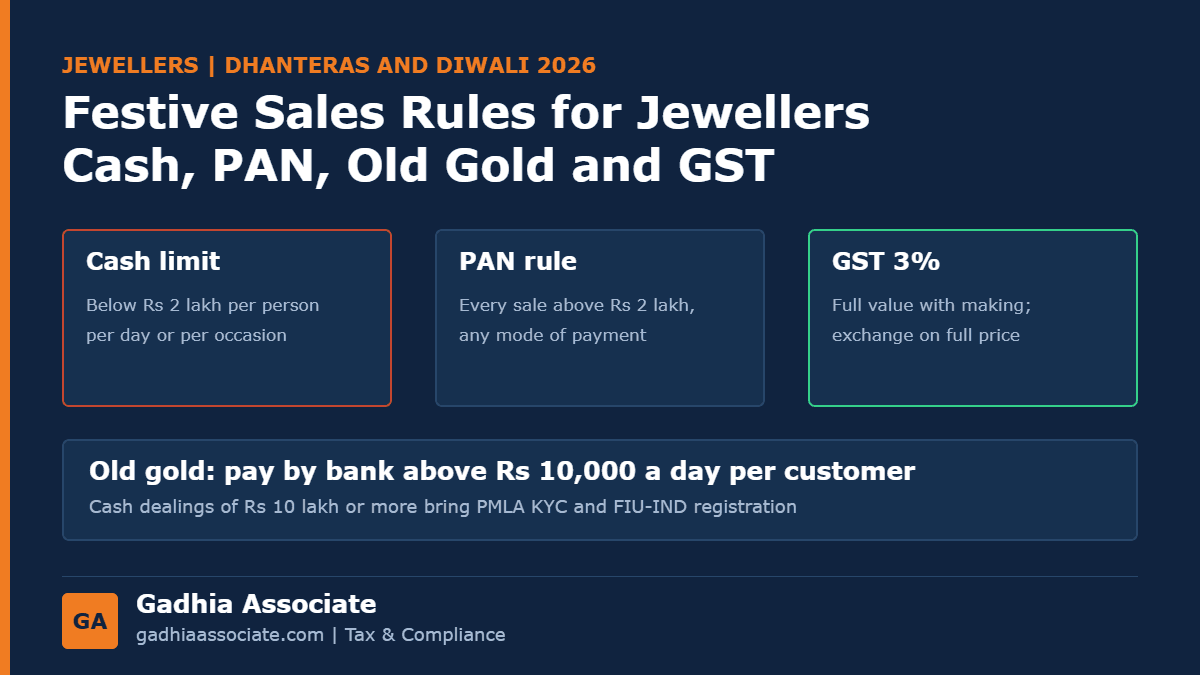
In short: A jeweller cannot receive Rs 2 lakh or more in cash from one person in a day, against one bill, or for one occasion such as a wedding, and splitting bills does not help; the penalty equals the cash received. Any sale above Rs 2 lakh needs the buyer's PAN, or the prescribed declaration if the buyer has none, whatever the mode of payment. Paying a customer more than Rs 10,000 in cash in a day for old gold makes that purchase disallowed in your income tax. GST is 3% on jewellery, on the full value including making charges, and on an exchange it is charged on the full price of the new piece. Cash dealings of Rs 10 lakh or more with one customer bring anti-money laundering duties: KYC, records and registration with FIU-IND. Keep a stock register by weight and purity, and bank the cash every day.
Our team handles accounts, GST, tax audits and compliance set-ups for jewellers. The details are at the end of this guide.
The Rs 2 lakh cash rule
- The limit: you cannot receive Rs 2 lakh or more in cash from one person in a single day, for a single transaction, or for transactions relating to one event or occasion, such as a wedding.
- Splitting does not work: two bills of Rs 1.7 lakh to the same family on the same day, or for the same wedding, are counted together.
- The penalty: a sum equal to the cash received, charged on you as the receiver, not on the customer.
- Exchange bills count: the cash part of an exchange bill is cash received.
- Advances: cash advances against a wedding order are part of the same occasion.
Our guide on cash transaction limits covers the other cash rules, such as the Rs 20,000 limit on loans and deposits.
PAN for sales above Rs 2 lakh
- Any mode of payment: a sale above Rs 2 lakh in one transaction needs the buyer's PAN, even if paid by card or UPI.
- No PAN: the buyer must give the prescribed declaration (Form 60 under the old rules), which you keep on record.
- Your risk: large sales without PAN are a common point in surveys and audits, so collect it at billing, not later.
Buying old gold from customers
- Pay by bank above Rs 10,000: a cash payment of more than Rs 10,000 to one person in a day is disallowed as a business expense, and that includes buying old gold.
- Document it: take a purchase voucher with the customer's name, address, ID or PAN, weight, purity and rate.
- GST: buying old gold from an individual who is not in business attracts no GST and no reverse charge.
- The customer's tax: selling or exchanging old gold is a sale of a capital asset for the customer. Our guide to gold and income tax explains how it is taxed.
GST on jewellery, making charges and exchange
- Rate: 3% on gold, silver and other jewellery, coins and bars.
- Making charges: when you sell the jewellery, making charges are part of its value, so 3% applies on the full bill.
- Exchange: GST is charged on the full price of the new jewellery. The value of the old gold only reduces what the customer pays.
- Reselling old jewellery as it is: if you resell a piece bought from a customer without melting or remaking it and take no credit on it, GST can be paid on your margin alone. Once it is melted and remade, GST applies on the full value.
- Returns and e-invoices: file GSTR-1 and GSTR-3B on time, and issue e-invoices on sales to registered buyers once your aggregate turnover has crossed Rs 5 crore. See our GST return calendar and guide to e-invoicing.
Anti-money laundering rules for jewellers
A dealer in precious metals and stones becomes a reporting entity under the Prevention of Money Laundering Act when it deals in cash of Rs 10 lakh or more with a customer, in one transaction or in transactions that appear linked. It must then register with FIU-IND, carry out KYC on the customer, keep records for five years and file the reports required. Given the Rs 2 lakh cash rule, most jewellers should never reach this level; cash paid out for old gold also counts.
Hallmarking
In districts where BIS hallmarking is compulsory, gold jewellery must carry the BIS hallmark with a six-digit HUID before it is sold. Keep the HUID on your stock records so each piece can be traced to its bill.
Books, stock and the bank account
- Stock register by weight and purity: opening stock, purchases, old gold received, issues to karigars, returns and sales, in grams and carats. A stock that does not match the books is the first thing questioned in a survey.
- Daily cash book: cash sales billed the same day and deposited in the bank regularly. Large cash balances on hand are hard to explain later.
- Cash deposits: banks report cash deposits in a current account that add up to Rs 50 lakh or more in a year. See our guide on cash deposit rules.
- Tax audit: required once turnover crosses Rs 1 crore, or Rs 10 crore when cash receipts and payments are within 5% of the total, which few jewellers meet. Smaller jewellers can use presumptive tax at 6% of digital and 8% of cash turnover, within the limits.
A checklist for the counter staff
- Total the cash from each family per day and per occasion, and stop below Rs 2 lakh
- Take PAN or the declaration on every bill above Rs 2 lakh
- Charge GST on the full value of the new piece in an exchange
- Pay for old gold above Rs 10,000 only by bank transfer
- Write the HUID, weight and purity on every bill
Back to Pareshbhai. This year, cash from one family is capped at Rs 1.99 lakh for the day and the occasion, with the rest by UPI or card, and every bill above Rs 2 lakh carries the buyer's PAN. Exchange bills charge 3% on the full price of the new jewellery, old gold above Rs 10,000 is paid for by bank transfer against a signed purchase voucher, and the stock register is updated each evening. A two-page counter checklist goes to every salesperson before Dhanteras.
How we help
- Set up billing, cash limits and PAN checks for the festive rush
- Stock registers by weight and purity, reconciled with the books
- GST returns, e-invoicing and treatment of exchange and old gold
- PMLA registration and KYC records where needed
- Tax audit or presumptive tax returns
- Replies to survey findings, notices and queries on cash sales
Gadhia Associate has been in practice since 2007 and has handled work for over 7,000 clients, with a 5.0 Google rating from more than 100 reviews. Jewellers and traders from Junagadh, Rajkot, Jamnagar, Porbandar and Veraval come to our Junagadh office, where same-day appointments are available. Work for jewellers elsewhere in India is handled online.
Expecting a busy Dhanteras? Get your billing, cash and GST rules checked before the rush. Call or WhatsApp +91 82005 28355, or message us on WhatsApp. The first consultation is free.
Frequently asked questions
How much cash can a jeweller accept from one customer?
Less than Rs 2 lakh in a day, against one bill, or for one occasion. Receiving Rs 2 lakh or more attracts a penalty equal to the amount.
Is PAN required for buying gold jewellery?
Yes, for a purchase above Rs 2 lakh in one transaction, however it is paid. A buyer without PAN must give the prescribed declaration.
What is the GST rate on gold jewellery in 2026?
3%, on the full value including making charges.
Is GST charged on the full value when old gold is exchanged?
Yes. GST is calculated on the full price of the new jewellery; the old gold only reduces the amount the customer pays.
Can a jeweller pay cash to buy old gold?
Only up to Rs 10,000 to one person in a day. Above that, the purchase is disallowed as an expense, so pay by bank transfer.
When does PMLA apply to a jeweller?
When cash dealings with a customer reach Rs 10 lakh or more, in one transaction or in linked transactions. KYC, records and FIU-IND registration then apply.
Position as of 13 October 2026. Income-tax rules are described as carried into the Income-tax Act, 2025 from 1 April 2026, where section and form numbers have changed. Hallmarking and PMLA duties depend on your district and dealings, so take advice on your own facts.