Cash Transaction Limits in 2026: Sections 269SS, 269T, 269ST and 40A(3) and the 100% Penalties Traders Get Caught By
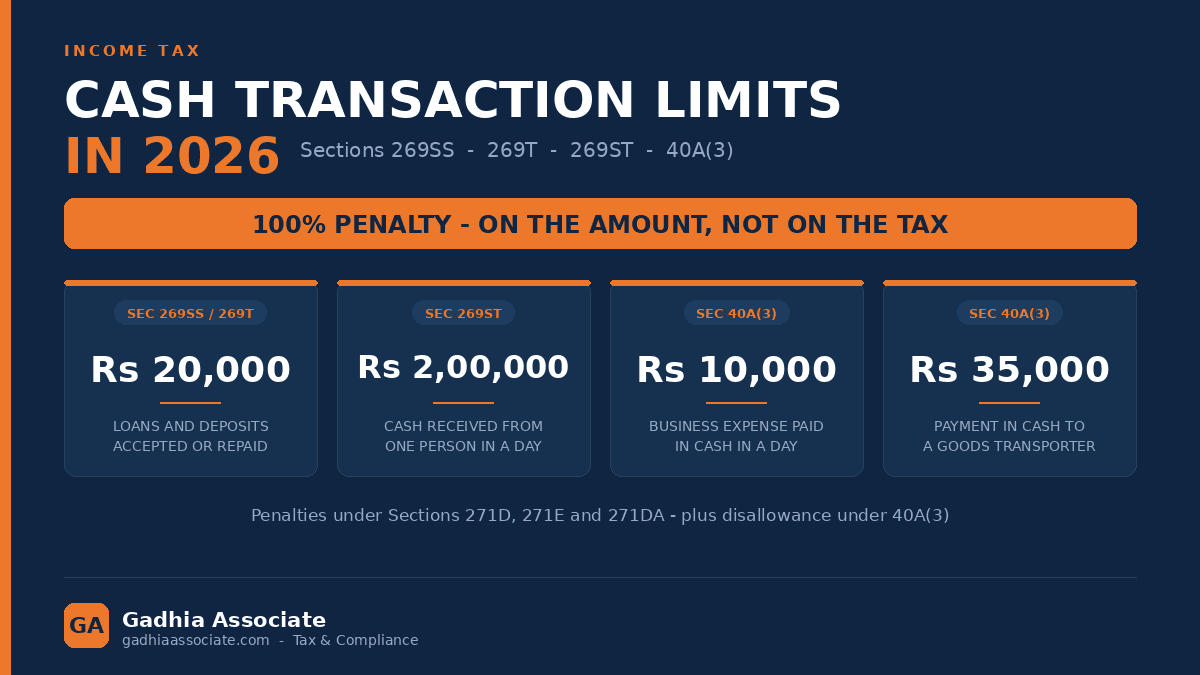
You run a trading business, a shop or a small unit, and cash is part of how it works. A customer pays Rs 3 lakh against a bill because that is how he has always paid. A friend hands you Rs 5 lakh for a season. A supplier wants Rs 25,000 in notes. None of it is hidden from your books. That is exactly the problem with the cash transaction limits in the Income-tax law — the penalties are not on the tax, they are on the amount, and they land on honest, recorded transactions.
The four cash transaction limits worth memorising
Almost every case we see in Junagadh comes down to one of four numbers:
- Rs 20,000 — loans and deposits, in and out (Sections 269SS and 269T)
- Rs 2,00,000 — cash you receive from one person in a day, or against one transaction, or one event (Section 269ST)
- Rs 10,000 — business expense paid in cash to one person in a day (Section 40A(3))
- Rs 35,000 — the higher limit for cash payments to a goods transporter
How much cash can I accept in a day, and what is Section 269ST?
Section 269ST says no person shall receive Rs 2 lakh or more in cash from a person in a day, in respect of a single transaction, or in respect of transactions relating to one event or occasion. All three tests apply independently; receipt must be by account payee cheque, draft or electronic mode.
The word people miss is "or". If one invoice is Rs 3 lakh you cannot take it as Rs 1 lakh on three days — it is still a single transaction. Equally, if a customer pays Rs 80,000 three times in one day against three bills, the day-wise test catches the Rs 2.4 lakh aggregate.
Can I take a cash loan from a relative?
Not if it is Rs 20,000 or more. Section 269SS bars accepting a loan, deposit or specified sum of Rs 20,000 or more otherwise than by account payee cheque, draft or electronic mode, and "specified sum" includes advances against transfer of immovable property. Section 269T applies the same threshold to repayment. Genuineness is not the test: a loan from your brother, entered in both books and repaid on time, still attracts penalty if it moved in cash.
Can I pay salary or expenses in cash?
You can, but Section 40A(3) disallows the expense where you pay more than Rs 10,000 in cash to one person in a day — Rs 35,000 for a transporter plying, hiring or leasing goods carriages. The disallowance is of the whole payment, not the excess: pay Rs 15,000 in cash and all Rs 15,000 is added back. Capital spending is similar — Section 43(1) keeps such payments out of the actual cost, so depreciation is lost forever. Cash also blocks donations above Rs 2,000 under Section 80G and health premium under Section 80D.
What is the penalty for cash transactions above Rs 2 lakh?
The arithmetic is not what anyone expects. The penalty under Section 271DA for breaching 269ST equals the amount received — not the tax on it, the whole amount — and it falls on the receiver, not the payer. Section 271D for a 269SS breach and Section 271E for a 269T breach work the same way: 100% of the loan or deposit.
So a transaction carrying a few thousand rupees of tax can carry a penalty in lakhs. The asymmetry is deliberate: these sections exist to stop cash movement, not to collect tax.
An illustrative example
Illustrative only. A Saurashtra trader raises one invoice of Rs 3,00,000 and the customer pays it all in cash. The sale is recorded, GST is charged, the income is offered to tax, and the tax on the profit element may be Rs 20,000. The penalty under Section 271DA can still be Rs 3,00,000 — the full receipt.
In the same year he accepts a Rs 5,00,000 cash loan from a friend and repays it in cash: Section 271D can be Rs 5,00,000 on acceptance and Section 271E another Rs 5,00,000 on repayment. Add Rs 60,000 of cash expenses above the daily limit, disallowed in full under 40A(3). Three ordinary-looking transactions, exposure above Rs 13 lakh, and not one rupee of income concealed.
If you are recognising your own books in that, get it looked at before a notice arrives. Call or WhatsApp +91 82005 28355 for a free first consultation. We will go through your cash receipts, loan accounts and expense pattern and tell you where the real exposure sits. Gadhia Associate has been practising since 2007 — 18+ years — and works with 7000+ clients across Saurashtra and Gujarat.
Which exceptions to the cash transaction limits actually apply?
Some do. Sections 269SS and 269T do not apply where the loan or deposit is taken from or paid to Government, a banking company, a post office savings bank, or a corporation established by a Central, State or Provincial Act.
The exception that matters most here: 269SS and 269T do not apply where both the person taking the amount and the person giving it have only agricultural income and neither has income chargeable to tax. That covers many genuine village-level dealings around Junagadh — but read it strictly. If either side has a shop, a business or salary, the exception is gone. A farmer who also runs a trading firm does not qualify.
Section 40A(3) has its own exceptions in Rule 6DD — payments on bank holidays or where banking was unavailable, payments to certain producers of agricultural or dairy produce, and others. They are narrower than most people assume, and each must be evidenced.
Section 273B provides that no penalty under 271D, 271E or 271DA is imposable if you prove reasonable cause. That is a real defence — an urgent hospital payment, banking unavailable — but it must be built on contemporaneous evidence, not improvised at the hearing.
How does the department find out?
Assume it will. Cash deposits above prescribed thresholds are reported by banks under the Statement of Financial Transactions and appear in your Annual Information Statement, alongside property registrations and high-value purchases. Surveys pick up cash books directly.
The route most people forget is their own tax audit. If you are covered, your auditor must report loans and deposits accepted and repaid, and receipts hit by 269ST, in the relevant clauses of Form 3CD — a signed audit trail sitting in the department's system. Our articles on tax audit under Section 44AB and on income tax notices explain how those disclosures are read.
Is cash allowed in property deals?
This is the most common trap of all. A cash advance against sale of immovable property is a "specified sum" under 269SS from Rs 20,000 upwards, and the consideration itself sits within 269ST at Rs 2 lakh. Registered documents, stamp duty records and the buyer's AIS make property the easiest place for the department to match. Fix the payment mode before the token money changes hands.
A practical checklist for staying inside the cash transaction limits
- Put every customer advance and every loan, including from family, through the banking channel.
- Do not split a large sale across days. Section 269ST covers a single transaction, so splitting the receipt does not help, and splitting the invoice artificially is worse.
- Move vendor payments to RTGS, NEFT or UPI. Cash above Rs 10,000 a day per person costs you the deduction even when the expense is genuine.
- Mark the Rs 35,000 transporter limit clearly so it is not applied to other vendors by mistake.
- Pay for capital assets by bank without exception — otherwise you lose depreciation for the asset's whole life.
- Where the agricultural exemption is relied on, document it: land records and confirmation that neither side has taxable income.
- Reconcile your cash book to your AIS quarterly, not once a year at audit time.
The fix is simple to design and expensive to postpone. Call or WhatsApp +91 82005 28355 for your free first consultation. We will set up a cash-handling process that fits how your business actually runs, on a fixed-fee or monthly plan with a dedicated client manager, fully digital across India or at our Junagadh office, where same-day appointments are usually available. Gadhia Associate holds a 5.0 Google rating from 100+ reviews.
Frequently asked questions
What will a review of my cash transactions cost?
We quote a fixed fee based on the years and volume of transactions, agreed before we start. For most trading businesses a one-time review plus a corrected process costs far less than a single 100% penalty.
How far back can this be fixed?
Going forward, immediately. Backwards, it depends on which years are still open to assessment and whether penalty proceedings have started. Past transactions cannot be undone, but exposure can often be reduced through correct disclosure and a properly evidenced Section 273B case.
What documents will you need?
Cash book and ledgers for the years concerned, bank statements, loan confirmations, sale invoices above Rs 2 lakh, your AIS, the last tax audit report if applicable, and any notice received.
Can the penalty be avoided once a notice has been issued?
Sometimes. Penalty under 271D, 271E and 271DA is not automatic — Section 273B allows it to be dropped where reasonable cause is established, and some transactions fall outside the sections once correctly characterised. What almost never works is arguing that the money was genuine or the tax was paid; that is not what these sections measure.
Note: the Income-tax Act, 2025, in force from 1 April 2026, re-enacts these provisions under a new numbering scheme. The substance — the Rs 20,000, Rs 2,00,000, Rs 10,000 and Rs 35,000 limits and the 100% penalties — continues, but section references in notices and audit reports may differ from the 1961 Act numbers used above. This article reflects the position as of September 2026; rules change through CBDT notifications and circulars, outcomes depend on the facts of each case, and you should confirm the current position with a qualified professional before acting.