Income Tax for Truck Owners and Transporters in 2026: Rs 1,000 per Tonne Presumptive Tax, 10-Vehicle Limit, No TDS on Freight
Truck owners with up to 10 goods vehicles can pay income tax on a fixed Rs 1,000 per tonne a month for heavy vehicles, without keeping books.
Rameshbhai runs four heavy trucks and two pickups out of Gondal. Every year he files his return on whatever profit his diesel and driver bills seem to leave, his customers deduct TDS on some bills and not on others, and his bank asks for an income figure he cannot explain when he applies for a truck loan. A simpler route has been open to him all along.
The income tax law has a presumptive scheme made for small transporters, and it fixes the income per vehicle instead of asking for full accounts. Here is how it works in 2026, with the TDS and cash rules that go with it.
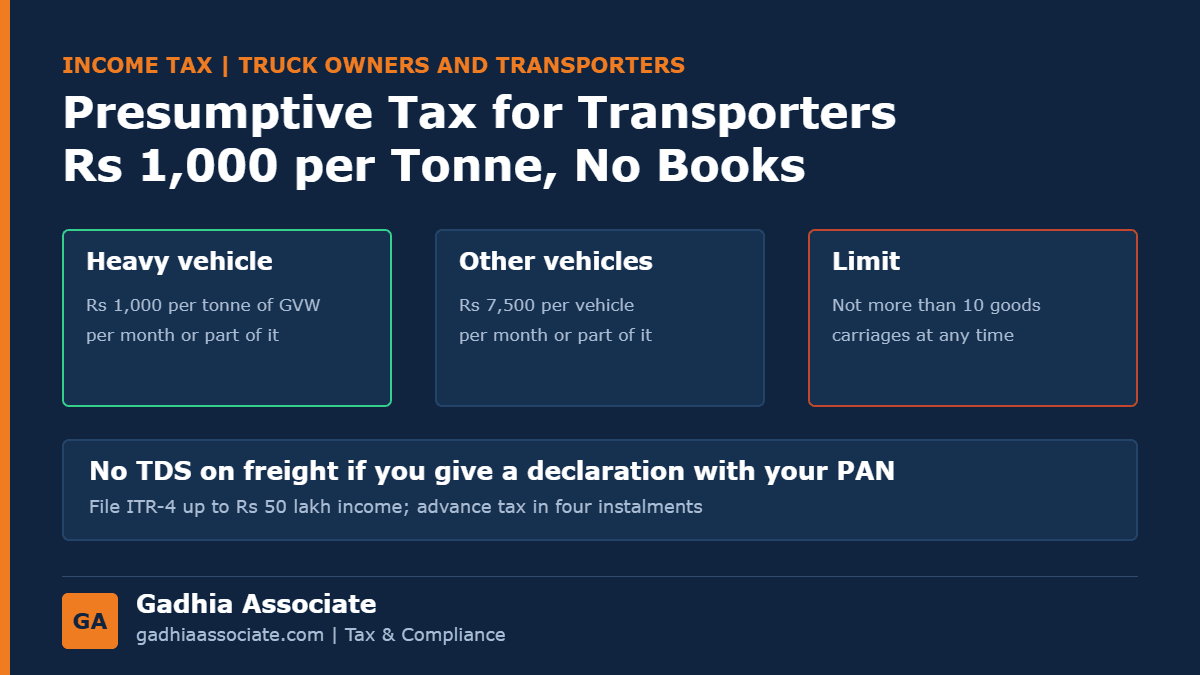
In short: A transporter who owns not more than 10 goods carriages at any time in the year can declare income at Rs 1,000 per tonne of gross vehicle weight per month for each heavy goods vehicle above 12 tonnes, and Rs 7,500 per month for each other goods vehicle, for every month or part of a month the vehicle is owned. No books or audit are needed unless you declare less. Diesel, salaries, repairs, interest and depreciation are treated as already allowed. Customers need not deduct TDS on freight if you give them a declaration with your PAN, and they can pay you up to Rs 35,000 in cash in a day. You file ITR-4 if your total income is up to Rs 50 lakh, but advance tax is paid in four instalments, not in one by 15 March. Owning an 11th vehicle at any point takes you out of the scheme for that year.
Our tax team handles presumptive returns, TDS declarations, GST and loan documents for transporters. The details are at the end of this guide.
Who can use the scheme?
- The business: plying, hiring or leasing goods carriages. Buses, taxis and other passenger vehicles are not covered; their owners look at the general presumptive scheme instead. See our guide to presumptive taxation.
- The 10-vehicle limit: you must not own more than 10 goods carriages at any time during the year. Vehicles bought on hire purchase or instalments count as owned.
- Anyone: an individual, HUF, partnership firm or company can use it.
How the income is calculated
- Heavy goods vehicle (gross vehicle weight above 12 tonnes): Rs 1,000 per tonne of gross vehicle weight, or unladen weight where relevant, for every month or part of a month you own it.
- Other goods vehicles: Rs 7,500 per vehicle for every month or part of a month.
- An example: four 25-tonne trucks for the full year give 4 x 25 x Rs 1,000 x 12 = Rs 12 lakh. Two pickups give 2 x Rs 7,500 x 12 = Rs 1.8 lakh. Total income from the business: Rs 13.8 lakh.
- Part of a month counts: a truck bought on 25 August counts from August.
- Higher income: you can always declare more than the presumptive figure.
- Partnership firms: salary and interest to partners can be deducted from the presumptive income, within the usual limits.
No books, but some records
- Expenses are already covered: diesel, tolls, driver salaries, repairs, insurance, EMI interest and depreciation are treated as allowed. You cannot claim them again.
- Depreciation still runs: the written-down value of each truck is reduced as if depreciation had been claimed, which matters when you sell it.
- Declaring less: if you want to show income below the presumptive figure, you must keep books and get them audited.
- Keep anyway: registration certificates, purchase and sale papers of vehicles, loan statements and bank statements, to match your return with your GST and TDS records.
TDS on your freight
- No TDS with a declaration: a customer paying you freight does not have to deduct TDS if you own not more than 10 goods carriages at any time in the year and give a declaration to that effect with your PAN. This rule continues under the Income-tax Act, 2025.
- Without it: TDS is deducted at 1% for individuals and HUFs and 2% for others, and you claim it back in your return.
- Check your credits: TDS deducted by customers shows in your Form 26AS and AIS. See AIS vs Form 26AS.
Cash and your customers
A business customer can pay a transporter up to Rs 35,000 in cash in a day for plying, hiring or leasing goods carriages, against the usual Rs 10,000. Above that, the customer loses the deduction for the expense, so most will insist on paying by bank. Our guide on cash transaction limits covers the other cash rules.
Return, advance tax and GST
- Return form: ITR-4 for individuals, HUFs and firms (other than LLPs) with total income up to Rs 50 lakh. Others file ITR-3 or ITR-5.
- Advance tax: unlike the general presumptive scheme, transporters pay advance tax in four instalments, by 15 June, 15 September, 15 December and 15 March, once the tax for the year exceeds Rs 10,000. See advance tax due dates.
- GST: a truck owner who issues no consignment note is not a goods transport agency, and the freight is exempt. If you issue LRs or bilties, the GTA rules apply. See our guide to GST for transporters and GTA.
When you outgrow the scheme
If you own an 11th goods carriage at any time in the year, even for a few days, the scheme is not available for that year. You then keep full books, and a tax audit applies if turnover crosses the audit limit. Plan purchases of the 11th truck around the year end, or consider running the larger fleet through a firm or company.
Back to Rameshbhai. His four 25-tonne trucks and two pickups give a presumptive income of Rs 13.8 lakh, which he declares in ITR-4 without books or audit, paying advance tax in four instalments. Each customer gets a declaration with his PAN confirming he owns not more than 10 goods carriages, so TDS stops being deducted on freight. For his next truck loan, the bank gets three years of returns built on a clear, consistent income figure.
How we help
- Work out presumptive income for each vehicle and file your return
- Prepare the no-TDS declaration for your customers, and reconcile TDS credits
- Advance tax planning in four instalments
- GST registration and returns where you work as a GTA
- Income certificates and projections for vehicle loans
- Books and tax audit once the fleet grows beyond 10 vehicles
Gadhia Associate has been in practice since 2007 and has handled work for over 7,000 clients, with a 5.0 Google rating from more than 100 reviews. Transporters and fleet owners from Junagadh, Gondal, Jetpur, Rajkot and Morbi come to our Junagadh office, where same-day appointments are available. Returns for transporters elsewhere in India are handled online.
Running trucks and unsure what income to show? Get your presumptive return and TDS declarations set up correctly. Call or WhatsApp +91 82005 28355, or message us on WhatsApp. The first consultation is free.
Frequently asked questions
What is the presumptive income for a truck under the income tax law?
For a heavy goods vehicle above 12 tonnes, Rs 1,000 per tonne of gross vehicle weight per month. For other goods vehicles, Rs 7,500 per vehicle per month.
How many trucks can I own and still use the scheme?
Not more than 10 goods carriages at any time during the year, including vehicles on hire purchase or instalments.
Do I need to maintain books of account?
No, unless you want to declare income below the presumptive figure, in which case books and an audit are required.
Can a customer deduct TDS on payments to a transporter?
Not if you own not more than 10 goods carriages and give a declaration with your PAN. Otherwise TDS is 1% for individuals and HUFs and 2% for others.
Which ITR form do transporters file?
ITR-4, if you are an individual, HUF or firm (not an LLP) with total income up to Rs 50 lakh. Otherwise ITR-3 or ITR-5.
Do transporters pay advance tax in one instalment?
No. The single 15 March instalment is only for the general presumptive scheme. Transporters pay in four instalments.
Position as of 14 October 2026. The presumptive scheme, the TDS exemption and the cash limit described here were carried into the Income-tax Act, 2025, with new section numbers. Your income depends on your vehicles and dates of ownership, so take advice on your own facts.