CSR Rules for Companies in 2026: Who Must Spend 2%, the Rs 5 Crore Profit Test, Unspent CSR Account, Penalties and CSR-2
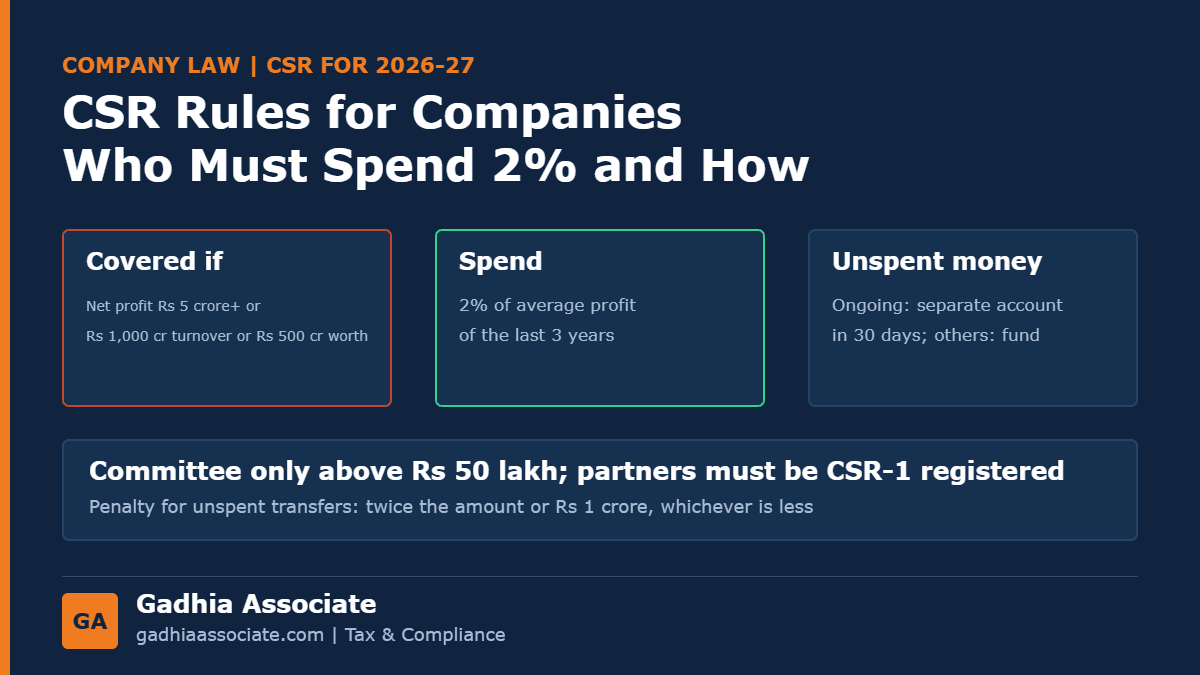
CSR applies to every company with net profit of Rs 5 crore or more last year, and it must spend 2% of its average profits on approved causes.
A ceramic tiles company in Morbi earned a net profit of Rs 6.2 crore in 2025-26, its best year so far. Its directors assumed CSR was only for large listed groups. Its auditor pointed out in September that the company is now covered, that it has to spend about Rs 9 lakh on CSR before 31 March 2027, and that money left unspent must be moved to a government fund or a separate bank account by fixed dates.
The Rs 5 crore profit test pulls in many family-run manufacturers and traders in Saurashtra that have never dealt with CSR. Here is how the rules work in 2026, and how to spend the money well rather than in a hurry in March.
In short: CSR under section 135 of the Companies Act applies for a year if, in the immediately preceding financial year, the company had net worth of Rs 500 crore or more, turnover of Rs 1,000 crore or more, or net profit of Rs 5 crore or more. It must spend at least 2% of its average net profit of the last three years on activities listed in Schedule VII, such as education, health, sanitation, rural development and the environment, directly or through a CSR-1 registered trust, society or Section 8 company. A CSR committee is needed only if the amount is above Rs 50 lakh. Money for an ongoing project that is not spent by 31 March goes to an Unspent CSR Account within 30 days; other unspent money goes to a Schedule VII fund within six months. Missing these steps costs the company twice the unspent amount or Rs 1 crore, whichever is less, plus penalties on officers.
Our company law team handles CSR applicability, policy, partner checks, unspent account transfers and reporting. The details are at the end of this guide.
Is your company covered?
- The three tests: net worth of Rs 500 crore or more, turnover of Rs 1,000 crore or more, or net profit of Rs 5 crore or more, in the immediately preceding financial year. Meeting any one is enough.
- For 2026-27: the test is applied to the accounts of 2025-26. A company that crossed Rs 5 crore net profit in 2025-26 must spend during 2026-27.
- Private companies too: the rule applies to every company, private or public, and to foreign companies with a branch or project office in India.
- Net profit: is worked out under section 198 of the Companies Act, not the taxable profit in your return.
How much to spend
- The amount: at least 2% of the average net profit of the three preceding financial years, or of the years since incorporation if fewer.
- An example: profits of Rs 3.8 crore, Rs 4.0 crore and Rs 6.2 crore average Rs 4.67 crore, so the CSR amount is about Rs 9.3 lakh.
- Overheads: administrative costs can be at most 5% of the CSR spend.
- Spending more: an excess can be set off against the next three years, if the board passes a resolution.
What counts as CSR, and what does not
- Counts: activities in Schedule VII, including hunger and poverty, education and skills, health care and sanitation, women and senior citizens, environment and animal welfare, heritage and culture, rural development, sports training, disaster relief, and contributions to funds such as the PM CARES Fund.
- Does not count: activities in your normal course of business, activities only for your employees and their families, political contributions, most activities outside India, and spending done mainly for marketing.
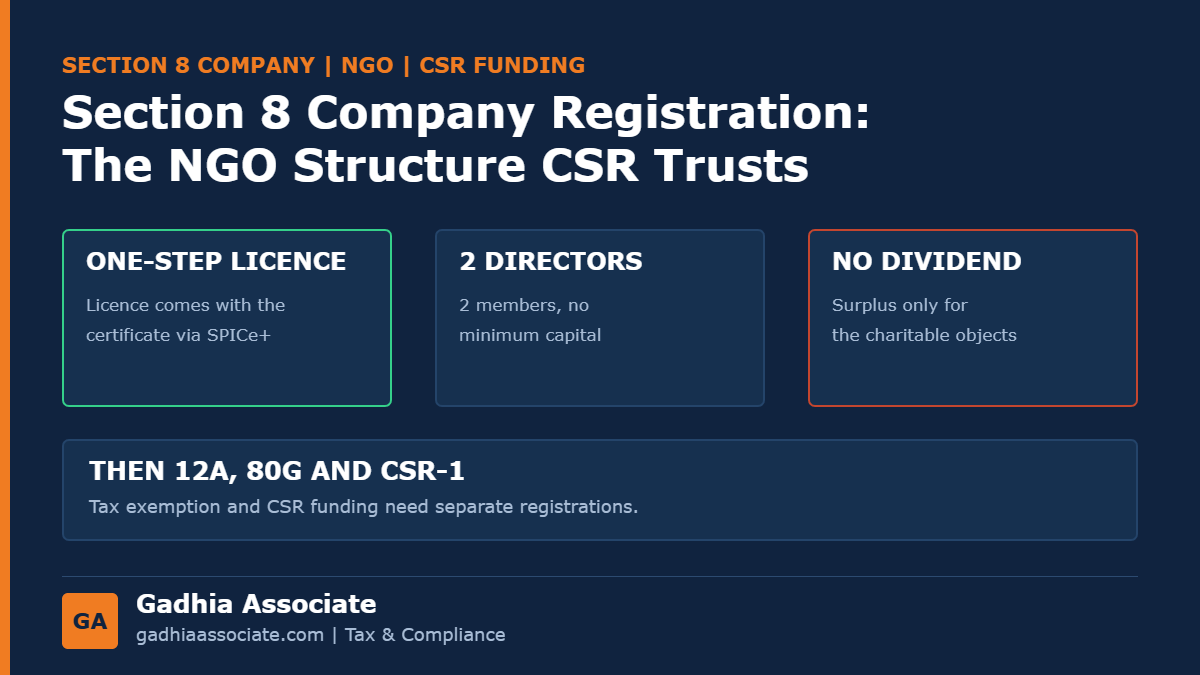
- Through a partner: a trust, society or Section 8 company implementing your CSR must be registered with the MCA in Form CSR-1. Check its registration, its 12A and 80G status and its record before you sign. See CSR-1 registration for NGOs.
Board, policy and committee
- CSR policy: the board approves a CSR policy and an annual action plan, and monitors the spending.
- Committee: a CSR committee of the board is needed only if the CSR amount is above Rs 50 lakh. Below that, the board itself does the committee's work.
- Disclosure: the board's report includes an annual report on CSR in the prescribed format, and the company reports its CSR spending to the MCA in Form CSR-2.
- Impact assessment: companies with an average CSR obligation of Rs 10 crore or more must get an independent impact assessment of projects of Rs 1 crore or more.
Money left unspent on 31 March
- Ongoing projects: transfer the unspent amount to a separate Unspent CSR Account in a scheduled bank within 30 days of the year end, and spend it within the next three financial years.
- Everything else: transfer the unspent amount to a Schedule VII fund, such as the PM National Relief Fund, within six months of the year end, that is by 30 September.
- Penalty: for not making these transfers, the company pays twice the amount required to be transferred or Rs 1 crore, whichever is less, and each officer in default one-tenth of it or Rs 2 lakh, whichever is less.
Income tax on CSR spending
CSR spending is not allowed as a business expense in the company's income tax. Whether a CSR donation can still be claimed under the deduction for donations to 80G institutions has been argued both ways, so plan it with advice. Our guide to claiming 80G deductions explains the receipts you need.
Back to the Morbi company. The board adopts a CSR policy, approves Rs 9.3 lakh for 2026-27, and chooses a CSR-1 registered trust running a girls' school near Morbi, with quarterly utilisation reports. Since the amount is under Rs 50 lakh, no committee is needed. If part of the money is still unspent on 31 March 2027 because the classroom block is an ongoing project, it moves to an Unspent CSR Account by 30 April 2027; otherwise it goes to a government fund by 30 September 2027.
How we help
- Check whether CSR applies and work out the amount from your section 198 profits
- Draft the CSR policy, annual action plan and board resolutions
- Check implementing partners for CSR-1, 12A and 80G, and draft the agreement
- Open and track the Unspent CSR Account and fund transfers
- Prepare the annual CSR report and Form CSR-2
- For NGOs, CSR-1 registration and reporting to donor companies
Gadhia Associate has been in practice since 2007 and has handled work for over 7,000 clients, with a 5.0 Google rating from more than 100 reviews. Companies from Junagadh, Rajkot, Morbi, Jamnagar and Gondal come to our Junagadh office, where same-day appointments are available. Company work for clients elsewhere in India is handled online. For the yearly ROC filings, see our guide to private limited company annual compliance.
Crossed Rs 5 crore profit last year? Plan your CSR now, not in March. Call or WhatsApp +91 82005 28355, or message us on WhatsApp. The first consultation is free.
Frequently asked questions
Which companies must spend on CSR?
Any company that, in the preceding financial year, had net worth of Rs 500 crore or more, turnover of Rs 1,000 crore or more, or net profit of Rs 5 crore or more.
How is the CSR amount calculated?
At least 2% of the average net profit of the three preceding financial years, worked out under section 198 of the Companies Act.
Is a CSR committee compulsory?
Only if the CSR amount is above Rs 50 lakh. Otherwise the board carries out the committee's functions.
What happens to unspent CSR money?
For ongoing projects, it goes to an Unspent CSR Account within 30 days of the year end and must be spent within three years. Other unspent money goes to a Schedule VII fund within six months.
Can a company give CSR money to any trust?
Only to a trust, society or Section 8 company registered with the MCA in Form CSR-1, for activities listed in Schedule VII.
Is CSR spending deductible in income tax?
Not as a business expense. A deduction for CSR donations to 80G institutions is disputed, so take advice before claiming it.
Position as of 14 October 2026, under section 135 of the Companies Act, 2013 and the Companies (CSR Policy) Rules, 2014 as amended. Applicability and the amount depend on your audited accounts, so take advice on your own figures.