Trust Registration in Gujarat 2026: Charity Commissioner Process, Documents, Timeline and the 12A and 80G Steps That Follow
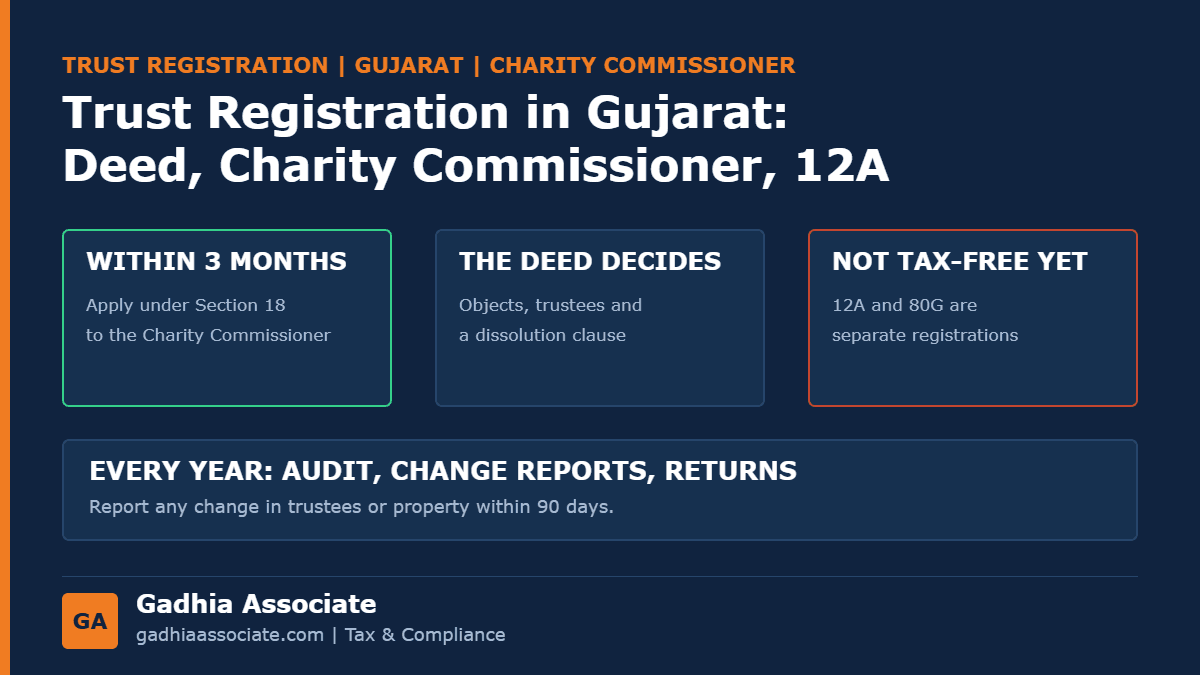
Registering a charitable trust in Gujarat takes two steps: a proper trust deed, then registration with the Charity Commissioner within three months.
A common story: a group of friends in Junagadh start collecting money for a gaushala, or for school fees of children in their community. They sign a trust deed at a notary, open a bank account, and the work begins. A year later a donor asks for an 80G receipt, a company asks whether they can give CSR funds, and the bank wants a registration certificate. That is when they learn the trust was never registered with the Charity Commissioner, the deed has no dissolution clause, and the income tax registration cannot even be applied for yet.
None of this is hard to get right at the start. This article explains how a public charitable trust is registered in Gujarat, what the deed must contain, what it costs in time, and what you must do every year after that.
Short answer: A public charitable trust in Gujarat is governed by the Gujarat Public Trusts Act, 1950 (earlier called the Bombay Public Trusts Act). After the trust deed is signed, the trustees must apply for registration to the regional Deputy or Assistant Charity Commissioner within three months of the trust's creation, under Section 18. The application is made online on the Charity Commissioner's portal, with the deed, trustee details and property particulars. Registration usually takes one to three months if the file is complete. Only after that should you apply for PAN, the income tax registration (12A) and 80G, which donors and CSR funders will ask for.
Trust, society or Section 8 company: which suits you?
- Public charitable trust: the simplest and cheapest to form, controlled by trustees, and supervised by the Charity Commissioner. It suits a family or a small group with a clear charitable purpose, such as a temple, gaushala, school fund or medical aid.
- Society: a membership body with elected office-bearers. In Gujarat, a charitable society is registered under the Societies Registration Act and also as a public trust with the Charity Commissioner, so it has two sets of rules.
- Section 8 company: registered with the Ministry of Corporate Affairs, with company-style governance and filings. It is not supervised by the Charity Commissioner, but its annual compliance is heavier. It suits larger organisations, hospitals and bodies working with corporates or across states.
For most local charitable work in Saurashtra, a public trust is the right starting point. We compared a trust and a Section 8 company for hospitals in an earlier article.
What must the trust deed contain?
The deed is the trust's constitution. The Charity Commissioner, the income tax department, banks and CSR donors will all read it. It should state clearly:
- Name and registered address of the trust
- Objects: charitable purposes for the public at large, such as relief of the poor, education, medical relief, environment or animal welfare, written specifically enough to show what the trust will actually do
- Settlor and initial corpus: who creates the trust and with what money or property
- Trustees: names, minimum and maximum number, how they are appointed and removed, and how decisions are taken
- No private benefit: trust income and property are to be used only for its objects, and not for the benefit of trustees or their relatives
- Bank operation and investments: who signs, and that funds will be invested only in modes allowed by law
- Dissolution clause: on winding up, remaining assets go to another charitable trust with similar objects, never back to the founders
The deed is signed on stamp paper as required by the Gujarat Stamp Act. Where immovable property such as land or a building is being given to the trust, the deed must also be registered with the Sub-Registrar.
A deed downloaded from the internet is the most common reason for trouble later. Objects that are too vague, a missing dissolution clause, or a clause letting trustees take a salary without limits can delay registration and later block the 12A and 80G approvals.
How is a trust registered with the Charity Commissioner?
- Sign the trust deed and get it registered with the Sub-Registrar if immovable property is involved.
- Apply online on the Charity Commissioner's portal within three months of creating the trust, in the prescribed form under Section 18, to the Deputy or Assistant Charity Commissioner of the region where the trust is based.
- Upload the documents listed below, with the fee.
- Verification and inquiry: the office checks the application and may ask for clarifications, originals or the presence of trustees.
- Registration: once satisfied, the office registers the trust and issues the registration certificate with the trust's registration number. This number is used everywhere afterwards, from the bank to the income tax portal.
Documents you will need
- Trust deed, and the Sub-Registrar's registration where applicable
- PAN, Aadhaar, photographs and address proof of the settlor and every trustee
- Consent and declarations of each trustee
- Proof of the registered office: property papers or a rent agreement, with the owner's no-objection letter
- List of the trust's movable and immovable property, with its estimated value
- Estimated annual income and expenditure of the trust
How long does it take, and what does it cost?
With a well-drafted deed and complete documents, registration usually takes one to three months, depending on the regional office and whether an inquiry or hearing is needed. Government costs are modest: the stamp duty on the deed, which is nominal where no immovable property is settled, plus the registration fee. The larger cost of a badly drafted deed is time: amendments, fresh applications, and months of delay before the income tax registrations can begin.
What comes after registration?
Registration with the Charity Commissioner makes the trust a recognised public trust. It does not make its income tax-free. The next steps, in order:
- PAN in the trust's name, and a bank account in the trust's name.
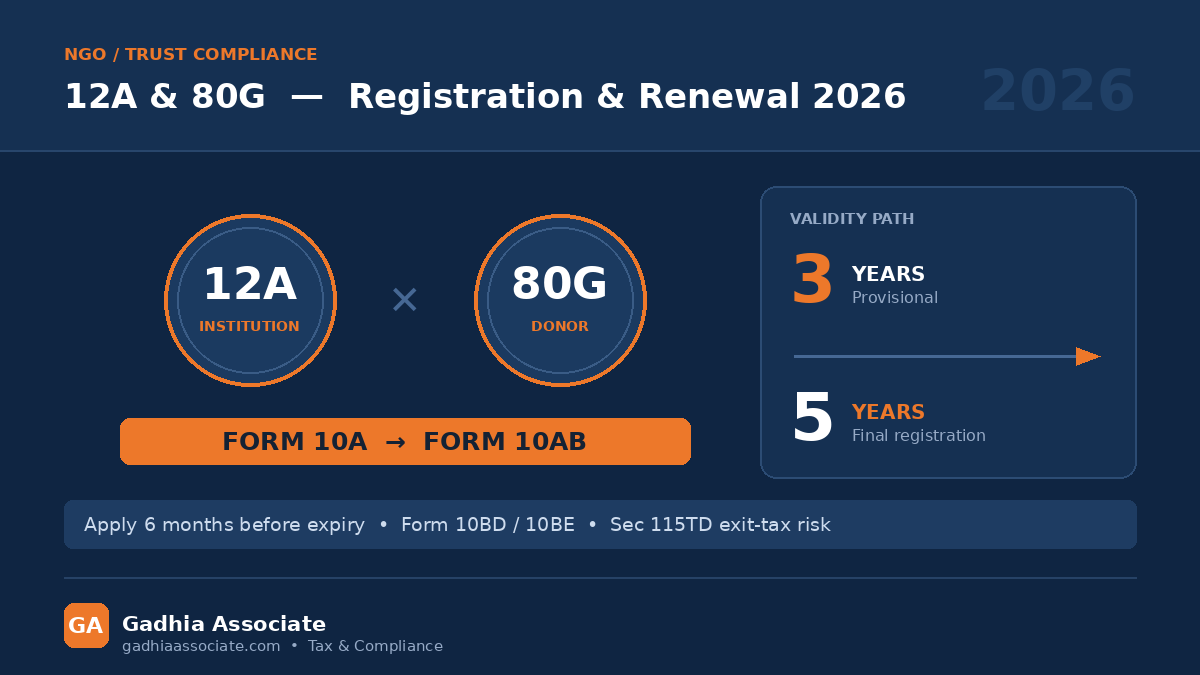
- Income tax registration (12A): first a provisional registration, valid for three years, and later the regular registration. Without it, the trust's surplus is taxed like any other income.
- 80G approval, so that donors can claim a deduction. Donors should know that this deduction is available only under the old tax regime, and cash donations above Rs 2,000 do not qualify.
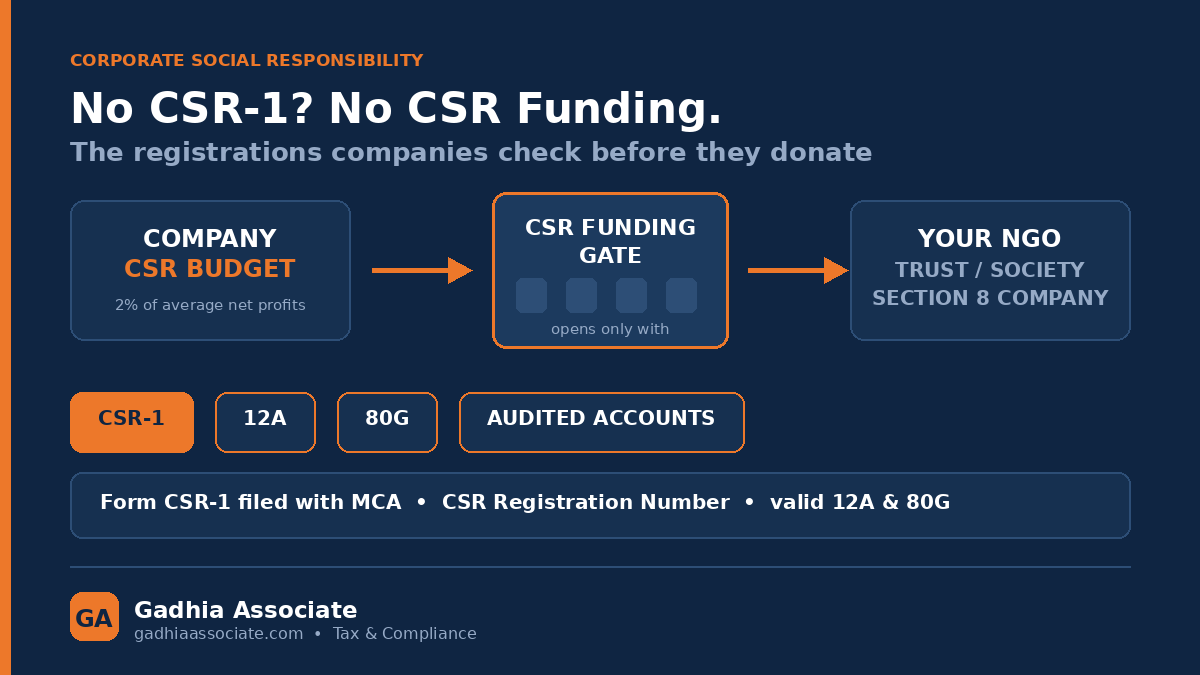
- NGO Darpan and CSR-1, if the trust wants government grants or CSR funding from companies.
We have explained 12A and 80G registration and renewal and CSR-1 registration for NGOs in separate articles.
What must a registered trust do every year?
- Accounts and audit: keep regular accounts and get them audited by a chartered accountant every year, as the Act requires for most trusts.
- Change reports: report any change in trustees, address or property to the Charity Commissioner within 90 days of the change. A trustee's death or resignation is the change most often forgotten.
- Property: the trust cannot sell, mortgage, exchange or gift its immovable property without the prior sanction of the Charity Commissioner.
- Contribution: pay the annual contribution to the Charity Commissioner's fund, which is based on the trust's gross annual income.
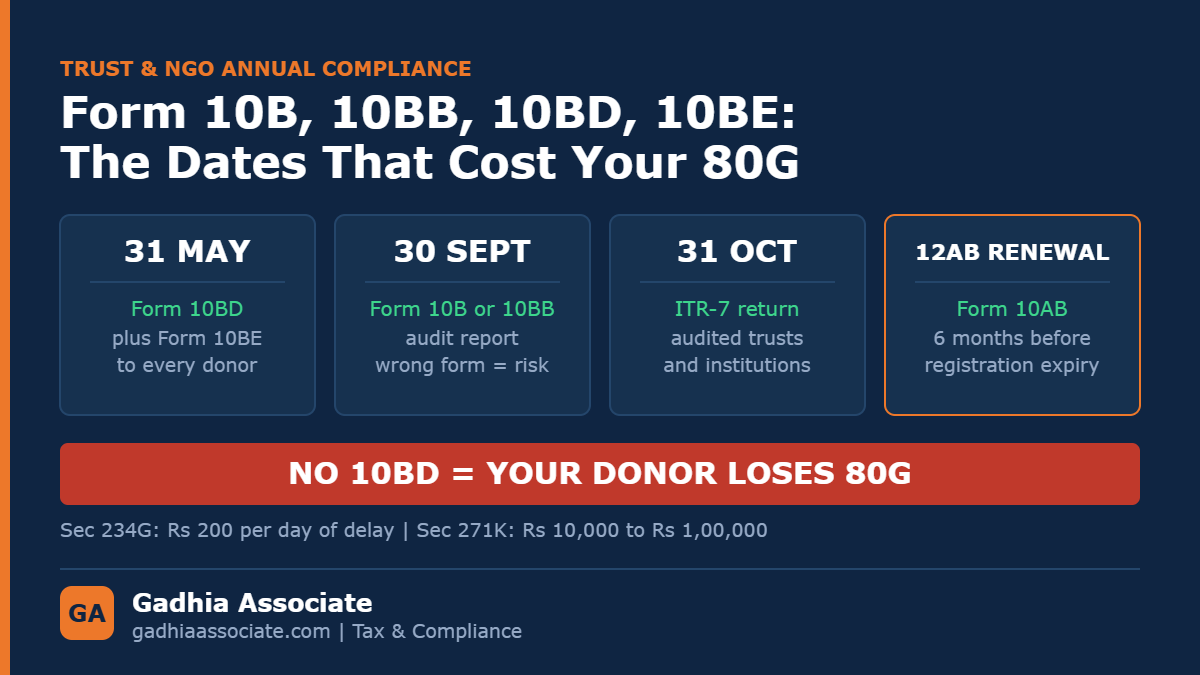
- Income tax: file the audit report and the income tax return every year, and issue donation certificates to donors. Our note on annual compliance for trusts and NGOs lists the deadlines.
Common mistakes with new trusts
- Missing the three-month window for applying to the Charity Commissioner.
- Using a private family trust deed for a public charitable purpose, or the other way round.
- Objects copied from another trust that have nothing to do with the actual work.
- No dissolution clause, or one that returns assets to the founders.
- Trust property bought in a trustee's personal name.
- Trust money kept in a trustee's personal bank account "until registration comes".
- Collecting donations and promising 80G before the approval is granted.
- Not filing a change report when a trustee dies or resigns, which later blocks bank and property work.
What we do for you
- Advise whether a trust, society or Section 8 company suits your purpose
- Draft a trust deed that works for the Charity Commissioner, the income tax department and future donors
- File the registration application with the Charity Commissioner and follow it through to the certificate
- Obtain PAN, and file for provisional and regular 12A registration and 80G approval
- Register the trust on NGO Darpan and for CSR-1
- Maintain accounts, audit them, and file change reports, returns and donation statements every year
Gadhia Associate has been in practice since 2007 and has handled work for over 7,000 clients across Saurashtra and Gujarat, with a 5.0 Google rating from more than 100 reviews. Trustees of temples, gaushalas, schools, hospitals and community trusts from Junagadh, Rajkot, Veraval, Keshod, Porbandar and Amreli come to our Junagadh office, where same-day appointments are available. Planning meetings can also be held online. Fixed-fee and monthly plans are available.
Starting a charitable trust, or found that yours was never registered properly? Call or WhatsApp +91 82005 28355, or visit our Junagadh office. The first consultation is free.
Frequently asked questions
Is registration with the Charity Commissioner compulsory in Gujarat?
Yes, for a public trust to which the Gujarat Public Trusts Act applies. The trustees must apply within three months of the trust's creation.
How many trustees are needed for a public trust?
The deed decides the number. In practice, at least two trustees are appointed, and three or more is better for continuity.
Can a trust be registered online in Gujarat?
Yes. The application is filed on the Charity Commissioner's online portal, though the office may still ask for originals or the presence of trustees.
Does registration with the Charity Commissioner make the trust tax-exempt?
No. Tax exemption needs separate registration with the income tax department, and donor deductions need 80G approval.
Can trustees take a salary from the trust?
Only if the deed allows it and the payment is reasonable for actual work done. Unreasonable payments to trustees or their relatives can cost the trust its tax exemption.
What is the difference between a private trust and a public trust?
A private trust benefits specific people, such as family members, and is not registered with the Charity Commissioner. A public trust benefits the public or a section of it and must be registered.
Position as of 25 September 2026. Procedures, forms and fees of the Charity Commissioner's office change from time to time, and the income tax provisions for trusts have been renumbered under the Income-tax Act, 2025 from 1 April 2026; the familiar names such as 12A and 80G are used here because that is how people still search for them. Take advice on your own facts before you sign a trust deed.