Your NGO Is Not Getting CSR Funding? CSR-1 Registration, 12A and 80G, and the Compliance Companies Check Before They Donate
A company was interested in your work. Its CSR team asked for one thing - your CSR-1 registration and CSR Registration Number - and you did not have one. Or you sent a proposal, the due diligence sheet came back, and then silence. If you run a trust, society or Section 8 company in Junagadh or anywhere in Gujarat and keep losing corporate funding at this exact stage, nothing is wrong with your work. Something is missing from your file - and it is fixable.
Can an NGO receive CSR funds without CSR-1?
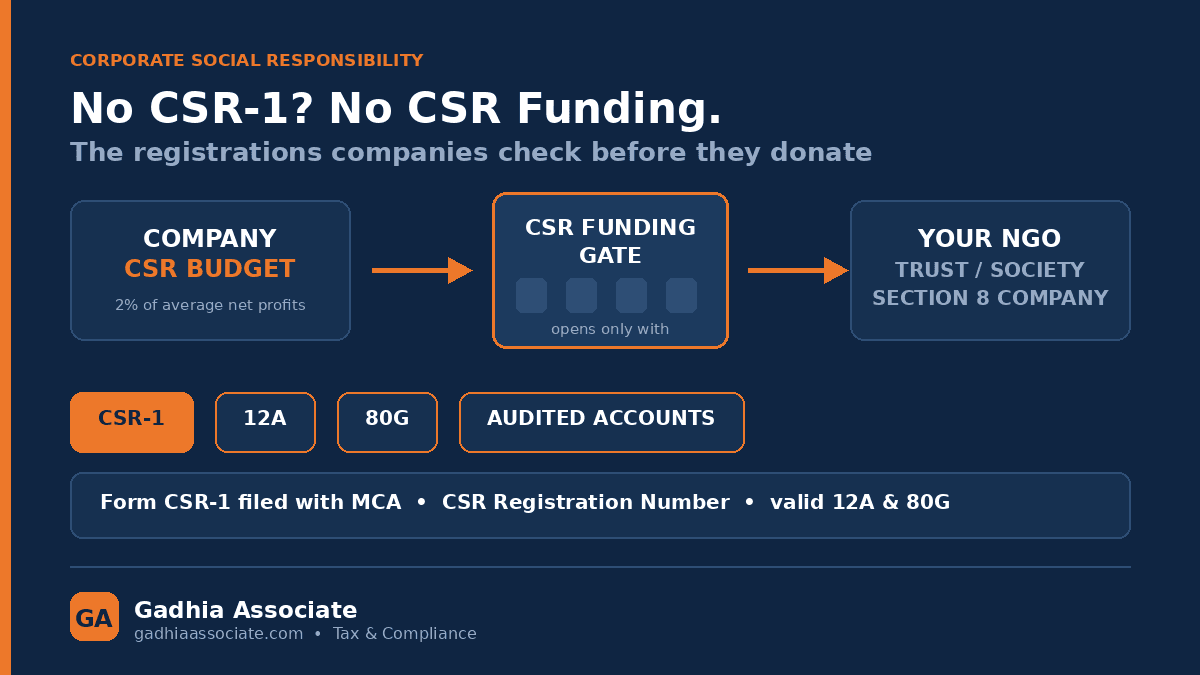
No - and it is not the company being difficult. Under the Companies (CSR Policy) Rules, an implementing agency must register with the Central Government by filing eForm CSR-1 with the Ministry of Corporate Affairs before it can undertake CSR activity on a company's behalf. On approval, the MCA allots a unique CSR Registration Number.
The company's auditor and board sign off on CSR spending, and without a CSR Registration Number that spend cannot be validly reported as CSR. Even a CSR head who loves your project cannot release the money. You are not rejected on merit - you are filtered out before merit is discussed.
What is a CSR Registration Number, and who can get one?
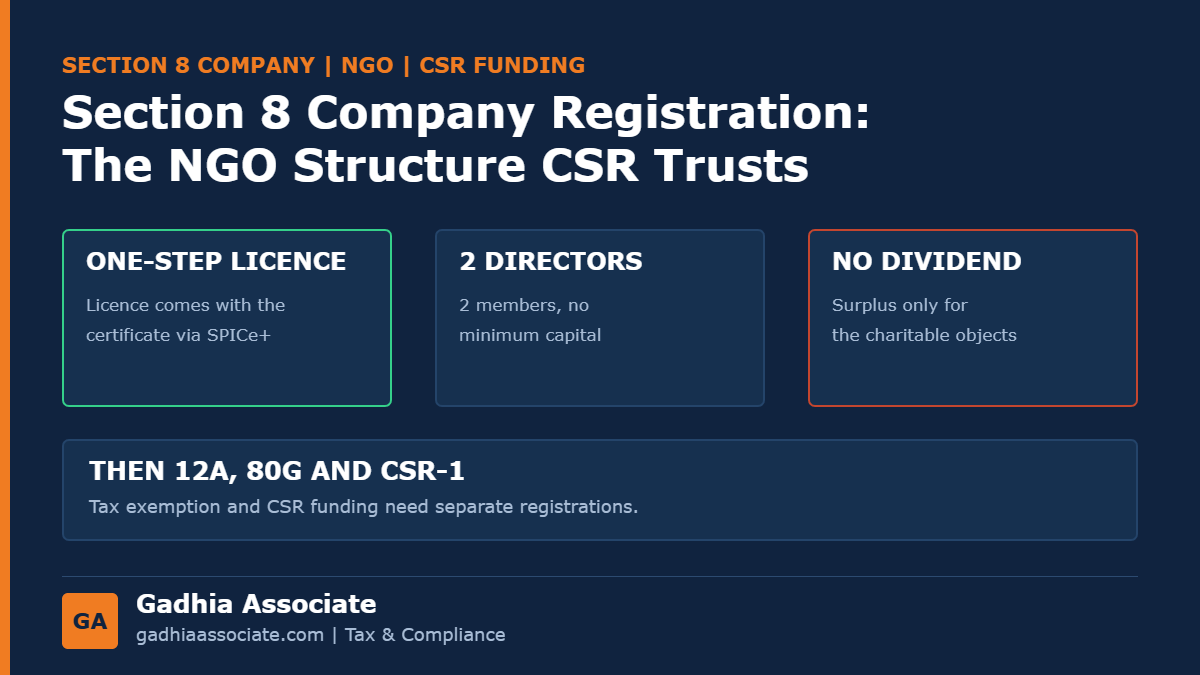
It is the identifier the MCA issues once your CSR-1 is approved. Corporates quote it in their own CSR reporting, which is why they will not move without it. Eligible entities are a registered public trust, registered society or Section 8 company. The entity is usually expected to hold Section 12A and 80G registration under the Income-tax Act and to have an established track record of at least three years in similar activities. That track record condition is generally understood not to apply where the entity was established by the funding company itself or by a statutory body. The form is filed digitally and verified by a practising professional - a chartered accountant, company secretary or cost accountant. Confirm the conditions applicable to your entity before filing, as the rules have been amended more than once.
Which companies actually have CSR money to give?
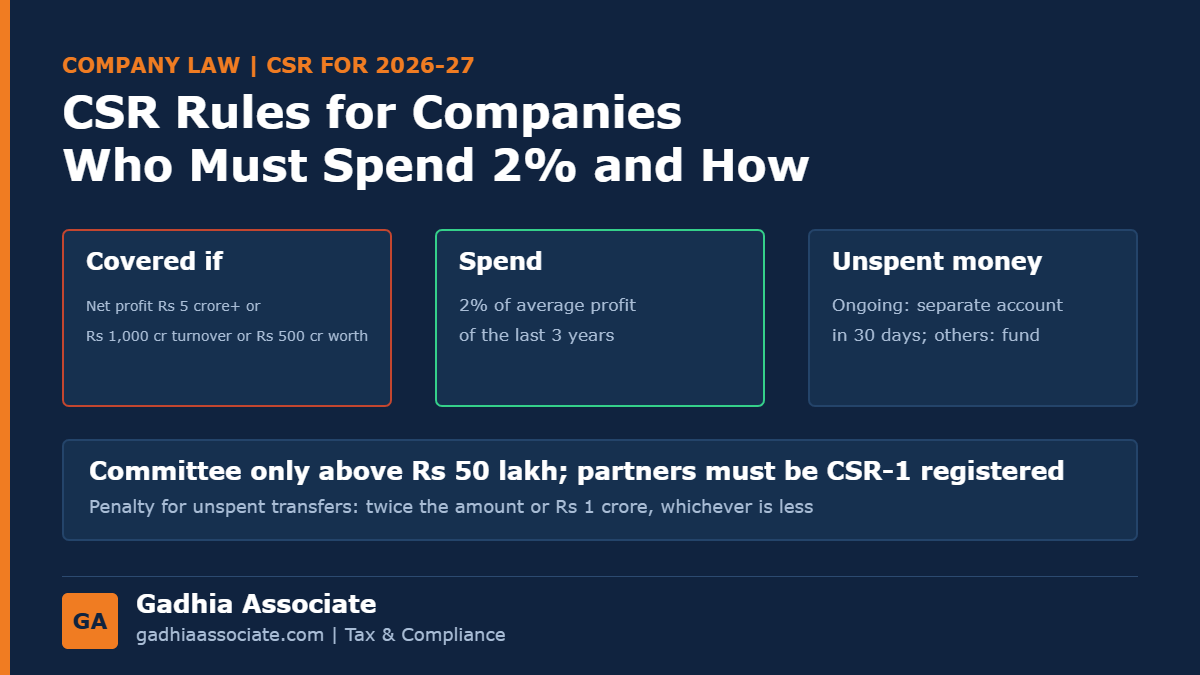
Knowing this helps you target rather than mass-mail. Under Section 135 of the Companies Act, 2013, CSR applies to a company that in the immediately preceding financial year had net worth of Rs 500 crore or more, turnover of Rs 1,000 crore or more, or net profit of Rs 5 crore or more. It must spend at least 2% of its average net profits of the three preceding financial years on CSR.
Two rules explain their timing. Unspent amounts for an ongoing project go to a separate Unspent CSR Account within 30 days of year end; other unspent amounts go to a Schedule VII fund within six months. Companies also report CSR in Form CSR-2. These timelines have been amended more than once, so verify current dates - but the effect is constant: CSR teams work to hard deadlines and fund only entities whose paperwork is already clean.
The cost of not fixing this
The arithmetic is blunt. Without CSR-1 you are not competing badly for corporate funding - you are invisible to every CSR budget in the country. One mid-sized company crossing the Rs 5 crore profit threshold may have Rs 10-20 lakh a year to place, and Gujarat has hundreds. You are on none of their lists.
It compounds. If your provisional 12A or 80G lapses, three things fail at once: donors lose the 80G deduction that motivated them, your exemption status is exposed, and your CSR-1 record no longer matches valid registrations. Restoring lapsed registrations takes months, and every cycle you miss is money already gone elsewhere. Missing audits and donation statements also leave existing donors unable to claim what you promised.
Get your file assessed before the next funding cycle
Before you approach another company, get your registrations checked. Gadhia Associate has been practising since 2007 - over 18 years - and serves more than 7,000 clients across Saurashtra and Gujarat, with a 5.0 Google rating from 100+ reviews. Your first consultation is free. Call or WhatsApp +91 82005 28355 with your trust deed and certificates, and we will tell you what is valid, what has expired and what is missing.
How do I register for CSR-1? The sequence that makes you fundable
Do these in order - skipping ahead is why applications get rejected.
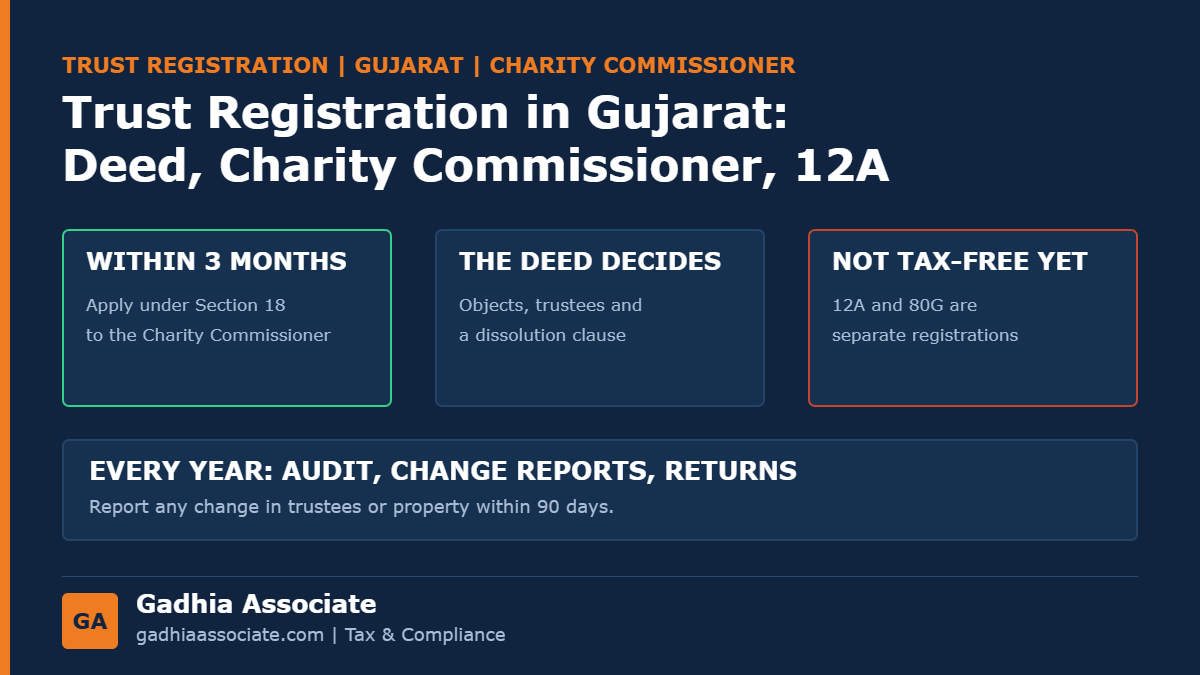
- Get the entity properly constituted - registered trust deed, society registration or Section 8 incorporation, with PAN in the exact registered name, matching across every document.
- Obtain 12A and 80G under the current regime. Registrations now carry validity periods under the 12AB/10AC framework - provisional first, then regular on application. Diarise the validity dates the day the certificate arrives. Our separate article on 12A and 80G registration and renewal covers the renewal traps.
- File eForm CSR-1 on the MCA portal with your registration details, attachments and digital signature, certified by a practising professional. Then put the CSR Registration Number on your letterhead and in every proposal.
- Build the annual hygiene: audited accounts each year, the audit report in Form 10B or 10BB as applicable, the donation statement in Form 10BD, and Form 10BE certificates to donors so their 80G claim survives scrutiny.
- Add project reporting capability - utilisation certificates, beneficiary data, photographs, and a named person who replies within a working day.
Illustrative example, round figures only: a company with average net profits of Rs 8 crore has a CSR obligation of about Rs 16 lakh. It shortlists four NGOs - two with CSR-1 and current 12A/80G, one whose 80G expired four months ago, one that never filed CSR-1. The last two are removed at first screening, before anyone reads their proposals. The compliant two split Rs 16 lakh.
What documents do companies ask an NGO for?
Run this as a self-audit today. A corporate CSR team typically asks for:
- CSR-1 acknowledgement and the CSR Registration Number
- 12A and 80G certificates, with their validity dates
- Registration deed or incorporation certificate, and entity PAN
- Audited accounts, usually for the last three years
- Income tax returns and the audit report in Form 10B or 10BB
- Form 10BD filed, and specimen Form 10BE certificates
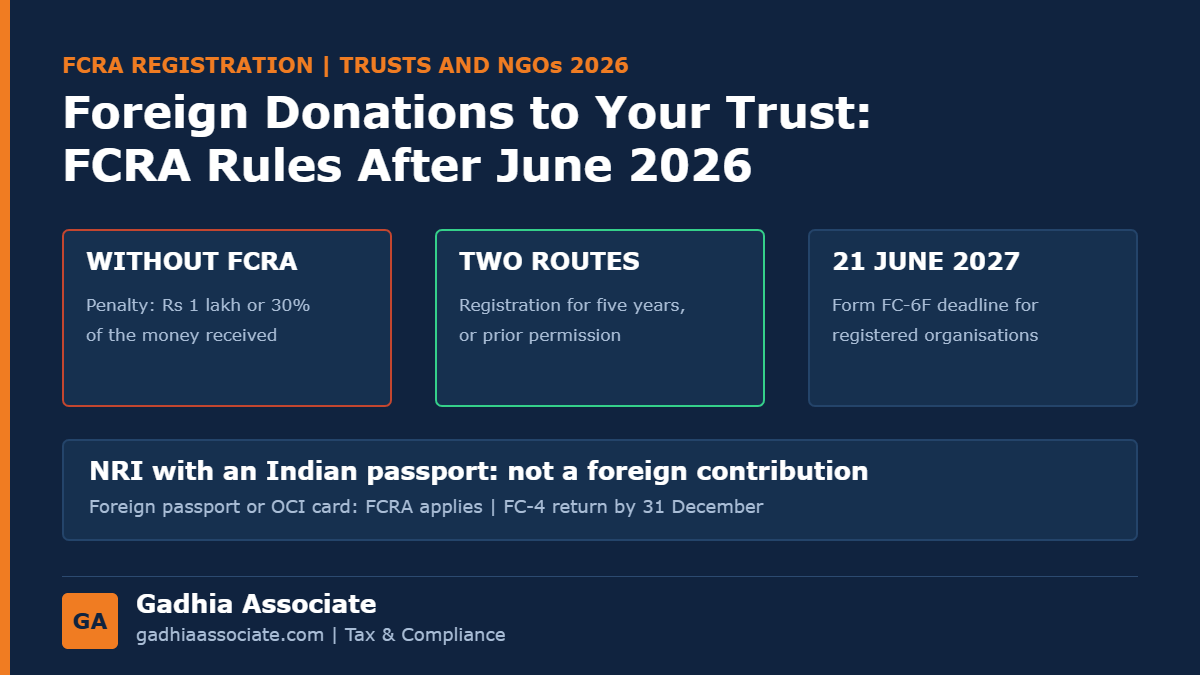
- FCRA registration - only where foreign contributions are involved
- Governance documents: trustee or director list, board minutes, policies
- Project proposal, budget and specimen utilisation certificate
- Bank details and a cancelled cheque in the registered name
If you cannot produce most of these within two working days, you will lose to an NGO that can.
Is 12A and 80G compulsory for CSR funding?
In practice, yes. Here is where files break:
- Expired provisional 12A or 80G. Fix: apply for regular registration within the prescribed window; if it has passed, take advice immediately.
- CSR-1 never filed. Fix: file it. This is usually the fastest single improvement to your fundability.
- Name or PAN mismatch across deed, PAN, 12A, 80G and bank records. Fix: correct everything to one exact legal name.
- No audited accounts or no Form 10B/10BB. Fix: complete the audits, oldest year first.
- Form 10BD not filed, so donors never got 10BE certificates. Fix: file for pending years and issue the certificates.
- No project reporting capacity. Fix: create a one-page monthly report format and use it even before you have a funder.
None of this makes you a compliance expert. It only requires the file to be built correctly once, then maintained.
Let us make your NGO fundable
Our NGO and trust compliance service covers exactly this: trust and Section 8 company formation, 12A and 80G registration and renewal, CSR-1 filing and certification, annual audits and Form 10B/10BB, and Form 10BD/10BE for your donors. We work on fixed fees and monthly plans with a dedicated client manager, from our Junagadh office with same-day appointments and fully digitally for NGOs anywhere in India. The first consultation is free - call or WhatsApp +91 82005 28355 and we will map your route to a CSR Registration Number.
Frequently asked questions on CSR-1 and CSR funding
Our NGO is only two years old. Can we still file CSR-1?
Generally a three-year track record in similar activities is expected, with an exception where the entity was established by the funding company or a statutory body. If you are short, get 12A, 80G and audits in place now so you can file the moment you qualify, and meanwhile approach individual and institutional donors, for whom CSR-1 is not required.
We have 12A and 80G. Is that enough for a company to fund us?
No. 12A and 80G deal with your income tax position and your donor's deduction. CSR-1 is a separate registration under company law, and it is what allows the company to treat the payment as CSR spend. You need both.
How long does CSR-1 take, and what does it cost?
Filing is not lengthy once documents are in order; the time goes into fixing 12A/80G validity, name mismatches or pending audits. Fees vary with the cleanup needed, so we quote a fixed fee after seeing your documents.
Do we need FCRA registration to receive CSR funds?
Not for CSR funds from an Indian company - FCRA is required only where you receive foreign contribution as defined under that law. Do not apply for it merely to look credible to corporates; it brings its own continuing obligations.
Disclaimer: This article reflects the position as we understand it in September 2026. Company law and income tax requirements for NGOs change through MCA and CBDT notifications, and CSR rules, forms and timelines have been amended several times. Outcomes depend entirely on the facts of your case. Please confirm the current position with a qualified professional before acting on anything stated here.