FCRA Registration for Trusts and NGOs in 2026: Who Needs It, the June 2026 Rule Changes, Form FC-6F Deadline, Fees and Process
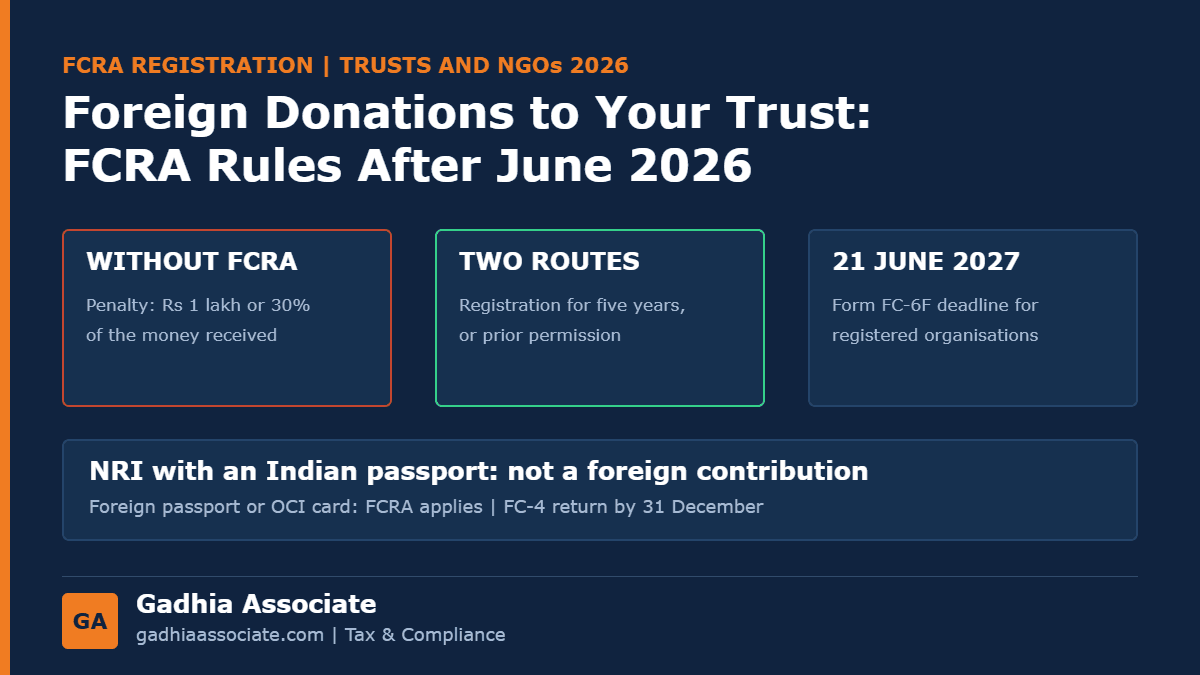
A trust or NGO needs FCRA registration or prior permission before it accepts money from a foreign source, even a foreign citizen of Indian origin.
A school trust near Porbandar gets a call from a former student, now settled in Leicester. He wants to give Rs 20 lakh for a new science lab. The trustees are delighted and send him the trust's bank details the same evening. It is the natural thing to do. If the money arrives, the trust has broken the law.
The donor holds a British passport. That makes his gift a foreign contribution, and a trust can accept one only after it is registered under the Foreign Contribution (Regulation) Act, 2010, or has prior permission for that gift. The rules were tightened again in June 2026. Here is what a trust, school, hospital or temple in Gujarat needs to know.
In short: Any trust, society or Section 8 company that wants to accept money from a foreign source needs FCRA registration or prior permission from the Ministry of Home Affairs. Registration is for organisations that are at least three years old and have spent Rs 15 lakh on their core activities in the last three years, and it is valid for five years. Others can apply for prior permission for a specific donor, amount and project. Since 22 June 2026, every registration is tied to named purposes and named States, and organisations already registered must file Form FC-6F by 21 June 2027. Accepting foreign money without approval can cost Rs 1 lakh or 30% of the amount, whichever is higher.
What counts as a foreign contribution?
- A donation from a foreign source: money, goods or securities from a foreign citizen, a foreign company, a foreign trust or foundation, or a foreign government or agency.
- Foreign citizens of Indian origin are included, and so are OCI cardholders. A donor who has taken a British, American, Canadian or Kenyan passport is a foreign source.
- An NRI is different. A donation from an Indian citizen living abroad, from his own savings and through a bank, is not a foreign contribution. Keep a copy of his Indian passport on file.
- The currency does not matter. A gift in rupees from a foreign citizen, even if handed over in India, is still a foreign contribution.
- Fees are not donations. Amounts received for goods or services in the ordinary course, such as fees paid by a foreign student, are not foreign contribution.
Registration or prior permission?
Registration, in Form FC-3A:
- For organisations that have existed for at least three years and have spent at least Rs 15 lakh on their core activities in the last three financial years, not counting administrative expenses.
- Valid for five years, for any number of donors.
- The fee is Rs 10,000 for one purpose and one State, plus Rs 300 for each additional purpose or State.
Prior permission, in Form FC-3B:
- For newer or smaller organisations that have a specific donor ready.
- It needs a commitment letter from the donor, stating the amount and the purpose.
- If the donor is an individual, he cannot be the chief functionary or an office bearer of the trust, and at least 75% of the trustees must not be his family members or close relatives.
- The money must be received within three years and used within four years of the approval.
- Where the Ministry releases the money in instalments, each later instalment needs the new Form FC-3BB and proof that 75% of the previous one has been used.
- The fee is Rs 5,000.
What changed in June 2026?
The Foreign Contribution (Regulation) Amendment Rules, 2026 were notified on 22 June 2026 and apply from that date.
- Purposes and States on the certificate: an applicant must pick its activities from a government list of 105 activities under five heads, social, educational, economic, cultural and religious, and name the States where it will work. Foreign money can be used only for those activities, in those States.
- Existing registrations: every organisation registered before the change must file Form FC-6F by 21 June 2027, stating the purposes and States it wants to keep. Any later change needs approval, with a resolution of the governing body.
- A minimum level of activity: an organisation is treated as active only if it has used at least Rs 10 lakh of foreign contribution in the last two financial years. The test applies at renewal and is a ground for cancellation.
- Key functionaries: the term now covers trustees, office bearers, governing body members and anyone who controls the organisation's affairs. An organisation with a foreign national in such a position, other than a person of Indian origin, will ordinarily not get registration or prior permission.
- More detail in the annual return: website and social media accounts, project-wise and State-wise spending, the ultimate donor where money comes through an intermediary, and publications during the year.
- A new portal: applications are now filed on the FCRA 2.0 portal, launched on 30 June 2026, with Aadhaar-based login and e-signing.
The minimum-activity test matters for small trusts. A trust that expects only an occasional foreign gift should weigh it before choosing registration over prior permission.
A separate Bill, on what happens to assets bought with foreign money when a registration ends, is before a parliamentary committee. It is not law yet.
The conditions every recipient must follow
- Designated bank account: foreign contribution must first be received in an FCRA account at the State Bank of India, New Delhi Main Branch. From there it can be moved to an FCRA account in a bank of your choice.
- No passing it on: foreign contribution cannot be transferred to another organisation.
- Administrative expenses: not more than 20% of the foreign contribution received in a year.
- Separate records: separate bank accounts and books for foreign and local funds.
- Aadhaar and Darpan: Aadhaar of every key functionary, and the organisation's NGO Darpan ID.
- Annual return: Form FC-4 by 31 December each year, with a chartered accountant's certificate, even if nothing was received. It sits alongside the income tax filings in our guide to trust and NGO annual compliance.
- Renewal: apply in Form FC-3C within six months before expiry. The Ministry advises applying at least four months ahead, because an expired registration cannot receive or use foreign money.
More than 18,000 registrations have been cancelled since 2015, so these are not conditions to treat lightly.
How does the application work?
- Check the route: registration if you meet the three-year and Rs 15 lakh tests, prior permission if you do not.
- Get the basics in place: registration of the trust or company, PAN, NGO Darpan ID and Aadhaar of all key functionaries. See our guides to trust registration in Gujarat and 12A and 80G registration.
- Open the FCRA account at SBI, New Delhi Main Branch. Its details go into the application.
- Prepare the documents: trust deed and registration certificate, activity reports and audited accounts for three years, the chartered accountant's certificate of expenditure, affidavits of the key functionaries, and for prior permission, the donor's commitment letter and a project report.
- Choose purposes and States with care, because the money can be used only for these.
- Apply online in Form FC-3A or FC-3B and pay the fee.
- Answer queries and co-operate with the field inquiry.
Applications usually take four to six months, so apply well before the donor's deadline. For the Porbandar school trust, the route is prior permission for this one gift: a commitment letter from the donor, a project report for the lab, and no money until the approval arrives.
What if foreign money has already come in?
- Accepting foreign contribution without registration or prior permission is an offence under the Act. It can be compounded by paying Rs 1 lakh or 30% of the amount received, whichever is higher. On Rs 20 lakh, that is Rs 6 lakh.
- The same rate applies to using foreign money for a purpose, or in a State, that is not on the certificate.
- Banks report foreign receipts to the Home Ministry, so such credits do get noticed.
- If it has already happened, do not spend the money. Have the facts examined, and deal with it through a compounding application rather than waiting for a notice.
Looking for funds from Indian companies instead? That needs a different registration, covered in our guide to CSR-1 registration and CSR funding.
What we do for you
- Check whether a donation is a foreign contribution, and which route fits your organisation
- Prepare and file the application for registration or prior permission, with the documents and certificates
- File Form FC-6F for registered organisations before 21 June 2027
- Keep the FCRA accounts and file the annual return in Form FC-4 by 31 December
- File renewals and intimations of changes on time
- Handle compounding applications and replies to queries from the Ministry
Gadhia Associate has been in practice since 2007 and has handled work for over 7,000 clients across Saurashtra and Gujarat, with a 5.0 Google rating from more than 100 reviews. Trusts, schools, hospitals, temples and gaushalas from Junagadh, Porbandar, Rajkot, Keshod, Veraval, Jamnagar and Amreli come to our Junagadh office, where same-day appointments are available. FCRA applications are filed online, so we also work with organisations elsewhere in Gujarat. Fixed-fee plans are available.
Has a donor abroad offered your trust money? Check before you share the bank details. Call +91 82005 28355 or message us on WhatsApp. The first consultation is free.
Frequently asked questions
Who needs FCRA registration?
Any trust, society or Section 8 company that wants to accept a donation from a foreign source, such as a foreign citizen, company or foundation.
Is a donation from an NRI a foreign contribution?
No, if the NRI holds an Indian passport and gives from his own savings through a bank. A donor with a foreign passport, including an OCI cardholder, is a foreign source.
What is the eligibility for FCRA registration?
Three years of existence and at least Rs 15 lakh spent on core activities in the last three financial years. Others can apply for prior permission for a specific donation.
What is the fee for FCRA registration?
Rs 10,000 for one purpose and one State, plus Rs 300 for each additional purpose or State. Prior permission and renewal cost Rs 5,000 each.
What is Form FC-6F and who must file it?
Organisations registered before 22 June 2026 must file it by 21 June 2027, to state the purposes and States for which they want to keep their registration.
What is the penalty for receiving foreign funds without FCRA approval?
The offence can be compounded at Rs 1 lakh or 30% of the amount received, whichever is higher, and prosecution is also possible.
Position as of 5 October 2026. FCRA rules, forms and the Ministry's practice change often, and each application is decided on its own facts. Take advice on your own organisation before you accept or use foreign funds.