Co-operative Society Audit and Income Tax in Gujarat 2026: The 30 September Audit Rule, Section 80P, Return Due Date and TDS
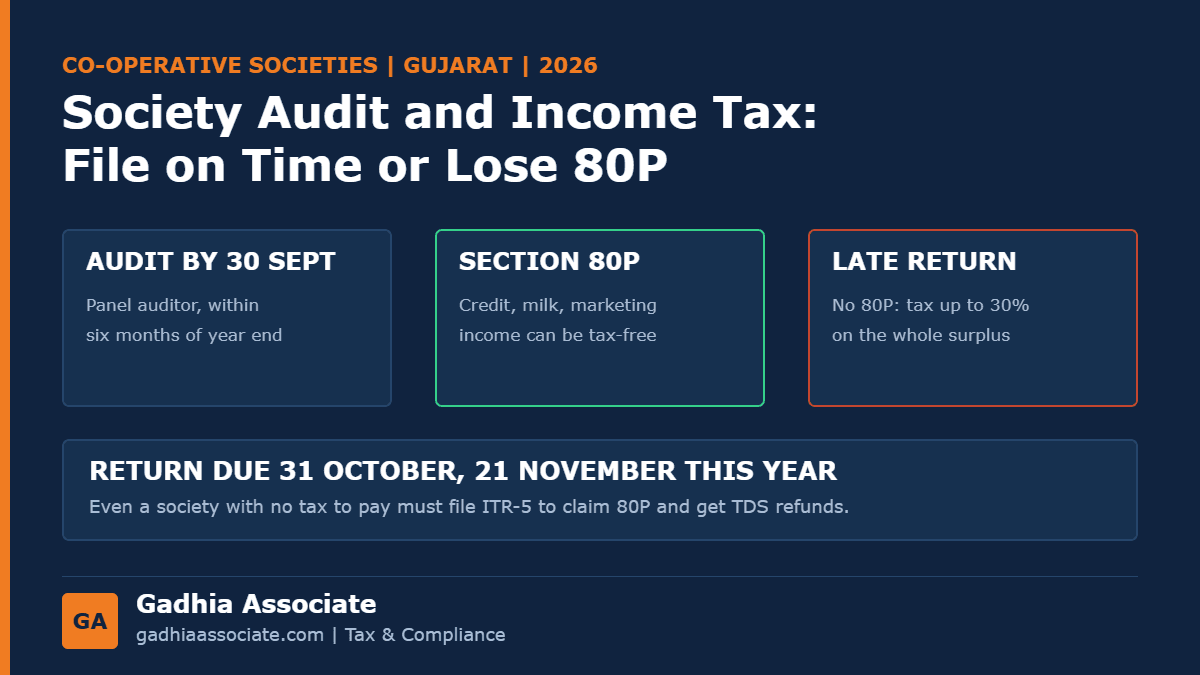
A co-operative society in Gujarat must finish its audit within six months of the year end, and file its tax return on time or lose the 80P deduction.
A milk co-operative in a village near Keshod has 240 members and a surplus of about Rs 9 lakh a year, most of it kept in deposits with the district co-operative bank. The secretary gets the yearly audit done and holds the general meeting, but has never filed an income tax return, because "a mandli has no tax". Then a notice arrives. The bank has reported the interest and the TDS it deducted, and the department wants to know why no return has been filed for four years.
It is a common pattern with societies: the co-operative law is followed, and the income tax law is forgotten. Here is what a society's committee needs to know about both.
In short: Under the Gujarat Co-operative Societies Act, 1961, every society must get its accounts audited by an auditor from the approved panel within six months of the close of the financial year, and hold its annual general meeting within the same time. For income tax, a society is a taxable entity that files its return in ITR-5. Section 80P can make most or all of its income tax-free, but only if the return is filed by the due date, which is 31 October for audited societies, and 21 November 2026 for this year. A society that files late loses the deduction and pays tax at up to 30% on its surplus.
What does the Gujarat Act require every year?
- Audit: by an auditor or audit firm from the panel approved by the government, completed within six months of the year end, that is, by 30 September.
- If it is not done: the Registrar gets the audit done and recovers the cost from the society.
- Annual general meeting: within six months of the year end, to place the accounts, the audit report and the committee's report before the members.
- If the meeting is not called: the officers responsible can be disqualified from holding office for up to three years.
- Audit fee: as prescribed by the government for the type and size of society.
Does a co-operative society pay income tax?
Yes, unless a deduction covers its income. The rates are 10% on the first Rs 10,000, 20% on the next Rs 10,000 and 30% above Rs 20,000, with a surcharge once income crosses Rs 1 crore. A society can instead opt for a flat 22%, but then it gives up the 80P deduction, so the option suits only a few.
What does Section 80P cover?
- Credit societies: the whole profit from providing credit to members. Co-operative banks do not get this, except primary agricultural credit societies.
- Marketing societies: the whole profit from marketing the agricultural produce of members.
- Milk, oilseed, fruit and vegetable societies: the whole profit of a primary society from supplying its members' produce to a federal society or to the government.
- Income from other co-operative societies: interest and dividends from investments with them.
- Other activities: up to Rs 1 lakh for a consumer society and Rs 50,000 for others.
The part that causes disputes is bank interest. Interest on deposits with nationalised and private banks is generally not covered. Interest from deposits with a co-operative bank has been allowed in several rulings, but the department often contests it, so the claim has to be made carefully and backed with the right documents.
The rule that costs societies the most
The 80P deduction is allowed only if the return is filed on or before the due date. For a society whose accounts are audited under the state Act, that date is 31 October. For AY 2026-27 it has been extended to 21 November 2026, as explained in our note on the extended due dates.
An example: the Keshod society has a surplus of Rs 9 lakh. Filed on time with a valid 80P claim, its tax can be nil. Filed late, or not filed, the same surplus is taxed at about Rs 2.78 lakh, before interest and penalty.
Many societies missed the date in past years because the statutory audit itself was late. For those cases, CBDT has allowed an application for condonation to the Chief Commissioner, under Circular 13/2023 for AY 2018-19 to 2022-23 and Circular 14/2024 for AY 2023-24. It is not automatic, and it has to be asked for.
TDS and cash rules that societies miss
- TDS on the society's deposits: banks deduct TDS on interest paid to the society. The refund comes only by filing the return.
- TDS on interest paid to members: a society whose turnover crossed Rs 50 crore in the previous year must deduct TDS on interest paid to members above the limit.
- TDS on payments: a society must deduct TDS on salaries, contractors, professionals and rent like any other organisation.
- Cash withdrawals: banks deduct 2% TDS once a society's cash withdrawals cross Rs 3 crore in a year.
- Cash loans and deposits: the Rs 20,000 limit applies, with a higher limit of Rs 2 lakh per member for primary agricultural credit societies. See our guide to cash transaction limits.
A yearly calendar for the committee
- April to June: close the books and hand them to the auditor.
- By 30 September: complete the audit and hold the annual general meeting.
- By 31 October: file the income tax return in ITR-5 with the 80P claim. This year, by 21 November.
- Every quarter: pay TDS and file TDS returns, and pay advance tax if any income is taxable.
- Whenever a notice comes: reply within the time given. Our guide to income tax notices explains the common ones.
What we do for you
- Prepare the society's accounts and schedules for the statutory audit
- Carry out the audit where we are appointed from the panel
- File the income tax return in ITR-5 with the correct 80P claim, on time
- Claim refunds of TDS deducted by banks
- Reply to notices where 80P was denied or returns were not filed, and apply for condonation where it is available
- Handle TDS returns and advise on cash limits
Gadhia Associate has been in practice since 2007 and has handled work for over 7,000 clients across Saurashtra and Gujarat, with a 5.0 Google rating from more than 100 reviews. Credit societies, milk societies, service co-operatives, housing societies and marketing societies from Junagadh, Keshod, Mangrol, Veraval, Rajkot, Porbandar and Amreli come to our Junagadh office, where same-day appointments are available. Returns and notice replies are filed online, so we also help societies elsewhere in Gujarat. Fixed-fee plans are available.
Is your society's return pending, or has a notice come? Call +91 82005 28355 or message us on WhatsApp. The first consultation is free.
Frequently asked questions
Is audit compulsory for a co-operative society in Gujarat?
Yes. Every society must get its accounts audited each year by an auditor from the approved panel, within six months of the close of the financial year.
Does a co-operative society have to file an income tax return?
Yes, in ITR-5. Even where the whole income is deductible under Section 80P, the deduction is available only through a return filed on time.
What is the due date for a co-operative society's income tax return?
31 October for societies whose accounts are audited under the state Act. For AY 2026-27 it is 21 November 2026.
Can a society claim 80P in a late return?
No. The deduction is denied if the return is filed after the due date, unless the delay is condoned on an application.
Is bank interest earned by a society taxable?
Interest from nationalised and private banks is generally taxable. Interest from other co-operative societies is deductible, and interest from co-operative banks is often disputed.
What is the tax rate for a co-operative society?
10% up to Rs 10,000, 20% from Rs 10,001 to Rs 20,000 and 30% above that, or 22% under the optional regime without the 80P deduction.
Position as of 3 October 2026. For AY 2026-27, the Income-tax Act, 1961 applies, and the new Act renumbers these provisions from tax year 2026-27. Rulings on Section 80P differ by the type of society and its income. Take advice on your own society before you file.