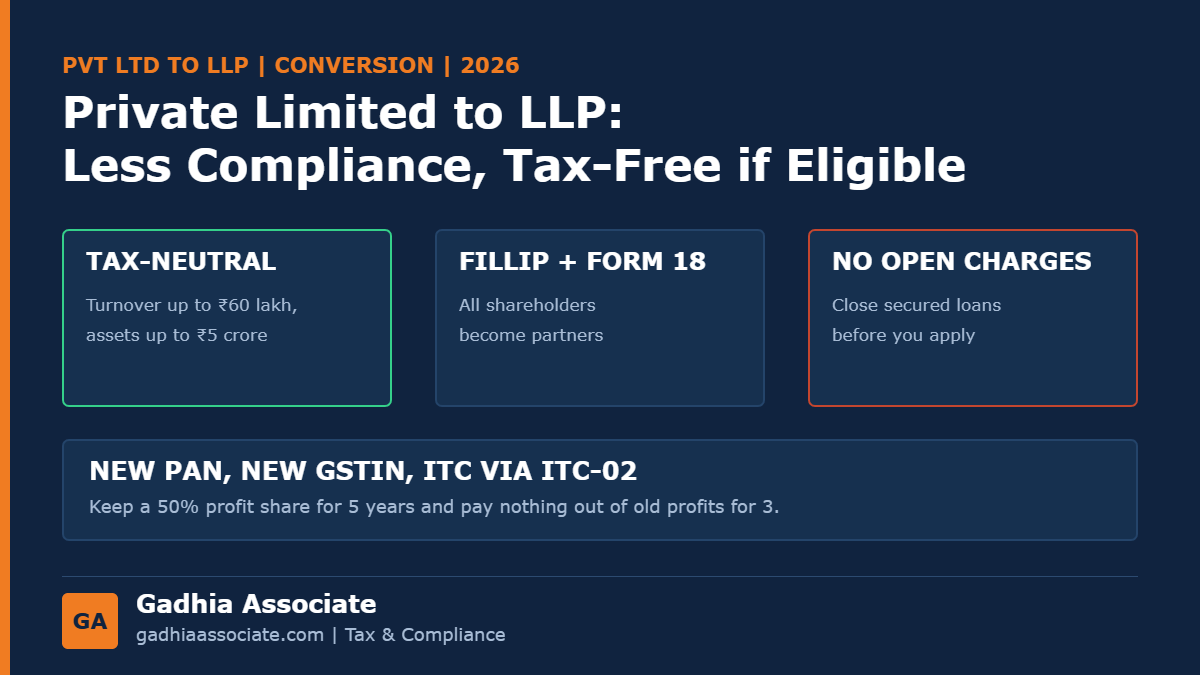
Converting a Partnership Firm into an LLP in 2026: Process, Form 17, Tax-Free Conditions, GST and What It Costs in Gujarat
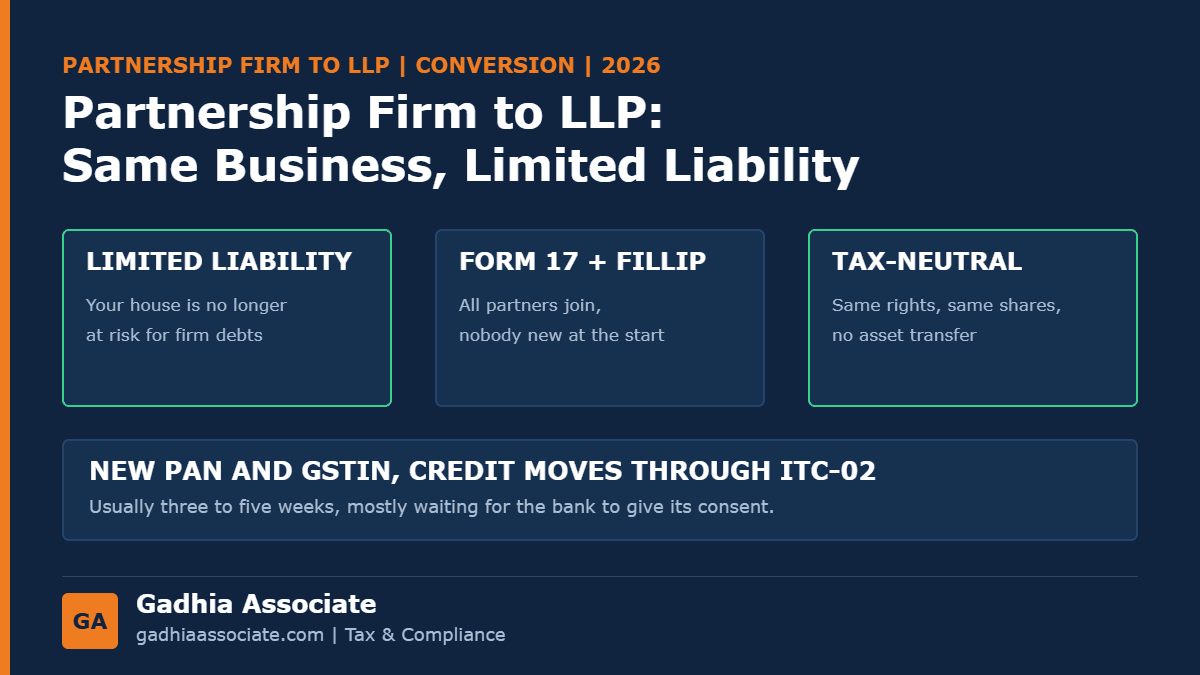
A partnership firm can convert into an LLP under the LLP Act, keeping its business and partners but gaining limited liability for every partner.
Three brothers in Jetpur have run a dyeing and printing firm for 22 years. A large customer has not paid for eight months, and a pollution case against a nearby unit has them thinking about something they never worried about before. In a partnership, every partner is personally liable for all the firm's debts, without limit, and that includes the house each of them lives in. Their bank manager has suggested converting into an LLP.
It is a sound suggestion for many firms, and the conversion is a well-defined process. Here is how it works, what it costs, how to keep it tax-free, and what changes for GST and the bank.
In short: Under Section 55 and the Second Schedule of the LLP Act, 2008, a firm converts by filing Form 17 along with the LLP incorporation form, FiLLiP. All partners of the firm, and nobody else, must become partners of the LLP. On registration, the firm's assets, liabilities, contracts and pending matters pass to the LLP and the firm is dissolved. The Registrar of Firms is informed in Form 14 within 15 days, and the LLP agreement is filed in Form 3 within 30 days. For income tax, the conversion has no tax effect if the partners' rights and obligations stay the same and no asset or liability is transferred after conversion. The LLP gets a new PAN and a new GST registration.
Why do firms convert?
- Limited liability: each partner's risk is limited to his agreed contribution, except for his own fraud or wrongdoing. Personal property is no longer exposed to the business's debts.
- A separate legal entity: the LLP owns the assets, signs contracts and continues even when partners change.
- Easier changes: partners can join or retire without dissolving or redrafting the whole business.
- Same tax treatment: an LLP is taxed like a firm, and partners' salary and interest stay deductible within the limits. Our guide to the partnership deed and Section 40(b) limits explains those limits.
- Credibility: banks, large buyers and export customers find an LLP easier to deal with, because its details are on the MCA record.
Who can convert?
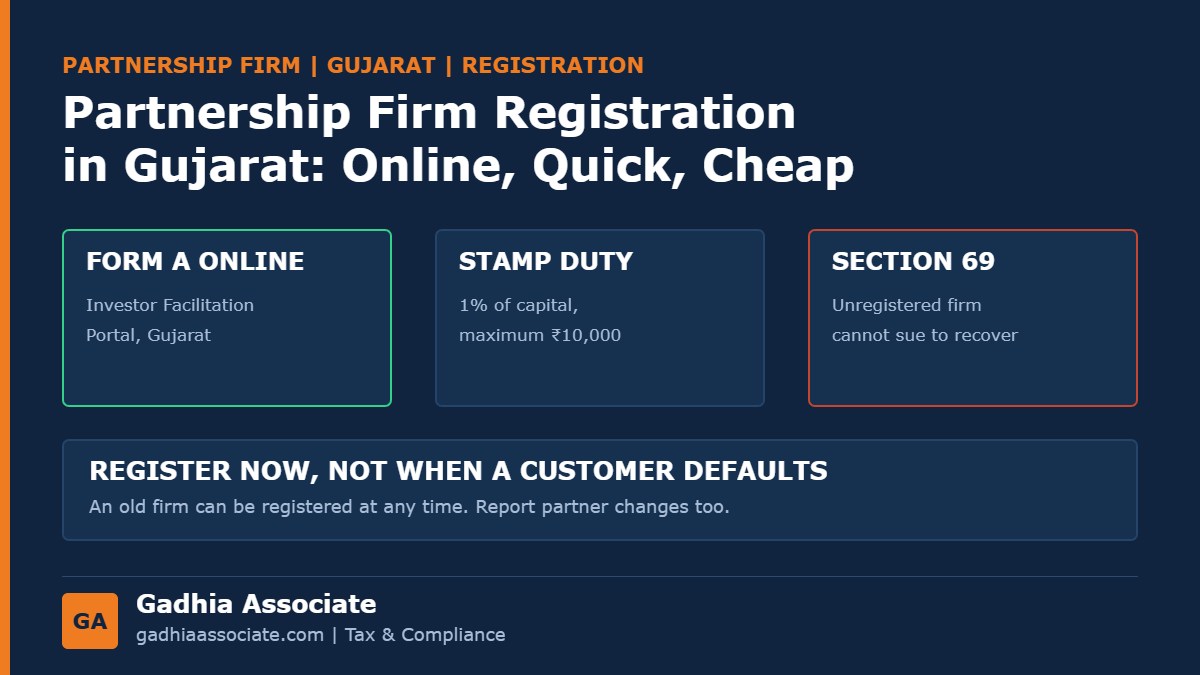
- A registered firm: the firm should be registered with the Registrar of Firms. If yours is not, register it first. In Gujarat this is an online process, covered in our guide to partnership firm registration in Gujarat.
- Same partners: every partner of the firm becomes a partner of the LLP, and nobody new joins at the time of conversion. New partners can be admitted afterwards.
- Creditors on board: secured creditors, usually the bank, must consent.
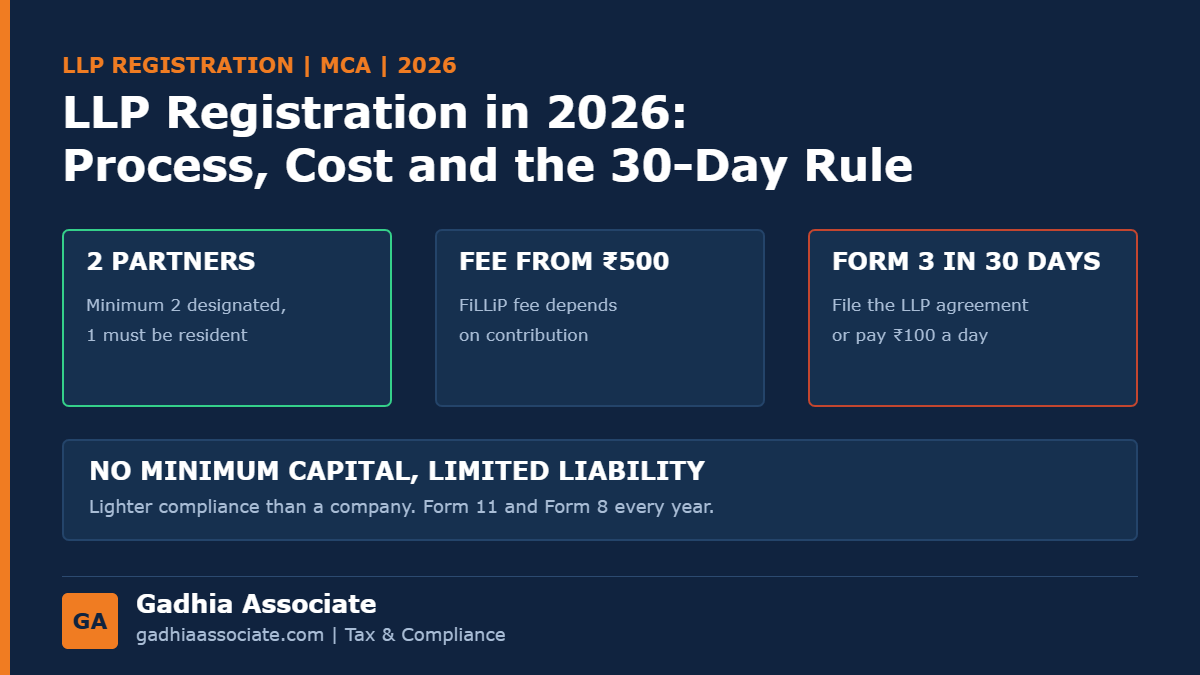
- Designated partners: at least two, with digital signatures and designated partner numbers, and at least one of them resident in India.
How does the conversion work?
- Digital signatures and designated partner numbers for the partners.
- Name reservation through RUN-LLP. The LLP can usually keep the firm's name, ending in "LLP".
- FiLLiP with Form 17, attaching a statement of assets and liabilities certified by a chartered accountant, the consent of all partners, the consent of secured creditors, the firm's registration certificate and deed, and its latest income tax return.
- Certificate of registration of the LLP. From this date, the firm stands dissolved and everything it owned or owed belongs to the LLP.
- Form 14 to inform the Registrar of Firms, within 15 days.
- Form 3, the LLP agreement, within 30 days.
- Updates: PAN and TAN, GST, bank accounts, licences and property records.
The whole process usually takes three to five weeks. Most of the time goes into the bank's consent and the certified statement of assets and liabilities.
How do you keep the conversion tax-free?
There is no special exemption section for this conversion. The position comes from the government's explanation when LLPs were brought into the tax law in 2009: since an LLP and a firm are treated alike, the conversion has no tax implications if the rights and obligations of the partners remain the same after conversion, and no asset or liability is transferred after conversion. If those conditions are broken, capital gains tax can apply.
In practice, that means:
- Take over all assets and liabilities at their book values.
- Keep each partner's capital and profit share exactly as in the firm.
- Do not revalue assets, or pay out or distribute assets to partners, at the time of conversion.
What happens to GST, the bank and licences?
- PAN and GST: the LLP gets a new PAN, so it needs a new GST registration. Unused input tax credit can be moved from the firm's GSTIN to the LLP's through Form GST ITC-02, after which the firm's registration is cancelled.
- Bank: accounts and loans move to the LLP's name and PAN, with the bank's sanction.
- Licences: Udyam, IEC, FSSAI, factory licence, GPCB consent and professional tax must be updated or obtained in the LLP's name.
- Property: land and buildings vest in the LLP by law, but revenue records must be updated. Check the stamp duty position before you file.
What does an LLP have to file every year?
Form 11, the annual return, by 30 May, and Form 8, the statement of accounts and solvency, by 30 October, along with the income tax return and DIR-3 KYC of the designated partners. An LLP whose turnover is within Rs 40 lakh, or whose contribution is within Rs 25 lakh, does not need a statutory audit under the LLP rules. Late filing costs Rs 100 a day for each form. Our guide to LLP annual compliance has the details.
When should a firm not convert?
- When the plan is to bring in equity investors. A private limited company suits that better, as our comparison of private limited, LLP and proprietorship explains.
- When the bank will not give its consent yet.
- When the firm is very small, low-risk and on presumptive tax, and the yearly filings would cost more than the protection is worth.
- When the firm owns property and the stamp duty cost in your case is high. Work it out first.
What we do for you
- Check whether conversion suits your firm, and what it will cost
- Register the firm with the Registrar of Firms first, if needed
- Prepare the certified statement of assets and liabilities and the partners' and creditors' consents
- File RUN-LLP, FiLLiP, Form 17, Form 14 and Form 3
- Draft the LLP agreement so that the conversion stays tax-neutral
- Move GST registration and credit, and update the bank, licences and records
Gadhia Associate has been in practice since 2007 and has handled work for over 7,000 clients across Saurashtra and Gujarat, with a 5.0 Google rating from more than 100 reviews. Partnership firms from Junagadh, Rajkot, Jetpur, Jamnagar, Morbi, Veraval and Porbandar come to our Junagadh office, where same-day appointments are available. MCA filings are online, so we also convert firms anywhere in India. Fixed-fee and monthly plans are available.
Want to convert your firm into an LLP? Call +91 82005 28355 or message us on WhatsApp. The first consultation is free.
Frequently asked questions
Can a partnership firm be converted into an LLP?
Yes, under Section 55 and the Second Schedule of the LLP Act, 2008, by filing Form 17 with FiLLiP, if all partners of the firm become the partners of the LLP.
Is the conversion of a firm into an LLP taxable?
No, if the partners' rights and obligations stay the same and no asset or liability is transferred after conversion. Otherwise, capital gains tax can apply.
Can an unregistered firm convert into an LLP?
It should first be registered with the Registrar of Firms, and then apply for conversion.
Does the LLP need a new GST registration?
Yes. The LLP has a new PAN, so it registers afresh, and unused credit can be moved from the firm through Form GST ITC-02.
How long does the conversion take?
Usually three to five weeks, depending mainly on the bank's consent and the documents.
What happens to the firm after conversion?
It is dissolved on the date of the LLP's registration, and its assets, liabilities, contracts and pending matters pass to the LLP.
Position as of 1 October 2026. MCA forms and fees change from time to time, and the income tax position comes from the government's 2009 explanation rather than a specific exemption section, so the facts of each firm matter. Stamp duty and land record practice vary. Take advice on your firm before you convert.