Private Limited vs LLP vs Proprietorship in 2026: Which Should You Register, What It Costs and What You Must File Every Year
Should I register a private limited company or an LLP in 2026?
If you are about to start a business, or you are already trading as a proprietor and your turnover has crossed roughly Rs 40-50 lakh, the private limited vs LLP vs proprietorship decision is now costing you money either way you go. Choose too heavy a structure and you pay for audits and filings you did not need. Choose too light a structure and you lose a corporate order, a bank limit or an investor because you cannot show a registered entity. Get it wrong and undoing it later means a fresh incorporation, a fresh PAN and GST, and often a year of transition.
So the real question is not which structure is best. It is what you are optimising for: liability protection, cost, annual compliance burden, tax, or credibility with buyers and banks. Answer that and the structure picks itself.
Private limited vs LLP vs proprietorship: the honest comparison
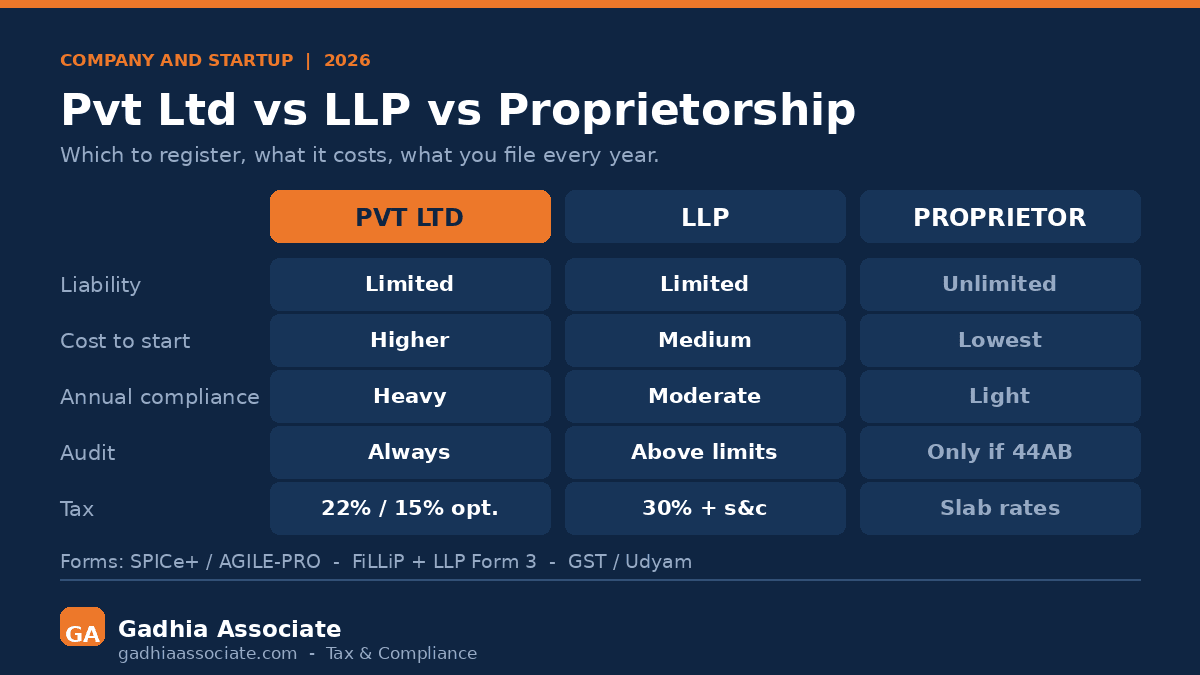
Liability. A proprietorship is you. There is no separate legal entity, so a business debt or a court decree reaches your personal house, land and savings. A private limited company and an LLP are separate legal persons with limited liability; your exposure is normally capped at your capital, subject to personal guarantees you sign and to fraud. A One Person Company (OPC) gives a single owner that same limited liability with a company structure.
Who you need. A private limited company needs a minimum of two shareholders and two directors. An LLP needs at least two partners, of whom two are designated partners. An OPC needs one member, one director and a nominee. A proprietorship needs only you.
How you set it up. Companies are incorporated through the MCA SPICe+ form with the linked AGILE-PRO application, which bundles name reservation, incorporation, PAN, TAN, and applications such as EPFO, ESIC, professional tax and a bank account. LLPs are incorporated through FiLLiP, followed by LLP Form 3 for the LLP agreement within the prescribed time. A proprietorship is not incorporated at all: you simply register what applies to your activity, typically GST, Udyam (MSME), a Gujarat shops and establishment registration, and a current account in the trade name.
Time. With digital signatures ready and names that clear on the first attempt, expect roughly 7-15 working days for a company or an LLP, and 1-5 working days for the registrations a proprietor needs. Name rejections and document mismatches are the usual cause of delay.
Indicative cost to start. These are indicative ranges only and vary with authorised capital, Gujarat stamp duty, the number of DSCs and professional fees. Broadly, a proprietorship is the cheapest (a few thousand rupees of registrations), an LLP typically sits in the middle, and a private limited company is usually the highest of the three because of higher stamp duty and more documentation. Ask for a written, itemised quote separating government fees from professional fees before you commit; anybody quoting a single flat all-India number without asking your capital and state is guessing.
Annual compliance. A company files AOC-4 (financials) and MGT-7 or MGT-7A (annual return) each year, holds board and general meetings, maintains statutory registers, files DIR-3 KYC for every director, and must have a statutory audit regardless of turnover. An LLP files Form 11 (annual return) and Form 8 (statement of account and solvency), and needs an audit only where turnover exceeds Rs 40 lakh or contribution exceeds Rs 25 lakh. A proprietorship files no MCA forms at all; it files your personal ITR, GST returns and a tax audit only if the income tax thresholds are crossed.
Tax. Domestic companies can opt for the concessional regimes: 22% under Section 115BAA plus surcharge and cess (an effective rate of roughly 25%), and 15% under Section 115BAB plus surcharge and cess for eligible new manufacturing companies, in each case giving up specified deductions. LLPs and partnership firms are taxed at 30% plus surcharge and cess. A proprietorship is taxed at your individual slab rates, which is genuinely cheaper at low income and worse at high income. The layer people forget: money taken out of a company as dividend is taxed again in the shareholder hands, whereas an LLP has no equivalent second layer on profit share to partners.
If you are reading this and still not sure, that is normal, and one conversation usually settles it. Gadhia Associate offers a free first consultation where we look at your turnover, funding plans and buyer profile and tell you plainly which structure fits, with an itemised fixed-fee quote and monthly payment options. Call or WhatsApp +91 82005 28355 before you pay for a registration you may not need.
Pick this if... four real scenarios
You are a freelancer or consultant billing under about Rs 40 lakh. Stay a proprietor. Register GST if required, take Udyam, use a separate current account, and file under presumptive taxation if eligible. Your compliance cost stays low and you keep slab-rate taxation. Revisit the decision when a client insists on a registered entity.
A family trading business in Junagadh with steady turnover and no outside investors. An LLP is usually the sweet spot: limited liability for the family personal assets, only two MCA forms a year, no statutory audit until Rs 40 lakh turnover or Rs 25 lakh contribution, and no dividend layer when profits come out. A private limited company makes sense here mainly if you plan to bring in non-family shareholders or want the stronger corporate image with larger buyers.
Two founders planning to raise investment. Private limited company, without much debate. Angel and venture investors expect equity shares, a cap table, ESOPs and a board. Trying to convert an LLP mid-fundraise wastes months at exactly the wrong time.
Bidding for corporate or government contracts. Many tenders and vendor onboarding processes ask for audited financials, an incorporation certificate and a minimum entity vintage. A private limited company is the safest choice; an LLP is accepted in many tenders but read the eligibility clause first, before you register anything.
Both a private limited company and an LLP can apply for DPIIT recognition under Startup India, with the tax and procedural benefits that follow. A proprietorship cannot. If that matters to you, see our article on Startup India DPIIT recognition, and try our Business Structure Advisor tool for a first-pass answer in a few minutes.
An illustrative comparison
Illustrative only. Take a business earning Rs 20 lakh of profit. As a proprietorship it is taxed in the owner slab, with no MCA filings and no statutory audit. As an LLP it is taxed at 30% plus surcharge and cess, with Form 11 and Form 8 each year and audit only past the thresholds above. As a private limited company under Section 115BAA it is taxed at roughly 25% effective, but a statutory audit is compulsory from year one, AOC-4 and MGT-7 are annual, and profit taken home as dividend is taxed again in your hands. The headline company rate looks lower; the total, after the second layer and the compliance, often is not. Your actual position depends on how much you withdraw and your personal slab.
What compliance do I have to do every year?
- Private limited company / OPC: statutory audit; AOC-4 and MGT-7 or MGT-7A with the MCA; DIR-3 KYC for every director annually; board and annual general meetings with minutes; statutory registers; income tax return, TDS returns and GST returns as applicable.
- LLP: Form 11 annual return; Form 8 statement of account and solvency; audit only if turnover exceeds Rs 40 lakh or contribution exceeds Rs 25 lakh; DIR-3 KYC for designated partners; income tax return, and TDS and GST returns as applicable. See our detailed article on LLP annual compliance for the due dates.
- Proprietorship: your personal income tax return, GST returns if registered, TDS returns if you deduct, and a tax audit only if the income tax thresholds are crossed. No MCA filings.
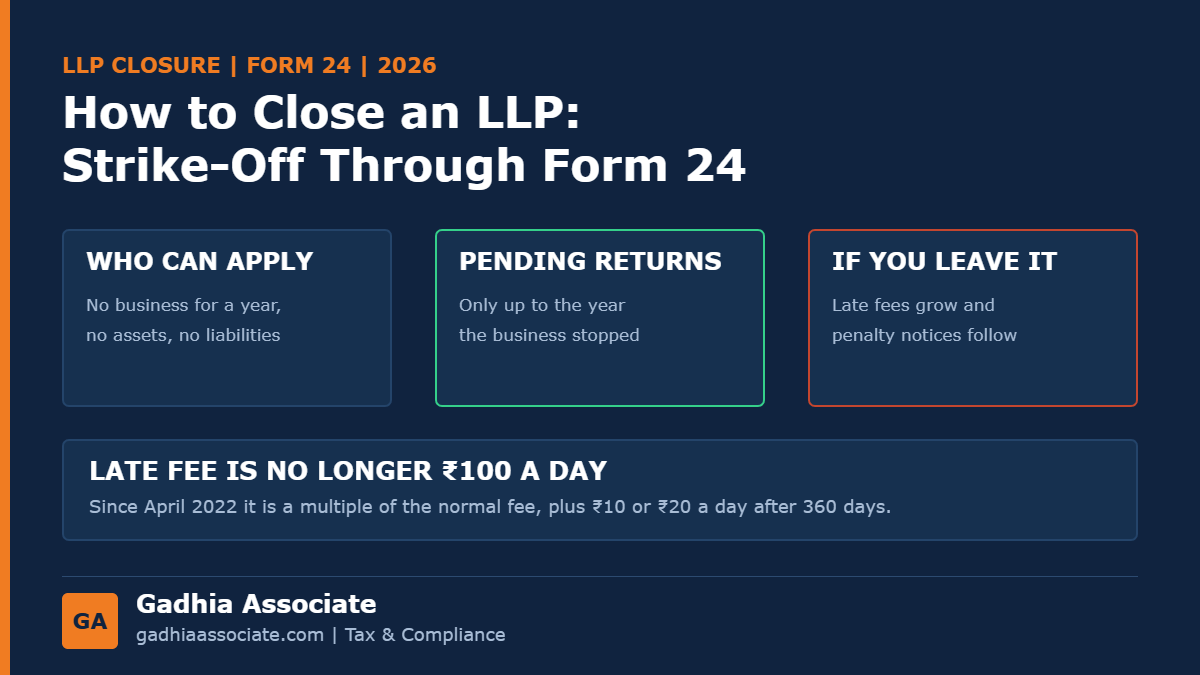
One warning that is specific to LLPs and catches people badly: late filing of LLP forms attracts an additional fee of Rs 100 per day, per form, with no upper cap. A Form 8 forgotten for three years is not a small penalty; it compounds quietly until you try to close, sell or borrow.
The mistakes people actually regret
- Registering a private limited company for the badge, then not filing. Audit, AOC-4, MGT-7 and DIR-3 KYC are due whether or not you traded. Directors get disqualified, penalties accumulate, and the cleanup costs more than the incorporation did. If a company is genuinely dormant, read our article on company strike off and close it properly.
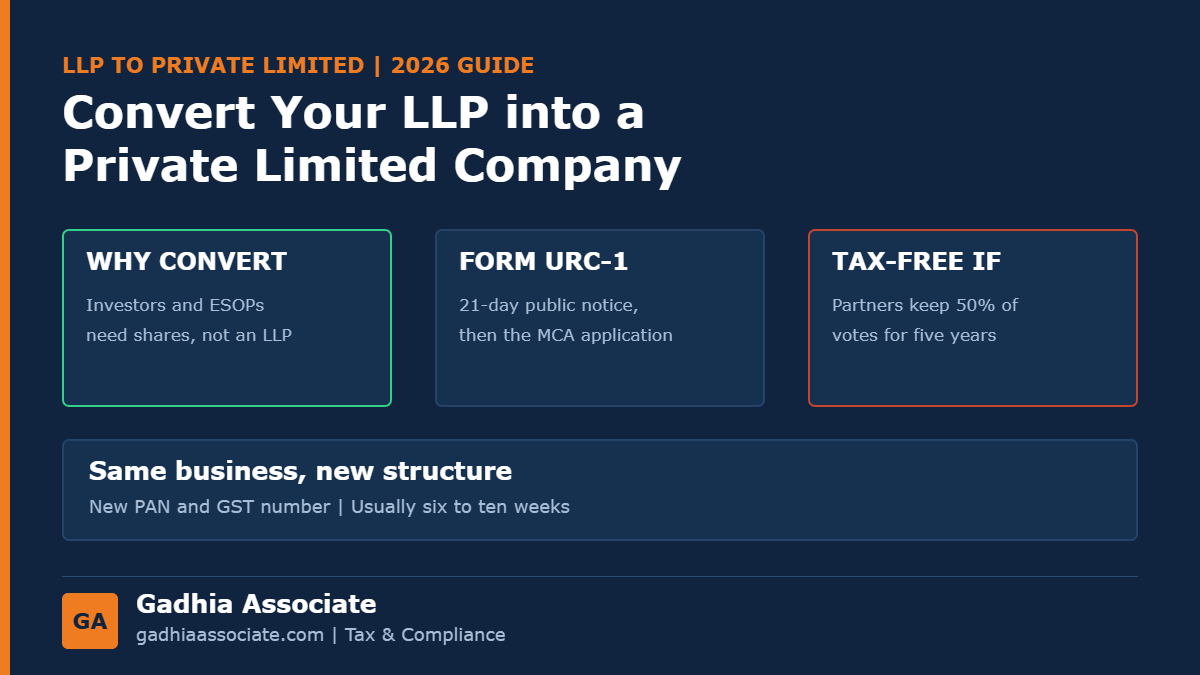
- Choosing an LLP and then needing funding. Converting to a private limited company is possible but slow and expensive, and it usually collides with a live term sheet.
- Running everything through a personal savings account. It destroys the limited liability argument, wrecks your books, and makes a bank limit or a tax notice far harder to defend.
- Choosing a structure on registration cost alone, then paying the difference back several times over in annual audit and filing fees.
Can I convert my proprietorship into a company later?
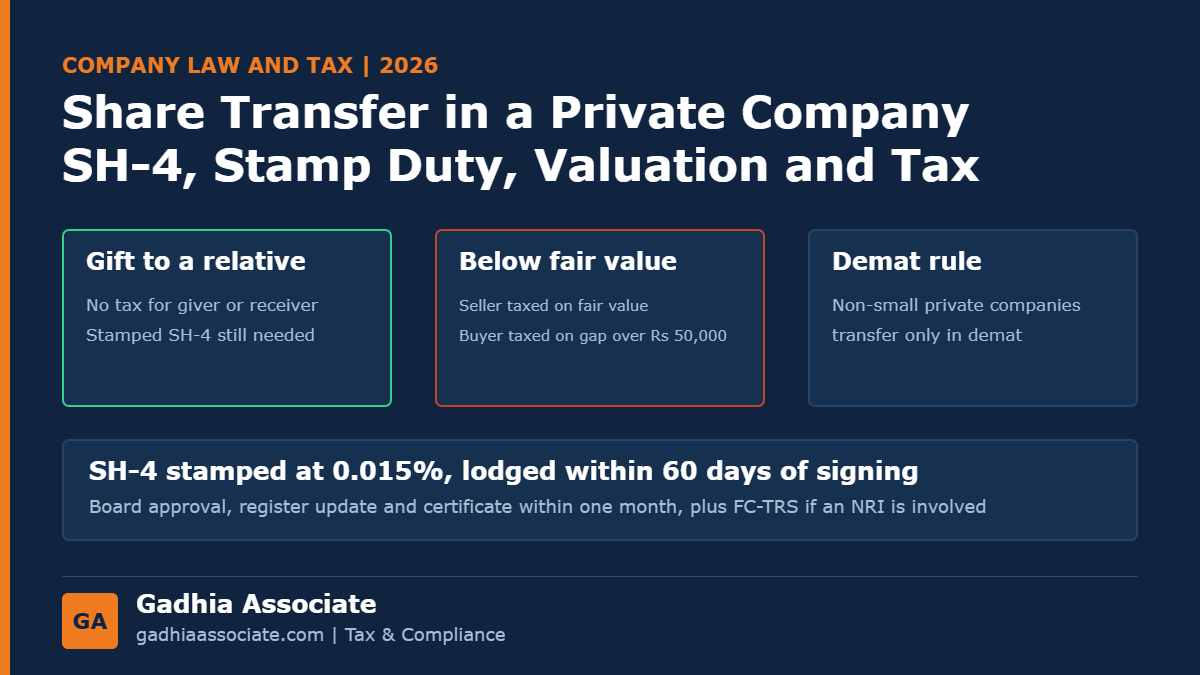
Yes. Proprietorships can be converted into a private limited company or an LLP, and an LLP can convert into a company, subject to conditions and approvals. It is a real project with fresh registrations, asset transfer, GST and PAN changes, and customer and bank updates. Doing it once, deliberately, at the right stage is fine. Doing it because nobody asked the right questions at the start is avoidable.
Gadhia Associate has been in practice since 2007, over 18 years, and works with more than 7,000 clients across Saurashtra and Gujarat, with a 5.0 Google rating from over 100 reviews. Meet us at our Junagadh office, usually with a same-day appointment, or work fully digitally from anywhere in India. You get a fixed fee agreed upfront, monthly payment options, and a dedicated client manager who tracks every due date for you. Take the free first consultation on +91 82005 28355 by call or WhatsApp, and choose your structure once, correctly.
FAQ
How much does it cost to register a company in India?
It depends on authorised capital, state stamp duty (Gujarat rates differ from other states), the number of digital signatures and professional fees. We give an itemised quote separating government charges from our fixed fee, so you can compare like with like.
How long does company registration take?
Usually about 7-15 working days for a company or LLP once documents and DSCs are ready and the name is approved. Name rejections and KYC mismatches are the main delays.
What documents do I need to register?
PAN and Aadhaar of every director or partner, passport-size photographs, address proof such as a recent bank statement or utility bill, proof of the registered office and a no-objection letter from the owner, and for a company, details of proposed capital and shareholding.
Which structure is best for a family business in Gujarat?
For most family-owned trading and manufacturing businesses in Junagadh and Saurashtra with no outside investors, an LLP balances liability protection against low annual cost. Move to a private limited company when you need funding, ESOPs, or credibility with large corporate buyers.
Position as of September 2026. Thresholds, forms, tax rates and due dates change through CBDT and MCA notifications, and fees vary by state, capital and case. Please confirm your specific position with a qualified professional before acting.