HUF in 2026: Does It Still Save Tax Under the New Regime, How to Fund It Without Clubbing, and When Not to Create One
"Sir, HUF ka PAN nikalva dijiye, tax bach jayega." We hear this every October, usually from someone whose friend told them at a wedding that an HUF is a free extra tax file. Sometimes it is exactly the right move and saves a family a lakh or more a year. Just as often, the HUF gets a PAN, a bank account and a rubber stamp, and then sits empty for six years because nobody worked out what income it was supposed to earn.
This article answers the practical question: in 2026, with the new tax regime as the default, is an HUF still worth creating, and if yes, how do you fund it without the income coming straight back to you?
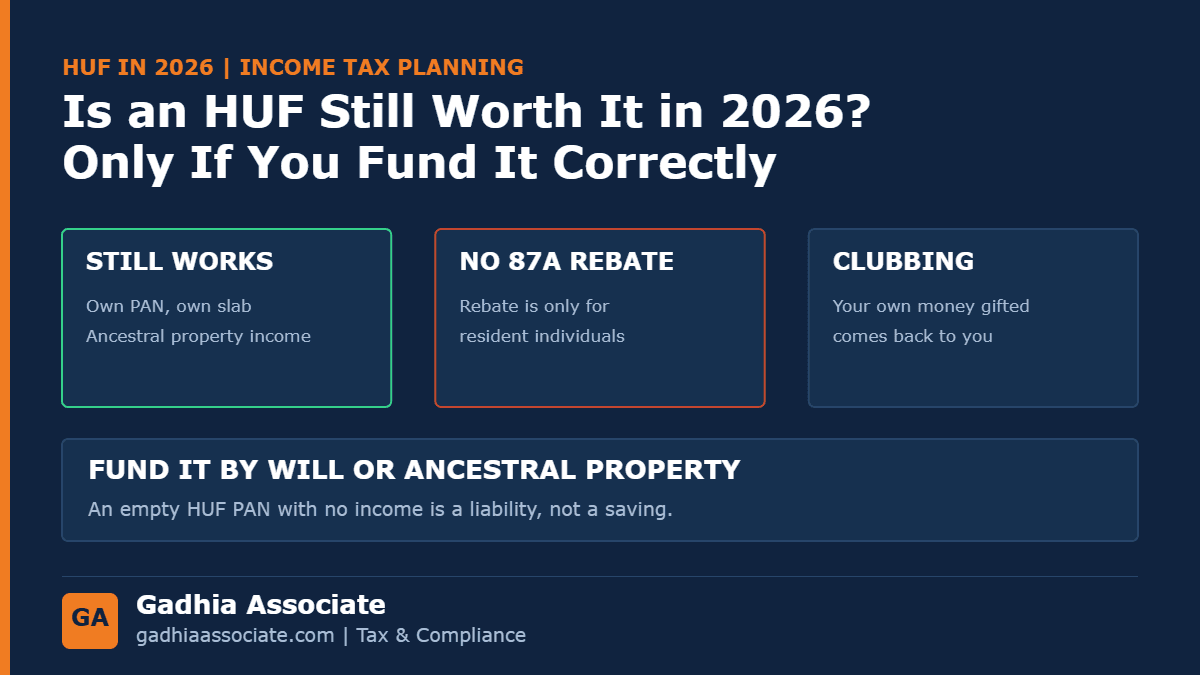
Short answer: An HUF is a separate taxpayer with its own PAN and its own slab, so it still works where a family has income-producing property that genuinely belongs to the family rather than to one person, such as an ancestral shop, inherited land, or a house left by a grandfather. What has shrunk is the deduction-based benefit, because the new regime is the default and the Section 87A rebate, which makes income up to Rs 12 lakh tax-free for individuals, is not available to an HUF. And if you simply gift your own money to your HUF, the income is clubbed back into your hands. Fund it correctly or do not bother.
What is an HUF, in practice?
A Hindu Undivided Family exists by operation of law in a Hindu family. It is not created by a deed the way a company is registered. In practice, an HUF is treated as coming into existence when a person marries, and it becomes useful for tax once it has property or capital of its own.
- Karta: the person who manages it, traditionally the senior-most member. A daughter can be karta.
- Coparceners: those with a birthright in the property, which since 2005 includes daughters equally.
- Members: a wider group, including a wife who is a member but not a coparcener.
- Documents: an HUF deed or declaration, PAN in the HUF's name, and a bank account in the HUF's name.
Does an HUF still save tax in 2026?
Look at what it does and does not get.
What it still gets: its own basic exemption and its own slab. Family income that would otherwise sit on top of the karta's 30% slab can be taxed in the HUF from the bottom of the slab again. It can also claim deductions such as 80C and 80D under the old regime, if the HUF opts for it, and it can own property, run a business, and use the presumptive scheme.
What it does not get: the Section 87A rebate, which is available only to resident individuals. This matters. An individual with income up to Rs 12 lakh under the new regime pays no tax because of the rebate, but an HUF with the same income does not get that benefit. The HUF also has no salary income, so no standard deduction.
So the honest position in 2026 is this. The HUF still helps by splitting income across another slab, and it helps most where the family has meaningful property income. It no longer helps a family whose entire income is salary, and it helps less than it did when deduction-heavy planning under the old regime was the norm.
The clubbing trap: this is where most HUFs fail
The single biggest mistake is funding the HUF from your own pocket. If you transfer your own money or property to your HUF, the income from it is added back to your income under the clubbing provisions (earlier Section 64(2)). You have created paperwork and saved nothing.
Ways an HUF can be funded properly:
- Ancestral or inherited property that came to the family, not to one individual
- A will that specifically leaves property to the HUF, for example a grandfather leaving a shop to his son's HUF
- Gifts from persons who are not members, keeping in mind that gifts above Rs 50,000 from non-relatives are taxable in the HUF's hands
- Income earned by the HUF itself once it has a small corpus, which then compounds within the HUF
A practical route used by many families is a gift by will from the previous generation. If your father wants his grandchildren's branch to have the shop, leaving it to your HUF rather than to you personally can be a better structure. This is a decision to take while the elder generation is alive.
What income suits an HUF?
- Rent from an ancestral shop, godown or house
- Interest and investment income on a corpus that belongs to the family
- Capital gains on family property, with the HUF getting its own exemption limit and its own Section 54 style exemptions where conditions are met
- Business income, where the family business genuinely belongs to the HUF and is run by the karta
Income that does not suit an HUF: salary, professional fees earned personally, and anything that is clearly the result of one member's individual skill. Trying to route personal professional income through an HUF is the kind of arrangement that unravels in assessment.
A simple example
A family owns an inherited shop in Junagadh that earns Rs 6 lakh a year in rent. The father is a businessman already taxed at 30%.
- Rent in the father's hands: roughly Rs 1.3 lakh of extra tax after the standard 30% deduction on house property income.
- Rent in the HUF, where the property genuinely belongs to the HUF: the taxable figure of about Rs 4.2 lakh falls in the HUF's own lower slabs, and the tax is a fraction of that.
The saving repeats every year, which is why families with real ancestral property should get this right once rather than debating it every March.
The problems nobody mentions at the wedding
- Exit is hard. Dividing an HUF needs a total partition, and partial partitions have not been recognised for tax since 1978. Money that goes into an HUF is not easy to take back out.
- Daughters have equal rights. Since 2005, daughters are coparceners. Planning that assumes only sons will share is planning for a dispute.
- Everything is joint. The karta manages, but the property belongs to the family. Disagreements between brothers become property disputes.
- Extra compliance. A separate return every year, separate books where there is business income, and separate bank discipline. An HUF that mixes personal and family money is worse than no HUF.
- The empty HUF. A PAN with no income and no return filed for years is a loose end that surfaces at the worst time.
When we say no
We usually advise against creating an HUF when the family's income is entirely salary, when there is no ancestral or inherited property and no intention to receive any, when the family is already discussing separation, or when the only plan is to move the person's own savings into the HUF. In those cases the clubbing rules, the missing rebate and the compliance cost outweigh the benefit.
Already have an HUF that is doing nothing?
Two options. Either give it a genuine purpose, by routing family property income to it and filing properly, or close it through a total partition and stop filing. Leaving it dormant with a live PAN is the worst of the three.
What we do for you
- Tell you honestly, on your numbers, whether an HUF saves your family anything in 2026
- Prepare the HUF deed or declaration and obtain the HUF PAN
- Set up the HUF bank account and demat, and define what belongs to the family
- Plan funding that does not fall foul of the clubbing rules, including wills from the elder generation
- Transfer ancestral property correctly, with stamp duty and registration handled
- File the HUF's income tax return every year and choose the right regime
- Handle total partition and its recognition when the family decides to separate
- Coordinate the HUF with a private family trust and with individual wills
Gadhia Associate has been in practice since 2007 and has handled work for over 7,000 clients across Saurashtra and Gujarat, with a 5.0 Google rating from more than 100 reviews. Business families from Junagadh, Rajkot, Veraval, Gir Somnath, Amreli and Porbandar come to our Junagadh office, where same-day appointments are available. Planning meetings with family members abroad can be arranged online. Fixed-fee and monthly plans are available.
Bring your family's property and income details to one meeting, and we will tell you whether an HUF is worth it for you. Call or WhatsApp +91 82005 28355. The first consultation is free.
Frequently asked questions
Does an HUF get the Section 87A rebate?
No. The rebate is available only to resident individuals, so an HUF pays tax from the first slab without it. This is the main reason the benefit is smaller than it used to be.
Can I gift my own money to my HUF to save tax?
You can gift it, but the income from that money is clubbed back into your own income, so no tax is saved. Funding should come from ancestral property, a will, or persons who are not members.
Is a deed necessary to create an HUF?
The HUF exists in law without a deed, but a written declaration is needed in practice to obtain a PAN and open a bank account.
Can a daughter be the karta of an HUF?
Yes. Since daughters are coparceners, a daughter can act as karta.
Can an HUF pay salary to the karta?
Yes, where the karta genuinely works for an HUF business and the remuneration is reasonable and supported by an agreement. It is then deductible for the HUF and taxable for the karta.
How is an HUF closed?
Through a total partition of all its assets among the coparceners, recognised for tax purposes. Partial partitions are not recognised, so a half-done partition leaves the HUF assessable as before.
Position as of 23 September 2026. Tax rates, the rebate and the regimes change with each Finance Act, and the Income-tax Act, 2025 has renumbered the income tax provisions from 1 April 2026; the older section numbers are used here because that is how people still search for them. HUF questions also involve Hindu personal law. Take advice on your family's facts before creating or partitioning an HUF.