Family Settlement of Property in Gujarat: Settlement Deed vs Partition vs Gift, Capital Gains, Stamp Duty and the Records Families Forget to Update
Three brothers in Junagadh have run a wholesale business together since their father died in 2009. The shop is in the father's name in the municipal records. The godown is in the eldest brother's name, though all three paid for it. The firm is a partnership between two of them, and the third has a share that was never written down. Now the youngest wants to move to Rajkot and take his share in cash, and nobody knows what "his share" is.
This is the most common family matter that comes to our office. It is rarely a legal fight at the start. It becomes one when the family delays, memories differ, and the next generation joins the conversation. The good news is that a properly done family settlement usually costs very little tax, if it is done in the right form.
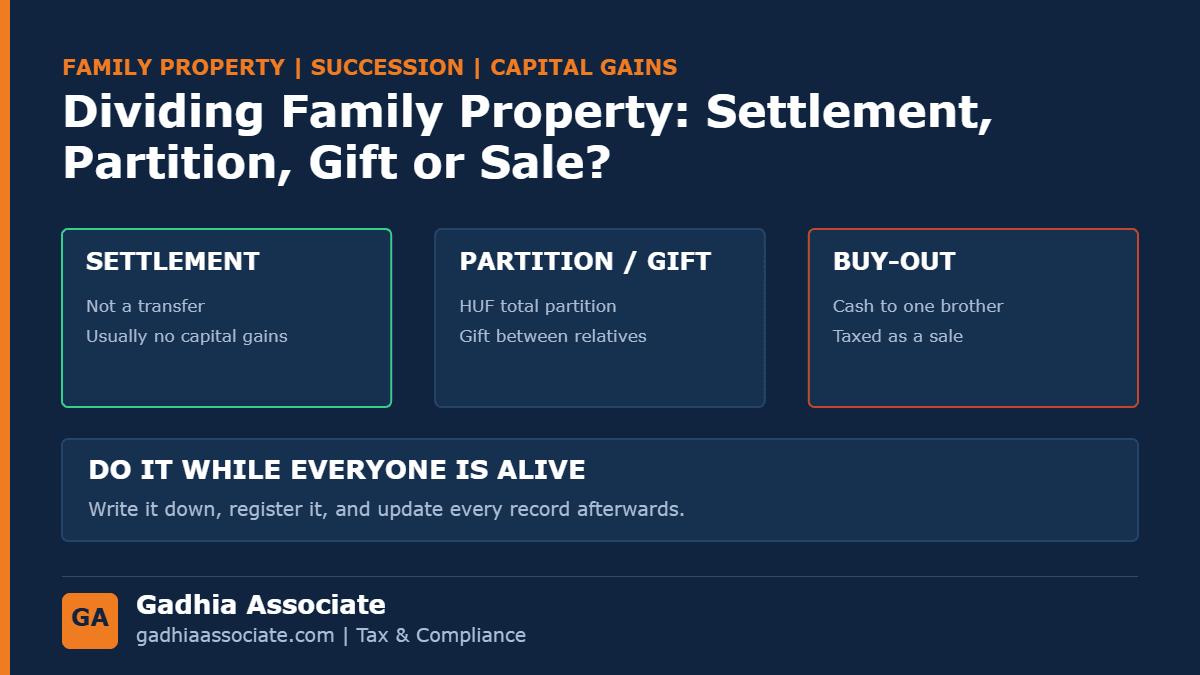
Short answer: A genuine family arrangement, where members with an existing claim settle who gets what, is not treated as a transfer. There is generally no capital gains tax and no gift tax within the family. But the tax result depends on the form: a partition of jointly held or HUF property is treated differently from a gift, and differently again from one brother buying out another for cash. Get the sequence wrong and you can turn a tax-free division into a taxable sale. Write it down, register what needs registering, and update every record afterwards.
What is a family settlement?
A family arrangement, or family settlement, is an agreement among family members to settle present or possible disputes about family property, so that peace and the family's property are preserved. The Supreme Court has long held that such an arrangement is not a transfer of property. Each member is said to be giving up a doubtful claim in exchange for certainty, not buying or selling anything.
That is the reason the tax outcome is usually favourable. Nothing is transferred, so there is no capital gains. And since the parties are relatives, even where a transfer is argued, the gift provisions do not tax receipts from relatives.
Two conditions matter. First, every person who gets a share must have some existing claim, however weak, to the property. A settlement that gives property to an outsider is not a family arrangement. Second, it must be genuine and made in good faith, not a device to move property to save tax.
The four ways families divide property, and how each is taxed
1. Family settlement or family arrangement
Used when several family members have overlapping claims to properties held in different names. Not a transfer, so generally no capital gains and no gift tax. Best suited to exactly the situation described above: a shop in the father's name, a godown in one son's name, a firm with an undocumented share.
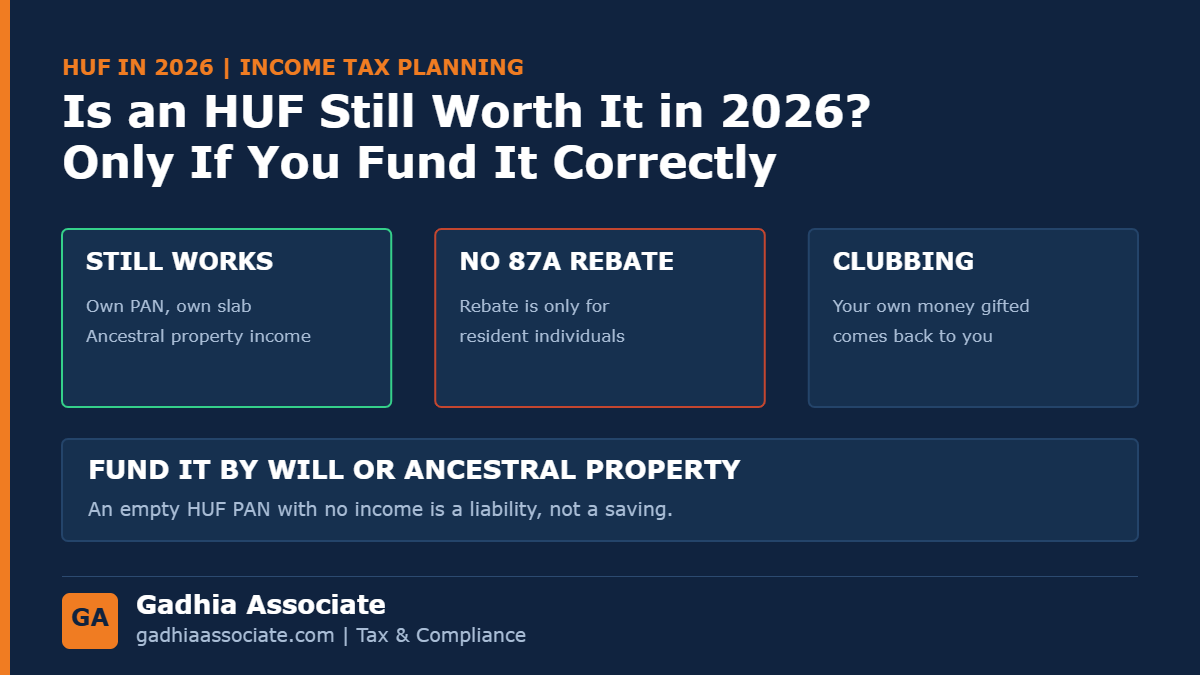
2. Partition of HUF property
If the property is held by a Hindu Undivided Family, a partition divides it among the members. Distribution of assets on a total partition is not treated as a transfer, and the members are not taxed on what they receive. For tax purposes, the partition has to be a total partition, recognised by the Assessing Officer. Partial partitions have not been recognised since 1978, so half-done partitions create problems that surface years later.
3. Gift or release deed
One member simply gives their share to another. Gifts between relatives are not taxable in the recipient's hands, and a gift is not a transfer for capital gains. The receiver takes over the original cost and holding period, so tax arrives only when the property is eventually sold. Stamp duty applies, and Gujarat charges concessional duty on transfers to close blood relatives, which is worth checking before choosing this route.
4. One brother buys out the others
This is a sale, however it is worded. The brother who takes money is liable to capital gains on his share. Where a division is unequal and the person getting more pays cash to balance it, that cash portion can be treated as a sale of the extra share. This is the single most common way a tax-free division becomes taxable, and it is usually discovered a year later, when a notice arrives.
Does a family settlement have to be registered?
This causes more confusion than anything else. The position broadly is:
- A family arrangement can be oral and still be valid between the members
- A written document that itself creates or extinguishes rights in immovable property must be stamped and registered
- A memorandum that merely records a family arrangement already made and acted upon does not need registration
In practice, when immovable property is involved, we prefer a properly stamped and registered document. An unregistered paper may hold between brothers who trust each other, but it will not satisfy a bank, a buyer, or the next generation. The stamp duty on a partition or settlement within the family is normally far lower than the duty on a sale deed, so the saving from avoiding registration is small compared with the risk.
What about the family business?
Dividing a business needs more care than dividing a house.
- Partnership firm: when a partner retires and takes assets or money above his capital balance, the firm can be taxed on the difference under the rules introduced in 2021 (Sections 9B and 45(4)). This surprises many families who assume a retirement is tax-free.
- Private limited company: shares can be transferred within the family, usually at fair value, with a share transfer form and board approval. The articles may contain pre-emption rights that must be followed.
- Proprietorship: the business goes with the person, but GST registration, licences, and bank accounts all need to be re-done in the new owner's name.
- Loans and guarantees: banks do not release a guarantor just because the family has divided. Every loan needs to be dealt with specifically.
What a good family settlement document contains
- Names and relationships of all members, including those who are giving up claims
- A short history of how each property came to be held, and in whose name
- A list of every asset: land, shop, godown, house, firm, company shares, bank accounts, gold, vehicles
- A list of liabilities, and who takes over each one
- Who gets what, clearly described with survey numbers and addresses
- A statement that each member accepts this in full and final settlement of all claims
- Signatures of spouses and adult children where their consent avoids future claims
- What happens to shared items such as an ancestral house or a temple
The steps most families forget after signing
A signed document is half the job. The other half is making the records agree with it:
- Mutation in revenue records, the 7/12 and 8-A entries for agricultural land
- Municipal property tax records and electricity connections
- Society share certificates and society records for flats
- Share transfer entries and the register of members for company shares
- Partnership deed reconstitution, PAN and GST updates for the firm
- Bank accounts, lockers, fixed deposits and nominations
- New wills for each member, matching the settlement
Nomination is not ownership. A bank nomination decides who receives the money, not who owns it. Families fight over this more often than over the property itself.
Should the property go into a trust instead?
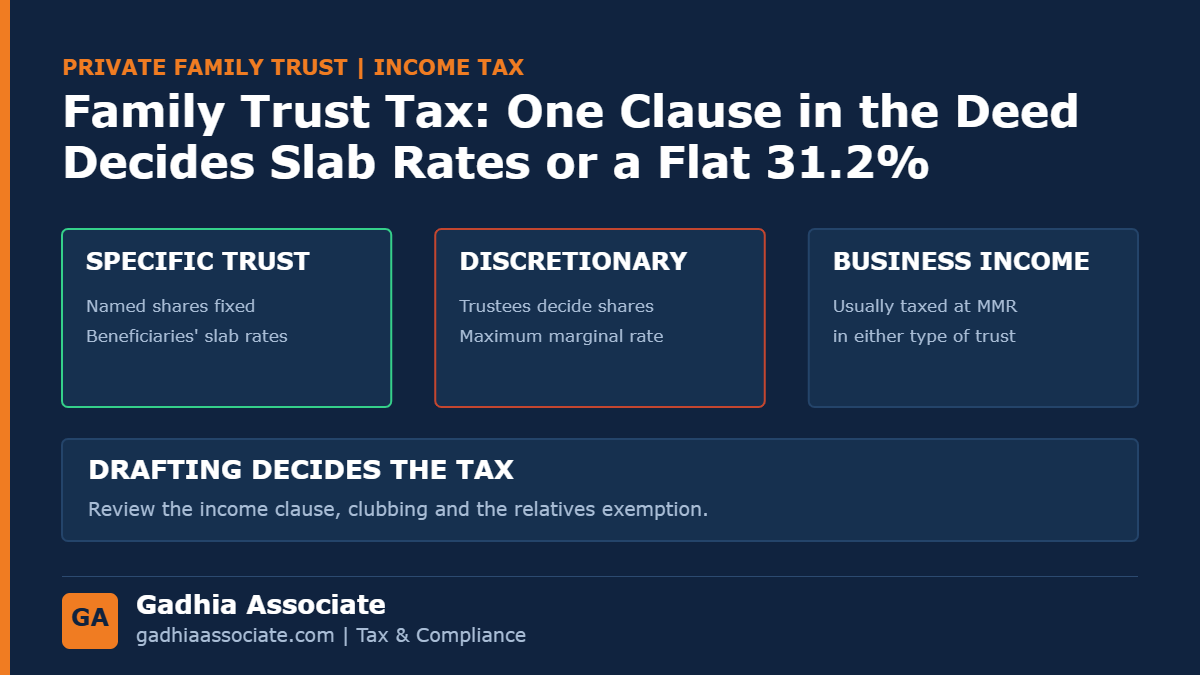
Sometimes. If the family wants the property to stay together and be managed for everyone, a private family trust can be better than dividing it. If the intention is a clean separation, a settlement is simpler. We often use both: a settlement to separate the branches, and a trust within each branch for succession.
Do it while everyone is alive
The single biggest saving is timing. A settlement made while the parents are alive and able to speak costs a fraction of what a dispute costs later. After a death without a will, the family needs succession documentation, all legal heirs must agree, and a single unwilling heir can hold a property for years. If your family has property in more than one name and no document, start the conversation this Diwali, when everyone is at home anyway.
What we do for you
- Map every asset and liability of the family and who actually holds what
- Advise which route costs least in tax and stamp duty: settlement, partition, gift or sale
- Draft the family settlement or partition deed, and coordinate registration
- Handle HUF partition and its recognition for tax
- Work out the capital gains where any part of the division is really a sale
- Reconstitute the partnership firm, or transfer company shares, with correct documentation
- Update PAN, GST, licences, bank accounts and revenue records after the settlement
- Draft matching wills, and set up a family trust where the family wants to hold property together
Gadhia Associate has been in practice since 2007 and has handled work for over 7,000 clients across Saurashtra and Gujarat, with a 5.0 Google rating from more than 100 reviews. Business families from Junagadh, Rajkot, Veraval, Gir Somnath, Amreli and Porbandar come to our Junagadh office, where same-day appointments are available. Meetings with family members who live outside India can be arranged online. Fixed-fee and monthly plans are available.
If your family property is in several names and nothing is written down, start with one meeting. Call or WhatsApp +91 82005 28355, or visit our Junagadh office. The first consultation is free.
Frequently asked questions
Is a family settlement taxable?
A genuine family arrangement among members who each have a claim is not treated as a transfer, so generally there is no capital gains tax, and receipts from relatives are not taxed as gifts. The position changes if one member is effectively paid to sell his share.
Does a family settlement deed need to be registered?
If the document itself creates or extinguishes rights in immovable property, it must be stamped and registered. A memorandum recording an earlier oral arrangement need not be. Where property is involved, registration is usually the safer route.
Can an oral family settlement be valid?
Yes, a family arrangement can be oral and binding between members, but proving it later is difficult, and banks and buyers will ask for a document.
What is the stamp duty on a partition deed in Gujarat?
Duty on a partition or family settlement is normally much lower than on a sale deed, and transfers to close blood relatives get concessional treatment. Rates change, so confirm the current position before executing the deed.
Can a daughter claim a share in ancestral property?
Yes. Daughters are coparceners in Hindu undivided family property with the same rights as sons. A settlement that ignores daughters, or is signed without their consent, is open to challenge.
What happens if one family member refuses to sign?
The settlement cannot be forced. Options are mediation, a partition suit, or settling with the willing members while keeping the disputed asset separate. A partition suit usually takes years, which is why most families settle.
Position as of 23 September 2026. This article is general information, not advice on your family's property. Tax treatment depends on how each asset is held and on the exact documents, stamp duty and registration rates change, and family property questions often involve personal law. Take advice on your own facts before signing anything.