GST Notice for ITC Mismatch: DRC-01C, GSTR-2B vs GSTR-3B Difference, and How to Reply in 7 Days Without Paying Tax You Don't Owe
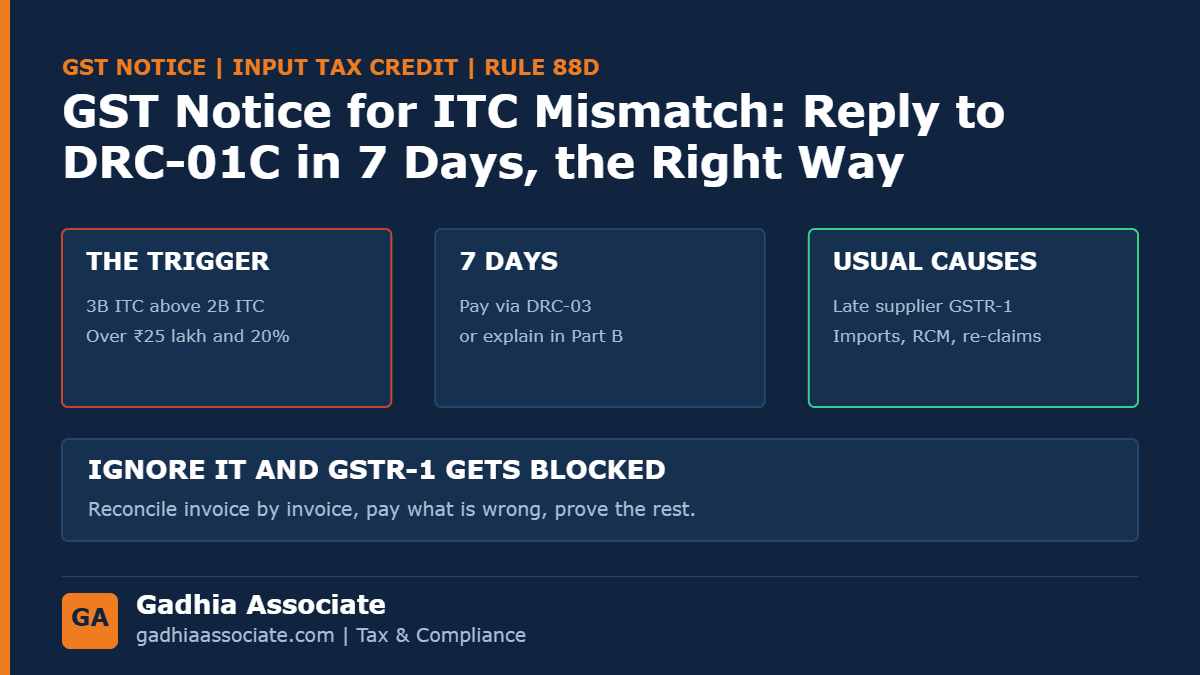
The notice arrived on a Friday evening, as these things usually do. A textile trader from Jetpur logged in to file his GSTR-1 on Saturday morning and found the portal would not let him. A message pointed him to Form DRC-01C. According to the system, he had claimed Rs 31 lakh more input tax credit in his GSTR-3B than his GSTR-2B showed, and he had seven days to either pay it back or explain.
He had done nothing dishonest. Half the difference was IGST on an import that never shows in GSTR-2B the way he expected. Most of the rest came from two suppliers who had filed their GSTR-1 late. But the system does not know that, and until someone explains it properly, it treats every rupee of difference as credit you were not entitled to.
Short answer: Since 1 January 2022, you can claim input tax credit only on invoices that appear in your GSTR-2B (Section 16(2)(aa)). When the credit you claim in GSTR-3B exceeds your GSTR-2B by more than the prescribed limit, the portal issues an intimation in DRC-01C under Rule 88D. You must reply within 7 days, either by paying the excess with interest through DRC-03 or by explaining the difference. If you ignore it, your next GSTR-1 is blocked, and the mismatch can later become a demand with interest at 18% and penalty. Most mismatches have an innocent explanation. The work is in proving it invoice by invoice.
Why does a mismatch between GSTR-2B and GSTR-3B matter so much now?
In the early years of GST, the invoice in your hand was enough to claim credit. That changed. Section 16(2)(aa) of the CGST Act now says credit is available only if the supplier has reported the invoice in their GSTR-1 and it has been communicated to you, which in practice means it appears in your GSTR-2B. With the Invoice Management System (IMS), you now accept, reject or keep pending each invoice your suppliers report, and your GSTR-2B is built from what you accept.
So GSTR-2B is no longer just a reconciliation tool. It is the legal ceiling on the credit you can take in a month, subject to a few genuine exceptions.
What is DRC-01C, and when is it issued?
Rule 88D of the CGST Rules lets the system compare the credit you claimed in GSTR-3B with the credit available in GSTR-2B for a return period. When the excess crosses the notified threshold, currently a difference of more than Rs 25 lakh and more than 20%, you receive an intimation in Part A of Form DRC-01C by email and on the portal.
You then have 7 days to respond in Part B, in one of three ways:
- Pay the excess credit with interest through DRC-03 and quote the payment
- Explain the difference with reasons, invoice by invoice where needed
- A mix of both: pay what is genuinely wrong and explain the rest
If you do not respond, you cannot file your next GSTR-1 or IFF. Your customers then cannot see your invoices in their GSTR-2B, which quickly becomes a business problem, not just a tax one.
Is DRC-01C the same as a show cause notice?
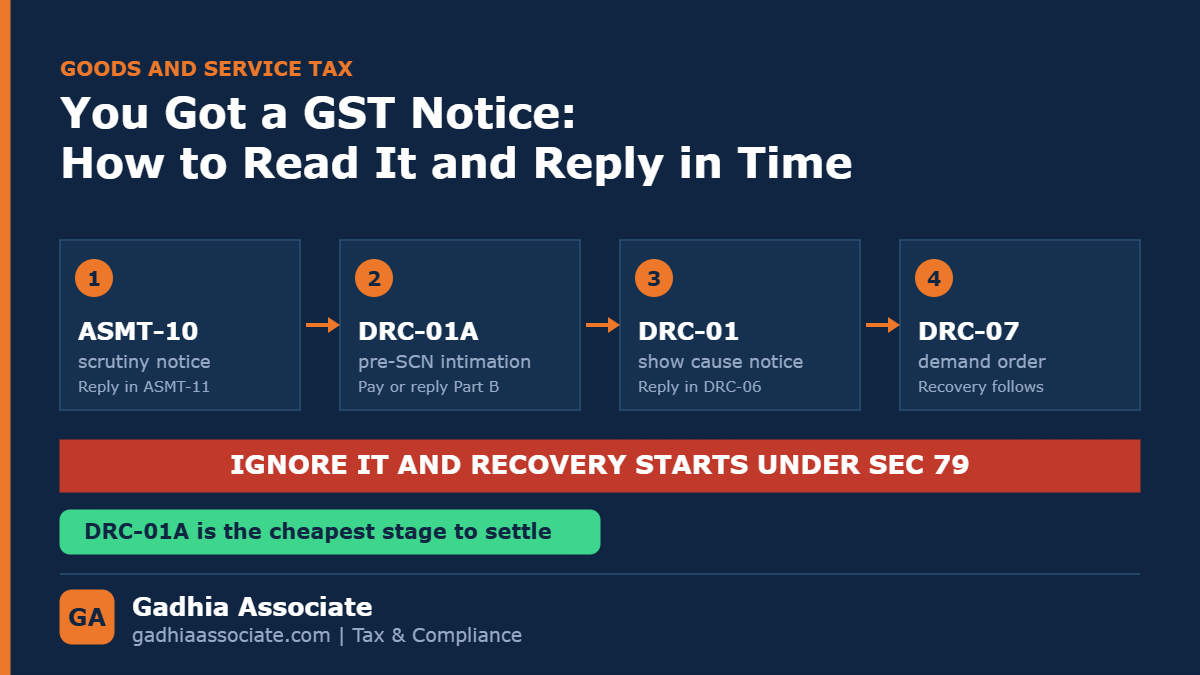
No. DRC-01C is an automated intimation. It is the system asking a question. But an unanswered or badly answered DRC-01C is often followed by a scrutiny notice in ASMT-10, and then a show cause notice demanding the excess credit with interest and penalty. For periods from FY 2024-25 onwards, demands are raised under the common provision in Section 74A. The better the first reply, the less likely the matter goes further.
Common innocent reasons for the difference
In our experience, most DRC-01C intimations have one or more of these causes:
- Supplier filed GSTR-1 late. The invoice was issued in March, but the supplier reported it in April. It will appear in next month's GSTR-2B.
- Import IGST. Credit on imports is based on the Bill of Entry. Timing differences or ICEGATE data issues often make it look like excess credit.
- Reverse charge. Credit on tax you paid yourself under reverse charge (for example on legal fees, GTA or rent from an unregistered person) does not come through GSTR-2B the same way.
- Re-claim of credit reversed earlier. Credit reversed for non-payment within 180 days and re-claimed after payment is legitimate, but shows as an excess.
- Invoices pending in IMS that you had not accepted before filing.
- ISD credit from a head office, and credit transferred on amalgamation or change of constitution.
- Supplier wrote the wrong GSTIN or reported the invoice as B2C.
And some reasons are not innocent: credit claimed twice, credit on blocked items like motor vehicles, food or personal use (Section 17(5)), or credit on invoices from suppliers who never filed returns at all. These need to be paid back, and it is cheaper to do it now.
How to reply to DRC-01C properly
- Download both returns. Your GSTR-3B for the period and the GSTR-2B for the same period and the next two or three months.
- Reconcile invoice by invoice. Match your purchase register with GSTR-2B. Mark each difference by reason: timing, import, RCM, re-claim, supplier error, or genuinely ineligible.
- Show timing differences clearly. For invoices that appear in a later GSTR-2B, show the month in which they appeared.
- Attach proof. Bills of entry, RCM payment challans, 180-day re-claim workings, supplier confirmations, and payment proof to suppliers.
- Pay what is genuinely wrong through DRC-03 with interest, and mention it in the reply.
- File Part B within 7 days and save the acknowledgement. Your GSTR-1 unlocks once a reply is filed.
A reply that says only "difference due to reconciliation" or "supplier will file" does not work. The officer who later picks up the case needs to see numbers that add up.
What about older years, before GSTR-2B became the rule?
For periods before 1 January 2022, the law did not yet make GSTR-2B a condition. Courts have repeatedly protected genuine buyers in that period. In the Suncraft Energy case, the Calcutta High Court held that credit could not be denied only because of a mismatch in GSTR-2A without first proceeding against the defaulting supplier, and the Supreme Court dismissed the department's appeal in December 2023. Several High Courts have taken a similar view since. For those years, a reply built on proof of genuine purchase, payment through bank, transport records and tax charged on the invoice is often strong. For later years, the argument is harder, and reconciliation and supplier follow-up matter more.
What does the department charge if the credit is disallowed?
- The credit itself, reversed or paid in cash
- Interest at 18% a year on credit wrongly availed and utilised (Section 50(3))
- Penalty, which in non-fraud cases is generally 10% of the tax or Rs 10,000, whichever is higher, and much higher where fraud or suppression is alleged
Paying the correct amount at the intimation or scrutiny stage usually limits the damage to tax and interest. Waiting for a formal order rarely makes things cheaper.
How to stop getting these notices
- Reconcile purchases with GSTR-2B every month before filing GSTR-3B, not once a year
- Act on invoices in IMS every month, and chase pending or missing invoices with suppliers
- Claim credit in the month it appears in GSTR-2B, and keep a running register of timing differences
- Pay suppliers within 180 days, or reverse and later re-claim the credit correctly
- Watch Rule 37A: if a supplier has not filed GSTR-3B by 30 September of the following year, reverse that credit by 30 November
- Claim all eligible credit for a year by 30 November of the following year or before you file GSTR-9, whichever comes first
- Stop buying from suppliers who repeatedly file late
What we do for you
- Reply to DRC-01C within the 7-day window, with invoice-wise reconciliation
- Reconcile GSTR-2B, IMS and GSTR-3B for past periods and identify real exposure
- Calculate and pay any excess credit with interest through DRC-03
- Draft replies to ASMT-10 scrutiny notices and show cause notices under Sections 73, 74 and 74A
- Represent you before the GST officer and file appeals where the demand is wrong
- Set up a monthly ITC reconciliation routine so the problem does not repeat
- Follow up with non-compliant suppliers and document their defaults
- Handle monthly GST returns, GSTR-9 and GSTR-9C
Gadhia Associate has been in practice since 2007 and has handled work for over 7,000 clients across Saurashtra and Gujarat, with a 5.0 Google rating from more than 100 reviews. Traders and manufacturers from Junagadh, Jetpur, Rajkot, Veraval, Gir Somnath and Porbandar come to our Junagadh office, where same-day appointments are available. Notices can equally be handled digitally for businesses anywhere in India. Fixed-fee and monthly plans are available.
Received a DRC-01C or ASMT-10? The 7-day clock is already running. Call or WhatsApp +91 82005 28355 now, or come to our Junagadh office today. The first consultation is free.
Frequently asked questions
What is Form DRC-01C in GST?
It is an automated intimation under Rule 88D, issued when the input tax credit you claimed in GSTR-3B exceeds the credit in your GSTR-2B beyond the notified threshold. You must pay the excess or explain it within 7 days.
What happens if I do not reply to DRC-01C?
You will not be able to file your next GSTR-1 or IFF. The mismatch can then be taken up in scrutiny and turned into a demand with interest and penalty.
Can I claim ITC if the invoice is not in GSTR-2B?
Generally no, from 1 January 2022 onwards. Exceptions include import IGST, reverse charge credit, ISD credit and re-claims of credit reversed earlier. Otherwise, you must wait until the supplier reports the invoice.
What is the interest rate on excess ITC claimed?
Interest at 18% a year applies on credit that was wrongly availed and utilised, from the date of utilisation until it is paid back.
My supplier has not filed GSTR-1. What should I do?
Follow up in writing, hold back the tax portion of the payment if your agreement allows, and do not claim the credit until it appears in GSTR-2B. If the supplier never files, the credit is at risk.
Is DRC-01C different from DRC-01B?
Yes. DRC-01B is issued when the tax liability in GSTR-1 is higher than in GSTR-3B. DRC-01C is about input tax credit, where GSTR-3B credit is higher than GSTR-2B.
Position as of 22 September 2026. GST thresholds, forms, IMS procedures and time limits change through notifications and advisories, and court positions depend on the facts and the period involved. Confirm the current position for your case before acting.