NRI Starting a Private Limited Company in India: FEMA Route, FC-GPR, Resident Director, Tax on Dividends and Step-by-Step Registration
The call came at 9:30 at night, which is morning in New Jersey. A software engineer from Junagadh, twelve years in the US, wanted to start a small IT services company back home. His brother would run the office, he would handle US clients, and the plan was to send Rs 25 lakh from his US account as start-up capital. He had already paid an online portal to "register the company in 7 days." What the portal had not told him was that sending that money from the US turned his company into a foreign-invested company, with RBI reporting deadlines, valuation rules and an annual return that, if missed, attract penalties running into lakhs.
None of this is difficult. It just has to be done in the right order. This article walks through it.
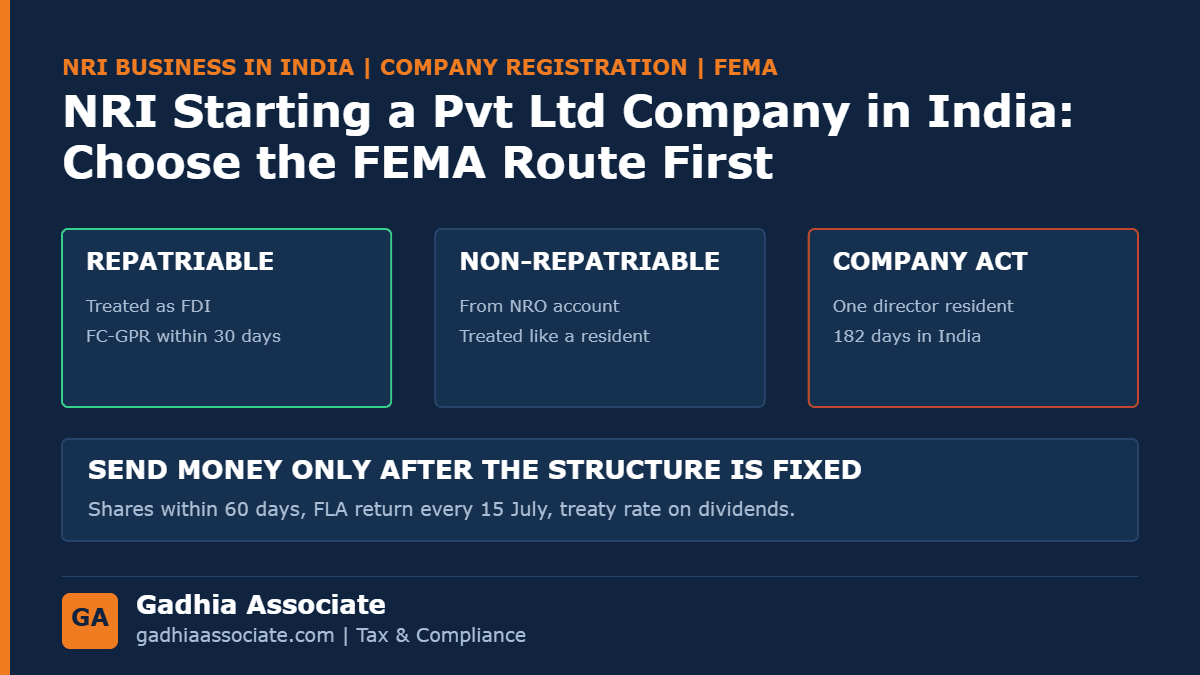
Short answer: An NRI or OCI cardholder can own and run a private limited company in India, and in most sectors no government approval is needed. The company needs at least one director who lives in India for 182 days or more in the year. How you fund it decides the compliance: money sent from abroad or from an NRE account, with the right to take it back, is treated as foreign direct investment (FDI) and needs FC-GPR reporting to the RBI within 30 days of allotting shares. Money invested from an NRO account on a non-repatriation basis is treated like a resident's investment, with much lighter reporting. Choose the route before you send a single rupee.
Can an NRI be a director and shareholder of an Indian company?
Yes. An NRI, an OCI cardholder, or even a foreign national can be a shareholder and a director. The NRI needs a Director Identification Number (DIN) and a digital signature, both of which can be obtained while living abroad. The only structural condition is that at least one director must be resident in India, meaning he or she stays in India for at least 182 days during the financial year. For a newly formed company, this is worked out proportionately in the first year. In practice, a parent, sibling or trusted professional in India usually fills this role. The resident director does not need to hold any shares.
Which business can an NRI start?
Most sectors are open to 100% foreign investment under the automatic route: IT and software services, manufacturing, trading (with conditions for retail), exports, food processing, consultancy and many more. Government approval is needed only in specific sectors such as defence, print media and some telecom and insurance limits. A few activities are completely closed to foreign investment, including lottery and gambling, chit funds, Nidhi companies, dealing in land and building as a real estate business, and tobacco products.
If you are a citizen of a country that shares a land border with India, separate approval requirements apply under Press Note 3. For most NRIs from Gujarat living in the US, UK, Canada, Australia or the Gulf, this does not arise.
Repatriable or non-repatriable: the decision that changes everything
This is the choice most online portals skip, and it is the most important one.
Route 1: Repatriation basis (treated as FDI)
You send money from your foreign bank account or invest from your NRE account, and you keep the right to take the capital and profits back abroad. The investment is treated as foreign direct investment. That brings:
- Shares must be allotted within 60 days of receiving the money, or the money must be refunded
- Shares must be issued at not less than fair value, backed by a valuation certificate from a CA or merchant banker (at incorporation, subscriber shares are normally issued at face value)
- Form FC-GPR on the RBI's FIRMS portal within 30 days of allotment
- The annual Foreign Liabilities and Assets (FLA) return to the RBI by 15 July every year
- Form FC-TRS whenever shares move between a resident and a non-resident
Route 2: Non-repatriation basis (treated like a resident)
You invest from your NRO account, or on terms that the capital stays in India. Under Schedule 4 of the FEMA Non-Debt Instruments Rules, this investment is treated on par with a resident's investment. There is no FC-GPR filing and no FLA return merely because of your shareholding. Dividends can still be sent abroad after tax. The capital itself can later be remitted within the NRO limits, which currently allow up to USD 1 million a financial year with the required paperwork.
For a small family business where the NRI simply wants a stake, Route 2 is often far simpler. For a business that may raise foreign funding or where the NRI wants the freedom to take the full capital back, Route 1 is the right choice. The route has to match how the money actually moves.
Step-by-step: registering the company
- Decide the structure: shareholders, directors, the resident director, and the investment route
- DSC and DIN for the NRI director: using the Indian passport and overseas address proof. Foreign-issued documents are notarised, and apostilled where required
- PAN for the NRI if not already held
- Name approval and SPICe+ filing with the MCA, which gives the company its PAN, TAN and bank account application together
- Open the company's bank account with an authorised dealer bank that handles FEMA reporting well
- Bring in capital by inward remittance (Route 1) or from the NRO account (Route 2), and collect the FIRC or bank certificate
- Allot shares within 60 days and file the return of allotment with the ROC
- File FC-GPR within 30 days of allotment if the investment is on a repatriation basis
- GST, Udyam, IEC and other registrations depending on the business
Registration itself usually takes two to three weeks when documents are ready. The FEMA steps run in parallel.
How are profits taxed and sent abroad?
- Company tax: the company can opt for the concessional rate of about 25.17% on its profits
- Dividends to the NRI: taxed in India, with TDS generally at 20% plus surcharge and cess. A tax treaty can reduce it; the India-UAE treaty, for example, caps dividend tax at 10%. To claim the lower rate you need a Tax Residency Certificate and Form 10F
- Salary or fees to the NRI director: taxable in India to the extent the services are rendered in India, and subject to TDS. Board sitting fees are also taxable in India
- Foreign tax credit: the Indian tax is usually creditable against tax in your country of residence. Coordinate both sides before the first dividend
- Repatriation: dividends on a repatriation-basis holding can be remitted freely through the bank with Form 15CA and, where needed, a CA certificate in Form 15CB
Mistakes we see NRIs make
- Sending money into a relative's account and investing it in the relative's name. It creates a benami-style problem and breaks the FEMA trail
- Missing the FC-GPR deadline. Late reporting needs a late submission fee or compounding with the RBI
- Forgetting the FLA return in later years, even when nothing changed
- Treating share application money as a loan for months. Unallotted money beyond 60 days must be refunded
- No resident director after a family member moves abroad, which puts the company in breach of the Companies Act
- Wrong residential status for the NRI personally. Spending too many days in India while setting up the business can make you a resident for tax, with your worldwide income taxable in India
Private limited company or LLP?
FDI in LLPs is allowed under the automatic route in sectors where 100% FDI is permitted without conditions. An LLP has lighter compliance and no dividend tax, because partners' profit share is exempt in their hands. But a company is easier to raise money in, is better understood by overseas clients and banks, and suits a business that will grow. For most NRIs building a real operating business in India, a private limited company is the better long-term vehicle.
What we do for you
- Advise on the right structure and the repatriable or non-repatriable route before you remit any money
- Obtain DSC, DIN and PAN for NRI directors, and coordinate notarisation and apostille
- Register the private limited company through SPICe+, including PAN, TAN and bank account
- Arrange valuation certificates and FEMA-compliant share allotment
- File FC-GPR, FC-TRS and the annual FLA return with the RBI
- Handle GST, Udyam, IEC and other business registrations
- Manage accounts, audit, ROC filings and income tax returns for the company
- Plan dividends, director fees and repatriation with treaty benefits, including Forms 15CA and 15CB
- Advise on your personal residential status and Indian tax as an NRI
Gadhia Associate has been in practice since 2007 and has handled work for over 7,000 clients across Saurashtra and Gujarat, with a 5.0 Google rating from more than 100 reviews. Many of our NRI clients have roots in Junagadh, Rajkot, Porbandar, Amreli and Gir Somnath and now live in the US, UK, Canada, Africa and the Gulf. The entire process can be handled online, with video calls timed to your time zone. Fixed-fee and monthly plans are available.
Planning a business in India from abroad? Talk to us before you send the money. Call or WhatsApp +91 82005 28355. The first consultation is free.
Frequently asked questions
Can an NRI register a private limited company in India?
Yes. An NRI can be a shareholder and director. The company must have at least one director who stays in India for 182 days or more in the financial year, and at least two directors and two shareholders in total.
Does an NRI need RBI approval to start a company in India?
Not in most sectors. Investment falls under the automatic route, and the RBI only needs to be informed through FC-GPR after shares are allotted, if the investment is on a repatriation basis.
What is the deadline for FC-GPR?
Within 30 days from the date shares are allotted to the non-resident investor. Shares themselves must be allotted within 60 days of receiving the money.
Can I invest from my NRO account?
Yes. Investment from an NRO account on a non-repatriation basis is treated like a resident's investment under Schedule 4 of the FEMA Non-Debt Instruments Rules, with lighter reporting.
Can an OCI cardholder start a company in India?
Yes. OCI cardholders are treated on par with NRIs for investment under FEMA and can be shareholders and directors.
How is dividend from an Indian company taxed for an NRI?
Dividends are taxed in India, with TDS generally at 20% plus surcharge and cess, reduced where a tax treaty gives a lower rate and you provide a Tax Residency Certificate and Form 10F.
Position as of 22 September 2026. FEMA rules, sectoral caps and reporting forms are amended from time to time, and the Income-tax Act, 2025 has renumbered income tax provisions from 1 April 2026. Treaty rates depend on your country of residence. Confirm the current position for your situation before acting.