Private Family Trust in India: How Families Protect Property Across a Second Marriage, and Why Timing Decides Whether It Holds
You are in your fifties. There was a divorce some years ago. You have two children from the first marriage, and perhaps a second wife and a younger child. The house in Junagadh is in your name, the shop sits inside a partnership firm, and the company shares are split between you and a relative who joined the business early. Nothing is written down. You have thought about this on several nights and put it off every morning.
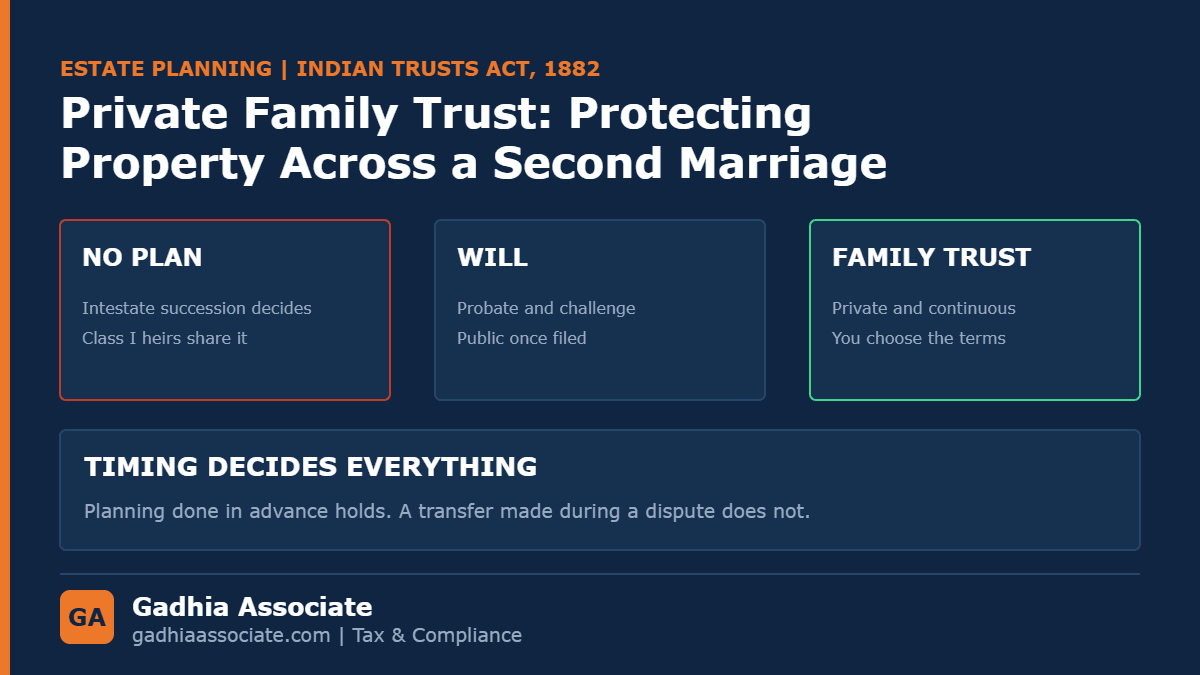
Short answer: A private family trust under the Indian Trusts Act, 1882 lets you decide now who receives which asset and when. It avoids probate, keeps the arrangement private, and continues after you. But it only holds if it is created in advance. A settlement made after a matrimonial dispute begins must be disclosed, and courts look through it.
What happens to my property if I die without a will after a divorce?
Your family does not decide. The statute does.
For a Hindu male dying intestate, the Hindu Succession Act, 1956 sends self-acquired property to Class I heirs first. That means the widow, the sons, the daughters, the mother, and the children of a predeceased child. The widow takes one share. Each surviving son, each daughter and the mother takes one share of their own.
A divorced first wife is not a widow, so she does not inherit. A second wife, where the marriage is valid, does. Children of both marriages are Class I heirs and stand equally. Section 16 of the Hindu Marriage Act, 1955 also protects children of a void or voidable marriage. They are treated as legitimate and can inherit a parent's self-acquired property, though their claim to ancestral or coparcenary property is narrower.
You can override almost all of this with a will, because self-acquired property can be willed freely. The catch is custody and proof. A Rajkot family we worked with lost two years because the original will could not be found and only a photocopy survived in a locker. In another matter, a plot near Gir Somnath was claimed by three separate sets of children, each holding a different piece of paper, none of them registered.
What does this look like in one family?
Illustrative example. Names invented, figures rounded.
Mahendrabhai, 58, lives in Junagadh. He divorced in 2010 and remarried in 2013. He has a son and a daughter from the first marriage and a young daughter from the second. He owns a house worth about Rs 2 crore, a shop worth about Rs 1 crore, and private limited company shares worth about Rs 3 crore. His mother is alive. There is no will and no trust.
If he dies tomorrow, the second wife, all three children and his mother each take an equal share of the self-acquired property. The company shares split five ways. Nobody can sign for the business without everybody agreeing. The shop tenant quietly stops paying while the position is unclear.
Had he settled the house and the shares into a family trust in 2019, with his brother and a professional as trustees, he could have directed something quite different. The first-marriage children take the shop and a fixed share of company income. The second wife holds a right of residence in the house for her lifetime. The youngest daughter's share stays with the trustees until she turns 25. No probate, no public filing, no five-way deadlock.
What is a private family trust in India, and how is it different from a charitable trust?
A private family trust is a private arrangement for named people. You, the settlor, transfer property to trustees, who hold and manage it for the beneficiaries on the terms written into the trust deed. It is governed by the Indian Trusts Act, 1882. For the trust to exist at all, the law wants three certainties: a clear intention to create a trust, certainty about which property is being settled, and certainty about who benefits.
Most families in Gujarat have only met the other kind of trust. A public charitable trust registers with the Charity Commissioner under the state public trusts law, applies for 12A and 80G, files Form 10B or 10BB, and reports donations through Form 10BD and issues Form 10BE. Our earlier articles on trust and NGO annual compliance and on 12A and 80G registration deal with that world in detail.
A private family trust is a different animal. No charitable object, no Charity Commissioner registration, no 12A, no 80G, no donation reporting. The Gujarat public trust route simply does not apply to it. People confuse the two constantly, including some advisers, and the confusion costs money.
Talk to us before anything is signed
If this matches your position, book a free first consultation at our Junagadh office or on phone or WhatsApp at +91 82005 28355. What you tell us stays between you and us, and nothing is shared with any family member without your instruction.
Does a family trust work if a divorce or maintenance case has already started?
No. This is the part that decides everything else in this article, so it comes early rather than late.
A trust created years before any dispute is ordinary estate planning. It is dated, disclosed, and has a family and commercial logic that anybody can follow. It stands.
A transfer made once a matrimonial dispute is in view is a different thing. Section 53 of the Transfer of Property Act, 1882 makes a transfer of immovable property made with intent to defeat or delay creditors voidable at the option of the person defeated or delayed. In maintenance proceedings, the Supreme Court in Rajnesh v. Neha (2020) made an affidavit of disclosure of assets and liabilities a mandatory filing for both sides. A settlement into a trust goes into that affidavit. Courts look through a transfer whose real purpose was to shrink the pool of assets, and they say so in plain language when they do.
So let us be direct. This firm does not structure transfers whose purpose is to defeat a maintenance or alimony claim, and we decline that work when it is asked for. Maintenance owed to a spouse or to children is a separate obligation from succession planning. A trust does not remove it and nothing here suggests otherwise.
The honest reason to act now is simpler and better than any clever argument: planning done today is safe, and planning done later is not.
Will vs trust in India: which one actually protects the family?
A trust generally protects better; a will is cheaper and simpler. Most families with real property need both.
- Proof after death. A will takes effect only when you die, and banks, registrars and companies usually want probate or a succession certificate before they act. A trust already holds title, so there is nothing to prove.
- Privacy. A will filed in a probate proceeding becomes a court record. A trust deed stays between the family, the sub-registrar and the tax department.
- Challenge. Wills are attacked on capacity, undue influence and forgery. A trust that has been running for years with bank accounts, filings and trustee minutes is far harder to unsettle.
- Control while you live. A will controls nothing until death. A revocable trust keeps you in charge and still has the structure operating.
- Cost. A will costs very little. A trust means stamp duty, registration, a PAN, and an annual return every year. Below a certain asset level the trust is not worth it, and we will tell you so.
In practice we often do a trust for the main assets and a will to catch everything left outside it, including anything acquired later.
Bring your papers, not your worries
Send us a one-page list of what you own and who is in the family. We will tell you whether a will, a trust, or both is the right answer for you. Free first consultation, fixed-fee engagement once the scope is clear. Phone or WhatsApp +91 82005 28355.
Revocable vs irrevocable trust: which suits my family?
Choose revocable if you want control, irrevocable if you want protection. You cannot have both fully.
A revocable trust can be amended or wound up by you during your lifetime. It is useful when the family position is still moving, and it becomes effectively irrevocable on your death. The tax cost is that the income is taxed in your hands under Sections 61 to 63 of the Income-tax Act, 1961, so there is no tax advantage at all.
An irrevocable trust is the real planning tool. Once assets are settled, they are out of your estate and into the trust. That is exactly what gives continuity and protection, and exactly why people hesitate.
Separately, a trust is either specific (determinate), where each beneficiary's share is fixed in the deed, or discretionary, where the trustees decide how much each beneficiary receives and when. Discretionary suits families where the children are at very different stages, or where a business may or may not be carried on by any of them. Specific suits families that want certainty on paper today.
How is a private family trust taxed in India?
Four points cover most of it.
Settling assets in. Section 47(iii) provides that a transfer of a capital asset under a gift, will or an irrevocable trust is not treated as a transfer, so capital gains generally do not arise. From assessment year 2025-26 this relief is confined to transfers by an individual or a Hindu Undivided Family, and it does not cover shares, debentures or warrants allotted to employees.
Section 56(2)(x). Receipt of property without consideration is normally taxed in the recipient's hands. The proviso to Section 56(2)(x) carves out a receipt from an individual by a trust created or established solely for the benefit of the relatives of that individual, with relative as defined in the Act. The word solely does the work. If the deed lets trustees add beneficiaries who fall outside that definition, the exception can be lost, and tribunals have said so. This clause is the single most important drafting point in the whole document.
Clubbing. Section 64 pulls income back to you where assets are transferred without adequate consideration to a spouse or a minor child, including through a trust for their immediate or deferred benefit. This has to be checked line by line against the beneficiary list, not assumed.
Trust income. A specific or determinate trust is assessed on the trustees as representative assessee under Section 161, at the rate applicable to the beneficiary. A discretionary trust is generally taxed under Section 164 at the maximum marginal rate, which Section 2(29C) defines as the rate for the highest slab for an individual, association of persons or body of individuals including surcharge. Section 164 carries its own exceptions, and Section 161(1A) taxes business income of a determinate trust at the maximum marginal rate with a narrow carve-out for a trust declared by will for a dependent relative.
Where company shares go into the trust, the dividend and buyback route out of the company has to be planned alongside it. Our article on taking money out of a private limited company legally sets out that side. Where a beneficiary lives abroad, read it with our article on NRI property in India.
How is the trust set up, including trust deed registration?
- Decide the beneficiaries and their class, and confirm each one falls within the definition of relative if you want the Section 56(2)(x) exception.
- Choose trustees, and name a successor trustee and the method of appointing future trustees.
- Decide revocable or irrevocable, specific or discretionary.
- Draft the trust deed: powers, distribution rules, accounts, removal of trustees, dispute mechanism, and what happens on the death of a beneficiary.
- Pay stamp duty. Stamp duty is a state subject. In Gujarat it is charged under the Gujarat Stamp Act, 1958, and the duty on a trust deed differs from the duty on a conveyance of immovable property into the trust. Confirm the current Gujarat rate before you execute, and confirm the rate of any other state where property is located.
- Register the deed. Where immovable property is settled, registration is compulsory under Section 17 of the Registration Act, 1908, at the sub-registrar with jurisdiction. Allow one to two weeks in Saurashtra for drafting, stamping and an appointment.
- Apply for the trust's PAN and open its bank account.
- Actually transfer the assets. Property mutation, share transfer forms, demat, and the firm's records.
- File the annual return, usually ITR-5 for a private family trust, and keep trustee minutes and accounts every year.
What goes wrong with a family trust in practice?
Five things, and we see them repeatedly.
- No successor trustee. A deed we were asked to review in Amreli named one trustee and said nothing about what happens when he dies. He died. The family went to court for something the draftsman could have fixed in one sentence.
- Assets never moved. The deed is signed and stamped, then the flat in Porbandar stays in the individual's name for six years. On death it passes by succession, not by the trust. The trust was decoration.
- The deed and the will contradict each other. Two documents, two lawyers, two different intentions, one estate.
- Trustee is also the main beneficiary with no check. This invites both a tax challenge and a family challenge.
- Nobody checked the stamp duty in the other state. The Gujarat property was handled properly and the Maharashtra flat was not.
What we do for you
- Reviewing the family position and the full asset position, including firms and companies
- Choosing between a will, a trust, or both
- Drafting the trust deed
- Choosing trustees and naming a successor trustee
- Settling assets into the trust and completing the actual transfers
- Stamp duty and registration of the deed
- PAN and tax registrations for the trust
- Annual trust compliance, accounts and income tax returns
- Coordinating with your family lawyer where a matrimonial matter exists
Gadhia Associate has been practising since 2007 and has worked with over 7,000 clients across Saurashtra and Gujarat, with a 5.0 Google rating from more than 100 reviews. Our Junagadh office offers same-day appointments, and we also advise families across India entirely online. Engagements are fixed-fee once the scope is settled.
The next step is one conversation
Call or WhatsApp +91 82005 28355 for a free first consultation, at our Junagadh office or online. Bring the property papers you have. We will tell you honestly whether a trust is right for your family, and if it is not, we will say that too.
Frequently asked questions
Can a private family trust stop my children from the first marriage being left out?
Yes, if it is set up while you are alive and assets are genuinely transferred into it. The trust deed names them as beneficiaries and fixes what they receive, so their position does not depend on intestate succession or on a will surviving a challenge. This is the most common reason Gujarat families come to us about a private family trust.
Does a family trust for property need registration with the Charity Commissioner?
No. A private family trust is governed by the Indian Trusts Act, 1882 and has nothing to do with the public trusts registration route, 12A, 80G or Form 10B. The trust deed does need registration with the sub-registrar under the Registration Act, 1908 wherever immovable property is settled into the trust, and stamp duty is payable under the state stamp law.
Is a prenuptial or postnuptial agreement valid in India?
Not as a directly enforceable contract in the way it is in England or the United States. Indian courts have declined to treat such agreements as binding, largely on public policy grounds. They do carry evidentiary weight, and courts have referred to them as evidence of what the parties intended about maintenance or property. Goa follows a different regime under its civil code.
Will a trust reduce my income tax?
Usually not, and that should not be the reason for creating one. A revocable trust's income is taxed in your hands under Sections 61 to 63. A discretionary trust is generally taxed at the maximum marginal rate under Section 164. A specific trust is taxed under Section 161 at the beneficiary's rate. The purpose is succession and continuity, not tax saving.
How long does it take to set up a family trust in Junagadh?
Two to four weeks in most cases. Discussing the family position and drafting takes the longest, usually a week. Stamping and execution takes a day or two. A sub-registrar appointment in Junagadh or Rajkot typically comes within a week. PAN, the bank account and the actual transfer of assets follow after registration.
This is general information and not legal advice on any matrimonial or succession dispute. Trust law, stamp duty and tax positions vary by state and by family. The Income-tax Act, 2025 has renumbered the income tax provisions with effect from 1 April 2026. Take advice on your own facts before acting, and where a matrimonial proceeding exists, take that advice together with your family lawyer.