GST for Restaurants, Hotels and Cloud Kitchens: 5% or 18%, the Specified Premises Rule and Why Your ITC Is Blocked
You run a restaurant on Talala road, or a twenty-room hotel that fills up through the Gir season, or a cloud kitchen working three delivery apps out of a rented kitchen in Junagadh. Your neighbour charges 5 per cent. The hotel down the road charges 18 per cent. Your rent is Rs 80,000 a month with GST on top, you just bought a Rs 6 lakh kitchen line, and your accountant says you cannot touch the credit on either. Charge the wrong rate and you either eat the tax yourself or hand the department a demand with interest and penalty. Both happen often enough.
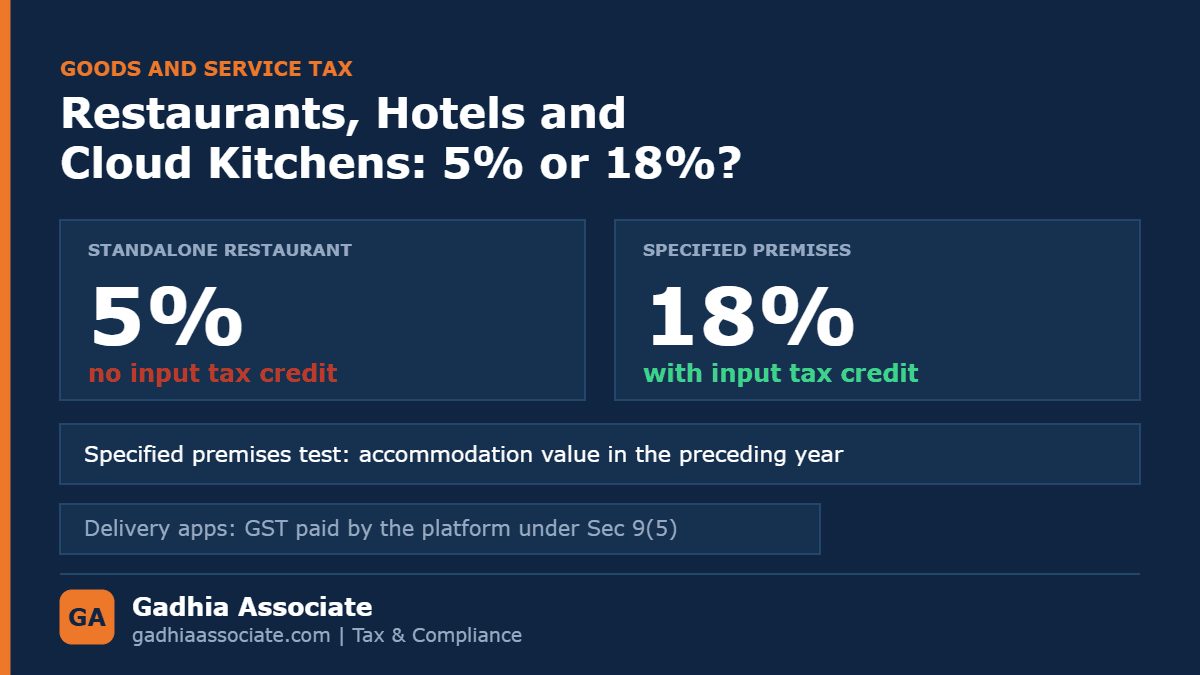
Short answer: A standalone restaurant, dhaba, takeaway or cloud kitchen charges 5 per cent GST with no input tax credit. Restaurant service inside "specified premises", broadly a hotel that supplied any room above Rs 7,500 per unit per day in the preceding financial year, is taxed at 18 per cent with full input tax credit.
What is the difference between a standalone restaurant and a restaurant in a hotel?
The rate turns on the premises, not on what you cook. Restaurant service supplied from premises that are not specified premises carries 5 per cent, and the notification denies input tax credit as a condition of that rate. Restaurant service supplied at specified premises carries 18 per cent, and credit is available in the normal way.
Until 31 March 2025 the test was the hotel's declared tariff, which meant the published rack rate, whether or not any room was ever sold at it. That produced years of argument. A hotel could print Rs 8,000 on the tariff card, sell nothing above Rs 5,000 all year, and still be pushed into the higher rate. With effect from 1 April 2025 the declared tariff test was dropped and replaced with the specified premises concept.
How does the specified premises test actually work?
Two routes in, and one of them is automatic. Premises are specified premises for a financial year if, in the preceding financial year, the value of supply of any unit of accommodation actually exceeded Rs 7,500 per unit per day. Note the words: value of supply, meaning what you actually charged and received, and any unit, meaning one suite sold once at Rs 9,000 during Diwali is enough to pull the whole property in for the next year. If that happened, the premises are specified premises and no declaration is required.
The second route is voluntary. A supplier who wants 18 per cent with credit can opt in by filing a declaration, and the formats are annexures to the rate notification. Annexure VII is for a registered person declaring existing premises as specified premises, filed between 1 January and 31 March of the preceding financial year. Annexure VIII is for a person applying for fresh registration, filed within fifteen days of getting the registration certificate. Annexure IX is the opt-out declaration, again filed in the 1 January to 31 March window.
The timing is the part people miss. The window is a calendar quarter, once a year, before the year it applies to. Decide in June that you would rather have credit and you cannot switch until the next window, unless the automatic Rs 7,500 test has already decided it for you.
A practitioner note on surprise visits. When an officer walks into a hotel restaurant, the first thing asked for is not the GST returns; it is the previous year's room-sale register or PMS extract, checked for the single highest realised rate. Then they compare that against the rate you have been charging in the restaurant. If your festival rates crossed Rs 7,500 and your restaurant bills say 5 per cent, that reconciliation is done in about ten minutes. Keep a one-page working, year by year, showing the highest realised room value and the rate conclusion that follows. It has saved clients a long argument more than once.
What is the GST rate on hotel room accommodation now?
Two slabs since 22 September 2025. Following the rate rationalisation notified in mid-September 2025, accommodation with a value of supply up to Rs 7,500 per unit per day is taxed at 5 per cent without input tax credit, replacing the earlier 12 per cent with credit. Accommodation above Rs 7,500 per unit per day is taxed at 18 per cent with credit. The old three-tier structure, with an exemption slab at the bottom and 12 per cent in the middle, is gone.
The sting for small hotels is real. The headline rate dropped from 12 to 5, which reads like relief, but credit went with it. A guest house in Junagadh selling rooms at Rs 3,000 now charges less tax and also loses credit on renovation, linen, air conditioners and commission paid to booking platforms. Sources still differ on the treatment of some bundled packages and older bookings straddling 22 September 2025, so confirm the current notification for your exact fact pattern rather than relying on a blog table.
Why can't a 5 per cent restaurant claim input tax credit on rent and equipment?
Because no credit is the price of the 5 per cent rate. It is not a blocked credit under Section 17(5) in the usual sense; it is a condition written into the rate entry itself. Take the 5 per cent, and credit on inputs, input services and capital goods used for that supply is out. Rent, electricity contracts, kitchen equipment, packaging, cleaning contracts, software, the accountant's fee, all of it stays as cost.
Illustrative example (round numbers, not anyone's real books):
- Monthly rent Rs 80,000 plus 18 per cent GST, which is Rs 14,400 of tax each month, Rs 1,72,800 a year.
- Kitchen equipment bought for Rs 6,00,000 plus 18 per cent, which is Rs 1,08,000 of tax.
- Assorted input services for the year, say Rs 3,00,000 plus 18 per cent, which is Rs 54,000.
- Total GST paid on inputs in year one: about Rs 3,34,800. As a 5 per cent restaurant you claim none of it. It sits in your cost.
- Run the same numbers as a specified premises restaurant at 18 per cent and all Rs 3,34,800 is creditable against output tax. But you are now charging your customer 18 per cent on a Rs 1,000 bill instead of 5 per cent, which is Rs 130 more per bill.
Illustrative only. Whether the credit or the lower customer-facing rate wins depends on your margin, your rent, how capital-heavy you are, and whether your customers are price-sensitive walk-ins or corporate guests who take credit themselves. Run the numbers before you file any declaration. Our article on GST input tax credit and blocked credits sets out the Section 17(5) categories separately, since those apply to everyone regardless of rate.
Not sure which rate your restaurant or hotel should be charging?
Bring last year's room register and one month of restaurant bills and we will give you a straight answer on rate, credit and whether a declaration is worth filing. First consultation is free. Call or WhatsApp +91 82005 28355.
Gadhia Associate has been practising since 2007 and works with over 7,000 clients across Saurashtra and Gujarat, holding a 5.0 Google rating from more than 100 reviews. We are based in Junagadh, Gujarat and work with clients across India, offering same-day appointments at the Junagadh office, fully digital service elsewhere, and fixed-fee or monthly compliance plans.
Who pays the GST on orders through Swiggy and Zomato?
The platform does, not you, under Section 9(5) of the CGST Act. Since 1 January 2022, restaurant service supplied through an electronic commerce operator has been notified under Section 9(5), which shifts the liability for the tax on that supply to the operator. Swiggy or Zomato collects the 5 per cent from the customer and pays it to the government. You do not charge GST on the food value of those orders and you do not pay tax on them.
What you still have to do is report them. This is the entry the auditor always queries, because restaurants routinely leave it out and their books then refuse to tie to their returns. Supplies made through the operator under Section 9(5) go in Table 14 of GSTR-1 and in Table 3.1.1(ii) of GSTR-3B, taxable value only, with no tax payable by you. The operator reports the same supplies in Table 3.1.1(i) and discharges the tax.
Two more things that trip people up. The commission the platform charges you carries 18 per cent GST, and that is a credit you cannot use if you are a 5 per cent restaurant, so it is pure cost. And your gross platform sales in the return will not match your bank credits, because the platform settles net of commission, delivery charges, discounts and TDS under Section 194-O. Reconcile gross to net every month; doing it once a year before the annual return is how small mismatches turn into big ones.
Are cloud kitchens, takeaway and catering treated as restaurant service?
Cloud kitchens and takeaway are restaurant service; catering depends on where it happens. A cloud kitchen has no seating and no walk-ins, and it is still supplying restaurant service, taxed at 5 per cent without credit from non-specified premises. Same for a food truck, a QSR counter, a dhaba on the highway, and parcel or takeaway sales from a dine-in restaurant. There is no separate lower rate for takeaway, whatever a competitor's bill suggests.
Outdoor and event catering generally attracts 5 per cent without input tax credit when supplied from premises that are not specified premises, and 18 per cent with credit when the catering is supplied at specified premises. If you cater weddings at a banquet hall attached to a hotel that crossed the Rs 7,500 room threshold last year, expect the higher rate. This corner of the notification has been amended more than once, so verify the entry against the current notification for a large contract before quoting a rate to a client.
Renting the banquet hall itself is a different supply from feeding people in it, and it is not restaurant service. Where a single package covers hall plus food plus decor, the classification argument is live, and a badly drafted single-line invoice is what loses it. Bill the components.
How does GST work on a bill that includes alcohol?
Alcoholic liquor for human consumption is outside GST entirely, so a single bill has to be split. It is excluded by the Constitution from the definition of goods for GST, and remains taxed by the state under VAT and excise. Food and non-alcoholic beverages take GST at your applicable rate; the liquor line takes state VAT at the Gujarat rate applicable to the permit sale.
How a menu or a bill gives the position away: a combined subtotal with one tax percentage applied across food and liquor together. That single line tells an officer the split was never done, and it invites a demand on the whole amount. Your POS must carry two tax masters, print two subtotals, and your books must keep liquor turnover separate. Liquor turnover also stays out of your GST aggregate turnover for the composition test, which matters if you are near the threshold.
What about packaged goods sold at MRP, like a water bottle?
Sold across the restaurant counter as part of the meal, it forms part of your restaurant service and takes your restaurant rate. A sealed water bottle or soft drink served at a table is not a separate sale of goods; it is consumed as part of the composite restaurant supply, so the 5 per cent or 18 per cent restaurant rate applies to it. Legal metrology rules on selling above MRP are a separate matter from GST, and you can be pulled up under those even where your GST treatment is right.
The distinction to hold onto is whether you are running a shop alongside the restaurant. If you have a retail counter selling sealed sweets boxes, namkeen packets or bottled goods to walk-in customers who are not dining, those are supplies of goods at their own HSN rates with credit available, and they need separate accounting. Our HSN/SAC Code Finder tool is useful for pinning down the right code before you set up the item masters.
Should a small restaurant take the composition scheme?
Sometimes, if you are small, local, and not selling liquor. Under Section 10 of the CGST Act, a restaurant can opt for composition where aggregate turnover in the preceding financial year does not exceed Rs 1.5 crore, which is Rs 75 lakh for the special category states. The notified rate for a restaurant under composition is 5 per cent of turnover, paid out of your own pocket rather than collected from the customer, with returns reduced to a quarterly statement in CMP-08 and an annual GSTR-4.
The conditions bite. No input tax credit. No interstate outward supplies. No supply of alcoholic liquor for human consumption, which rules out any place with a permit-room. No tax collected on the invoice, and the invoice must say you are a composition taxable person not eligible to collect tax. Registered customers cannot take credit from you, so corporate and B2B business dries up. Composition suits a single-location, cash-counter, dine-in place with steady local trade. It rarely suits anyone chasing growth. Our articles on the GST composition scheme and on whether you need GST registration at all go through the thresholds in more detail.
On registration and invoicing as you grow: restaurant service is a service, so the turnover threshold for registration is lower than the goods threshold, and selling through a delivery platform means you need registration from the first order regardless of turnover. E-invoicing applies once aggregate turnover crosses Rs 5 crore in any year from 2017-18 onwards, and the obligation continues even if turnover later falls. Taxpayers at Rs 10 crore and above also face the 30-day limit for reporting an invoice to the IRP, which our article on e-invoicing and the 30-day limit covers.
Charging the wrong rate for the last two years?
It is fixable, and the cost of fixing it grows every month with interest. We will work out the exposure, the corrective filings, and the rate position going forward. Free first consultation. Call or WhatsApp +91 82005 28355, or come into the Junagadh office.
FAQ
My hotel sold one room at Rs 8,000 last year. Do I now charge 18 per cent in my restaurant?
Yes. The specified premises test looks at whether the value of supply of any unit of accommodation exceeded Rs 7,500 per unit per day in the preceding financial year. One room, one night, is enough. The premises become specified premises for the current year automatically, with no declaration needed, and restaurant service there is taxed at 18 per cent with input tax credit.
Can I choose 18 per cent so that I can claim credit on my rent?
Yes, by opting in. You file the declaration in the prescribed annexure format to declare the premises as specified premises, and the window runs from 1 January to 31 March of the year preceding the financial year it applies to. Fresh registrants file within fifteen days of registration. Work out whether the credit exceeds the extra tax your customers will pay before you commit.
Do I pay GST on Swiggy and Zomato orders?
No. Under Section 9(5) of the CGST Act the platform pays the tax on restaurant service supplied through it. You still report the taxable value in Table 14 of GSTR-1 and Table 3.1.1(ii) of GSTR-3B, with no tax payable by you. The 18 per cent GST on the platform's commission is a cost you cannot recover if you are a 5 per cent restaurant.
How should a bill with food and beer be taxed?
As two separate parts. Alcoholic liquor for human consumption is outside GST and is taxed under Gujarat VAT and excise, so food and soft drinks carry GST at your restaurant rate while the liquor line carries state VAT. A single combined tax percentage across both is the most common error and the easiest one for an officer to spot on a bill.
Is a cloud kitchen taxed differently from a dine-in restaurant?
No. A cloud kitchen supplies restaurant service and takes the same 5 per cent without input tax credit from premises that are not specified premises. Registration is still required, and where you sell through a delivery platform it is required from the first order. Take-away and parcel sales from a dine-in restaurant are also restaurant service at the same rate.
This article reflects the position as of September 2026. Rates, limits and the specified premises rules change through CBIC notifications and circulars, and the September 2025 rate rationalisation is recent enough that some commentary still conflicts. Please confirm the current notification, or speak to us, before acting on anything here.