Starting Exports from Gujarat: IEC, AD Code, LUT, GST Refund and RoDTEP Explained in Order
Your first export order has landed. A buyer in Dubai or Rotterdam has confirmed, the goods are almost packed, and your clearing agent at Mundra or Pipavav has sent a one-line WhatsApp asking for "IEC and AD Code". If you make or trade goods in Junagadh, Rajkot, Jamnagar, Gondal or anywhere else in Saurashtra and this is your first shipment out of India, that message is usually where the scramble starts. The registrations have a sequence. Miss one at the wrong point and the container waits at the port while free days run out and detention starts billing.
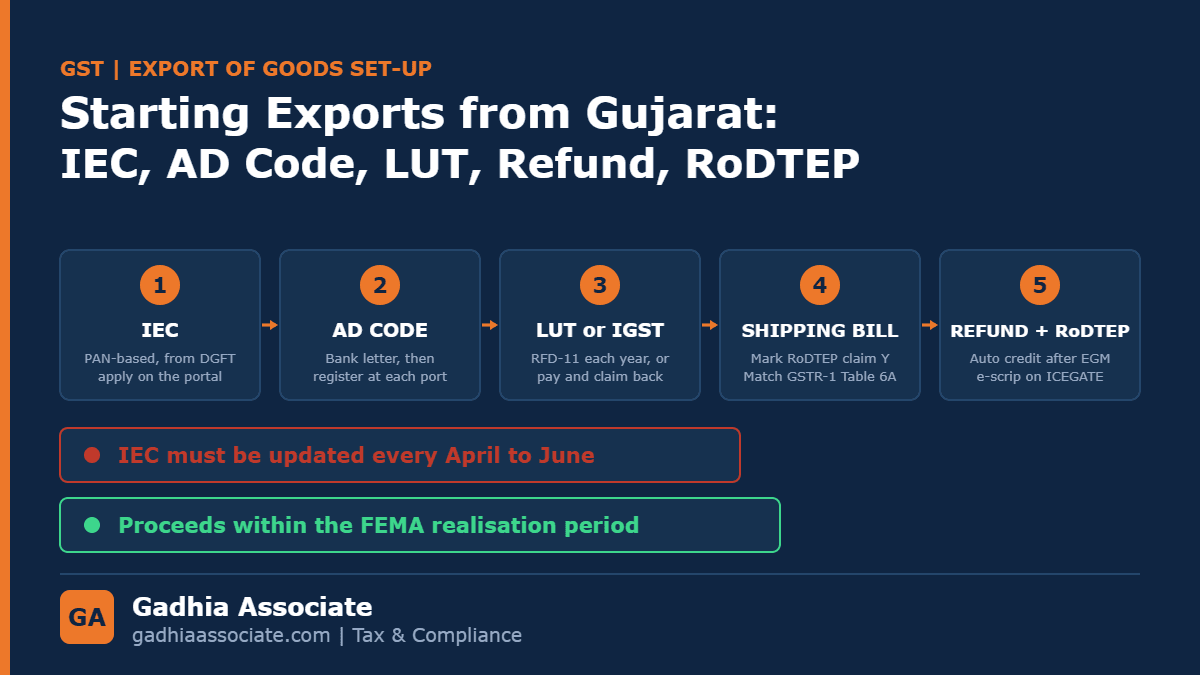
Short answer: Do it in this order. Apply for the Importer Exporter Code on the DGFT portal, get an AD Code letter from your bank and register that code at each port or ICD you will ship from, file a Letter of Undertaking in Form RFD-11 on the GST portal or instead decide to export on payment of IGST, then declare RoDTEP in the shipping bill and open a credit ledger on ICEGATE.
What do I actually need in place before the first shipping bill can be filed?
Four things, and only two of them are optional. You need an IEC from the DGFT, an AD Code registered at the port of shipment, a GST registration, and a decision on whether you are exporting under a Letter of Undertaking or on payment of IGST. RoDTEP and an RCMC are add-ons that bring money back to you but do not block the shipment.
The part exporters underestimate is timing. The IEC itself is usually issued the same day or within a day or two once the application goes through on the DGFT portal. The AD Code is the slow one. Your bank has to issue the code on its letterhead in the customs format, and then the port has to register it in the customs system. Between the branch, the regional office and the port, plan on a week to ten working days in practice, sometimes longer if your bank branch has never issued one before. Start it before your production is finished, not after.
How do I get an IEC, and what do exporters keep forgetting about it?
The IEC is issued by the Directorate General of Foreign Trade and it is PAN-based. One PAN, one IEC - you cannot hold two for the same entity, and a proprietor's IEC rides on the proprietor's PAN. The application is filed on the DGFT portal with a digital signature or Aadhaar-based e-signing, and the government fee is Rs 500 (reported consistently across sources, but the portal shows the live amount at payment, so treat that as the number to confirm).
Now the thing that catches people. Every IEC must be electronically updated on the DGFT portal between April and June each year, even when absolutely nothing has changed - same address, same bank, same directors. It is a confirmation exercise, not an amendment. If you do not do it by 30 June, the IEC is deactivated, and a deactivated IEC means no shipping bill, no bill of entry, nothing. Reactivation is just doing the same updation late, so it is not fatal, but it is discovered at the worst possible moment: when a consignment is already at the port.
We have seen this play out more than once with clients who exported steadily for years, never touched their DGFT login, and then hit a wall in July. Put it in the same calendar reminder as your first-quarter TDS return. It takes fifteen minutes.
What is an AD Code and why does each port need it separately?
An AD Code is the identifier of your bank branch - an authorised dealer in foreign exchange - and customs uses it to know which bank account your export proceeds and your refunds are tied to. Your bank issues it as a letter. That letter then has to be registered at the customs location you are shipping from.
Registration is per port. An AD Code registered at Mundra does nothing for a shipment leaving from Kandla, Pipavav, Nhava Sheva or Ahmedabad air cargo. If you are loading at an inland container depot, the ICD needs it too. Without the registration live in the customs system for that location, your agent simply cannot file the shipping bill - the system rejects the IEC and AD Code combination. This is the single most common reason a first shipment slips by a week.
Practical note on what the bank actually asks for: your IEC certificate, GST certificate, PAN, the constitution documents, and a request on your letterhead specifying the ports. Name every port you might realistically use, not just the first one. Adding a port later means going back to the branch.
Should I export under LUT or pay IGST and claim the refund?
Export of goods is a zero-rated supply under Section 16 of the IGST Act, and Section 16(3) gives you two routes. Route one: file a Letter of Undertaking and export without paying IGST, then claim refund of the unutilised input tax credit sitting in your ledger. Route two: pay IGST on the export invoice and claim refund of that IGST.
Pick based on where your money is. If your inputs carry GST and your only sales are exports, credit piles up and never gets used - the LUT route with an ITC refund is the natural fit, and you never part with working capital on the export invoice at all. If you also sell in the domestic market and your output liability already absorbs your credit, paying IGST and taking it back under Rule 96 is simpler and faster, because that refund is largely automatic.
The LUT is filed in Form RFD-11 on the GST portal. It is per financial year, so it lapses on 31 March and has to be refiled - another quiet renewal that gets missed. There is no fee and no physical submission for most taxpayers. If you are not eligible for an LUT you would have to furnish a bond with a bank guarantee instead, which is rare for ordinary exporters but worth checking.
One relief worth knowing if you use import schemes: Rule 96(10) of the CGST Rules, which barred the IGST-paid refund route for exporters who had imported inputs under Advance Authorisation or EPCG, was omitted with effect from 8 October 2024 by Notification 20/2024-Central Tax. Courts have since held the omission applies to pending proceedings as well. If someone told you years ago that you must use the LUT route because of an Advance Authorisation, that advice is out of date.
How does the refund actually reach my bank in each route?
In the IGST-paid route, you never file a refund application. Under Rule 96 of the CGST Rules, the shipping bill itself is treated as the refund application. For it to work, three things have to line up: the invoice details have to appear in Table 6A of your GSTR-1, a valid GSTR-3B has to be filed for that period, and the shipping line or airline has to file the Export General Manifest. GSTN transmits your invoice data to the customs system, customs matches it against the shipping bill and the EGM, and the amount is credited directly to the bank account linked to your AD Code.
Which means when the money does not arrive, it is nearly always one of three things: the EGM has not been filed or was filed with errors, the invoice number or value in the shipping bill does not match GSTR-1, or the bank account is not validated on the GST portal. Rule 96 says a mismatch pushes the deemed filing date to the date you rectify it - so a typo does not kill the refund, it just parks it. Check the ICEGATE and GST portal scroll status yourself rather than waiting; our article on GST refunds getting stuck for months goes into the troubleshooting in detail.
In the LUT route it is the opposite: nothing is automatic. You file Form RFD-01 on the GST portal for refund of unutilised input tax credit, with the statement of export invoices, shipping bills and the relevant annexures. This is a real application with a real officer, deficiency memos and all. For the mechanics of what credit you can actually claim, see our piece on GST input tax credit.
Illustrative example. Say you export goods worth Rs 50,00,000 in a quarter under LUT and your inputs for the period carried Rs 4,00,000 of GST, with no domestic sales. The Rs 4,00,000 has nowhere to go against output tax, so you would claim it as a refund of unutilised credit in Form RFD-01, subject to the turnover-based formula in the Rules. Had you chosen the IGST-paid route at, say, 18%, you would have paid Rs 9,00,000 on the export invoices and got it back automatically - using the credit in the process, but blocking Rs 9,00,000 of cash for the weeks in between. Round figures, illustrative only.
Want someone to set this up once, properly?
Gadhia Associate has been practising since 2007 from our Junagadh office, and we handle export set-up and monthly GST work for clients across Saurashtra and Gujarat. First consultation is free. Call or WhatsApp +91 82005 28355 and tell us your product and your port - we will tell you what is missing and how long it will take.
What is RoDTEP and what has to be declared in the shipping bill?
RoDTEP - Remission of Duties and Taxes on Exported Products - refunds embedded central, state and local taxes that are not otherwise credited back, like electricity duty and fuel levies inside your cost. It is a percentage of FOB value, notified per HS code in Appendix 4R of the Foreign Trade Policy. Published rates have generally sat in the low single digits, roughly 0.3% to about 4.3% depending on the product, and they are revised often enough that you should read the current Appendix 4R for your own HS code rather than trust a figure in any article, including this one.
The bit that costs people money: you have to make the RoDTEP declaration in the shipping bill at the time of filing, marking the claim as "Y" against each item. Leave it blank and the benefit is gone for that shipment. There is no retrospective claim. Tell your CHA in writing, for every consignment, that RoDTEP is to be claimed - do not assume it is a default setting.
The benefit arrives as a transferable e-scrip in your RoDTEP credit ledger on ICEGATE, which you have to create using your IEC and a valid digital signature. You can use the scrip to pay basic customs duty on your own imports, or sell it to an importer who needs it. Get your HS code right before any of this: our HSN/SAC Code Finder tool is a reasonable starting point, though for a borderline classification please get it reviewed.
Duty drawback is a separate scheme with separate rates, and the two interact. Claiming both on the same shipment needs a look at which drawback rate you are on, because the higher drawback rates already build in the taxes RoDTEP is meant to remit. Worth a short conversation with your consultant before the first shipping bill rather than a correction after fifty of them.
How long do I have to bring the money in, and what is an e-BRC?
Export proceeds must be realised and repatriated to India within the period set under FEMA. As of now that period is nine months from the date of export for ordinary exporters - but this number has been amended more than once recently and there are reports of a further change taking effect from 1 October 2026, so confirm the current regulation with your AD bank before you agree long credit terms with a buyer. We are flagging it plainly: the nine-month figure is what we can see today and it is in flux.
Your bank tracks every shipping bill against realisation in EDPMS, the Export Data Processing and Monitoring System. Until the payment is matched, that shipping bill sits open in EDPMS, and banks do chase it - you will get a letter about outstanding bills eventually, usually when you are applying for something else. Once realised, the bank closes it and an electronic Bank Realisation Certificate is generated, which is what DGFT and scheme authorities look at as proof. Keep the e-BRC references with your shipping bill file. If you also invoice foreign clients for services, the treatment differs in places and our article on billing foreign clients as an Indian freelancer covers the FIRC and ITR side of that.
What else should I set up if I want scheme benefits?
If you intend to use Foreign Trade Policy benefits beyond RoDTEP, get an RCMC - a Registration cum Membership Certificate from the Export Promotion Council relevant to your product, applied for through the common e-RCMC module on the DGFT portal. It is issued for five financial years. Without it, most scheme authorisations will not be granted.
Two GST points that come up in the first year. Export freight and the place of supply for international transport have been amended more than once, and exemptions have come and gone, so ask your consultant what applies to your specific FOB or CIF terms rather than relying on an older blog. And commission you pay to a foreign sales agent is generally an import of service on which you discharge GST under reverse charge, then take credit - people forget to show it at all because no money moves through a GST invoice. That is an entry auditors query.
Status Holder recognition - Export House upward - comes later, based on FOB export performance in freely convertible currency over the current and previous three financial years. It brings procedural easing rather than cash. Do not chase it in year one. And if you are still not registered under GST, exporting goods does not automatically need registration in every case, but in practice you will want it for the refund; see our article on whether you need GST registration.
What does a realistic first-shipment checklist look like?
- IEC issued by the DGFT, with the April to June annual updation calendared for every year
- Current-year LUT filed in Form RFD-11 on the GST portal, or a clear decision to export on payment of IGST
- AD Code letter from your bank, registered at every port and ICD you might ship from
- Bank account validated on the GST portal, and the same account linked to the AD Code
- ICEGATE registration with a valid digital signature, and a RoDTEP credit ledger created
- HS code confirmed, and the current Appendix 4R rate for it checked
- Written instruction to your CHA to mark the RoDTEP claim as "Y" on every shipping bill
- Invoice, packing list and shipping bill details matched so GSTR-1 Table 6A reconciles
- EGM filing confirmed with the shipping line after sailing
- RCMC from the relevant Export Promotion Council, if you want scheme benefits
- Payment terms that fit inside the FEMA realisation period, whatever it currently is
Shipping soon and not sure what is missing?
We are based in Junagadh, Gujarat, and work with clients across India and with NRIs entirely digitally. 7000+ clients, a 5.0 Google rating from over 100 reviews, same-day appointments at the Junagadh office, and fixed-fee or monthly plans so you know the cost before you start.
Send us your product description and port on WhatsApp at +91 82005 28355. The first consultation costs nothing.
Frequently asked questions
Can I export goods without a GST registration?
You can hold an IEC without GST registration, and some exporters of exempt goods operate that way. But without GST registration you cannot file an LUT, cannot claim refund of input tax credit, and cannot claim the IGST-paid refund under Rule 96. For almost any exporter with taxable inputs, registration is what makes the zero-rating worth anything in cash terms.
What happens if I miss the April to June IEC updation?
The IEC is deactivated after 30 June, and a deactivated IEC blocks shipping bills and bills of entry until it is restored. Restoration is simply completing the same updation on the DGFT portal, and a small fee may apply for a late or deactivated case. The real cost is the shipment sitting at the port while you sort it out.
Do I need a separate AD Code for each port I ship from?
You use the same AD Code from your bank, but it must be registered separately at each customs location. A code registered at Mundra will not let your agent file a shipping bill at Kandla or Nhava Sheva. Ask your bank to list every port in the letter up front, because adding one later means another round with the branch.
Why has my IGST refund on exports not been credited?
Under Rule 96 the shipping bill is the refund application, so it usually stalls on data rather than on discretion. Check that the Export General Manifest was filed by the carrier, that invoice numbers and values match between the shipping bill and Table 6A of GSTR-1, that GSTR-3B is filed, and that your bank account is validated on the GST portal.
Is RoDTEP claimable if I forgot to declare it in the shipping bill?
No. The RoDTEP declaration has to be made in the shipping bill at the time of filing by marking the claim against each item. There is no mechanism to add it afterwards for that consignment. Instruct your clearing agent in writing for every shipment, and reconcile your scrip credits on ICEGATE against your shipping bills monthly.
This reflects the position as of September 2026. DGFT, CBIC and CBDT notifications change rates, timelines and procedures regularly, and some of the figures here are themselves under amendment. Please confirm the current position before acting on anything in this article.