DTAA for NRIs in 2026: Cut TDS on NRO Interest with a TRC and Form 41 (Old Form 10F), Treaty Rates by Country and Credit Abroad
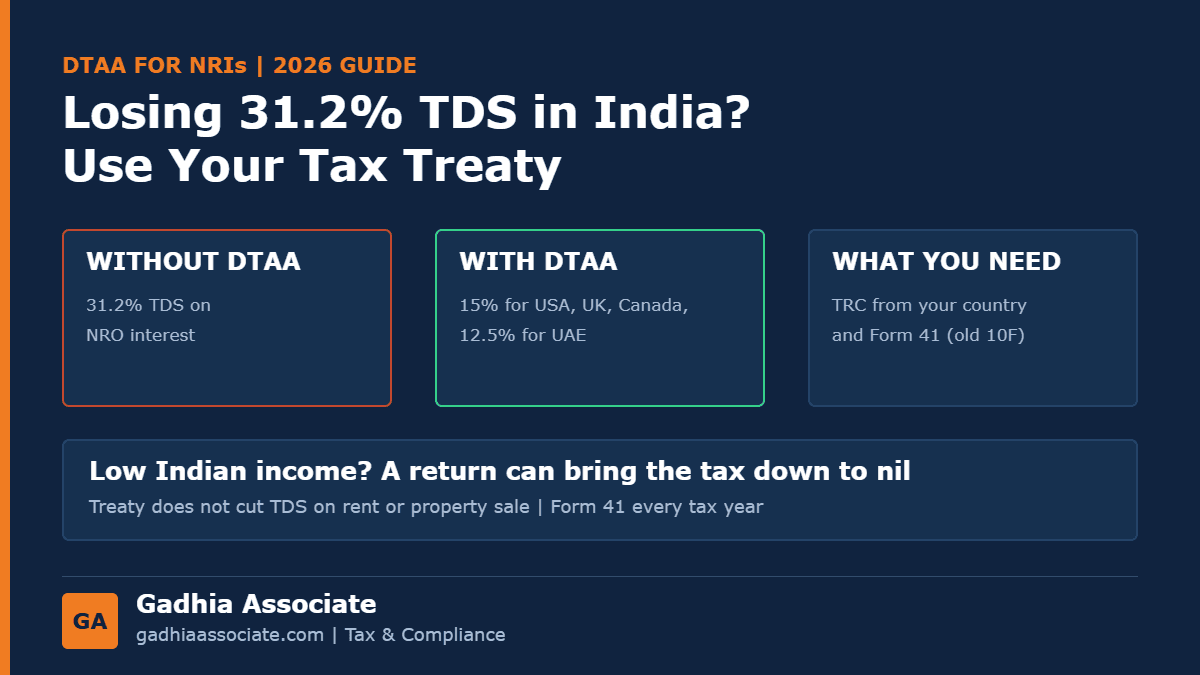
DTAA for NRIs: a tax residency certificate and Form 41 can cut the TDS on your NRO interest from 31.2% to 15%, or to 12.5% if you live in the UAE.
Ketan and Hitesh are brothers from Keshod. Ketan works in London and Hitesh in Dubai, and both keep their savings in fixed deposits in their NRO accounts in Junagadh. Each earns about Rs 3 lakh of interest a year, and the bank deducts Rs 93,600 from each of them. Ketan assumes the UK will give him credit for all of it. Hitesh assumes nothing can be done, because there is no income tax in Dubai. Both are wrong, and both lose money every year.
The fix is the tax treaty between India and the country where you live, called a Double Taxation Avoidance Agreement, or DTAA. Here is how an NRI uses it in 2026, under the new Income-tax Act.
In short: India's treaties cap the tax India can charge an NRI on interest and dividends. On NRO interest, the cap is 15% for residents of the USA, the UK, Canada, Australia and Singapore, and 12.5% for the UAE, against 31.2% under Indian law. To get it, you need a tax residency certificate (TRC) from your country, Form 41 filed online on the Indian income tax portal, which replaced Form 10F from 1 April 2026, and a short declaration for your bank. If your Indian income is low, a tax return can cut the tax further, even to nil, and bring back the excess. The treaty does not reduce TDS on rent or on a property sale, and most countries give credit for Indian tax only up to the treaty rate.
Our NRI Desk files Form 41, prepares the paperwork your bank asks for and files the return that gets the excess back, for NRIs in any country. The details are at the end of this guide.
What does a DTAA do for an NRI?
India taxes an NRI on income that arises in India, such as interest, rent, dividends and capital gains. The country where you live usually taxes your income from everywhere, including India. Without relief, the same interest would be taxed twice. The treaty caps what India can take, and your country then gives credit for the Indian tax.
- It caps India's tax: on interest and dividends, India cannot charge more than the treaty rate.
- It gives you credit abroad: your country reduces its own tax on the same income by the Indian tax, up to the treaty rate and never by more than its own tax on that income.
- It settles where you are resident: if both countries treat you as resident in the same year, the treaty's tie-breaker rule decides. It looks at where you have a permanent home, then where your personal and economic ties are closer, then where you usually live, and then your citizenship.
- You get the better of the two: where Indian law gives a lower rate than the treaty, Indian law applies.
In the Income-tax Act, 2025, section 159 gives these treaties effect in India. It took the place of sections 90 and 90A from 1 April 2026.
What are the treaty rates for NRIs in 2026?
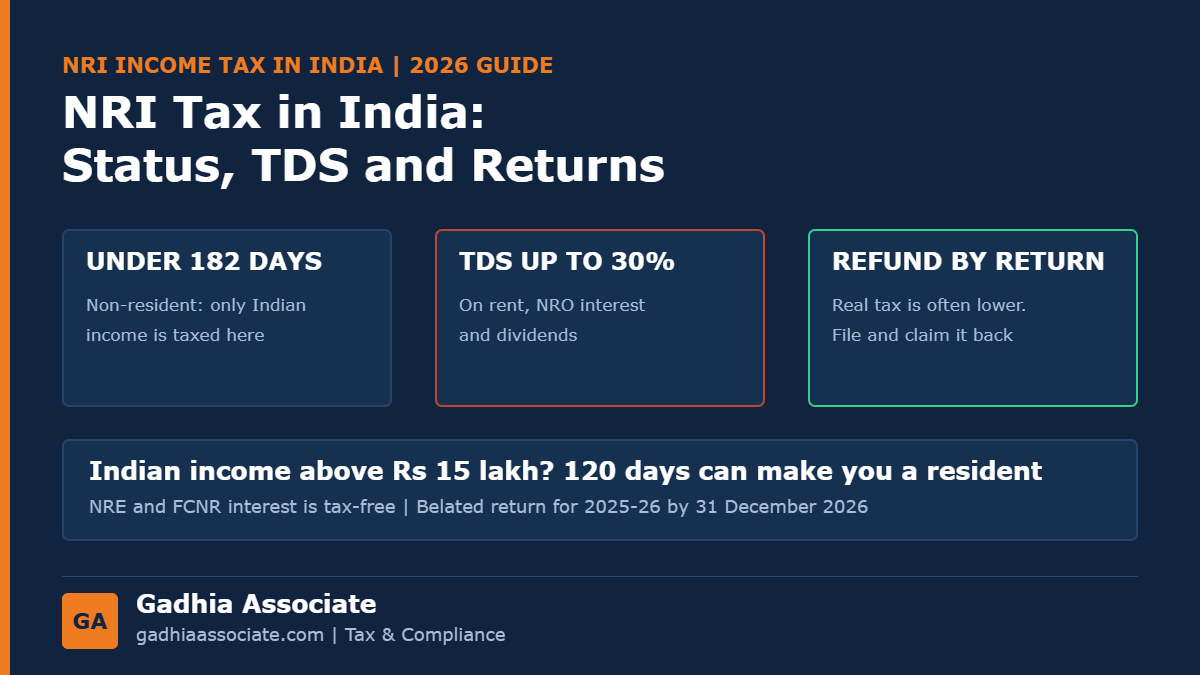
Without a treaty claim, the bank deducts 30% plus 4% cess, or 31.2%, from NRO interest, and companies deduct 20% plus cess from dividends. The treaty rates for an individual are:
- USA: interest 15%. The treaty rate on dividends is 25%, so the Indian rate of 20% plus cess, being lower, applies.
- UK: interest 15%, dividends 10%.
- Canada: interest 15%. Dividends are 25% under the treaty, so the Indian rate applies.
- Australia: interest 15%, dividends 15%.
- UAE: interest 12.5%, dividends 10%.
- Singapore: interest 15%, dividends 15%. The treaty can limit the lower rate to income that is sent to Singapore.
A treaty rate is the full rate. Tax tribunals have held that surcharge and cess cannot be added on top, and if they are added when your return is processed, that can be challenged. India has treaties with more than 90 countries and the rates differ, so check yours before you claim.
What documents do you need?
- A tax residency certificate from your country's tax authority, covering the period of the income. In the USA it is Form 6166, applied for on Form 8802, and in the UK a certificate of residence from HMRC. In Canada and Australia the tax authority issues a certificate of residency, and in Singapore IRAS issues a certificate of residence. In the UAE, the Federal Tax Authority issues a tax residency certificate through EmaraTax.
- Form 41, filed online on the Indian income tax portal. More on it below.
- A declaration for the bank or company that you are the beneficial owner of the income and have no permanent establishment in India, meaning a fixed place such as an office or branch through which you do business.
- Your PAN, and copies of your passport and visa or OCI card if the bank asks for them.
Give these to every bank and company before the interest or dividend is paid, and the lower rate applies from then on. TDS already deducted at 31.2% does not come back from the bank. It comes back only through your tax return.
How does Form 41 work?
- What it is: a self-declaration with your status, the country where you are resident, your tax number there, your address there and the period of your residence, with your TRC uploaded.
- Online only: it is filed on the e-filing portal, under the forms for the Income-tax Act, 2025, for the tax year you choose.
- No PAN needed: an NRI without a PAN can register on the portal as a non-resident and file it.
- Every year: it is filed once for each tax year, and the TRC must be valid for that year.
- No changes later: once submitted, it cannot be edited, so check every detail first.
- Income before April 2026: income up to 31 March 2026 still falls under the old Act, where the same document was Form 10F.
Why your country will not make up for excess Indian TDS
Most countries that tax your income from everywhere, including the USA, the UK, Canada and Australia, give credit for Indian tax only up to the treaty rate. Anything India deducts above that is not credited abroad, and it stays with India unless you claim it back.
- Ketan in London: of the Rs 93,600 deducted, the UK will credit at most 15% of his interest, or Rs 45,000, and never more than the UK tax on that interest. The other Rs 48,600 is lost unless he claims it back in an Indian return, and if Rs 3 lakh is his only income in India, the return can get back all Rs 93,600. Once he gives the bank his HMRC certificate of residence and Form 41, the bank deducts Rs 45,000, and the UK can credit that against its own tax on the same interest.
- Hitesh in Dubai: the UAE does not tax his salary or his interest, so every rupee deducted in India is a real cost. With a UAE tax residency certificate and Form 41, his TDS falls to 12.5%, or Rs 37,500. And since Rs 3 lakh is his only income in India, below the Rs 4 lakh that is tax-free under the new regime, a return brings his Indian tax to nil and gets all of it back.
When a tax return does better than the treaty
The treaty rate is only a ceiling. Your actual Indian tax is worked out in your return, at the treaty rate or at the normal rates, whichever is lower for each kind of income.
- Low Indian income: under the new regime, the first Rs 4 lakh of an NRI's total income is not taxed and the next Rs 4 lakh is taxed at 5%. The rebate that makes income up to Rs 12 lakh tax-free applies only to residents, so an NRI does not get it. Even so, an NRI with modest interest often owes far less than 15%.
- The claim: ITR-2 has a table for income taxed at treaty rates, which asks for the country, the article of the treaty and whether you hold a TRC.
- The refund: it is paid into an Indian bank account that you have validated on the tax portal, which can be your NRO account. If you have no bank account in India, the return lets you give one foreign bank account instead.
- Stopping the deduction itself: where your real tax is far below the TDS, a lower deduction certificate tells the bank to deduct less or nothing. You apply online in Form 128 before the interest is paid, and you need a PAN for it.
Our guides to NRI income tax in India and to NRIs who have not filed a return explain the return side, including past years.
What the treaty does not reduce
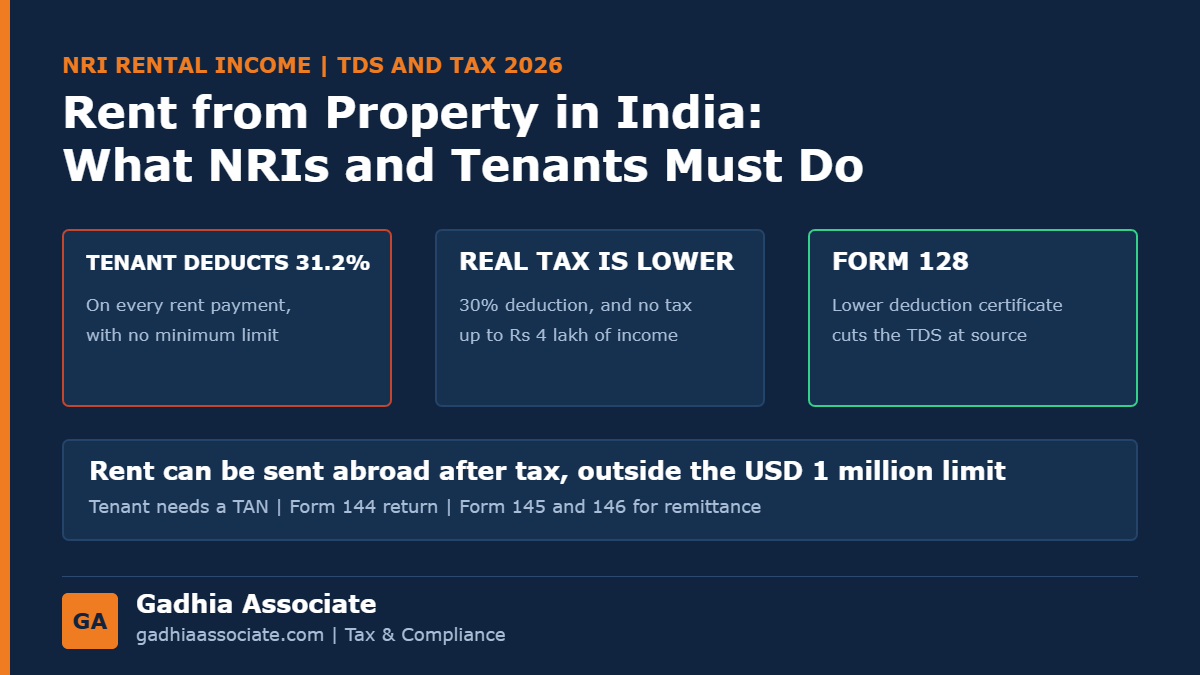
- TDS on rent: India keeps the full right to tax rent from property in India, so your tenant still deducts 31.2%. A lower deduction certificate is the way to reduce it. See NRI rental income.
- Tax on a property sale: gains on property in India are taxed in India under every treaty. See NRI selling property in India.
- Gains on shares: for residents of the USA, the UK, Canada and Australia, India taxes gains on Indian shares and equity funds under its own law, at 12.5% on long-term gains above Rs 1.25 lakh a year.
- The paperwork for sending money abroad: banks ask for Form 145 before NRO money goes abroad, and many also ask for a CA's certificate in Form 146. The tax rules need Form 146 only when the money sent is taxable and the total for the year is above Rs 5 lakh. See Form 145 and Form 146.
Two points for NRIs in the Gulf and Singapore
- Mutual fund gains: the India-UAE treaty lets India tax gains on shares of Indian companies, and the India-Singapore treaty does the same for shares bought on or after 1 April 2017. Gains on most other assets, except property in India, are left to the country of residence. Tax tribunals have held, for a UAE resident in 2019 and a Singapore resident in March 2025, that units of Indian mutual funds are not shares, so the gains were not taxable in India. No High Court has settled the point yet, and fund houses usually still deduct TDS, so the claim is made in the return, with a TRC and Form 41.
- The deemed resident rule: an Indian citizen with Indian income above Rs 15 lakh who is not liable to tax in any other country is treated as resident in India, as "not ordinarily resident". The government said in 2020 that this is not meant to tax Indian citizens working in the Gulf on what they earn there. Income earned abroad is not taxed in India unless it comes from a business or profession in India.
How our NRI Desk helps
- Check the treaty rate for each kind of income you earn in India
- File Form 41 on the portal, with or without a PAN, and guide you on getting the TRC in your country
- Prepare the declaration and covering letter for each bank and company
- File your Indian return with the treaty claim, and get excess TDS refunded
- Apply for a lower deduction certificate where your real tax is lower still
- Give your accountant abroad the Indian tax figures needed for the foreign tax credit
How it works from abroad: a first call at a time that suits your time zone, a clear fixed fee before we start, documents shared on WhatsApp or email, and one person who handles your file from start to finish. No visit to India is needed. See everything our NRI Desk does.
Gadhia Associate has been in practice since 2007 and has handled work for over 7,000 clients, with a 5.0 Google rating from more than 100 reviews. From our office in Junagadh, Gujarat, the NRI Desk works with NRIs in the UK, the USA, Canada, the UAE and the Gulf, Australia, Singapore and Africa.
Losing 31.2% of your NRO interest to TDS? Call or WhatsApp +91 82005 28355, or message us on WhatsApp. The first consultation is free.
Frequently asked questions
What is the DTAA rate on NRO interest?
15% for residents of the USA, the UK, Canada, Australia and Singapore, and 12.5% for residents of the UAE, against 31.2% without a treaty claim. You need a TRC, Form 41 and a declaration for the bank.
Is Form 10F still needed in 2026?
For income from 1 April 2026, Form 10F has been replaced by Form 41 under the Income-tax Act, 2025. It is filed online, once for each tax year. Form 10F still applies to income up to 31 March 2026.
Can an NRI file Form 41 without a PAN?
Yes. An NRI without a PAN can register on the income tax portal as a non-resident and file Form 41 online.
Does DTAA reduce TDS on rent or on a property sale?
No. Rent and gains from property in India are taxed in India under every treaty. TDS on them can be reduced only with a lower deduction certificate.
Do I need a new TRC every year?
Yes. The TRC must cover the year for which you claim the treaty rate, and Form 41 is filed for each tax year. If your country's tax year does not match India's April to March year, you may need certificates for two years.
Can I get back TDS already deducted at 31.2%?
Yes, by filing an Indian income tax return on time that claims the treaty rate or, where it is lower, tax at the normal rates. A late return can be filed only up to 31 December after the tax year ends, and an updated return cannot be used to claim a refund.
Position as of 8 October 2026. Treaty rates differ by country and by type of income, and your country's rules decide how much credit you get there for Indian tax. Take advice on your own facts before you act.