NRE vs NRO vs FCNR Account in 2026: Tax, Repatriation and What to Do with Your Indian Bank Accounts When You Move Abroad
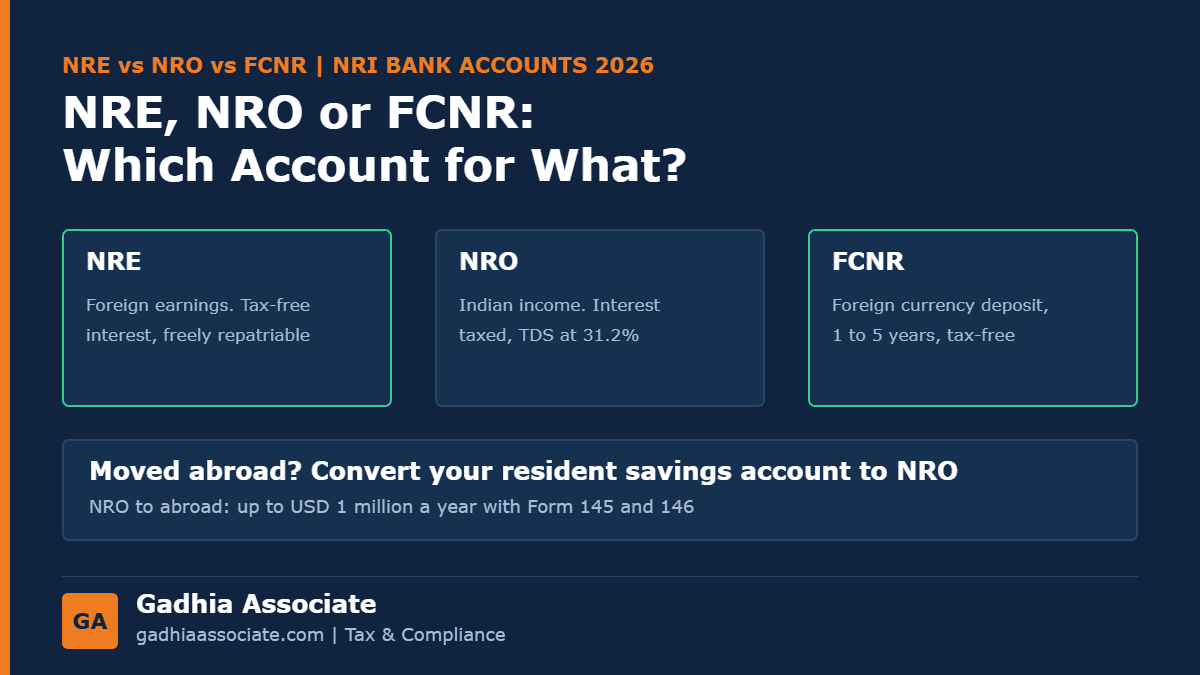
NRE vs NRO vs FCNR: an NRE account holds foreign earnings tax-free, an NRO account holds Indian income, and FCNR is a foreign currency deposit.
Krupa moved from Rajkot to Toronto for work in 2022. Four years on, her salary account in India is still an ordinary resident savings account. Her SIPs run from it, her rent is credited to it, and her father operates it. Nobody told her that this account should have been changed the year she left, or that tax on her fixed deposit interest is being deducted at the wrong rate.
The rules are not complicated, but they sit in two different laws, and banks rarely explain them. Here is what each NRI account is for, how it is taxed, how money moves in and out, and what to change when you move abroad.
In short: Under FEMA, a person who goes abroad for a job, a business or an indefinite stay becomes a non-resident from the day of leaving, and must convert resident savings accounts into NRO accounts. An NRO account is for money that arises in India. Its interest is taxed, with TDS at 31.2%, and up to USD 1 million a year can be sent abroad with Form 145 and Form 146. An NRE account is for money earned abroad. Its interest is tax-free in India and the balance can be taken out freely. An FCNR deposit is held in a foreign currency for one to five years, with tax-free interest and no rupee exchange rate risk. Most NRIs need one NRO account and one NRE account.
Our NRI Desk reviews accounts, recovers excess TDS and prepares the certificates banks ask for, for NRIs in any country. The details are at the end of this guide.
When do you become an NRI for your bank?
For banking, the law is FEMA. If you leave India for employment, for business, or in circumstances that show you intend to stay abroad for an uncertain period, you become a non-resident from the day you leave, however many days you spent in India that year. The RBI also treats students who go abroad to study as non-residents, though some banks apply this only from the next financial year.
The 182-day test that people quote for income tax is a separate test. The two can give different answers in the year you leave, so check both. Our guide to NRI income tax and residential status covers the tax side.
NRO account: for your Indian income
- What goes in: rent, dividends, pension, interest, sale proceeds of Indian assets, and the balance of your old savings account.
- Currency: rupees.
- Tax: the interest is taxable. The bank deducts TDS at 30% plus cess, which is 31.2%, from the first rupee.
- Treaty rate: if your country has a tax treaty with India, the bank can deduct at the treaty rate, generally 15% for the USA, the UK, Canada and Australia and 12.5% for the UAE. It needs your tax residency certificate and Form 41 every year.
- Taking money abroad: income such as rent and interest can go out after tax. Beyond that, up to USD 1 million in a financial year, with Form 145 and Form 146. See our guide to Form 15CA and 15CB, now Form 145 and 146.
- Joint holder: another NRI, or a resident on a "former or survivor" basis, which means the resident takes over only if the NRI dies.
NRE account: for your foreign earnings
- What goes in: money you send from abroad, or transfer from another NRE or FCNR account. Indian income normally goes to the NRO account. Rent, dividends, pension and interest can be credited to an NRE account only after tax, if the bank agrees.
- Currency: rupees, so the value moves with the exchange rate.
- Tax: the interest is tax-free in India for as long as you are a non-resident under FEMA. If you move back for good, it becomes taxable from then on.
- Taking money abroad: principal and interest, any amount, at any time.
- Joint holder: another NRI. A resident close relative can be added only on a "former or survivor" basis, and can operate the account only with a power of attorney.
FCNR deposit: savings kept in foreign currency
- What it is: a fixed deposit, not a savings account, for one to five years.
- Currency: US dollars, pounds, euros, Canadian or Australian dollars and other major currencies. There is no rupee exchange rate risk, because you are repaid in the currency you deposit.
- Tax and repatriation: the interest is tax-free in India while you are a non-resident, or "not ordinarily resident" after you return, and the full amount can be taken abroad.
How does money move between the accounts?
- NRE to NRO: allowed freely. But the money then loses its free passage abroad.
- NRO to NRE: allowed within the USD 1 million limit, after tax, with Form 145 and Form 146.
- From abroad: into NRE or NRO.
A common and costly mistake is to send foreign savings into an NRO account. That money then needs a chartered accountant's certificate to go back out.
What must you change when you move abroad?
- Savings accounts and fixed deposits: tell every bank and convert them to NRO. Continuing to run a resident account is a breach of FEMA, and the penalty can be up to three times the amount involved.
- Open an NRE account for the money you send home.
- Demat and mutual funds: update your KYC to non-resident. Shares and units bought while you were a resident move to an NRO-linked demat account or folio. Some fund houses restrict investors living in the USA and Canada.
- PPF: you can continue it until maturity, but cannot extend it or open a new one.
- Insurance and loans: inform the insurer and the lender, and pay premiums and EMIs from the NRO or NRE account.
- PAN and the income tax portal: update your residential status and foreign address. If you do not, the PAN can become inoperative, as our note on PAN inoperative explains.
- Tenants and buyers: tell them, because the TDS they must deduct changes. See NRI rental income.
Coming back to India later reverses all this. Our guide on returning to India after years abroad covers it.
Which account should you use for what?
- Salary and savings from abroad that you may want back: NRE or FCNR.
- Rent, dividends, pension and sale of property in India: NRO.
- Inherited money and gifts received in India: NRO. See NRI inherited property and NRI gift tax.
- Family expenses, EMIs and investments in India: either. Use NRE if you want the unspent balance to stay freely repatriable.
How our NRI Desk helps
- Review your Indian accounts and tell you which to convert, open or close
- Get the treaty rate applied on NRO interest, with Form 41 and your residency certificate
- File your Indian return and recover excess TDS
- Issue Form 146 and file Form 145 when you move NRO money abroad or to your NRE account
- Plan a large transfer, such as sale proceeds or an inheritance, within the USD 1 million limit
- Advise on FEMA where an old resident account or investment was never updated
How it works from abroad: a first call at a time that suits your time zone, a clear fixed fee before we start, documents shared on WhatsApp or email, and one person who handles your file from start to finish. No visit to India is needed. See everything our NRI Desk does.
Gadhia Associate has been in practice since 2007 and has handled work for over 7,000 clients, with a 5.0 Google rating from more than 100 reviews. From our office in Junagadh, Gujarat, the NRI Desk works with NRIs in the UK, the USA, Canada, the UAE and the Gulf, Australia, Singapore and Africa.
Not sure your Indian accounts are set up correctly? Call or WhatsApp +91 82005 28355, or message us on WhatsApp. The first consultation is free.
Frequently asked questions
What is the difference between an NRE and an NRO account?
An NRE account is for foreign earnings: the interest is tax-free in India and the money can be taken abroad freely. An NRO account is for Indian income: the interest is taxable and, apart from current income such as rent and interest, only USD 1 million a year can be taken abroad, after tax.
Is interest on an NRO account taxable?
Yes. TDS is 30% plus cess, 31.2%, and can be reduced under a tax treaty with a tax residency certificate and Form 41.
Can I keep my resident savings account after moving abroad?
No. Under FEMA it must be converted into an NRO account once you become a non-resident.
Can I transfer money from an NRO account to an NRE account?
Yes, within USD 1 million in a financial year, after tax, with Form 145 and Form 146.
Is interest on an FCNR deposit taxable in India?
No, while you are a non-resident, or "not ordinarily resident" after returning to India.
Can an NRI hold a joint account with a parent in India?
Yes, in a limited way. A parent can be added to an NRO or NRE account on a "former or survivor" basis. The parent takes over only if the NRI dies, and until then can operate the account only with a power of attorney.
Position as of 6 October 2026. Bank rules and treaty rates differ, and FEMA status depends on your own facts. Take advice before you move large sums.