Buying a Flat in Dubai from India in 2026: LRS Limit, 20% TCS, Instalments, Rental Income Tax, Schedule FA and Selling Later
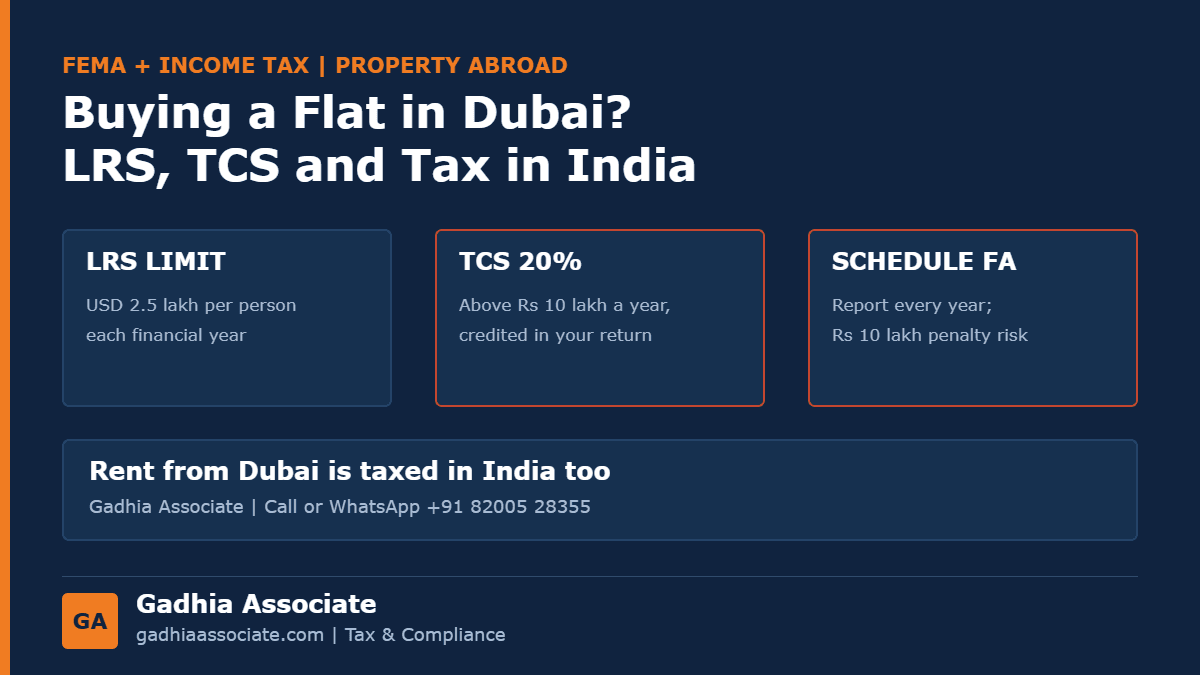
A resident Indian can buy a flat in Dubai with up to USD 2.5 lakh a year per person under LRS, but 20% TCS applies and the flat must be reported.
Bhavinbhai, a jeweller in Rajkot, and his wife want to buy an off-plan flat in Dubai for about AED 15 lakh, roughly Rs 3.5 crore, paid in instalments over three years. Their bank has asked for remittance forms and a declaration, and quoted TCS that runs into lakhs. They also plan to rent the flat out and wonder whether rent from a country with no income tax is taxed in India.
Dubai has become the most popular overseas property market for Gujarati families. The rules for buying are simple, but the tax and reporting continue for as long as you own the flat. Here is how it works in 2026.
Our team plans the remittances, handles TCS credit and files returns with foreign property and income. Call or WhatsApp +91 82005 28355, or see the details at the end of this guide.
Paying for the flat under LRS
- The limit: USD 2.5 lakh per person each financial year, for all LRS purposes together, including travel and investments.
- Family purchases: family members can each use their own limit for a jointly owned property.
- Instalments: off-plan payment plans work well with LRS, as each year's instalments fit within that year's limit.
- Own funds: the money is sent from your own account in India, through your bank, with the remittance form and declaration it asks for.
- Escrow: payments for off-plan projects in Dubai go into the project's escrow account, not to an agent.
- Through a company: buying through a company abroad follows the overseas investment rules instead. See setting up a company in Dubai.
TCS on the remittance
- Rate: 20% on property remittances above Rs 10 lakh per person in a financial year.
- Not a cost: TCS is credited to your PAN and adjusted against your tax, including advance tax, or refunded after your return.
- Cash flow: on large payments the TCS is a big sum, so plan it with your advance tax. See TCS on foreign remittance.
- Bank forms: for some remittances the bank asks for income tax forms and a CA certificate. See Forms 145 and 146.
Rent from the flat
- Taxable in India: a resident is taxed on worldwide income, so Dubai rent is taxed here as house property income, with the 30% standard deduction.
- No credit to claim: the UAE does not tax the rent, so the full Indian tax applies.
- Keeping it abroad: income from investments made under LRS does not have to be brought back, but it must still be reported and taxed.
- Advance tax: no tax is deducted on this rent, so include it in your advance tax.
Reporting every year
- The right return: ITR-2, or ITR-3 if you have business income, with the property in Schedule FA and the rent in Schedule FSI.
- Every year: the flat must be reported every year you own it, even in a year with no rent.
- Penalty: not reporting foreign assets can attract a Rs 10 lakh penalty under the Black Money Act. The relief for small foreign holdings does not cover immovable property.
- Missed years: foreign assets left out of earlier returns may be covered by the FAST-DS scheme, open until 31 December 2026. See FAST-DS 2026.
Selling the flat later
- Capital gains in India: a flat held for more than 24 months gives a long-term gain taxed at 12.5%; otherwise it is taxed at your slab rate.
- Rupee terms: the gain is worked out in rupees, so a falling rupee adds to it.
- No exemption for buying abroad: the exemptions for reinvesting in a house apply only to a house in India. See saving capital gains tax.
- Selling before completion: selling an off-plan contract is also a transfer, taxed on the gain.
Family and succession
- Will: property in Dubai can follow local succession rules unless you have a will that the UAE recognises, so speak to a lawyer about one.
- Gifts: gifting the flat to a family member is a transfer under FEMA and needs care.
- If you move: if you later become a non-resident, the rent and gains abroad generally fall outside Indian tax.
Back to Bhavinbhai. The flat is bought in both names, and each spouse remits within their own limit each year as the instalments fall due. The TCS on each remittance is planned against their advance tax, so little cash is locked up. Their returns move to ITR-3, with the flat in Schedule FA from the first year of payment, and the rent, once the flat is let, is taxed in India with the 30% deduction. A will is registered in Dubai, and a sale before 24 months is avoided so the gain stays long-term.
How we help
- Planning remittances under LRS for each family member
- TCS credit planning against advance tax
- Returns with Schedule FA, FSI and foreign rental income
- Capital gains on sale or assignment of a flat abroad
- Fixing missed disclosures, including FAST-DS
- Structuring through a company abroad, where it fits
Gadhia Associate has been in practice since 2007 and has handled work for over 7,000 clients, with a 5.0 Google rating from more than 100 reviews. Families and businesses from Junagadh, Rajkot, Jamnagar, Surat and Ahmedabad come to our Junagadh office, where same-day appointments are available. Clients elsewhere are handled online.
Planning to buy property in Dubai, or already own one? Get the remittances, TCS and reporting right from the first payment. Call or WhatsApp +91 82005 28355, or message us on WhatsApp. The first consultation is free.
Frequently asked questions
Can a resident Indian buy property in Dubai?
Yes, under the Liberalised Remittance Scheme, within USD 2.5 lakh per person each financial year.
Is TCS charged on sending money for a Dubai flat?
Yes, 20% on remittances above Rs 10 lakh per person in a financial year, adjustable against your tax.
Is rent from a Dubai flat taxable in India?
Yes, for a resident, as house property income with the 30% standard deduction.
Do I need to show my Dubai flat in my income tax return?
Yes, in Schedule FA every year you own it. Not reporting it can attract a Rs 10 lakh penalty.
Is the gain on selling a Dubai flat taxed in India?
Yes. Held over 24 months, it is taxed at 12.5%; otherwise at your slab rate.
Can I save capital gains tax by buying another flat in Dubai?
No. The reinvestment exemptions apply only to a house in India.
Position as of 29 October 2026, under FEMA and the Liberalised Remittance Scheme, and the income tax rules under the Income-tax Act, 2025. Banks and the UAE have their own requirements, so take advice before you remit.